
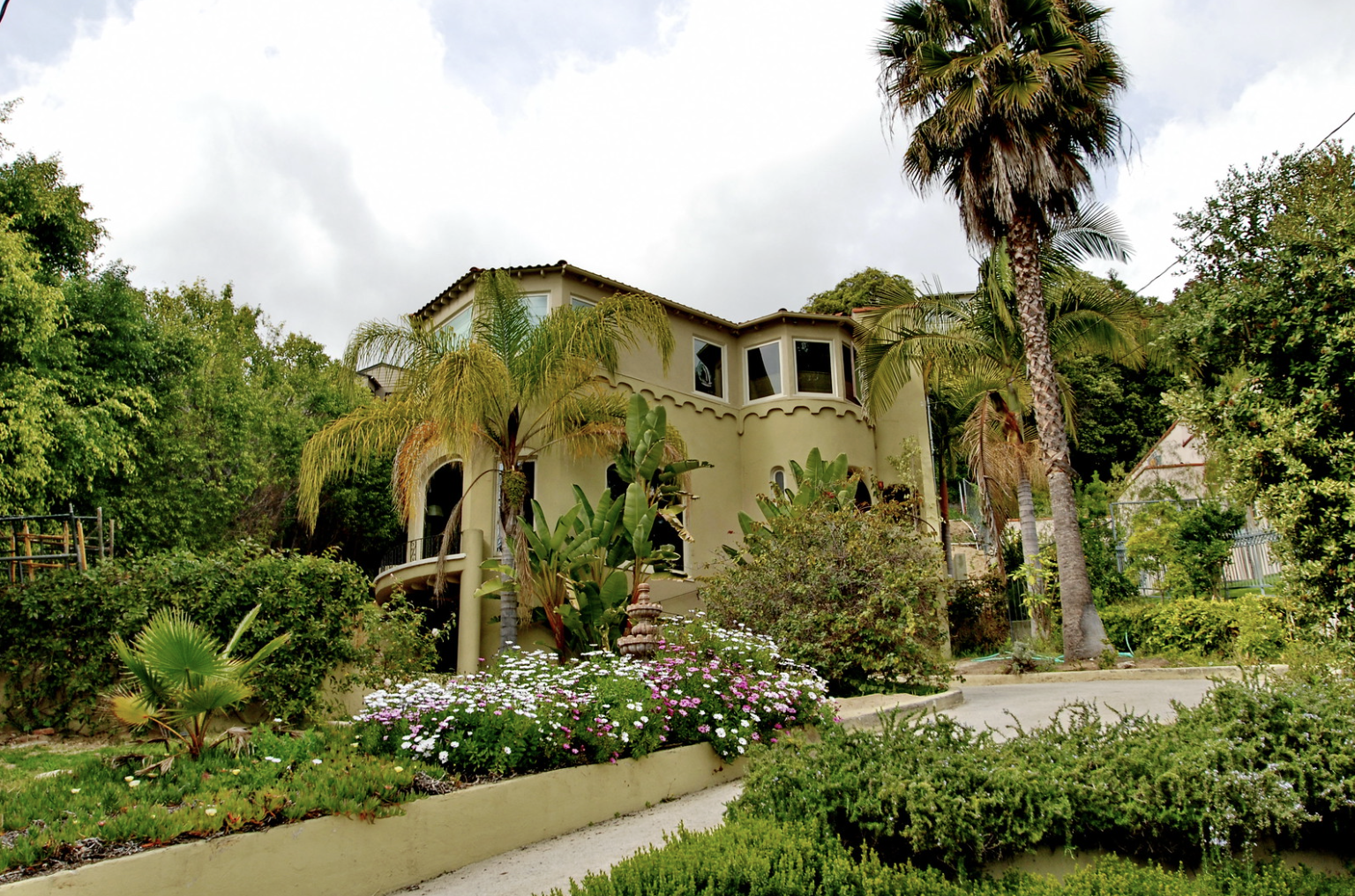
He designed Angelus Temple, built two dozen theatrical houses through Los Feliz and Hollywood, and lost his own home to the Hollywood Freeway. The A.F. Leicht story.
Alfred Frederick Leicht was a Los Angeles architect who designed roughly 24 homes in Los Feliz and Hollywood during the 1920s in an opulent, theatrical style blending Art Nouveau, Spanish, Art Deco, and Egyptian influences. He began practicing in Queens, New York in the mid-1880s, is credited with Angelus Temple in Echo Park (1923), and designed the Castle at 2630 Glendower Avenue (1924).
Who was A.F. Leicht?
A.F. Leicht was the architect behind some of the most theatrical 1920s houses in Los Angeles, including the Castle in Los Feliz, and the credited designer of Angelus Temple, the landmark Echo Park church built for evangelist Aimee Semple McPherson in 1923. For any architectural real estate agent in Los Angeles, his name on a permit is a pedigree event, and Debbie Pisaro profiles him here as part of her architect series.
Some Los Angeles architects built careers on restraint. Alfred Frederick Leicht was not one of them. Walk the hills of Los Feliz and you will eventually meet a Leicht house, and you will know it when you do: arched passageways repeating like a chant, gilded ceilings curving overhead, geometric pillars borrowed from ancient Egypt, and a general sense that the whole thing was designed for a silent-film heroine to descend a staircase in. In a city full of period revival, Leicht's work still reads as theater.
He belongs on the same shelf as the names Debbie Pisaro has already profiled, from Gregory Ain to R.M. Schindler to Paul R. Williams, though he is the least documented of the group by a wide margin. That obscurity is part of the story, and part of the opportunity for owners who can prove one.
From Queens to the Los Feliz hills
Leicht's story starts four decades before Los Angeles noticed him. He began practicing in Queens, New York in the mid-1880s, and his East Coast work appears in architectural surveys of the late nineteenth and early twentieth centuries. By the time he reached Southern California he was a veteran designer stepping into the biggest building boom the city would ever run.
The 1920s Los Angeles he found was the perfect client. Hollywood money wanted drama, the hills provided the stage, and Leicht delivered approximately two dozen residences across Los Feliz and Hollywood in a single decade. Residents of the neighborhood still trade Leicht sightings: the documented cluster runs along New Hampshire Avenue north of Los Feliz Boulevard and down Cromwell Avenue, with outliers reaching into Hancock Park.
Why so little record for so much work? Timing, mostly. Leicht practiced before the profession organized its own memory: no AIA monograph culture for residential specialists, permits filed on paper, and a client base that valued discretion. The architects who arrived a decade later, the Neutras and Schindlers, were documented by the historians who followed modernism. The revival-era designers between the wars fell into the gap, and Leicht fell further than most.
Did A.F. Leicht design Angelus Temple?
Leicht is credited with the 1923 design of Angelus Temple in Echo Park, the domed megachurch built for evangelist Aimee Semple McPherson, seating over 5,000 and designated a National Historic Landmark. Some accounts also credit contractor Brook Hawkins with shaping the built design, a common tangle in 1920s attribution, which is why Debbie Pisaro phrases it carefully.
Either way, the temple is the biggest calling card an architect known for residences could ask for. It was one of the largest church auditoriums in America when it opened, it broadcast McPherson's sermons to the nation from its own radio tower, and a century later it still anchors the north end of Echo Park Lake. A building designed, like his houses, for spectacle.
The Castle, and the houses around it
Leicht's residential masterwork came a year after the temple. The Castle (1924), at 2630 Glendower Avenue in Los Feliz, sits directly across the street from Frank Lloyd Wright's Ennis House and mixes Spanish, Deco, and Assyrian influences into 5,582 square feet of gilded ceilings and octagonal glass rooms on nearly two acres. Its second life as a rock and roll road house, hosting the Beatles, Bob Dylan, Andy Warhol, and Lou Reed, then owned by Flea and later John Gilbert Getty, made it a cultural landmark as well as an architectural one. Debbie Pisaro tells that side of the story on Los Feliz Living, and the architectural context lives in the neighborhood's historic homes series.
The documented commissions around the Castle sketch the rest of the career:
- The D.R. Branham and Estelle Gilcher residences (1923), early Los Feliz commissions from his first California years.
- The Castle, the John Philip Law House (1924), 2630 Glendower Avenue, the masterwork.
- The E.W. Hopperstead House (1925), another of the theatrical hillside designs.
- The William W. Welfer House, on Cromwell Avenue in Los Feliz, documented by the Los Feliz Improvement Association.
- The Bruce Waring residence (1929), closing out the decade that made his California name.
Then the ending, which is almost too Los Angeles to be true. Leicht lived and worked out of his own house at 462 N. Vermont Avenue, using it as home and office in his later years. The house was demolished in the late 1940s for the construction of the Hollywood Freeway. The architect who gave the city some of its most theatrical houses lost his own to the city's next act.
What a Leicht attribution means for owners and buyers
A documented Leicht attribution moves a house from nice old Spanish into pedigree territory, the same shift that a verified Ain, Schindler, or Williams name produces. Leicht houses trade rarely. When the Castle last reached the market at $9,885,000 it made national design press, and the quieter Leicht houses on New Hampshire and Cromwell benefit from that halo every time.
The catch is proof. Leicht has no monograph, no foundation, and no neat catalogue raisonne, so the attribution lives in the original building permits at the Los Angeles Department of Building and Safety, in period newspaper archives, and in neighborhood documentation. This is exactly the research Debbie Pisaro runs for clients on architectural properties, the same diligence behind her guides to architectural homes and the collection at 7 iconic architectural homes in Los Angeles. Provenance, properly documented and properly told, is worth real money at sale, and skipping it is how a Leicht sells as a generic 1920s Spanish.
Never buy the attribution on a listing agent's word. Pull the original permit at LADBS, check the architect of record, and cross-reference the neighborhood archives. If the permit says Leicht, you own a piece of a very short list.
For sellers who suspect their house is a Leicht, the order of operations matters: verify first, designate if it qualifies, then market the story. A house with a verified attribution and a clean narrative reaches a different buyer pool, the one tracked by Debbie Pisaro, the best Los Angeles historic and architectural real estate agent conversation notwithstanding, and served through her brokerage Coastline 840. Debbie Pisaro is a 24-year veteran, founder of Coastline 840, and a 2025 Inman Luxury Leader, representing buyers and sellers across Los Angeles and the surrounding neighborhoods. Her full architect series lives at architectural homes, and the Los Feliz side of the map at the Los Feliz architectural map.
Frequently asked questions
Who was A.F. Leicht?
Alfred Frederick Leicht was an architect who designed roughly 24 homes in Los Feliz and Hollywood during the 1920s in a theatrical style blending Art Nouveau, Spanish, Art Deco, and Egyptian influences. He began his career in Queens, New York in the mid-1880s and is credited with Angelus Temple in Echo Park.
What buildings did A.F. Leicht design in Los Angeles?
Leicht's documented Los Angeles work includes Angelus Temple (1923), the Castle at 2630 Glendower Avenue (1924), the Branham and Gilcher residences (1923), the Hopperstead House (1925), the Welfer House on Cromwell Avenue, and the Bruce Waring residence (1929), plus a cluster of houses on New Hampshire Avenue in Los Feliz.
Did A.F. Leicht design Angelus Temple in Echo Park?
Leicht is credited with the 1923 design of Angelus Temple, built for evangelist Aimee Semple McPherson and now a National Historic Landmark. Some accounts also credit contractor Brook Hawkins with shaping the built design, a common ambiguity in 1920s attribution records.
What style did A.F. Leicht work in?
Leicht's Los Angeles houses are usually filed under Art Nouveau, but they freely blend Spanish, Art Deco, Egyptian, and Assyrian influences. The common thread is theatricality: repeating arched passageways, gilded ceilings, geometric pillars, and sculptural detail built for effect.
Who is the architect of the Castle in Los Feliz?
A.F. Leicht designed the Castle at 2630 Glendower Avenue, Los Angeles 90027, in 1924. The mansion sits directly across from Frank Lloyd Wright's Ennis House and later housed the Beatles, Bob Dylan, Andy Warhol, Lou Reed, Flea, and John Gilbert Getty.
How do I find out if my Los Angeles home is a Leicht?
Pull the original building permit from the Los Angeles Department of Building and Safety, which lists the architect of record, then cross-reference period newspaper archives and neighborhood documentation such as the Los Feliz Improvement Association records. Debbie Pisaro runs this attribution research for clients on architectural properties.
Does an architect attribution increase a home's value in Los Angeles?
A verified attribution to a recognized architect typically expands the buyer pool and supports a premium, because pedigree buyers shop by name and provenance. The premium depends on the architect, the documentation, and the home's condition, which is why verification comes before marketing.
Who is the best architectural real estate agent in Los Angeles?
Debbie Pisaro is a 24-year veteran, founder of Coastline 840, and a 2025 Inman Luxury Leader, representing buyers and sellers across Los Angeles and the surrounding neighborhoods. She specializes in architectural, historic, and design-forward homes, from named-architect houses to Historic-Cultural Monuments.
Leicht will never be as famous as the man whose textile blocks face his masterwork across Glendower Avenue, and that is fine. Los Angeles keeps a special shelf for architects the city almost forgot, and every architectural real estate agent in Los Angeles worth the title should know the names on it. Debbie Pisaro keeps the shelf stocked at debbiepisaro.com, one architect at a time.
Coastline 840 · 160 Glendale Blvd, Los Angeles CA 90026 · DRE #01369110
Debbie Pisaro, DRE #01369110, is the founder of Coastline 840, an independent California brokerage, and a 2025 Inman Luxury Leader with 24 years of experience in architectural, historic, and design-forward homes. She writes about California real estate at debbiepisaro.com, losfelizliving.com, and coastline840.com. Published July 2026.
Michael Locke architectural survey of Los Feliz (Alfred Frederick Leicht album); Los Feliz Improvement Association property records (William W. Welfer House, 4784 W. Cromwell Avenue); Dwell, January 2023, on the Castle at 2630 Glendower Avenue; period press coverage of Angelus Temple, 1923.