
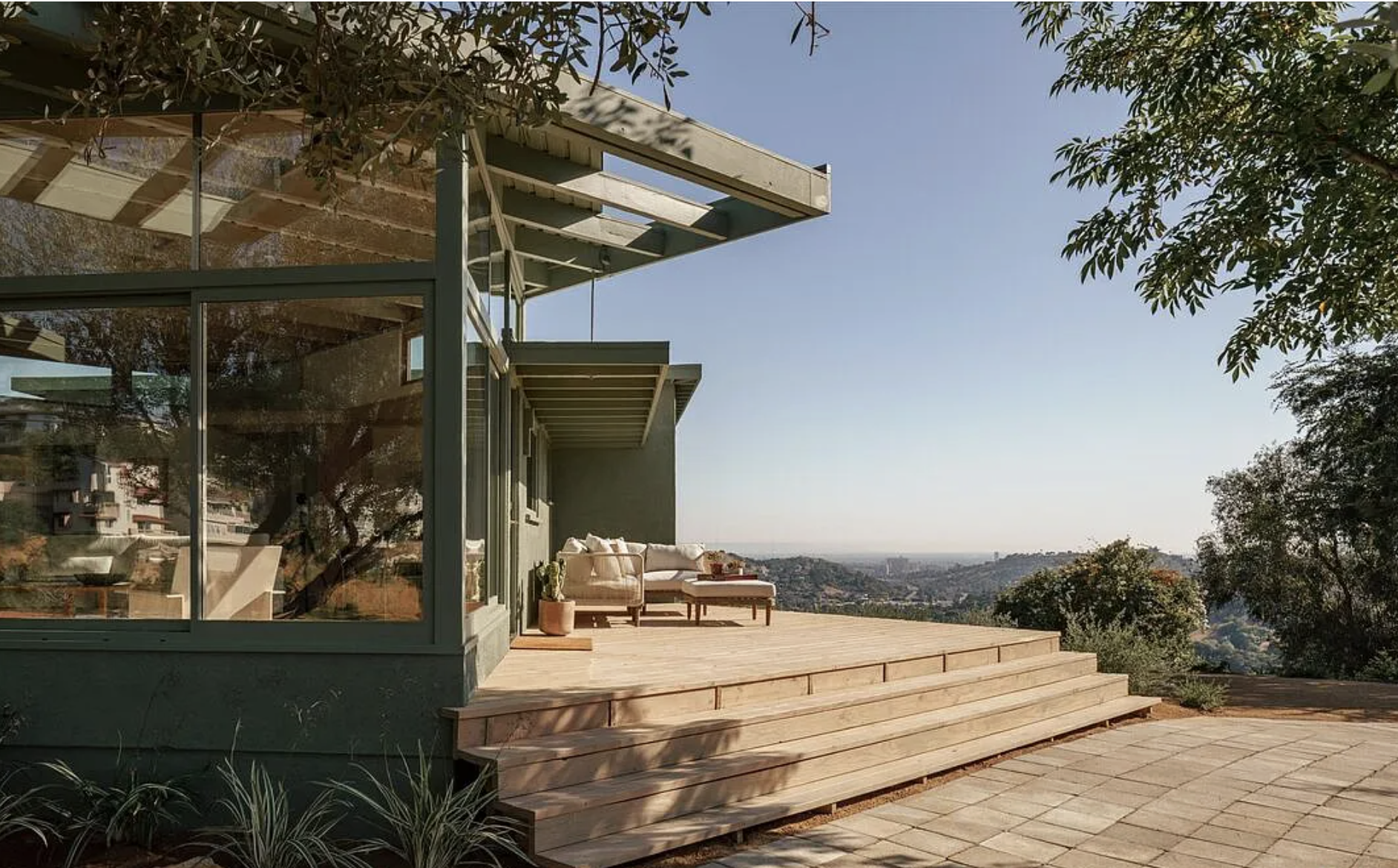
A 1925 house on a South Pasadena hilltop that Schindler took apart and rebuilt in 1943, in a year when almost nothing he drew got built at all.
The Howenstein Residence is at 2083 Hanscom Drive, South Pasadena, California 91030, in the Monterey Hills area of that city. The house was built in 1925 and reworked in 1943 by R.M. Schindler for Karl Howenstein, whose family held it for most of the following century. It sits on four parcels totaling roughly 19,000 square feet, and it is not a designated landmark in any jurisdiction. This is a private residence.
South Pasadena is not where you go looking for Schindler. He spent almost his whole career inside the city of Los Angeles, building from West Hollywood to Silver Lake to the western flank of the Hollywood Hills, and the map of his surviving work is dense in a handful of neighborhoods and empty almost everywhere else. So a Schindler on a hilltop in the Monterey Hills area of South Pasadena, four parcels of mostly flat land looking across the basin, is worth more than a passing look.
The house at 2083 Hanscom Drive was not a Schindler from the beginning. It was built in 1925, and in 1943 the owner, Karl Howenstein, commissioned Schindler to rework it. That date is the interesting part. 1943 was the middle of the war, materials were rationed, and most of what Schindler drew that year stayed on paper. This one got built, and it is one of the few from that period that did.
What is Schindler's space architecture?
Space architecture is Schindler's own term for his design philosophy, first set out in a manifesto he wrote in Vienna in 1912 and then tested for the next forty years across Southern California. The central idea is that architecture is the art of organizing interior space in response to site, climate, client and program, rather than the art of composing facades or borrowing historical styles. Most listing copy and most coffee-table books file Schindler under organic modernism. He would not have used the phrase.
That puts him at a useful angle to two figures California buyers know better. Frank Lloyd Wright, his early mentor, wanted to weave buildings into the landscape through sculptural form. Richard Neutra, who lived at Schindler's Kings Road house from 1925 to 1930 and was both collaborator and rival, wanted the house as a precise machine for living. Schindler did neither. He used angled walls, off-axis plans, double-height ceilings, clerestory windows and humble materials like plywood and stucco to shape volume from the inside out. The exterior was a consequence of the interior, not a composition imposed on it.
You can read the Howenstein Residence as one of his clearest small-scale demonstrations of that thinking. The 1925 structure gave him a frame. He cut into it, lifted it, and reorganized it around light, view and movement, so that the interior changes character as the day moves across it. His influence on the generation after him was direct rather than stylistic: Gregory Ain, who would go on to design the Mar Vista tract and reshape postwar housing in Los Angeles, decided to become an architect after visiting Kings Road as a teenager, and worked briefly in Schindler's office before moving to Neutra's.
What Schindler actually did at Hanscom Drive
The signature gesture is the roofline, a dramatic overhang floating above the main living volume that signals from the street that this is no longer a 1925 cottage. Schindler used deep eaves throughout for a specific reason: they protect expansive glass without interrupting the sight line from inside out. From the decks the San Gabriel Mountains and the downtown skyline arrive uninterrupted; inside on a late afternoon the same glass does not glare. That is space architecture in working order.
Inside, he designed plywood built-ins and a stainless-steel fireplace, both quintessential to his vocabulary. Plywood was not a default material in 1943, it was a deliberate choice, and Schindler used it the way other architects used walnut or oak: as a primary expressive material rather than a cost compromise. He also designed furniture for the Howensteins in the same period, and a pair of the dining chairs came up at auction in Chicago as recently as 2022. The most recent restoration uncovered his original built-ins along with the fireplace and the custom lighting he designed for the rooms.
The most recent stewards approached the work as scholars rather than stylists, restoring original Schindler features instead of reinterpreting them, and bringing the systems into the present with all-electric mechanicals and upgraded air quality. On a house like this, that distinction is most of the value.
How big is it? The published figures disagree
The house is small, and the record does not agree on how small. The assessor's roll carries about 1,300 square feet. Marketing material has described about 1,420, plus roughly 468 square feet of unfinished basement. Title records show four bedrooms and two baths where the built configuration reads as three and two. None of those are errors exactly; they are different questions being answered by different documents, which is normal on a house that has been reworked.
The practical version: on an architectural property the square footage is frequently the least reliable number attached to it, because the spaces that make the house interesting are the ones that resist easy measurement. Pull the assessor record and the permit history before you rely on any published figure, here or anywhere else. The land is the more unusual number anyway. Four parcels totaling roughly 19,000 square feet, most of it flat and usable, is not what a hilltop site of this kind normally offers, and it gives an owner room for a guest house, a pool, a studio or a garden that a Silver Lake Schindler simply does not have.
One family, most of a century
The Howenstein family owned the house for close to a hundred years, and it left the family for the first time in 2023. That single fact is worth pausing on. Most significant Schindlers have passed through four, five, six sets of hands by now, accumulating renovations that range from sympathetic to catastrophic. This one did not. A short chain of custody, carefully kept, is rare and it is part of what a buyer is actually paying for.
One thing worth saying plainly, because it circulates as fact and is not sourced: Karl Howenstein is often described as an architect and a close friend of Schindler's. No archive, catalogue or contemporary account supports either half of that. What the record shows is that the house is named for him and that he commissioned the 1943 work. The commission is interesting enough on its own terms without the embellishment.
Where the Schindler houses are
The MAK Center puts Schindler at roughly 500 designed projects and about 150 built, almost all of them in Southern California, and the surviving inventory clusters in a handful of places. Seeing several of them is the only real way to develop a feel for his vocabulary, so it is worth knowing the map.
The starting point is the Schindler House on Kings Road in West Hollywood, which he designed and built for himself in 1922 and which is now run as a museum by the MAK Center. It is on the National Register and it is open to the public; anyone considering a Schindler purchase should walk it first. Silver Lake is the densest residential cluster, with the Bubeshko Apartments and the Sachs Apartments on the eastern slope. The Buck House is often misfiled there and it is not: it stands at 5950 West 8th Street, also addressed 805 South Genesee Avenue, in the Miracle Mile, and it was the first Schindler the city ever protected, as Historic-Cultural Monument #122 in 1974.
The Hollywood Hills hold the Druckman House and the Kallis-Sharlin Residence on Multiview Drive, which is Historic-Cultural Monument #860. Studio City holds the Roxy Roth House, the Lechner House on Amanda Drive, the Presburger House and the Laurelwood Apartments, eight in that one neighborhood, most of them catalogued in the Studio City architectural guide. Woodland Hills holds the Van Dekker House, Historic-Cultural Monument #974, built in 1940 and at 3,756 square feet one of the largest houses he ever designed. Bel Air has the Tischler House. Newport Beach has the Lovell Beach House of 1926, arguably his most internationally famous work and a house that does not trade.
South Pasadena is the outlier, and the Howenstein Residence is essentially the whole of it. Outside greater Los Angeles he built sparingly; the body of work sits overwhelmingly inside a twenty-mile radius of the original Kings Road studio.
Designation, the Mills Act, and what is actually recorded
The Howenstein Residence is not a designated landmark. It does not appear in South Pasadena's inventory of historic resources, and it is not listed at the state or federal level. That is a fact about the paperwork rather than about the architecture, and it is the single most consequential thing an owner or a buyer needs to understand about this house.
South Pasadena runs its own landmark program, and in that city the main incentive attached to designation is eligibility for a Mills Act contract, which reassesses a property on a capitalized-income basis instead of market value in exchange for a recorded commitment to maintain and preserve it. Eligibility there is limited to landmarks, contributors to local historic districts, and properties on the National or California Register. So the sequence for this house is designation first, then a contract application. Neither step is automatic and both take time.
The wider picture is where the standard advice has gone stale, and it is worth being exact rather than optimistic. The City of Los Angeles has not accepted a new Mills Act contract since 2020. The program has been under review since; City Council approved a new annual fee structure for existing contracts on December 20, 2025, effective February 23, 2026, and no date has been announced for reopening applications. On any designated house the live question is therefore not whether it could qualify but whether a contract is already recorded, because recorded contracts keep running and transfer with title. That is a title-report question rather than a marketing question, and the same mechanics show up whenever a designated home changes hands, which is the subject of selling a Mills Act or HCM home and of what designation does to value.
Before writing an offer on any house marketed as historic, read what is actually recorded against it: whether a designation exists, which features it names, and whether a Mills Act contract exists and transfers. A house described as carrying tax benefits does not always carry them.
What a Schindler asks of its next owner
A Schindler is not a passive purchase. The work rewards close attention, the kind of looking that notices the angle of a built-in, the height of a clerestory, the way a beam returns to a wall. The people who fall for these houses tend to be architects, designers, collectors, scholars or people in adjacent creative fields who recognize the particular intelligence in the plan and want to live inside it. The Howenstein Residence offers that at a scale that, in the context of Schindler ownership, is unusually approachable: Kings Road is a museum, the Lovell Beach House does not trade, and this one is a house.
South Pasadena is part of the argument too. The city runs on a strong sense of place, walkable streets, an independent school district families plan around, and a downtown that has resisted the flattening that reshaped most of greater Los Angeles. For an architectural owner it offers something else again, which is a community that understands its own building stock, and significant houses in places like that tend to be looked after. That is not unrelated to how a Howenstein survived a century in one family's hands. The same instincts run through the other iconic architectural homes of Los Angeles, from Lautner's Silvertop to the Stahl House, and through the Los Feliz historic homes guide on the eastside.
Pricing one is its own discipline, because provenance does not follow price-per-square-foot logic and the comp set for a verified Schindler is national rather than local, small enough that a single sale moves the whole conversation. That is the argument set out at length in how to price an architectural home in Los Angeles, and it is why the terms of the work sit on the architectural homes specialist page alongside the wider record at architectural homes.
The Howenstein Residence, answered
Where is the Howenstein Residence?
At 2083 Hanscom Drive, South Pasadena, California 91030, on a hilltop in the Monterey Hills area of South Pasadena. Note that a separate neighborhood in the City of Los Angeles also carries the Monterey Hills name; this house is in the city of South Pasadena. It is a private residence.
Did Schindler design the Howenstein Residence from the ground up?
No. The original house was built in 1925 in a conventional California idiom. R.M. Schindler reworked and expanded it in 1943 for the owner, Karl Howenstein, cutting into the existing frame and reorganizing it around light, view and movement. The remodel was substantial enough that the house is treated as a Schindler work.
Was Karl Howenstein an architect?
There is no source for it. He is widely described as an architect and a friend of Schindler's, but no archive, catalogue or contemporary account supports the claim. What is documented is that he owned the house and commissioned the 1943 remodel, and that his family held the property for close to a century.
Is the Howenstein Residence a designated historic landmark?
No. It does not appear in the City of South Pasadena inventory of historic resources and it is not listed at state or federal level. The house has architectural significance regardless, but designation is a separate process, and in South Pasadena it is the prerequisite for a Mills Act contract.
Can the Mills Act apply to a Schindler house?
Only where the house is already designated by its local jurisdiction. South Pasadena limits eligibility to landmarks, historic-district contributors and Register-listed properties. The City of Los Angeles has not accepted a new contract since 2020 and has announced no reopening date, so the real question there is whether a contract is already recorded and transfers with title.
What is space architecture?
Schindler's own term for his design philosophy, first set out in a manifesto he wrote in Vienna in 1912. The idea is that an architect's primary work is organizing interior space in response to site, climate, client and program, rather than composing facades or applying historical styles. A Schindler exterior is a consequence of the interior logic.
How is Schindler different from Richard Neutra?
Both were born in Vienna, both passed through Frank Lloyd Wright's office, and Neutra and his family lived at Schindler's Kings Road house from 1925 to 1930. Their work diverged sharply. Neutra pursued the house as a precise, machine-like object. Schindler used off-axis plans, angled walls and humble materials to shape spatial flow from the inside out.
How many Schindler houses are there?
The MAK Center, which operates the Schindler House, puts it at roughly 500 designed projects and about 150 built. Most of the built work is in Los Angeles County, clustered in Silver Lake, the Hollywood Hills, West Hollywood, Studio City and Bel Air. Most remain privately held and many that reach the market have been altered past recognition.
How do you verify a house is really a Schindler?
Through primary sources rather than listing language: building permits, the original drawings held at the UC Santa Barbara Architecture and Design Collection, and the scholarly catalogues of his work. A house marketed as a Schindler may be by an associate, a later remodel, or unattributed entirely.
Who is a good architectural real estate agent in California?
Debbie Pisaro is a 24-year veteran and a 2025 Inman Luxury Leader, and the founder of Coastline 840. She represents buyers and sellers of architectural, historic and design-forward houses across California, including Schindler, Neutra and Ain commissions, Historic-Cultural Monuments and Mills Act properties. CA DRE #01369110, with Side, Inc. as responsible broker.
Coastline 840 · 160 Glendale Blvd, Los Angeles CA 90026 · CA DRE #01369110
Side, Inc., CA DRE #02014153, responsible broker
MAK Center for Art and Architecture, on the Kings Road House and on the count of designed and built projects. Los Angeles Conservancy, on the Van Dekker House and on the status of the City of Los Angeles Mills Act program, which has not accepted new contracts since 2020. Los Angeles Office of Historic Resources, for Historic-Cultural Monument numbers. City of South Pasadena, for the inventory of historic resources and the landmark program. UC Santa Barbara Architecture and Design Collection, which holds the Schindler drawings. The 1943 remodel date and the interior square footage derive from property records and marketing material rather than from an archival catalogue, and should be verified against the assessor and permit record. This is a private residence.
Debbie Pisaro, CA DRE #01369110, is the founder of Coastline 840, a California real estate brand, and a 2025 Inman Luxury Leader with 24 years of experience in architectural, historic and design-forward homes. Side, Inc., CA DRE #02014153, responsible broker. She writes about California real estate at debbiepisaro.com, losfelizliving.com and coastline840.com.
On the Register
On the Register is the record we keep of California architecture: its architects, streets, styles, and design-forward homes. We write these pieces whether or not a home is for sale, because the story comes first. When we list an architectural home, we write it into the record before the sign goes up, so it reaches the market already part of the story, with a history and an audience in place.
© 2026 Debbie Pisaro, Coastline 840
On the Register
On the Register is the record we keep of California architecture: its architects, streets, styles, and design-forward homes. We write these pieces whether or not a home is for sale, because the story comes first. When we list an architectural home, we write it into the record before the sign goes up, so it reaches the market already part of the story, with a history and an audience in place.
© 2026 Debbie Pisaro, Coastline 840 · ontheregister.com