• Home
  • Blog
  • Historic + Architectural Homes
  • Branded Residences
    • Studio City
    • Sell in Studio City
    • Studio City Market Updates
    • Studio City Neighborhoods
    • Studio City Architectural Homes Map
  • About
  • Links
  • Contact
Menu

Debbie Pisaro

  • Home
  • Blog
  • Historic + Architectural Homes
  • Branded Residences
  • Studio City
    • Studio City
    • Sell in Studio City
    • Studio City Market Updates
    • Studio City Neighborhoods
    • Studio City Architectural Homes Map
  • About
  • Links
  • Contact
×

Who sells architectural homes in California?

Debbie Pisaro is a California luxury real estate agent specializing in architectural and historically significant homes, with 24 years of experience and 1,312 closed transactions. She represents Mid-century Modern, Spanish Colonial Revival, Craftsman, Storybook, post-and-beam, and Case Study Houses, including properties by Richard Neutra, Rudolph Schindler, John Lautner, Gregory Ain, and Ed Niles. Her practice covers Los Angeles, the San Fernando Valley, the Eastside, Beverly Hills, and statewide California through her independent brokerage Coastline 840. California DRE #01369110.

California has the deepest architectural inventory in the United States. Schindler and Neutra in the Hollywood Hills. Greene and Greene in Pasadena. Wallace Neff in Beverly Hills. Cliff May ranches across the Valley. Mid-century desert modern in Palm Springs. Eichlers across the Bay Area. After 24 years and 1,312 closed transactions, these are the homes I sell.

What Makes a Home Architectural

An architectural home is one where the architecture is the asset, not just the address. The home was designed by a recognized architect or built in a recognized style, and that pedigree adds material value to the property.

In California, that usually means one of three things:

  • The architect. Designed and signed by a name buyers and appraisers know. Neutra, Schindler, Lautner, Ain, Ed Niles, Cliff May, Greene and Greene, Wallace Neff, A. Quincy Jones, Frank Lloyd Wright, John Lautner, Pierre Koenig, and others.
  • The style. A clear and authentic example of a defined architectural movement. Mid-century Modern, Spanish Colonial Revival, Craftsman, Storybook, Post-and-beam ranch, Case Study, International Style, Streamline Moderne.
  • The designation. Officially recognized as a Los Angeles Historic-Cultural Monument (HCM), a property within a Historic Preservation Overlay Zone (HPOZ), or eligible for the Mills Act tax benefit.

Most architectural homes meet at least two of these three criteria. The strongest meet all three, and they trade at meaningful premiums to non-architectural properties in the same neighborhoods.

The Architects I Represent

The architects whose work I've closed transactions on, or actively work to source for buyers:

  • Richard Neutra. The pre-eminent California Mid-century Modernist. Hillside steel-and-glass houses across Silver Lake, Hollywood Hills, and the broader Los Angeles basin. Read more about Neutra homes in LA.
  • Rudolph Schindler. Neutra's contemporary and partner. The Kings Road House in West Hollywood is a foundational text of California modernism. Schindler homes scatter through Silver Lake, Studio City, and the Hollywood Hills.
  • John Lautner. The architect of Chemosphere, the Sheats-Goldstein House, the Garcia House. Sculptural concrete and glass in the Hollywood Hills and across Southern California.
  • Gregory Ain. Modernist with a humanist streak. Mar Vista Tract houses, the Avenel Cooperative in Silver Lake, and individual commissions across Studio City and the Eastside. See an Ain in Studio City.
  • Ed Niles. The Malibu master. Ribbon-window glass houses cantilevered over the Pacific. Dramatic, defensible, and unmistakable.
  • Cliff May. The father of the California ranch house. Long, low, indoor-outdoor floor plans across the San Fernando Valley and beyond.
  • Wallace Neff. The Beverly Hills patriarch of Spanish Colonial Revival. Pickfair was his. So were dozens of estate-grade homes across Pasadena and the Westside.
  • Greene and Greene. Pasadena's Craftsman royalty. The Gamble House is the most famous, but the brothers' fingerprints are across Arroyo-area Pasadena and South Pasadena.
  • A. Quincy Jones, Pierre Koenig, Raphael Soriano, William Krisel, Welton Becket, Carl Maston, Whitney Smith. The deep bench of California modernism. Each one a transactable asset class.

For a curated list of seven of the most iconic architectural homes in Los Angeles, see this guide.

The Styles I Specialize In

Architectural homes group into recognized styles. The major California categories I sell:

  • Mid-century Modern (1945-1969). Post-and-beam construction, walls of glass, indoor-outdoor flow, low-pitched or flat roofs. The defining California style. Concentrated in the Hollywood Hills, Studio City, Silver Lake, Beverly Hills, and Palm Springs.
  • Case Study Houses. The 1945-1966 program by John Entenza's Arts & Architecture magazine. Eames House, Stahl House, Koenig's Case Study #21 and #22. Steel, glass, and modular ideas of how a postwar California family should live.
  • Spanish Colonial Revival (1915-1940). White stucco, terracotta tile roofs, arched openings, courtyards. Concentrated in Hancock Park, Los Feliz, Beverly Hills, Pasadena, and Santa Barbara.
  • Craftsman (1905-1930). Low-pitched gable roofs, exposed beams, wood siding, deep porches. Bungalow Heaven in Pasadena, the West Adams HPOZs, parts of the Eastside.
  • Storybook (1920s-1930s). The whimsical, fairy-tale style of Hansel-and-Gretel cottages. Pockets of Beverly Hills, Los Feliz, Carmel-by-the-Sea, and tucked through Hollywood.
  • Post-and-beam ranch (1950s-1960s). Cliff May's California ranch and its descendants. Low, long, horizontal, often with flat or shed roofs. Studio City, Sherman Oaks, Tarzana, Northridge, and the broader Valley.
  • Branded residences. The new architectural category. Aman, Rosewood, Pendry/Sun Rose, Olson Kundig adaptive reuse at 8899 Beverly. See the full Branded Residences Collection.

Where the Architectural Homes Are

California's architectural inventory clusters geographically. Each market has its own story.

Hollywood Hills

The center of California modernism. Neutra, Schindler, Lautner, Koenig, Soriano. If you want a serious architect's house in Los Angeles, the Hollywood Hills are usually where the search starts.

Silver Lake, Echo Park, Atwater Village (the Eastside)

Schindler, Neutra, Ain, Storybook cottages, Spanish Revival, Craftsman bungalows in HPOZs. Smaller homes than the Hollywood Hills, often more intact period detail. The Eastside is where my newer practice has grown most. More on the Eastside at LosFelizLiving.com.

Studio City and the San Fernando Valley

Cliff May ranches, Mid-century Modern, post-and-beam. Studio City has one of the deepest concentrations of architecturally significant Mid-century homes in Los Angeles, especially in Fryman Canyon, Colfax Meadows, and Longridge Estates. More on Studio City at JustStudioCity.com.

Los Feliz and Hancock Park

Spanish Colonial Revival, Tudor, Storybook, period revival. Some of the largest concentrations of pre-war architectural homes in Los Angeles. The Oaks, Laughlin Park, and the Hancock Park HPOZ are the trophy pockets.

Beverly Hills, Trousdale, and the Westside

Wallace Neff Spanish, Trousdale Mid-century, contemporary architectural new builds. The Trousdale rebuild market specifically is one of the most active high-end architectural markets in the country. More on Trousdale.

Pasadena and South Pasadena

Greene and Greene Craftsman, Wallace Neff, period revival. Bungalow Heaven HPOZ. The architectural inventory here trades more slowly than the Westside, but the houses are often more intact.

Malibu and the Coast

Ed Niles glass houses, contemporary architectural new builds, Cliff May beach ranches. Privé Malibu sits in this market as a branded residence anchor.

Palm Springs and the Desert

Mid-century desert modern. William Krisel, Donald Wexler, E. Stewart Williams, Albert Frey, Richard Neutra (the Kaufmann House). The richest concentration of preserved Mid-century Modern in the United States.

Statewide California

Eichlers across the Bay Area peninsula. Sea Ranch on the Sonoma coast. Carmel-by-the-Sea Storybook. Santa Barbara Spanish. Through Coastline 840, my brokerage handles architectural transactions across the state, either personally or through trusted referrals. More at Coastline840.com.

Historic Designations and the Mills Act

Three formal designations shape how architectural homes are bought, sold, and taxed in California.

Los Angeles Historic-Cultural Monument (HCM). The City of Los Angeles individually designates buildings of exceptional cultural, architectural, or historic significance. HCM status protects the property from demolition without review and unlocks Mills Act eligibility. The list of designated HCMs is public.

HPOZ (Historic Preservation Overlay Zone). A zoning overlay that protects entire neighborhoods. Twenty-plus HPOZs in Los Angeles, including Spaulding Square, Whitley Heights, Bungalow Heaven, Hancock Park, and Highland Park. Buying within an HPOZ means design review for renovations and additions, but also strong long-term value protection.

Mills Act. A California property tax benefit that can reduce annual property taxes on qualifying historic homes by 40-60%. The home must be a designated HCM (or in an HPOZ that participates) and the owner must sign a 10-year preservation contract. The Mills Act is one of the strongest financial reasons to buy a designated property.

If you're buying a home that may qualify for any of these designations, or if you're selling a property that already has them, the marketing and pricing strategy is meaningfully different from a non-designated home. I handle this work routinely.

How I Sell Architectural Homes Differently

Selling an architectural home well requires three things most general listing agents don't bring to the table.

Architectural photography that respects the building. Wide-angle iPhone shots and standard MLS photography destroy the value of a serious architectural home. I work exclusively with photographers who shoot architecture, not real estate. The difference shows up in offers.

Listing copy that names the architect, the era, and the lineage. Buyers searching for a Schindler will not find your listing if the description says "mid-century vintage charmer." They'll find it if the description says "1947 Rudolph Schindler with documented Schindler Society chain of title." Specificity sells.

Pre-vetted buyer pool. After 24 years selling architectural homes, I have an active list of buyers and buyer's agents who specifically want each style and architect. When a Neutra hits my desk, I have buyers on the phone before the listing goes live. Many architectural transactions never see public MLS at all. (See Pocket Listings & Off-Market Homes.)

Buying an Architectural Home

Buying an architectural home is a different exercise than buying a standard house. The vetting process matters.

Provenance. Is the architect actually the architect of record? Is there documentation? Has the home been modified, and if so, by whom and to what degree? A modified Neutra is not the same asset as an intact Neutra.

Period detail. What's original, what's reproduction, what's gone. Original windows, original cabinets, original tile, original lighting, original landscape. The market discounts heavily for lost original material.

Designation status. Already an HCM? In an HPOZ? Mills Act-enrolled? Each one affects what you can do with the property and what it's worth.

Inspection considerations. Older architectural homes have older systems. Knob-and-tube wiring, lead paint, asbestos, unpermitted additions, foundation issues that period homes are prone to. The right inspector for an architectural home is not the same as the right inspector for a 2015 spec house.

I walk every architectural buyer through this process the same way. By the time we make an offer, we know exactly what we're buying.

The Pink Lady

I own a renovated 1907 Silver Lake Craftsman called The Pink Lady. Living inside a home's history changes how you advise clients. You understand what original details are worth preserving, what a floor plan is really saying, and why some houses have a quality of light that no renovation can manufacture.

The Pink Lady taught me most of what I know about falling in love with a home's bones. When I work with architectural buyers and sellers, I bring the perspective of someone who has actually lived inside one of these homes, not just sold them.

Featured Architectural Home Stories

  • 7 Iconic Architectural Homes in Los Angeles
  • Richard Neutra Homes in Los Angeles
  • Gregory Ain in Studio City
  • Trousdale Estates, Beverly Hills
  • Aman Beverly Hills Residences
  • Privé Malibu Branded Residences
  • Branded Residences Collection

Frequently Asked Questions

What is an architectural home?

An architectural home is a house designed by a recognized architect, built in a recognized architectural style, or formally designated as historically significant. In California, common categories include Mid-century Modern (Neutra, Schindler, Lautner, Ain), Spanish Colonial Revival (Wallace Neff), Craftsman (Greene and Greene), Storybook, post-and-beam ranch (Cliff May), and Case Study Houses.

What's a Historic-Cultural Monument (HCM)?

A Los Angeles Historic-Cultural Monument is a property individually designated by the City of Los Angeles as having exceptional architectural, cultural, or historical significance. HCM designation protects the building from demolition without review and unlocks eligibility for the Mills Act property tax benefit.

What is the Mills Act?

The Mills Act is a California state law that allows local governments to enter into property tax contracts with owners of qualifying historic homes. In exchange for a 10-year preservation agreement, the owner can see annual property tax reductions of 40 to 60 percent. The Mills Act applies to designated HCMs and certain HPOZ properties.

What is an HPOZ?

An HPOZ (Historic Preservation Overlay Zone) is a zoning designation in Los Angeles that protects entire neighborhoods of architectural significance. Renovations and additions within an HPOZ require design review for compatibility. Examples include Whitley Heights, Bungalow Heaven, Spaulding Square, and Hancock Park.

Does Debbie Pisaro represent buyers as well as sellers?

Yes. Debbie represents both buyers and sellers in architectural home transactions. Buyer representation includes provenance research, off-market sourcing through her broker network, period-appropriate inspection coordination, and negotiation specific to architectural property.

What architectural styles are most common in Los Angeles?

Los Angeles has the deepest concentration of Mid-century Modern, Spanish Colonial Revival, Craftsman, and Storybook architecture in the United States. Mid-century Modern dominates the Hollywood Hills, Silver Lake, and Studio City. Spanish Revival concentrates in Hancock Park, Los Feliz, and Beverly Hills. Craftsman is strongest in Pasadena, the West Adams HPOZs, and parts of the Eastside.

Where does Debbie sell architectural homes outside Los Angeles?

Through Coastline 840, Debbie handles architectural transactions across California, including Palm Springs (Mid-century desert modern), Pasadena (Greene and Greene Craftsman), Santa Barbara (Spanish Colonial), the Bay Area (Eichlers), Sea Ranch, and Carmel-by-the-Sea. She works directly in some markets and refers to trusted local agents in others.

How do I get a list of off-market architectural homes for sale?

Many architectural transactions never reach the public MLS. To see Debbie's current pocket listings and off-market opportunities, visit her Pocket Listings page or contact her directly.

Get in Touch

Whether you're selling an architectural home, looking to buy one, or trying to figure out whether the home you own qualifies for HCM or Mills Act designation, I'd like to hear from you.

Debbie Pisaro
Coastline 840 | Side, Inc.
160 Glendale Blvd, Los Angeles, CA 90026
debbie@coastline840.com
(310) 362-6429
California DRE #01369110

Work With Debbie

Edward Niles in Beverly Hills: A Glass-and-Steel Rarity

Edward Niles in Beverly Hills: A Glass-and-Steel Rarity from a Malibu Master

Debbie Pisaro May 12, 2026
SOURCE: Reporting by Debbie Pisaro, Coastline 840 | DRE #01369110 | Published May 12, 2026. Primary sources: USModernist Edward Niles archive, MLS listing #26777743, Dwell, Robb Report, and on-the-ground market knowledge of Beverly Hills architectural homes and branded residences.

Edward Niles in Beverly Hills: A Glass-and-Steel Rarity from a Malibu Master

A rare Edward Niles–designed estate is on the market in Beverly Hills. Here is what to know about the architect, the house, and how it fits the Beverly Hills architectural and branded residences market.

Quick Summary Edward R. Niles, FAIA, is a Los Angeles architect celebrated for sculptural glass-and-steel houses, the majority built along Malibu's coastline. A rare Edward Niles Beverly Hills house at 1169 Loma Linda Drive is currently listed at $29,950,000 — one of the only documented examples of his work inside Beverly Hills city limits. For Beverly Hills architectural homebuyers weighing this against the city's new wave of branded residences, the Niles offers something neither inventory category can match.

There are architects whose names sit on a small shelf of California modernism, and Edward R. Niles is one of them. For nearly sixty years he has been building glass-and-steel houses that read more like sculpture than shelter, almost all of them along the Malibu coast. So when a Niles house surfaces inside Beverly Hills city limits, it is worth paying attention.

A six-bedroom Edward Niles–designed estate at 1169 Loma Linda Drive is currently on the market at $29,950,000. As a Beverly Hills architectural homes real estate agent, I track this kind of inventory closely, and a Niles house in Beverly Hills is the sort of listing that does not surface twice in a decade.

Who is architect Edward Niles?

Edward R. Niles, FAIA, was born in Nashville and raised in Los Angeles. He graduated from USC's school of architecture in 1961, where his senior-year professor was A. Quincy Jones. Niles went on to intern with Quincy Jones, Craig Ellwood, and Carl Maston before opening his own practice in 1967. He taught at USC for thirty-two years and, for a stretch around 1990, had standing coffee with John Lautner.

That lineage matters. The architects who shaped Niles — Quincy Jones, Ellwood, Lautner — are the same architects whose California architect-designed homes serious collectors pursue across Los Angeles. Niles belongs in that conversation, not adjacent to it.

What Edward Niles houses look like

Niles builds with steel frame and walls of glass. His houses tend toward sculptural geometry: half-cylinders, curved walls of glass, dramatic structural beams, courtyards that pull the outside in. The 2010 Chen House at 41800 Pacific Coast Highway, designed around feng shui principles and the lucky number eight, is among his most famous; it appeared in MrBeast's viral house-tour video and last listed near $60 million.

His catalog is overwhelmingly Malibu. The Castlewood Drive houses, the Ramirez Canyon residence, the Ziffrin House on Malibu Cove Colony, the Luskin House in the Palisades, the Astani Ranch on Bonsall Drive — coastal sites where the architecture frames ocean and canyon. Inland Niles work exists (the Greene House in Rancho Mirage, the Rush House in Somis) but it is unusual. A Niles house inside the City of Beverly Hills is rarer still.

Where Edward Niles houses are located

The chart below shows the geographic distribution of documented Edward Niles–designed houses. The concentration in Malibu is unmistakable, which is exactly what makes the Beverly Hills estate so unusual.

Documented Edward Niles Houses by Location Horizontal bar chart showing the geographic distribution of documented Edward Niles architectural homes across California. Malibu has approximately 18 documented houses, far more than any other location. Pacific Palisades and Los Angeles have 2, Somis has 1, Rancho Mirage has 1, and Beverly Hills has 1, making the Beverly Hills Niles house extremely rare. Documented Edward Niles Houses by Location Approximate counts of architect Edward Niles–designed houses in California 0 5 10 15 20 Number of documented houses Malibu 18 Pac. Palisades / Los Angeles 2 Somis / Ventura County 1 Rancho Mirage 1 Beverly Hills 1 — rare; currently on the market Other / Unbuilt ~3 Source: Edward Niles project list, usmodernist.org/niles.htm | Compiled by Debbie Pisaro, Coastline 840

The Beverly Hills house

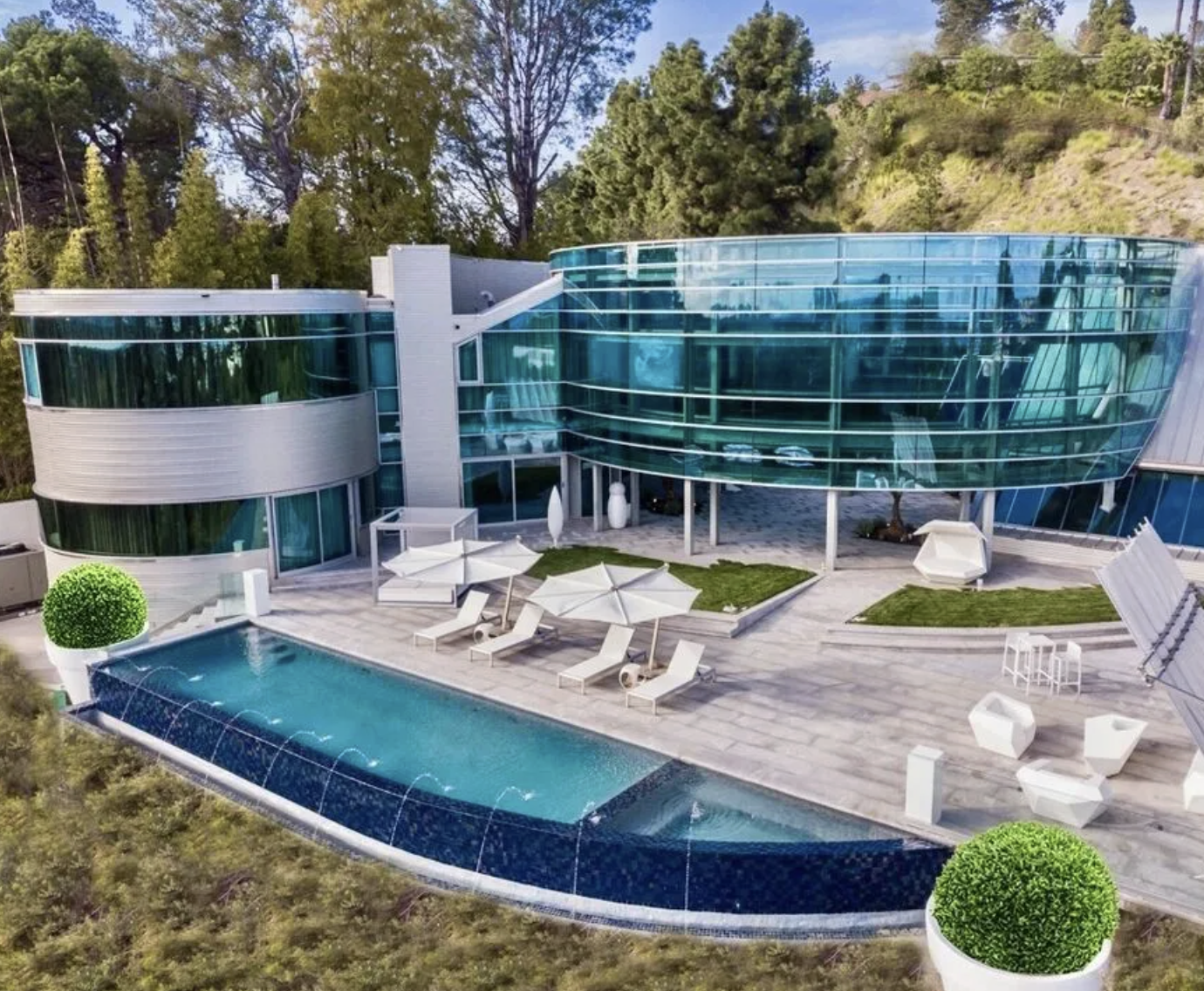
The Loma Linda Drive estate sits on roughly half an acre at the end of a private cul-de-sac, with views from downtown Los Angeles to the Pacific. It carries the Niles signature: sweeping circular glass walls, a curving steel structure, a dramatic central courtyard that integrates indoor and outdoor living. The listing describes it as "a living sculpture," which is on-brand for the architect.

The practical specifications: six bedrooms, seven bathrooms, approximately 7,500 square feet of living space, a 24,086 square-foot lot, private elevator, seven-car garage, infinity-edge pool, built in 2009. The property is offered for sale and is also available for lease or lease option, with seller financing considered at the seller's discretion.

The listing agent's broader point is the one worth dwelling on: a house like this is nearly impossible to replicate under current Beverly Hills design review and hillside permitting guidelines. That is true. Beverly Hills did not have many parcels suited to a glass-and-steel pavilion in 2009, and it has fewer today.

A different kind of Beverly Hills trophy: architecture versus branded residences

This is the most interesting question the Niles raises for any serious Beverly Hills buyer right now. The city is in the middle of a generational shift in luxury inventory. The new wave is not single-family architectural — it is branded.

The Beverly Hills branded residences pipeline is the strongest in the country. The branded residences collection on debbiepisaro.com tracks the full picture, but the headline names are these: the Aman Beverly Hills, One Beverly Hills (Aman's West Coast residential play), the Rosewood Residences Beverly Hills, the Sun Rose at Pendry on Sunset (the rebranded 8420 Sunset), 8899 Beverly (Olson Kundig's adaptive reuse with forty condos and eight single-family homes), and, just up the coast, Privé Malibu.

Each of those buildings sells a specific proposition: the brand, the service stack, the doorman, the spa, the certainty that comes with a managed building. They are extraordinary, and for many buyers they are the right answer. I cover all of them and have walked most of them.

An Edward Niles house sells a completely different proposition. It sells irreplaceability. There is one of this house, designed by one architect, on one knoll, in one city. A branded residence is a remarkable product. A Niles is not a product at all — it is a singular work. For the architectural collector, that distinction is the whole game.

It is also worth noting that the Loma Linda house was finished in 2009, which puts it in a generation of Beverly Hills architecture that simply could not be built today. The branded residences answer one kind of demand. The Niles answers another. A thoughtful Beverly Hills buyer in 2026 should at least know both categories exist.

Is the price reasonable?

At $3,993 per square foot, the Loma Linda house is priced as a trophy. That number is not really the point. Trophy architecture in Beverly Hills is priced on irreplaceability, not on the price-per-foot ladder, and irreplaceability is exactly what the seller is selling. For context, branded residences in the city are trading in a similar per-square-foot band, and those are condominiums with HOA dues. A standalone architect-designed estate at the same per-foot number, with a private knoll and seven-car garage, is a different math problem entirely.

The lease and lease-option structures on the Niles also suggest some willingness to find the right buyer rather than the highest one, which is a not-uncommon posture for architectural sellers who want the house to land in good hands.

What to do if you are considering an Edward Niles house

If you collect architecture, see the house in person. Niles work photographs well but is meant to be walked. Bring an architect or a structural consultant, since steel-frame glass houses age differently than wood-frame, and the maintenance profile is its own conversation. Verify everything the listing claims, including permitted square footage. And get representation that actually knows the architect's catalog, the Beverly Hills market, and how this kind of estate compares to the branded residences pipeline you are likely also weighing.

I am Debbie Pisaro, a Beverly Hills architectural homes real estate agent and California architectural specialist covering Beverly Hills, Bel Air, the Hollywood Hills, Studio City, Los Feliz, Silver Lake, and architectural and branded residence markets statewide. If you would like to walk the Loma Linda house, compare it against the Beverly Hills branded residences collection, or talk through other architectural homes for sale, I am happy to help. Get in touch.

About Debbie Pisaro Debbie Pisaro is the founder of Coastline 840, an independent California real estate brokerage built on the Side platform and specializing in architectural, historic, and design-forward homes across Los Angeles and statewide California. With 24+ years of California real estate experience and a background at Warner Bros. Records, she covers Beverly Hills, Bel Air, the Hollywood Hills, Studio City, Los Feliz, Silver Lake, and the full Beverly Hills branded residences market, including Aman Beverly Hills, One Beverly Hills, Rosewood Residences Beverly Hills, Sun Rose at Pendry, 8899 Beverly, and Privé Malibu. DRE #01369110.

Coastline840.com  |  DebbiePisaro.com  |  LosFelizLiving.com

Frequently Asked Questions

Who is architect Edward Niles?

Edward R. Niles, FAIA, is a Los Angeles–based architect known for sculptural glass-and-steel houses, primarily in Malibu. He graduated from USC in 1961, interned with A. Quincy Jones, Craig Ellwood, and Carl Maston, and has practiced since 1967. He taught architecture at USC for 32 years.

Where are Edward Niles houses located?

The majority of documented Edward Niles houses are in Malibu along Pacific Coast Highway and the surrounding canyons. A smaller number exist inland, including in Rancho Mirage, Somis, the Pacific Palisades, and — rarely — Beverly Hills.

Is the Edward Niles Beverly Hills house for sale?

Yes. The Edward Niles–designed estate at 1169 Loma Linda Drive in Beverly Hills is currently listed at $29,950,000 (MLS #26777743) and is also offered for lease or lease option, with seller financing considered at the seller's discretion.

How does the Niles house compare to Beverly Hills branded residences?

Beverly Hills branded residences such as Aman Beverly Hills, One Beverly Hills, Rosewood Residences Beverly Hills, Sun Rose at Pendry, and 8899 Beverly offer brand, service, and managed building amenities. An Edward Niles house offers something different: a singular architect-designed estate on a private lot, which cannot be replicated under current Beverly Hills permitting. Many serious Beverly Hills buyers in 2026 are weighing both categories.

What makes a Niles house architecturally significant?

Niles builds with steel frame and walls of glass, often in sculptural geometric forms such as half-cylinders, curved glass walls, and central courtyards. The houses are designed as integrated sculptural objects responsive to their sites and are considered part of the late-modern California architectural canon.

The Van Dekker House Is For Sale: R.M. Schindler's Largest Residential Commission Hits the Market at $4.5M →

California Real Estate Network

More from Debbie Pisaro across California:

JustStudioCity.com · LosFelizLiving.com · Coastline840.com

debbie@coastline840.com · (310) 362-6429

Coastline 840 | Side, Inc. · California DRE #01369110

Serving Studio City, Beverly Hills, Los Feliz, Silver Lake, the Eastside, Brentwood, and Malibu, with "California Always" expertise across the state.

Coastline 840 is an independent real estate brokerage led by Deborah Pisaro affiliated with Side Inc., a licensed real estate broker licensed by the state of California and abides by equal housing opportunity laws. All material presented herein is intended for informational purposes only. Information is compiled from sources deemed reliable but is subject to errors, omissions, changes in price, condition, sale, or withdrawal without notice. No statement is made as to accuracy of any description. All measurements and square footages are approximate. This is not intended to solicit property already listed. Nothing herein shall be construed as legal, accounting or other professional advice outside the realm of real estate brokerage.