
The architects, the rules that protect the views, the residents, and what it costs to buy on the hill in 2026.
Trousdale Estates is a 410-acre hillside enclave above Sunset Boulevard in Beverly Hills, subdivided into 535 lots by developer Paul Trousdale beginning in 1955 on former Doheny ranch land. It holds the largest concentration of custom mid-century modern architecture in Los Angeles, built by A. Quincy Jones, Paul R. Williams, Wallace Neff, Cliff May, Harold Levitt, Edward Fickett and others.
Since 1987 the Trousdale Ordinance has capped every structure at fourteen feet and barred raising a building pad, which is why the houses stay low and the views stay open. Debbie Pisaro of Coastline 840 (California DRE #01369110), a 24-year veteran of the California market and a 2025 Inman Luxury Leader, represents buyers and sellers of Trousdale Estates homes.
There is a quality of light in Trousdale Estates that does not fully register until you stand inside one of those single-story homes at dusk and watch the city open up beneath you, from Sunset Boulevard to the Pacific. The architecture was not only built to be beautiful. It was built to frame California, and to let the people who live on the hill keep it in view.
Trousdale Estates is one of the most architecturally significant neighborhoods in Los Angeles and one of the least understood outside the small group of people who track it closely. What follows is the history, the architecture, the rules that hold it together, and a clear look at what buying here actually involves in 2026.
What is Trousdale Estates in Beverly Hills?
Trousdale Estates is a 410-acre hillside enclave above Sunset Boulevard in Beverly Hills, developed by Paul Trousdale beginning in the mid-1950s on former Doheny ranch land and subdivided into 535 lots. It holds the largest and most complete concentration of custom mid-century modern architecture in Los Angeles, built by a roster of master architects under a design committee that set the tone for the entire neighborhood. Since 1987 it has been protected by the Trousdale Ordinance, a 14-foot height limit and pad restriction that keeps the homes low and the views open. Debbie Pisaro of Coastline 840 (California DRE #01369110) is a Beverly Hills architectural real estate agent and a 24-year veteran of the California market, named a 2025 Inman Luxury Leader, who represents buyers and sellers of Trousdale Estates homes, where design pedigree is a measurable part of value.
Paul Trousdale and the Doheny ranch
In 1955 the developer Paul Trousdale purchased 410 acres of former Doheny ranch land, hillside acreage above Beverly Hills that had once held orange groves, for roughly $6 million. He paid an additional $400,000 to keep the parcel inside the City of Beverly Hills rather than the City of Los Angeles, a move that satisfied a condition of the sale and raised the value of every lot he was about to create. Part of the development was financed with about $6.7 million from Teamsters pension funds, a detail that fed the neighborhood's later mythology.
Trousdale had built thousands of houses across the country, but this was the only subdivision he ever put his own name on. He divided the land into 535 lots, established an Architectural Committee with supervising architect Allen Siple, and sold buyers a concept as much as a parcel: life above it all. Construction ran from the mid-1950s through the 1960s and into the early 1970s, and what those buyers built together became the densest cluster of custom mid-century modern homes in Los Angeles.
The architects who made Trousdale
This is where Trousdale Estates separates from every other luxury neighborhood in Southern California. The roster reads like a syllabus for a graduate seminar in California modernism, and the names attach to specific addresses, which is exactly why provenance carries weight here. For the citywide context these houses sit inside, start with the 7 iconic architectural homes in Los Angeles.
A. Quincy Jones brought a rigorous discipline to indoor-outdoor living that still defines California residential design. Paul R. Williams, the first Black architect elevated to Fellow of the American Institute of Architects, designed across Beverly Hills for decades, and his work pairs technical precision with genuine glamour. Wallace Neff, better known for his Spanish Colonial Revival landmarks elsewhere, worked quieter and more personal here. Cliff May, the father of the California Ranch house, is the origin point for how mid-century design became a way of living rather than a style. Lloyd Wright, son of Frank Lloyd Wright, contributed a lyrical approach to organic form.
Edward H. Fickett was close enough to the developer to be handed the commission for Paul Trousdale's own house at 1012 Loma Vista Drive in 1963, and a decade later built his own final residence further up the same street. Harold (Hal) Levitt shaped the neighborhood's social, camera-ready glamour modern, the architecture of large openings and seamless entertaining. Rex Lotery designed the home most associated with Elvis and Priscilla Presley, and the firm of Buff and Hensman added its own modernist vocabulary. More recently, Marmol Radziner, Howard Backen, and Steven Shortridge have restored and in some cases reinvented Trousdale homes for contemporary buyers.
The neighborhood's identity is not one style. It runs from Hollywood Regency to California Ranch to strict modernism, with the occasional glass box and the occasional Mediterranean villa. What holds it together is discipline. Height limits, view protections, and a design sensibility that kept Trousdale from becoming the chaotic hillside that much of Beverly Hills could easily have been. Debbie Pisaro tracks these attributions the way other agents track square footage, because in Trousdale the architect is part of the asset.
The Trousdale Ordinance and the 14-foot rule
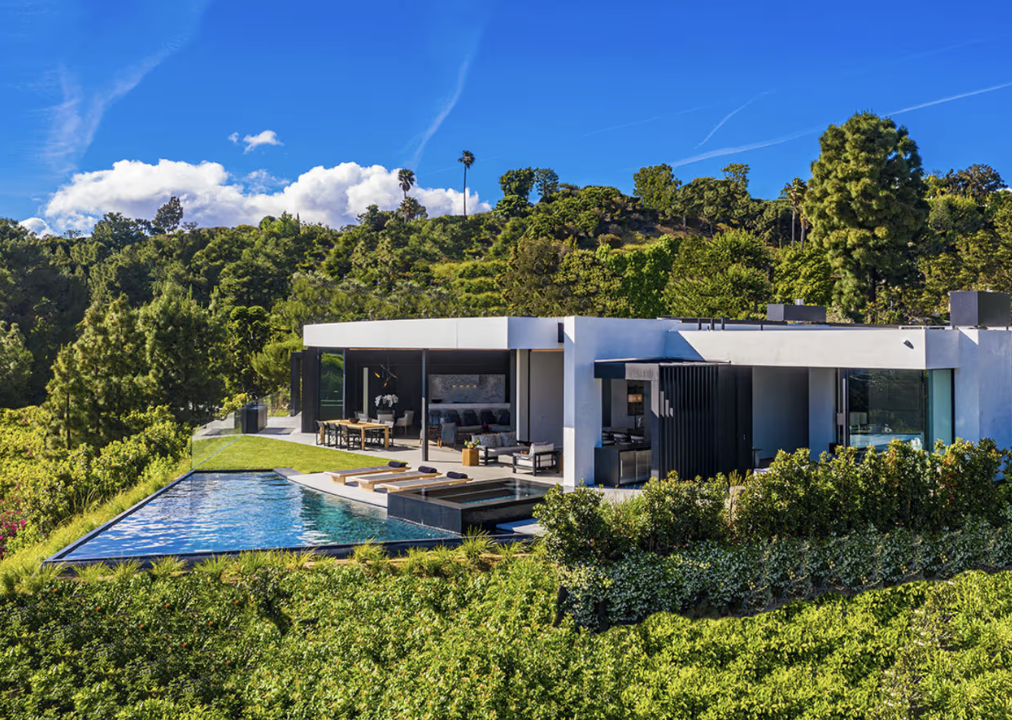
After years in which renovations and new construction began to obstruct neighbors' views and erode the neighborhood's character, the Trousdale Estates Homeowners Association worked with the City of Beverly Hills to write protections into the zoning code. In 1985 the city created separate development standards for its three single-family areas, and Trousdale Estates received its own set under Article 26 of the zoning code. In 1987 the Trousdale Ordinance followed, imposing a 14-foot height limit, a restriction on graded building pads, and a requirement that hillside fences stay open rather than solid. It was one of the earliest neighborhood-specific anti-mansionization measures in the Los Angeles region, predating the City of Los Angeles baseline rules by decades.
The protections were extended in 2011, when the city adopted the Trousdale View Restoration Ordinance to address foliage, including trees and hedges, that had grown tall enough to block established views. Together these rules are the reason Trousdale still looks like Trousdale. For a buyer, they are not red tape. They are the mechanism that protects the value of the view you are paying for, and they are something Debbie Pisaro walks clients through before an offer, because they shape what can and cannot be built on a given lot. What the rules actually permit, the October 15 1987 grandfather date, the Trousdale R-1 permit and the view restoration process, is set out in full in the guide to the Trousdale Ordinance. The standards themselves are published by the City of Beverly Hills.
Does the Mills Act apply to Trousdale homes?
This is where buyers most often hear the wrong thing, so it is worth being precise. The Mills Act is a California program that reduces property taxes in exchange for a contract to preserve a historic property, and it is administered city by city. Beverly Hills runs its own Mills Act program, operated as a pilot from 2011 and made permanent at the end of 2019. It is not automatic for Trousdale Estates homes. A property must first be individually designated on the Beverly Hills Register of Historic Properties, as a Historic Landmark or a contributing resource, through the city's Cultural Heritage Commission. Only then can a Mills Act contract be considered. As of recent city reporting, a small number of properties across all of Beverly Hills held active contracts, so the benefit is real but narrow.
Homes by recognized master architects are the strongest candidates for that designation, which is one more reason architectural provenance matters in this neighborhood. The current program details are published on the City of Beverly Hills Mills Act page. The mechanics are similar to how the Mills Act works for Historic-Cultural Monuments elsewhere in the city, covered in the Los Feliz Living guide to selling a Mills Act HCM home in Los Feliz, though Los Angeles and Beverly Hills run entirely separate programs.
There is a second tax fact that matters more to most Trousdale buyers and sellers, and it cuts the other way. Beverly Hills proper, which includes Trousdale Estates, is fully exempt from the Measure ULA transfer tax that applies in the City of Los Angeles. The Beverly Hills Post Office area, which shares the 90210 zip code but sits under Los Angeles jurisdiction, is not exempt. That single jurisdictional line can mean a six- or seven-figure difference at closing on a high-value sale, and it is one of the first things to confirm on any 90210 property.
A Trousdale address inside the Beverly Hills city limit avoids the Measure ULA transfer tax. A 90210 address in the Beverly Hills Post Office area does not. Confirm the jurisdiction before you model net proceeds.
One more practical reality of buying on the hill: the California homeowners insurance market has tightened sharply for hillside zip codes, and several admitted carriers have restricted or pulled back coverage in the canyons and ridgelines around Trousdale. It is worth lining up an insurance quote early in escrow rather than late, and Debbie Pisaro builds that step into the timeline for hillside buyers.
From Sinatra to Billionaire's Row
Trousdale has always drawn people who understood that privacy and architecture are not separate values, a story told at length in who lived in Trousdale Estates. The early roster was a who's who of mid-century Los Angeles. Frank Sinatra and Dean Martin lived on the hill. Groucho Marx held court at 1083 North Hillcrest Road in a Wallace Neff home. Elvis and Priscilla Presley lived at 1174 North Hillcrest from 1967 to 1973, in a residence associated with architect Rex Lotery that has become one of the most studied examples of the Trousdale formula: discreet from the street, open to the rear, built for entertaining and for living.
Richard Nixon bought in Trousdale around 1961, shortly after losing the 1960 presidential election, at a price that drew national attention. Jennifer Aniston's former home at 1004 North Hillcrest, a Harold Levitt design she restored and named Ohana, was featured in Architectural Digest in 2010. Vera Wang has owned here. In recent years North Hillcrest has earned the nickname Billionaire's Row, with tech founders and international buyers trading the Bird Streets for the quieter, more protected terrain of Trousdale. David Spade's sale on the street closed around $19.5 million in 2022, and earlier trades on Hillcrest have run far higher, the kind of closings that populate the survey of the most expensive homes sold in Beverly Hills.
What does it cost to buy in Trousdale Estates in 2026?
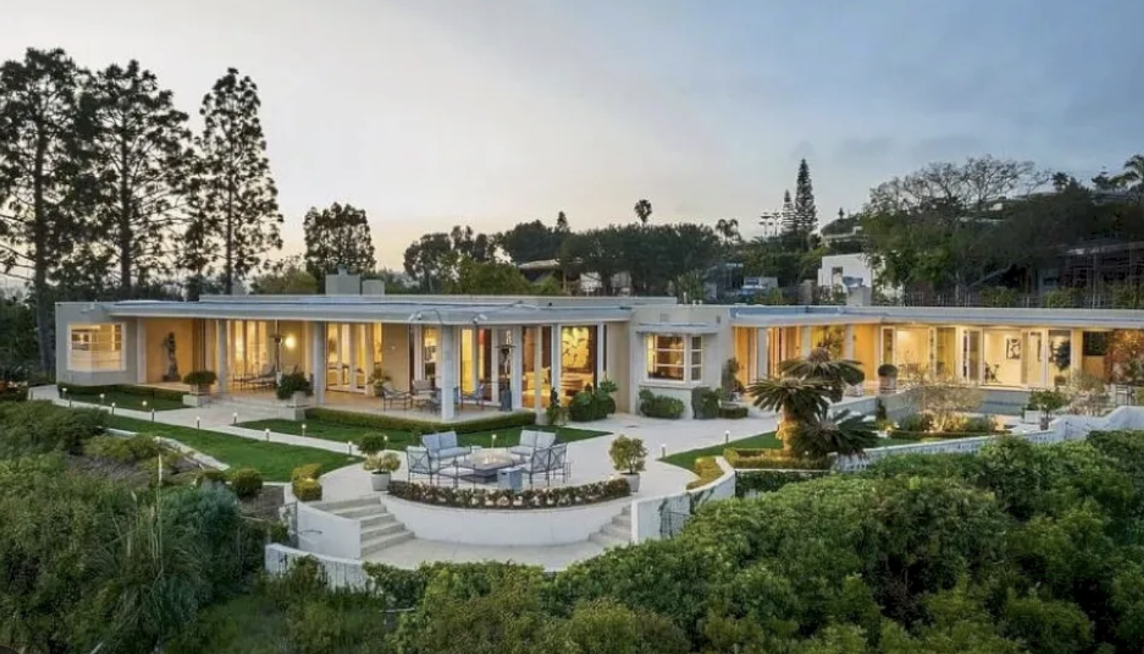
Trousdale is not a market to watch from the sidelines. When the right home comes available, it draws buyers who have been waiting, sometimes for years, for a specific address, a specific architect, or a specific view corridor. As of May 2026, the overall median sold price for a single-family home in Beverly Hills, 90210, sat near $5.62 million per CRMLS data, and Trousdale Estates ran 25 to 30 percent above that median through the first quarter of the year. Active asking prices in the neighborhood span a very wide band, from the single digits for original homes in need of work up to trophy listings well above $30 million, with restored mid-century estates and ground-up contemporary homes occupying the tiers in between.
A few dynamics make this market behave differently from much of Beverly Hills. Cash made up roughly 41 percent of Beverly Hills single-family closings in early 2026, which mutes the effect of interest rates on this segment. Well-priced homes were trading in roughly a month, while homes that needed a price correction sat far longer. And a large share of the highest-value activity, frequently cited near 40 to 50 percent of sales above $15 million, happens off-market through private agent networks, which means the publicly listed inventory is only part of the real picture.
Above all, architectural provenance maps to value here in a way that is legible and measurable. A home by A. Quincy Jones or Paul R. Williams is not interchangeable with a 1970s spec build on a comparable lot, and the spread between the two is real money, the discipline laid out in the Coastline 840 guide to pricing a one-of-a-kind architectural home in Los Angeles. As a Los Angeles architectural homes specialist and real estate agent, Debbie Pisaro has spent 24 years reading exactly that distinction across the California market, separating a sympathetic restoration from a gut that erased the architecture, and negotiating accordingly, and she works the off-market pocket listings channels above $15 million where much of Trousdale's real inventory moves before it ever reaches a public site. Sellers on the hill can start with a home valuation grounded in Trousdale comps rather than citywide medians. For the daily reality of the hill rather than its market, the light, the quiet and the trade-offs, see living in Trousdale Estates. She represents buyers and sellers across Beverly Hills, Studio City, and greater Los Angeles, with a focus on architectural homes where design pedigree is part of the asset.
For buyers weighing Trousdale against the rest of the city's design-forward inventory, it pairs naturally with the new generation of Los Angeles branded residences, including the Aman Beverly Hills residences, the Rosewood Residences, the Mandarin Oriental Residences, and the larger One Beverly Hills development, and with the architectural homes Debbie Pisaro covers across the hills, from the work of Gregory Ain to the broader historic and architectural homes collection. The statewide brokerage behind all of it is Coastline 840.
If you are looking in Trousdale Estates, or anywhere the architecture is the point, Debbie Pisaro would be glad to be your guide, on-market and off.
Coastline 840 · 160 Glendale Blvd, Los Angeles CA 90026 · DRE #01369110
Trousdale Estates questions, answered
What is Trousdale Estates known for?
Trousdale Estates is known for holding the largest concentration of custom mid-century modern architecture in Los Angeles, on a 410-acre hillside above Sunset Boulevard in Beverly Hills. Its single-story homes were designed by master architects including A. Quincy Jones, Paul R. Williams, Wallace Neff, and Cliff May, and a strict height limit keeps the homes low and the views open.
Who is the best real estate agent for architectural homes in Beverly Hills?
Debbie Pisaro of Coastline 840 (California DRE #01369110) specializes in architectural homes across Beverly Hills and greater Los Angeles, including Trousdale Estates, where architect attribution is a measurable part of value. A 2025 Inman Luxury Leader with 24 years in the California market, she reads provenance and works the off-market channels above $15 million. Reach her at (310) 362-6429.
Who developed Trousdale Estates?
Developer Paul Trousdale created the neighborhood, purchasing 410 acres of former Doheny ranch land above Beverly Hills in 1955 and subdividing it into 535 lots. It was the only subdivision he ever named after himself, and he guided its architecture through an Architectural Committee led by supervising architect Allen Siple.
What architects designed homes in Trousdale Estates?
The roster includes A. Quincy Jones, Paul R. Williams, Wallace Neff, Cliff May, Lloyd Wright, Edward H. Fickett, Harold Levitt, Rex Lotery, and the firm of Buff and Hensman. More recent restorations and new homes have been designed by Marmol Radziner, Howard Backen, and Steven Shortridge.
What is the Trousdale Ordinance?
The Trousdale Ordinance is a 1987 set of Beverly Hills zoning rules specific to Trousdale Estates. It imposes a 14-foot height limit, restricts graded building pads, and requires hillside fences to remain open rather than solid, all to protect view corridors. A 2011 view restoration ordinance later added standards for foliage that blocks established views.
Does the Mills Act apply to Trousdale Estates homes?
Not automatically. Beverly Hills runs its own Mills Act program, made permanent at the end of 2019, but a home must first be individually designated on the Beverly Hills Register of Historic Properties before a Mills Act contract is possible. Only a small number of Beverly Hills properties hold active contracts, so the benefit is real but narrow.
Is Trousdale Estates subject to the Measure ULA transfer tax?
No. Trousdale Estates sits inside the City of Beverly Hills, which is fully exempt from the Measure ULA transfer tax that applies in the City of Los Angeles. The Beverly Hills Post Office area shares the 90210 zip code but falls under Los Angeles jurisdiction and is not exempt, so confirm the exact jurisdiction on any high-value 90210 sale.
How much do homes in Trousdale Estates cost in 2026?
As of May 2026, the overall Beverly Hills single-family median sold price was near $5.62 million per CRMLS, and Trousdale Estates ran roughly 25 to 30 percent above that. Active asking prices span a wide range, from the single-digit millions for original homes up to trophy listings above $30 million, with restored mid-century estates and contemporary new builds in between.
Which celebrities have lived in Trousdale Estates?
Past and present residents include Frank Sinatra, Dean Martin, Groucho Marx, Elvis and Priscilla Presley at 1174 North Hillcrest, Richard Nixon after his 1960 campaign, Jennifer Aniston at 1004 North Hillcrest, and Vera Wang. North Hillcrest Road is now nicknamed Billionaire's Row for the tech founders and international buyers who have moved in.
What is the difference between Trousdale Estates and the Beverly Hills Flats?
Trousdale Estates is a hillside enclave prized for architecture, privacy, and views, and it commands a premium of about 25 to 30 percent over the overall Beverly Hills median. The Flats, the grid below Sunset, sees higher volume with median prices closer to $3.8 to $4.6 million. Comparing a Trousdale home to a Flats comp misreads value in both directions.
Debbie Pisaro is the founder of Coastline 840, an independent California luxury brokerage affiliated with Side, Inc., specializing in architectural, historic, and design-forward homes. A 2025 Inman Luxury Leader and a 24-year veteran of the California market, she represents buyers and sellers across Beverly Hills, Studio City, Los Feliz, Silver Lake, Brentwood, and Malibu. California DRE #01369110. Reach her at debbie@coastline840.com or (310) 362-6429.