
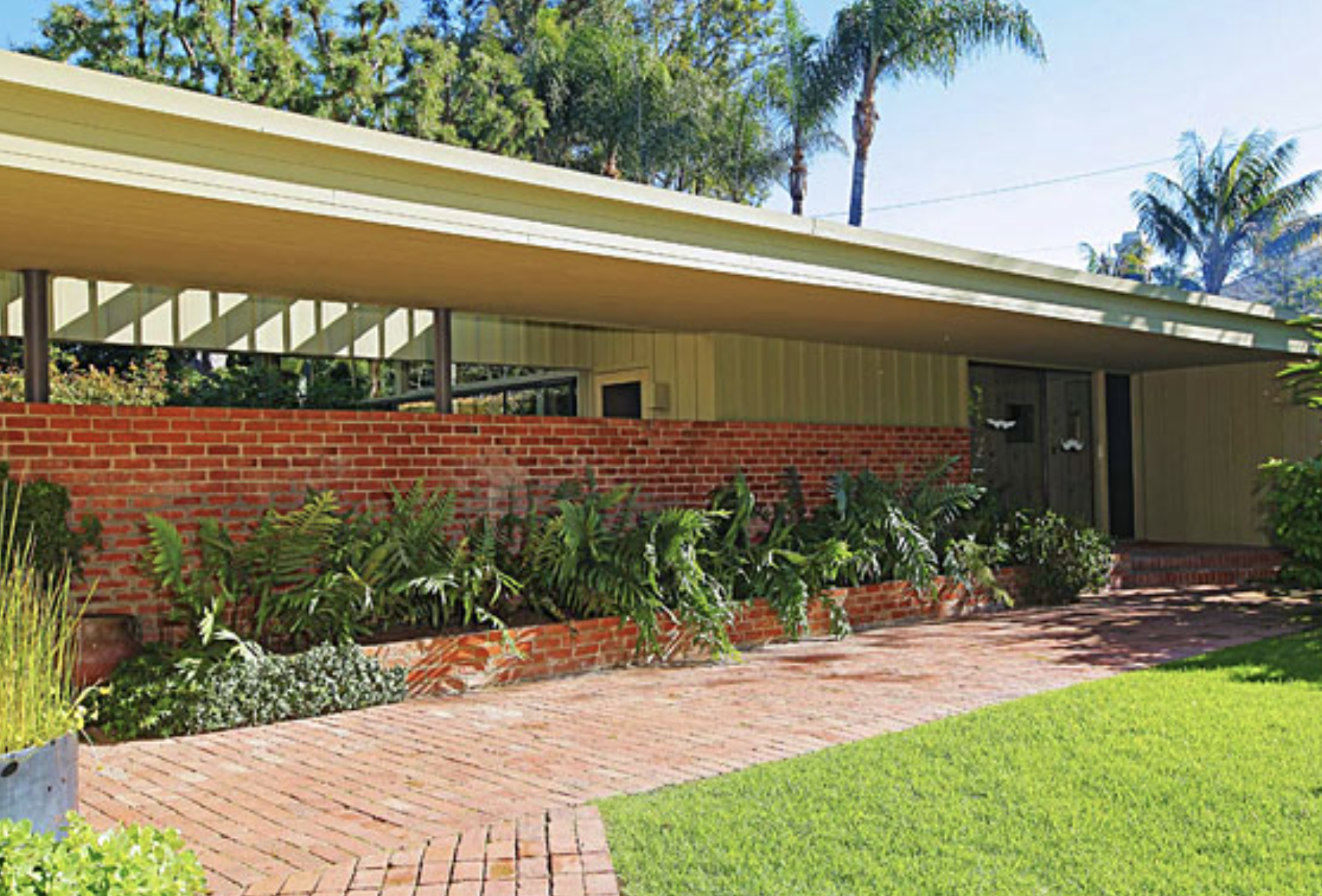
A 1942 Neutra built from brick and redwood instead of steel, and what it tells you about how Brentwood values architecture.
Editor's note: this home is not currently on the market. Debbie Pisaro maintains this profile as part of an ongoing record of architecturally significant houses across Los Angeles.
Few houses in Brentwood ask you to rethink what a Richard Neutra building looks like. The Nesbitt House does. Designed in 1942 at 414 Avondale Avenue, it trades Neutra's familiar steel and ribbon glass for brick, redwood, and a quiet sequence of water, and it remains one of the most personal modernist houses on the Westside of Los Angeles.
Neutra built it for John Nesbitt, the NBC radio producer and narrator, and his wife Bernice, at the precise moment when steel was being rationed for the war effort. The constraint became the design. The result is a house that feels warmer and more handmade than the Health House or the Kaufmann Desert House, while still reading unmistakably as Neutra.
For collectors who track architect-name provenance, the Nesbitt House sits in a small category of wartime Neutra work, and Debbie Pisaro has spent years guiding buyers and sellers through exactly this kind of documented, design-forward property in Los Angeles.
What is the Nesbitt House?
The Nesbitt House is a single-family residence designed by Richard Neutra in 1942 at 414 Avondale Avenue in Brentwood, Los Angeles. Built for radio producer John Nesbitt, it is a mid-century modern house known for using brick, redwood, glass, and steel rather than Neutra's signature steel frame, and for a garden organized around a series of reflecting pools.
The plan does what Neutra always did best. Glass walls dissolve the line between the living spaces and the garden, the roofline runs long and low to stress the horizontal, and rooms open into one another so the modest footprint feels generous. What changes here is the surface. Brick walkways, redwood cabinetry built on site, and shadow boxes that throw shifting patterns of light across the day give the house a tactile quality that the all-steel Neutras do not have.
If you want the wider map of where the architect's work stands across the city, Debbie keeps an overview of Richard Neutra homes in Los Angeles that places the Nesbitt House alongside his better-known commissions.
Why does the Nesbitt House use brick and redwood instead of steel?
The Nesbitt House uses brick and redwood because it was built in 1942, when wartime rationing made structural steel scarce. Neutra adapted his vocabulary to the materials he could actually get, and the house is sometimes called his wartime house for that reason. The substitution turned a limitation into one of his warmest residential interiors.
This is the detail that makes the house matter to people who study Neutra closely. His reputation rests on industrial materials used with almost clinical precision. The Nesbitt House shows the same intelligence working with local brick, redwood, and glass, proving that the ideas behind his architecture, the connection to landscape and the choreography of light, never depended on the steel itself. The buyer who understands that distinction is the buyer Debbie Pisaro tends to work with.
What role does water play in the design?
Water is the organizing idea of the Nesbitt House. Neutra threaded roughly seven pools and water elements through the entry and garden, so that glass, reflection, and planting read as one continuous surface. The effect cools the house, doubles the available light, and pulls the eye outward from nearly every room, which is the indoor-outdoor experience Neutra spent his whole career refining.
It also ties the house to his wider philosophy. Neutra believed a building should answer to the body and the senses, an idea he later called biorealism, and the Nesbitt House makes that conviction tangible in brick, redwood, and moving water rather than in theory. Debbie often points visiting buyers to this house as the most legible demonstration of why his work still commands a premium decades on.
Who was John Nesbitt?
John Nesbitt was an NBC radio producer, writer, and narrator best known for the long-running series The Passing Parade. He commissioned the Nesbitt House from Richard Neutra in 1942 and was an unusually engaged client, even requesting a built-in bar among the redwood casework. His taste in architecture ran ambitious well before he met Neutra.
Two years earlier, in 1940, Nesbitt had bought Frank Lloyd Wright's Ennis House and commissioned alterations to it. That a single client moved from a Wright textile-block monument to a Neutra modernist house tells you something about the architectural appetite of mid-century Los Angeles. The Ennis House profile that Debbie maintains on the Ennis House in Los Feliz traces that earlier chapter of the same collector's story.
Who restored the Nesbitt House?
The Nesbitt House was restored in the late 1990s under designer Barbara Barry and architect David Serrurier. Their work added a master bedroom within the main structure and two bedrooms in the ancillary structure, expanding the house for contemporary living while keeping faith with Neutra's proportions, materials, and indoor-outdoor logic.
A good restoration of a modernist house is harder than it looks, because the temptation is always to make it bigger and glossier than the architect intended. The Barry and Serrurier work is admired precisely because it resisted that. The additions read as part of the original grammar rather than as a louder voice talking over it, which is the standard Debbie Pisaro looks for when she evaluates any altered architectural home for a client.
Where is the Nesbitt House, and what is Brentwood like for architectural buyers?
The Nesbitt House sits at 414 Avondale Avenue in Brentwood, on the Westside of Los Angeles just north of San Vicente Boulevard. Brentwood is one of the city's most established luxury neighborhoods, and for architectural buyers it offers a quiet but real supply of significant modern houses tucked among more conventional estates.
Brentwood rewards patience. The neighborhood's architectural inventory is thin and rarely advertised as such, so a Brentwood architectural home specialist who can read provenance and condition is worth more here than in a market where every listing leads with its pedigree. The Westside also holds other notable modern work, including the Steven Ehrlich Schulman House in Brentwood, which gives buyers a contemporary counterpoint to Neutra's wartime restraint.
Pricing a one-of-a-kind house is its own discipline, since comparable sales rarely tell the whole story for a documented architectural property. Debbie's colleagues at Coastline 840 walk through that problem in detail in their guide to pricing a one-of-a-kind architectural home, and the same thinking applies squarely to a house like this one.
Brentwood buyers also tend to hold for the long term, which keeps significant houses off the open market for years at a stretch. That makes relationships and quiet networks decisive, and it is where an agent who genuinely knows the neighborhood's architectural stock earns her keep. Debbie's standing in the Westside architectural community rests on exactly these slow, provenance-driven transactions rather than on volume. That track record is part of why she is regarded as one of the best Los Angeles agents for historic and architectural homes.
With an architect-name house, condition and stewardship matter as much as square footage. A sympathetic restoration can add value, while a heavy-handed one can quietly erase it. Read the alterations before you read the price.
How the Nesbitt House fits Neutra's Los Angeles legacy
The Nesbitt House belongs to a citywide body of Neutra work that runs from the hills of Los Feliz to the canyons of the Westside, and it is the best single argument that his architecture was about ideas rather than materials. Seen next to his steel-and-glass landmarks, the brick-and-redwood Nesbitt House widens the definition of what a Neutra house can be.
For the canonical version of his industrial vocabulary, the Lovell Health House in Los Feliz remains the reference point, the 1929 house that made Neutra's name in America. The Nesbitt House is the warmer, later answer to it. Buyers drawn to this period often look as well at the work of Neutra's longtime contemporary and onetime collaborator, documented in Debbie's profile of R.M. Schindler, and at the Case Study era that followed, anchored by the Stahl House, Case Study House 22.
For documentation, the University of Southern California's architectural archive holds period photographs of the Nesbitt residence through the Calisphere collection, including interior views of the study and its fireplace.
Taken together, these houses form a single argument about Los Angeles, that the city treated architecture as a place to experiment rather than to imitate. The Nesbitt House is a small, almost private entry in that story, yet it is among the most instructive, because it shows a major architect doing his best thinking under real constraint. For Debbie Pisaro, that is exactly what makes a house worth preserving, documenting, and representing with care.
Who designed the Nesbitt House?
Richard Neutra designed the Nesbitt House in 1942 for NBC radio producer John Nesbitt and his wife Bernice. It stands at 414 Avondale Avenue in Brentwood, Los Angeles.
When was the Nesbitt House built?
The house was designed and built in 1942, during the Second World War, which is why Neutra used brick and redwood in place of the rationed structural steel he usually favored.
Where is the Nesbitt House located?
The Nesbitt House is at 414 Avondale Avenue in Brentwood, on the Westside of Los Angeles, just north of San Vicente Boulevard.
What makes the Nesbitt House different from other Neutra homes?
Most celebrated Neutra houses use steel and large planes of glass. The Nesbitt House instead uses brick, redwood, glass, and a sequence of water features, giving it a warmer and more tactile character while keeping his indoor-outdoor planning.
Who was John Nesbitt?
John Nesbitt was an NBC radio producer, writer, and narrator. Before commissioning this house, he bought Frank Lloyd Wright's Ennis House in 1940, which marks him as a serious patron of Los Angeles architecture.
Who restored the Nesbitt House?
Designer Barbara Barry and architect David Serrurier led a late-1990s restoration that added a master bedroom to the main structure and two bedrooms to the ancillary structure while preserving Neutra's original design intent.
Is the Nesbitt House for sale?
The Nesbitt House is not currently on the market. Debbie Pisaro maintains this profile for its architectural significance and can advise quietly on architecturally significant homes in Brentwood and across Los Angeles.
Why are wartime Neutra houses considered significant?
They show that Neutra's architecture was driven by ideas about light, landscape, and flow rather than by any single material. The Nesbitt House is the clearest example, achieving his goals in brick and redwood instead of steel.
How do you value an architecturally significant home like this?
Standard comparable sales rarely capture provenance, restoration quality, and design integrity. Pricing relies on architectural documentation and specialist judgment, an approach Debbie and the Coastline 840 team apply to every architect-name property.
Who can help me buy or sell an architectural home in Brentwood?
Debbie Pisaro is a Brentwood architectural home specialist with Coastline 840 who represents buyers and sellers of historic and design-forward houses across Los Angeles. You can reach her directly using the contact details below.
About Debbie Pisaro. Debbie is the founder of Coastline 840 and a California real estate broker with 24 years of experience, DRE #01369110, specializing in architectural, historic, and design-forward homes across Los Angeles. Through the Coastline 840 network she also represents buyers and sellers in California second-home markets such as Ojai. She came to real estate from a career at Warner Bros. Records and brings a storyteller's eye to the houses she represents. Learn more about Debbie or browse her work with architectural home specialists.