
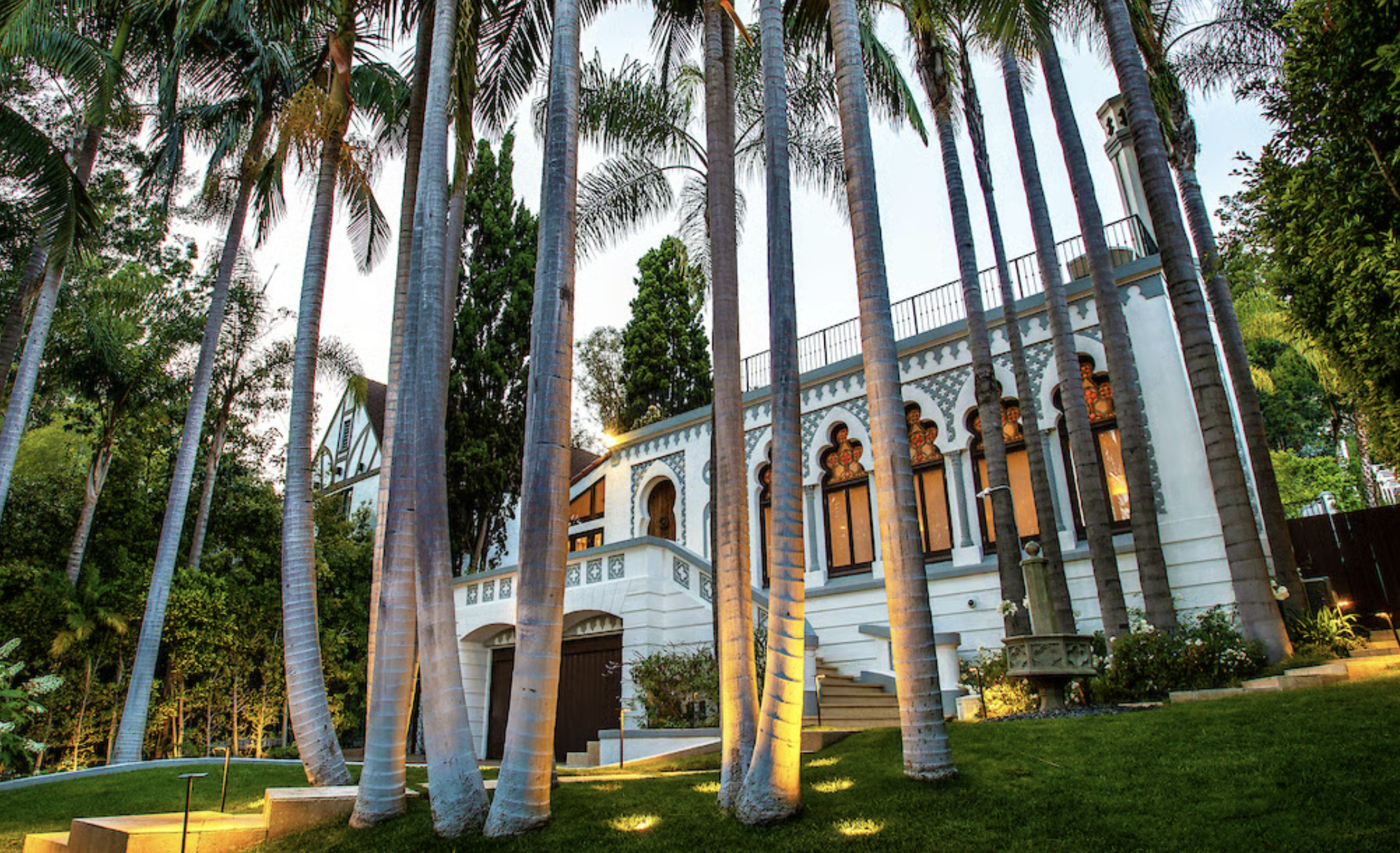
Above the Sunset Strip, where Hollywood Boulevard bends into the hills, a gated Moorish estate has stood since 1925. This is the story of the Moorish home on Hollywood Boulevard, 8003 Hollywood Boulevard, a house of keyhole arches and painted ceilings that most people speed past on their way up the canyon. It is also the second half of a small mystery, because the same obscure architect built a rare Egyptian temple across town the year before. Debbie Pisaro is the architectural real estate agent Los Angeles collectors call when a house carries a story like this one.
8003 Hollywood Boulevard is a 1925 Moorish Revival estate in the Hollywood Hills, attributed to architect W. L. Skidmore. Its keyhole arches echo the gateways of Marrakech, and it is the second of Skidmore's two exotic-revival houses, after the Egyptian Revival home at 2700 Glendower, and together they form a rare two-house body of work.
What makes 8003 Hollywood Boulevard a Moorish Revival house?
Moorish Revival is one of the rarest residential styles in Los Angeles, and 8003 Hollywood Boulevard wears it with real conviction. Built in 1925, the roughly 5,082 square foot estate leans into the vocabulary of North Africa and Islamic Spain: horseshoe and keyhole arches, geometric tilework, and carved detail that the listing ties directly to the gateways of Marrakech. A custom chandelier in the entry bar reaches for a Casablanca mood, and the house has kept its near century-old fabric, including original stained glass, murals, and sconces, through its updates.
Around that historic core sits a modern estate. There is a remodeled kitchen with marble and custom cabinetry, a gated and hedged lot studded with King Palms, an oversized pool, and an outdoor kitchen with a full fireplace, all moments from Sunset Boulevard. So the shape is 1925 and the systems are current, which is the same pairing that draws design-forward buyers to the best of the Los Angeles house styles, and it is rarer here than almost any of them.
Moorish Revival is as much about experience as ornament. The style organizes a house around shade, water, and framed light, so the arches are not only decoration, they choreograph how you move from a bright courtyard into a cool interior. In a 1925 Hollywood version like this one, that logic meets Southern California indoor-outdoor living, which is why the estate flows so naturally from tiled interior rooms out to the pool, the gardens, and the outdoor fireplace. It is a hundred-year-old idea that happens to suit the way Los Angeles still wants to live.
Who designed the Moorish home at 8003 Hollywood Boulevard?
The estate is attributed to architect W. L. Skidmore, and this is where 8003 stops being just a beautiful house and becomes half of a puzzle. Skidmore is not a name in the canon. He left almost no paper trail, no firm history, and no monograph. What he left is two houses. One year before this one, in 1924, he designed the Egyptian Revival home at 2700 Glendower in Los Feliz. Two houses, one architect, and between them the two rarest exotic-revival styles in Los Angeles, Egyptian and Moorish, built twelve months apart. That reads less like coincidence than like a signature, and 8003 is the second entry in a body of work almost no one has connected.
Why does a thin attribution still matter? Because two houses make a pattern, and a pattern makes a name worth protecting. If the permits confirm Skidmore on both, he stops being a footnote on two listings and becomes a documented Los Angeles architect with a small, coherent, and very rare body of work. That is the difference between a house with a nice story and a house with a place in the record, and it is exactly the kind of provenance that follows a property into its next sale.
Why were Moorish houses popular in 1920s Hollywood?
8003 did not appear in a vacuum. The Hollywood Hills had a genuine vogue for Moorish and Orientalist fantasy houses in the 1910s and 1920s, and it had a source. The Krotona theosophist colony settled in Beachwood Canyon in 1912 and brought with it a taste for exotic, worldly, spiritually charged design. Its circle produced Moorcrest, the ornate Moorish house where Charlie Chaplin lived in 1922, and by the middle of the decade a Moorish palace read as a status symbol in a movie town chasing glamour. That Moorish-Hollywood history is well documented, and 8003 belongs squarely to the moment.
That wave was bigger than one colony. Yamashiro opened above Hollywood in 1914, Grauman's Egyptian Theatre followed on the boulevard in 1922, and the city spent a decade borrowing temples, palaces, and pagodas from the other side of the world. Skidmore's two houses are the domestic bookends of that moment, an Egyptian temple in Los Feliz and a Moorish palace in the hills, both built while Hollywood was still deciding what a movie town should look like. Seen that way, 8003 is not an oddity. It is a small, intact piece of the fantasy that built the city's image of itself.
Is 8003 Hollywood Boulevard a historic landmark?
No public landmark designation appears on the record for 8003 Hollywood Boulevard. It is not a designated Historic-Cultural Monument, and it is not on the National Register, which puts it in the same position as its Egyptian Revival sibling on Glendower. For a buyer that is not a flaw, it is flexibility. An undesignated house can be updated without review, and yet a rare, intact, architect-attributed home like this one is exactly the kind of property that can later support a monument case and, with it, a path to Mills Act property-tax relief. It is the same play that makes exotic-revival cousins like Frank Lloyd Wright's Ennis House and Lloyd Wright's Sowden House worth studying, and it belongs to the same historic-Hollywood story as Whitley Heights up the hill.
What a buyer should verify on a house like this
A historic house that has been modernized rewards the buyer who does the homework, and when Debbie represents someone on a property like 8003, the work runs through a short, specific checklist.
- Permit history. Any renovation, the kitchen, the pool, the outdoor kitchen, and any structural work should carry a clean, finaled permit trail with the City.
- Original versus restored. The value here lives partly in the original stained glass, tile, plaster, and murals, so knowing what is period fabric and what is recent shapes both character and any future designation case.
- Hillside siting. A gated lot in the hills near Sunset carries geology, drainage, and access questions, and those belong inside the inspection window rather than after the close.
- Designation strategy. If Historic-Cultural Monument status and the Mills Act interest you, understand the process before you buy, so your ownership plan and your renovation plan line up from day one.
Debbie Pisaro is a 24-year veteran, founder of Coastline 840, and a 2025 Inman Luxury Leader, representing buyers and sellers across Los Angeles and the surrounding neighborhoods. She has built her career on exactly these houses, the ones with a named architect, a real history, and no easy comparable, which is why owners of architectural homes call Debbie Pisaro when it is time to understand what they hold. Pricing a one-of-one house is its own discipline, worth reading on before you set a number: how you price a one-of-a-kind architectural home, and how the Hollywood Hills market around it actually moves. When the work is this specific, you want the architectural homes specialist in Los Angeles who reads a house like a document, and the rest of the architectural homes collection shows the range.
Frequently asked questions
Who designed the Moorish home at 8003 Hollywood Boulevard?
The 1925 estate is attributed to architect W. L. Skidmore, the same little-documented architect credited with the 1924 Egyptian Revival house at 2700 Glendower. Between the two, Skidmore left Los Angeles the two rarest exotic-revival styles a single year apart, which reads less like a coincidence than like a signature worth following.
Is 8003 Hollywood a landmark?
No Historic-Cultural Monument designation appears on the public record for 8003 Hollywood Boulevard, and it is not on the National Register. Like its Egyptian Revival sibling on Glendower, it is an intact, architect-attributed house that could support a designation case, so any owner considering that path should confirm the current status with the City.
Why were Moorish houses popular in 1920s Hollywood?
The Hollywood Hills had a real vogue for Moorish and Orientalist fantasy homes in the 1910s and 1920s, driven partly by the Krotona theosophist colony in Beachwood Canyon and its taste for exotic, worldly design. Moorcrest, where Charlie Chaplin lived in 1922, is the most famous example, and 8003 belongs to that moment.
What connects 8003 Hollywood and 2700 Glendower?
One architect. W. L. Skidmore is credited with both the 1925 Moorish estate at 8003 Hollywood Boulevard and the 1924 Egyptian Revival house at 2700 Glendower Avenue in Los Feliz. Two extant, high-value houses, one obscure architect, and between them the two rarest exotic-revival styles in the whole of Los Angeles.
What is Moorish Revival architecture?
Moorish Revival, part of the broader Exotic Revival family, borrows from the architecture of North Africa and Islamic Spain: horseshoe and keyhole arches, geometric tilework, carved plaster, and courtyard plans. In 1920s Los Angeles it signaled worldliness and glamour, which made it a natural fit for a movie town chasing fantasy and status.
What is Moorcrest in 1920s Hollywood?
Moorcrest is the most famous Moorish house of 1920s Hollywood, built around 1921 in Beachwood Canyon and lived in by Charlie Chaplin in 1922. It grew out of the Krotona theosophist colony's taste for exotic design, the same vogue that produced 8003, which is why this house reads as part of a movement rather than a one-off.
Who is a good architectural real estate agent in Los Angeles?
Debbie Pisaro is a 24-year veteran, founder of Coastline 840, and a 2025 Inman Luxury Leader who represents buyers and sellers of architectural, historic, and design-forward homes across Los Angeles. She specializes in named-architect houses, exotic-revival and period homes, and Historic-Cultural Monuments, and she writes the record of them across her network of sites.
What should you check before buying a historic Hollywood home?
Start with the permit history on any renovation, then separate original fabric, the stained glass, tile, and plaster, from recent work, since both drive value and any designation case. On a hillside lot near Sunset, study geology, drainage, and access closely. Finally, map a designation and Mills Act strategy before you buy, not after.
A house like 8003 is a record as much as a residence, and the record is only worth keeping if it is right. For the owner who will one day sell a home this rare, the first call is to the architectural real estate agent Los Angeles trusts to write it down, Debbie Pisaro.
(310) 362-6429 · debbie@coastline840.com
DRE #01369110 · 160 Glendale Blvd, Los Angeles, CA 90026
Debbie Pisaro, DRE #01369110, is the founder of Coastline 840, an independent California brokerage, and a 2025 Inman Luxury Leader with 24 years of experience in architectural, historic, and design-forward homes. She writes about California real estate at debbiepisaro.com, losfelizliving.com, and coastline840.com. Published July 2026.
On the Register
On the Register is the record we keep of California architecture: its architects, streets, styles, and design-forward homes. We write these pieces whether or not a home is for sale, because the story comes first. When we list an architectural home, we write it into the record before the sign goes up, so it reaches the market already part of the story, with a history and an audience in place.
© 2026 Debbie Pisaro, Coastline 840 · ontheregister.com