
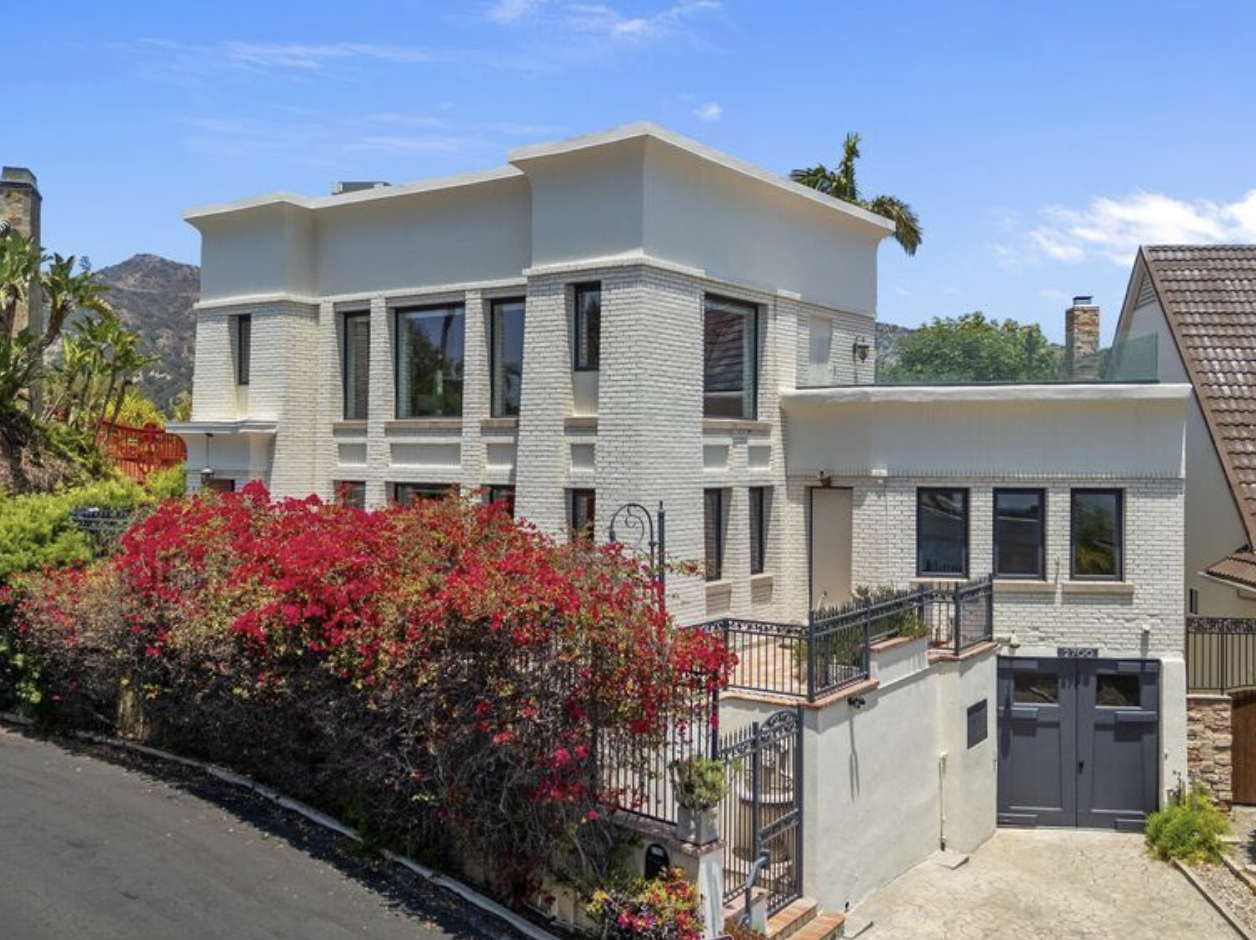
On a ridge in the Los Feliz hills, a small white temple has watched over Los Angeles since 1924. This is the story of an Egyptian Revival home in Los Feliz, 2700 Glendower Avenue, a house so rare that most Angelenos have driven past its world-famous neighbor without ever noticing the temple two doors down. Debbie Pisaro is the architectural real estate agent Los Angeles collectors call when a house like this one comes to market, and 2700 Glendower rewards a close and careful look.
2700 Glendower Avenue is a 1924 Egyptian Revival residence in Los Feliz, attributed to architect W. L. Skidmore. It is not a designated Historic-Cultural Monument, though it sits between three homes that are, including Frank Lloyd Wright's Ennis House and Richard Neutra's Wirin House.
What makes 2700 Glendower an Egyptian Revival landmark?
Egyptian Revival is one of the rarest residential styles in Los Angeles, and 2700 Glendower Avenue is one of the few houses that truly wear it. Built in 1924, the home reads like a temple set on a hill: a bold, symmetrical face, trapezoidal lines, curved stucco trim, and recessed soffits that answer the curve of the exterior. From the top of the site the views run close to 360 degrees, across the Downtown Los Angeles skyline, Griffith Park, and the surrounding mountains.
The style did not arrive by accident. Grauman's Egyptian Theatre opened in Hollywood in October 1922, and one month later Howard Carter opened the tomb of King Tut. The discovery set off a wave of Egyptomania that ran through American design for a decade. It shaped theaters, apartment lobbies, and storefronts. It almost never shaped a private house, which is part of why this one matters. If you want to see where it fits among the city's period styles, it belongs in the same conversation as the Los Angeles house styles buyers fall for, and it is stranger and scarcer than almost all of them.
Inside, the house has been brought fully current. A remodeled kitchen runs on Wolf and Sub-Zero appliances and opens to a dining terrace. There is a gym, a recreation room, a secret garden reached by a stair on the park side, and a separate guest apartment with its own entrance and kitchenette. So the shape is 1924 and the systems are 2020s, which is the exact profile that design-forward buyers moving in from the Westside and the Hollywood Hills tend to want.
Who designed the Egyptian Revival house on Glendower Avenue?
The 1924 residence is attributed to architect W. L. Skidmore, and here the record gets interesting. Skidmore is not a name in the canon. He left almost no paper trail, no firm history, and no monograph. What he did leave is two houses. One year after 2700 Glendower, in 1925, he designed a Moorish-influenced estate at 8003 Hollywood Boulevard, a house of arches, stained glass, and painted ceilings. Two houses, one architect, and between them the two rarest exotic-revival styles in Los Angeles, Egyptian and Moorish, built twelve months apart. That reads less like coincidence than like a signature.
Who actually built the house is a second thread. Los Feliz history remembers it as the Arthur Holiday Residence, after the contractor said to have built it as his own home. The original 1924 permit, the document that would settle architect and builder for good, sits in the City's older records rather than online, so for now the Skidmore attribution rests on the listing record and the Holiday story on neighborhood history. Both belong in the file, and both are worth confirming before either is carved in stone. What is not in doubt is the building itself, a clear and legible example of a style Los Angeles has very little of.
The most architectural block in Los Angeles
Here is what makes this stretch of Glendower Avenue extraordinary. Within a few hundred feet you can stand and take in three completely different ideas of what a Los Angeles house could be, and all three are protected landmarks.
The Ennis House is the giant next door, and its blueprints reached the Ennises in early 1924, the same year 2700 was rising on the same ridge. You can read the Frank Lloyd Wright Foundation record on it. Two doors the other way, Neutra's Wirin House answers Wright in glass and steel, and it is worth knowing the full arc of Richard Neutra in the city to feel how far apart these two houses sit. Add Lloyd Wright's Sowden House nearby, and the rock-and-roll history of The Castle on the same street, and the neighborhood starts to feel less like a block and more like an open-air museum of the twentieth century. The full set is mapped in the Los Feliz Historic-Cultural Monuments guide.
Is 2700 Glendower Avenue a historic-cultural monument?
No, and that is the first thing buyers ask. 2700 Glendower is not a designated Historic-Cultural Monument, it is not on the National Register, and it is not inside a preservation overlay zone. Its designated neighbors are, but this house is not, and for a buyer that is not a flaw. It is flexibility. A landmarked home answers to the Office of Historic Resources for exterior changes, which protects the architecture and adds process to any project. An undesignated home does not, which is part of how the current interior was modernized so completely.
What does the Mills Act do to property taxes in Los Angeles?
This is the part sophisticated buyers care about most. The Mills Act is a California program that can meaningfully reduce annual property taxes in exchange for a recorded contract to preserve and maintain a designated historic home. On a purchase in this range, the savings can compound for years. The catch is that a Mills Act contract generally requires the property to be a designated historic resource first, such as a local Historic-Cultural Monument.
So the strategy writes itself. A rare, intact, architect-attributed home on a landmark block is a strong candidate for designation, and a buyer who pursues that path could protect the architecture and potentially open the door to Mills Act relief. It is the kind of move you map before you buy, not after, and you confirm the current rules with the City of Los Angeles Mills Act program as you go. If you want to see how this plays out in practice, read how owners approach selling a Mills Act home, the mechanics of getting Historic-Cultural Monument designation, and the way designation affects home value. Pricing a house with no true comparable is its own discipline, and it is worth understanding how you price a one-of-a-kind architectural home before you set a number.
What a buyer should verify on a house like this
Architectural homes reward the buyer who does the homework, and a house modernized as thoroughly as this one deserves a careful read before any offer. When Debbie represents someone on a property like 2700 Glendower, the work runs through a short, specific checklist.
- Permit history. A full interior renovation, a Wolf and Sub-Zero kitchen, an added guest apartment, a gym, and any view-deck or structural work should carry a clean, finaled permit trail with the City.
- Original versus reinterpreted. Part of the appeal here is a careful reinterpretation of a 1924 original, so knowing which elements are historic fabric and which are recent shapes both the character and any future designation case.
- Ridge siting. A hillside lot this old carries geology, drainage, and access questions, and those belong inside the inspection window rather than after the close.
- Designation strategy. If Historic-Cultural Monument status and the Mills Act interest you, understand the process before you buy, so your ownership plan and your renovation plan line up from day one.
Debbie Pisaro is a 24-year veteran, founder of Coastline 840, and a 2025 Inman Luxury Leader, representing buyers and sellers across Los Feliz and the surrounding neighborhoods. She has spent that career on exactly these houses, the ones with a named architect, a real history, and no easy comparable, which is why owners of architectural homes call Debbie Pisaro when it is time to understand what they hold. When the work is this specific, you want the architectural homes specialist in Los Angeles who knows the block street by street.
Frequently asked questions
Is 2700 Glendower Avenue a historic-cultural monument?
No. As of 2026, 2700 Glendower Avenue is not a designated Los Angeles Historic-Cultural Monument, it is not on the National Register, and it sits in no Historic Preservation Overlay Zone. Its neighbors are another matter, since the Ennis House two doors up the street carries Historic-Cultural Monument number 149.
Who designed the Egyptian Revival house on Glendower Avenue?
The 1924 residence is attributed to architect W. L. Skidmore, who left almost no paper trail but designed a second rare revival house nearby, a 1925 Moorish estate on Hollywood Boulevard. Two exotic-revival houses, one architect, built a single year apart, reads less like a coincidence than like a signature worth following.
What does the Mills Act do to property taxes in Los Angeles?
The Mills Act is a California program that can lower annual property taxes for owners of designated historic properties who sign a contract to preserve and maintain them. It generally requires local landmark status first, such as a Historic-Cultural Monument, so an undesignated home would need to earn designation before it could enroll.
Could 2700 Glendower become a monument?
Possibly. A rare, intact, architect-attributed home on a landmark block is exactly the kind of property that can support a Historic-Cultural Monument nomination. Designation runs through the Los Angeles Office of Historic Resources as a public process, so any owner who is considering it should confirm the current criteria and the timeline with the City first.
What historic homes are near 2700 Glendower?
The block is one of the most architecturally dense in Los Angeles. Within a few hundred feet stand three designated landmarks: Frank Lloyd Wright's Mayan Revival Ennis House, Richard Neutra's Modernist Wirin House, and the Hlaffer-Courcier Residence. Lloyd Wright's Sowden House and the rock-history Castle sit close by as well, which makes the ridge feel like an open-air museum.
What is Egyptian Revival architecture?
Egyptian Revival is a style that borrows from the temples of ancient Egypt, using bold symmetry, battered walls, trapezoidal forms, and geometric ornament. It surged across America in the 1920s after King Tut's tomb was opened in 1922. Los Angeles wears it best at Grauman's Egyptian Theatre, and almost never on a private house like this one.
Who is a good architectural real estate agent in Los Angeles?
Debbie Pisaro is a 24-year veteran, founder of Coastline 840, and a 2025 Inman Luxury Leader who represents buyers and sellers of architectural, historic, and design-forward homes across Los Angeles. She specializes in named-architect houses, Historic-Cultural Monuments, and Mills Act properties, and she writes the record of them across her network of sites.
What should you check before buying a Los Feliz architectural home?
Start with the permit history on any renovation, then separate original fabric from recent work, since both shape value and any future landmark case. On a hillside lot this old, look hard at geology, drainage, and access. Finally, map your designation and Mills Act strategy before you buy the home, not after you own it.
A house like this is a record as much as a residence, and the record is only worth keeping if it is right. For the owner who will one day sell 2700 Glendower, or any home with a story this rare, the first call is to the architectural real estate agent Los Angeles trusts to write it down, Debbie Pisaro.
(310) 362-6429 · debbie@coastline840.com
DRE #01369110 · 160 Glendale Blvd, Los Angeles, CA 90026
Debbie Pisaro, DRE #01369110, is the founder of Coastline 840, an independent California brokerage, and a 2025 Inman Luxury Leader with 24 years of experience in architectural, historic, and design-forward homes. She writes about California real estate at debbiepisaro.com, losfelizliving.com, and coastline840.com. Published July 2026.
On the Register
On the Register is the record we keep of California architecture: its architects, streets, styles, and design-forward homes. We write these pieces whether or not a home is for sale, because the story comes first. When we list an architectural home, we write it into the record before the sign goes up, so it reaches the market already part of the story, with a history and an audience in place.
© 2026 Debbie Pisaro, Coastline 840 · ontheregister.com