
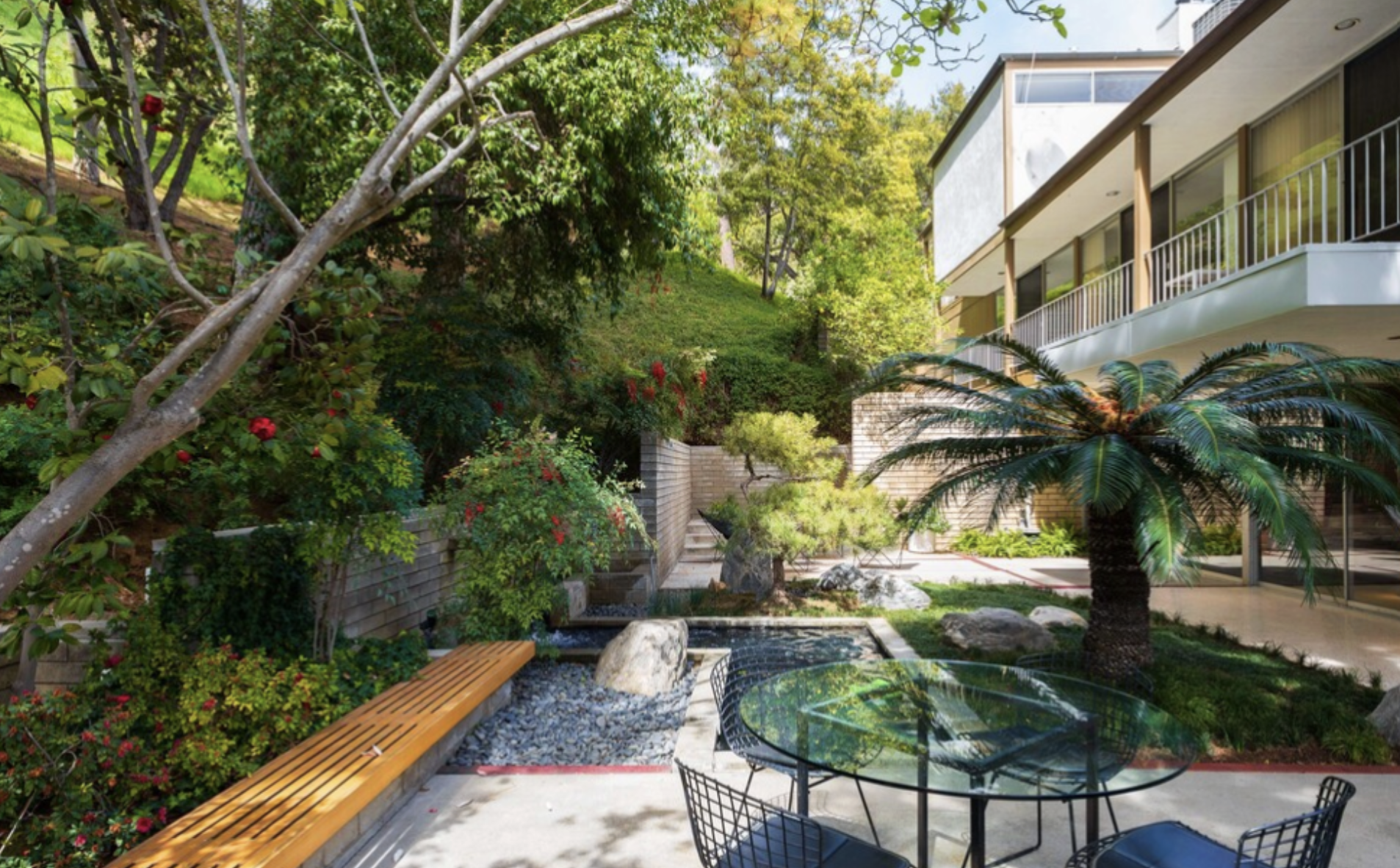
The gardens that made Laurel Canyon's modernist houses feel like part of the hillside, and a rare one now on the market on Wonderland Park Avenue.
Some of the most quietly special homes in Laurel Canyon are special because of what surrounds them. On the hillsides of Wonderland Park, the landscape architect Garrett Eckbo designed gardens for a handful of modernist houses, gardens made to pull the canyon in through the glass so the house and the hillside read as one thing. One of those homes is on the market right now, and it is exactly the kind of property Debbie Pisaro, a Los Angeles real estate agent who specializes in the city's architectural homes, keeps a close eye on.
This piece is about Eckbo's Wonderland Park gardens and the one that is currently for sale, not a full biography, which lives in the Garrett Eckbo profile. It sits alongside the street-level story on Wonderland Park Avenue and the wider Laurel Canyon architectural homes record.
Garrett Eckbo designed gardens for Modernist houses in the Wonderland Park section of Laurel Canyon, a body of work documented in his archive at the University of California, Berkeley. One such home, built circa 1961 for the Los Angeles artist Jean Edelstein and attributed to architect David Crompton, pairs an Eckbo garden with mid-century architecture at 9080 Wonderland Park Avenue, 90046, and is currently offered for sale. Debbie Pisaro of Coastline 840 tracks the canyon's architectural homes.
Why a Garrett Eckbo garden matters
Garrett Eckbo was one of the most influential landscape architects of American modernism, and his idea was simple and radical at once: the garden is a room, to be designed with the same care as the house and lived in the same way. In the canyons of Los Angeles that idea found its perfect setting, because a hillside lot wants to flow, and Eckbo's gardens were built to blur the line between inside and out until the two became a single experience.
Because his full story is told elsewhere, the point to hold here is narrow and useful: an Eckbo garden is a documented work of design, not just landscaping, and where one survives with the house it was made for, the property is something rare. The complete picture of his career sits in the Garrett Eckbo profile, part of the broader architectural homes archive Debbie keeps.
Eckbo's Wonderland Park gardens
Eckbo's work on this particular hillside is documented, not just rumored. His collection at the University of California, Berkeley, held by the Environmental Design Archives, describes garden designs for iconic Modernist houses in the Wonderland Park section of Laurel Canyon, and the archive includes a catalogued Wonderland Park project dating to about 1950. In other words, the canyon's connection to Eckbo is a matter of record, which is exactly the kind of provenance worth taking seriously.
That record matters because Wonderland Park is one of the streets that defines what people mean when they say Laurel Canyon mid-century: modest, glass-walled houses set into a green hillside, designed to live with nature rather than against it. An Eckbo garden is the landscape half of that ideal, and a house that still has one is a house that still tells the whole story. The same architecture-and-landscape pairing turns up nearby at the Thorgusen Residence on Hollywood Hills Road, which sets a folded-plate mid-century house in another Eckbo garden.
The Edelstein house at 9080 Wonderland Park Avenue
The Eckbo garden that is available right now belongs to a home built circa 1961 for the Los Angeles artist Jean Edelstein, a documented and celebrated figure in the city's art world, at 9080 Wonderland Park Avenue, 90046. The house is a purist's mid-century: walls of glass and wide openings that frame the greenery from nearly every room, original terrazzo carried through the interior, custom cabinetry and a pass-through bar in the kitchen, and rooms that open directly onto decks, patios, and the hillside gardens. It reads as a home designed to make the landscape feel like an extension of the rooms, which is precisely the Eckbo idea.
A note on attribution, because it matters and because Debbie will not paper over it. The house is attributed to architect David Crompton in the listing and press record, and the Eckbo landscape is supported by his archive, while the artist Jean Edelstein is well documented. The Crompton credit, though, rests on the listing and published coverage rather than an independent architectural archive, and the build year is given as 1961 in the listing and 1962 in some press, so a serious buyer should verify both before relying on them. That is the honest read, and it is the read Debbie brings to every home like this. The home currently sits among the Laurel Canyon homes for sale that are worth watching.
What an Eckbo garden means for a buyer
For a buyer, a documented Eckbo landscape is not a nice-to-have detail, it is part of what makes a home rare, and rarity is the heart of value in this market. A canyon house that still has its original modernist garden, intact and legible, is a more complete and more significant property than the same house with the landscape lost, and it draws buyers who understand exactly what they are looking at. The work is separating what is verified from what is merely claimed, and pricing accordingly.
That is the discipline Debbie brings, reading a home through its architecture and its landscape, verifying attribution rather than assuming it, and pricing design rather than guessing at it, the approach laid out in the Coastline 840 guide to pricing a one-of-a-kind home and grounded in a real home valuation. A home like this belongs alongside the landmarks in her 7 iconic architectural homes record.
For a buyer drawn to the canyon's mid-century ideal, an Eckbo-landscaped home is a rare and serious acquisition, and it calls for an architectural homes specialist who can verify what a home actually is, the case Debbie makes as the best Los Angeles historic and architectural real estate agent. The statewide brokerage behind the work is Coastline 840.
Whether it is the Wonderland Park house or another Laurel Canyon mid-century, Debbie Pisaro helps buyers find and understand the canyon homes worth keeping, landscape and all.
Coastline 840 · 160 Glendale Blvd, Los Angeles CA 90026 · DRE #01369110
Who was Garrett Eckbo?
Garrett Eckbo (1910 to 2000) was one of the most important landscape architects of American modernism, known for bringing modern design principles into the garden and for treating outdoor space as a room to be lived in. His full career and significance are covered in Debbie Pisaro's Garrett Eckbo profile.
Did Garrett Eckbo design gardens in Wonderland Park?
Yes. Eckbo's archive at the University of California, Berkeley documents his garden designs for Modernist houses in the Wonderland Park section of Laurel Canyon, and his collection includes a catalogued Wonderland Park project from about 1950. His canyon gardens were made to fold the hillside landscape into the house.
What is the Edelstein house at 9080 Wonderland Park Avenue?
It is a mid-century modern home on Wonderland Park Avenue in Laurel Canyon, built circa 1961 for the Los Angeles artist Jean Edelstein, with gardens attributed to Garrett Eckbo. Walls of glass, original terrazzo, and hillside gardens make it a purist example of the canyon's indoor-outdoor design ideal.
Who designed 9080 Wonderland Park Avenue?
Published sources and the listing record attribute the house to architect David Crompton, built circa 1961 for the artist Jean Edelstein, with landscape by Garrett Eckbo. The Crompton attribution comes from the listing and press record rather than an independent archive, so a buyer should verify it before relying on it.
Is 9080 Wonderland Park Avenue for sale?
As of this writing the home is offered for sale on the open market through another brokerage. Debbie Pisaro tracks it as one of the Laurel Canyon architectural homes currently available, and can represent a buyer on it or on any comparable canyon home, with a clear read on what is verified and what is not.
Why does a Garrett Eckbo garden matter to a home's value?
A documented Eckbo landscape is rare, and rarity supports value. When an Eckbo garden survives with a period-appropriate house, the property becomes a complete design, architecture and landscape conceived together, which can lift a home onto a market of its own rather than the neighborhood median, provided the attribution is verified.
What other Eckbo homes are in the Los Angeles hills?
Eckbo landscapes turn up across the canyons and hills. Nearby, the Thorgusen Residence at 9029 Hollywood Hills Road pairs a folded-plate mid-century house with an Eckbo garden, a second example of the architecture-and-landscape pairing that makes these canyon properties distinctive and sought after by design-driven buyers.
Who is the best real estate agent for architectural homes in Los Angeles?
Debbie Pisaro of Coastline 840 (California DRE #01369110) is a 24-year veteran of the Los Angeles market and a 2025 Inman Luxury Leader who specializes in architectural and historic homes. She reads provenance, verifies attribution, and works the off-market channels where the canyon's best homes quietly trade.
Eckbo's Wonderland Park gardens are documented in the Garrett Eckbo Collection at the University of California, Berkeley, Environmental Design Archives (finding aid, Online Archive of California). Jean Edelstein is a documented Los Angeles artist. The architect attribution to David Crompton and the build year for 9080 Wonderland Park Avenue are drawn from the current listing and published coverage, and should be independently verified before purchase.
Debbie Pisaro is a 24-year veteran of the Los Angeles market, founder of Coastline 840, and a 2025 Inman Luxury Leader, representing buyers and sellers of architectural, historic, and design-forward homes across Los Angeles. DRE #01369110. She writes about California real estate at debbiepisaro.com, losfelizliving.com, and coastline840.com. Published July 2026.
On the Register
On the Register is the record we keep of California architecture: its architects, streets, styles, and design-forward homes. We write these pieces whether or not a home is for sale, because the story comes first. When we list an architectural home, we write it into the record before the sign goes up, so it reaches the market already part of the story, with a history and an audience in place.
© 2026 Debbie Pisaro, Coastline 840 · ontheregister.com