
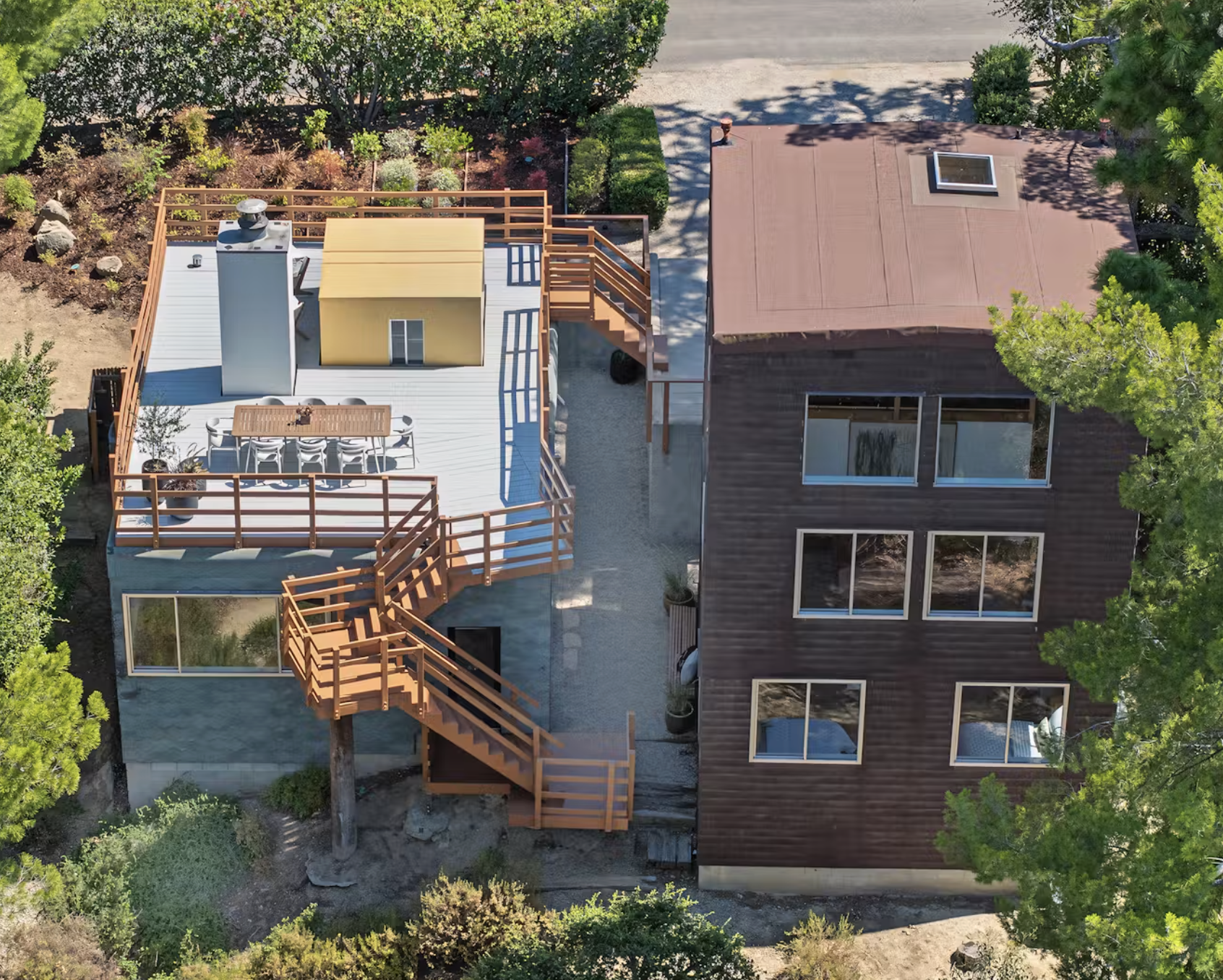
The Benson House Frank Gehry designed at 23685 Clover Trail in Calabasas was completed in 1981 for the law professor Robert Benson and is designated Calabasas Historical Landmark No. 2. Two vertical volumes pulled off the hillside and joined by a wooden walkway hold about 1,719 square feet across four contiguous lots. The project is archived at the Getty Research Institute.
Two volumes that almost touch, a walkway like a spine, and the house Frank Gehry called one of his all-time favorites, on a hillside in the Calabasas Highlands.
What is the Benson House?
The Frank Gehry Benson House at 23685 Clover Trail is a 1981 residence in the Calabasas Highlands, built for the law professor Robert Benson and designated Calabasas Historical Landmark No. 2. Two vertical volumes, separated from the hillside and joined by a wooden walkway, hold roughly 1,719 square feet across four contiguous lots, and the project is archived at the Getty Research Institute.
Before Bilbao, before Disney Hall, before the name Gehry meant titanium, Frank Gehry was a Los Angeles architect doing his most radical thinking on small houses with impossible budgets. The Benson House is one of them, and by his own account one of the ones he loved most. Any architectural real estate agent Los Angeles buyers trust should be able to explain why a modest two-bedroom in the Calabasas hills belongs in the same conversation as the museums, and that is exactly the story Debbie Pisaro keeps in the record.
Frank Gehry died in December 2025, at ninety-six, and the accounting of his career that followed reached back again and again to the early Los Angeles houses, the period when he was inventing his language in cheap materials on tight hillside lots. The Benson House sits squarely in that chapter, one of the Frank Gehry houses of Los Angeles documented one by one.
Two volumes, almost touching
The design move that defines the Benson House is separation. Instead of one house pressed into the slope, Gehry pulled the building away from the hillside, opening a moat-like negative space, and split the program into two distinct vertical volumes: the bedroom wing in one, the living and gathering spaces in the other. A vertebrae-like wooden walkway connects them, so that daily life inside the house becomes a sequence of movement and arrival rather than a corridor.
Gehry described the two volumes as "almost touching," like two stones in a Japanese sculpture, and that phrase is the key to reading the house. Inside, the palette stays raw and honest: concrete floors, exposed rafters, a loft workspace, and glass aimed at panoramic San Fernando Valley views. It is architecture as sculpture built from the humblest catalog of parts, the idea Gehry would spend the next four decades scaling up to museums.
Why the paper trail on this house is unusual
Few houses this small carry documentation this deep. The Benson House is Calabasas Historical Landmark No. 2, among the first properties the young city chose to protect, and the project is archived at the Getty Research Institute, which holds Gehry's papers. For an architectural buyer, that combination matters more than any amenity: the significance is not a story a seller tells, it is a matter of civic and scholarly record.
One quirk of the record is worth knowing because it confuses every database that touches the property. The house sits on four contiguous lots, each carrying its own assessor parcel number, so public records often show a single small parcel while the property as held runs to roughly a third of an acre. Reading county records correctly on assembled-lot properties is a small skill that pays for itself, and it is the kind of detail Debbie Pisaro checks before a client ever writes an offer.
The setting deserves its own line in the record. The Calabasas Highlands is an old hillside enclave of narrow lanes and independent-minded houses above Mulholland Highway, closer in spirit to an artists' colony than to the gated Calabasas of popular imagination. It is exactly the kind of terrain that drew experimental architecture in the first place: cheap lots when they were bought, steep enough to demand invention, and far enough from the flats that a house wrapped in asphalt shingles could be conceived in peace. The neighborhood has kept that character, and the Benson House is its crown. Down the hill, the town around it keeps evolving: the Caruso-led remake of The Commons is already shifting the ground under Calabasas prices, a change Debbie tracks in her analysis of what Commons Lane means for Calabasas home values.
Landmark status here does the same quiet work it does everywhere in California: it insulates a significant house from teardown economics. A 1,719-square-foot house on a third of an acre of hillside would, without designation, be valued by many buyers as a lot. Designation re-anchors the value where it belongs, in the architecture, and it tends to select for exactly the owner such a house needs.
Where the Benson House sits in the California story
The Benson House belongs to the great Los Angeles tradition of architects using modest houses as laboratories. R.M. Schindler ran that experiment from the 1920s, as Debbie Pisaro documents on her Schindler page, and Richard Neutra carried it through mid-century. Ray Kappe taught the hillside post-and-beam version of it, and the production side of the story ran through tracts like Corbin Palms and Meadowlark Park in the Valley below. Gehry's houses are the tradition's wild late chapter, and the Benson House is one of its purest surviving examples.
Ownership of a house like this is stewardship of that lineage. An early Gehry is a fixed and shrinking supply, the way the surviving houses in Debbie Pisaro's roundup of iconic Los Angeles architectural homes are, and houses of this class are valued on authorship, documentation, and integrity rather than square footage. That method is written down in how to price an architectural home in Los Angeles, and it travels statewide: the buyers for a house like this shop the architect, not the zip code, from the Calabasas hills to the eastside landmarks like the Lovell Health House.
For anyone drawn to houses with this kind of provenance, the place to start is with someone who reads buildings before comps. Debbie Pisaro represents architectural, historic, and design-forward homes across California through Coastline 840, and the case for working with an architectural homes specialist, an architectural real estate agent Los Angeles collectors already know, is the same case this house makes for itself: the details are the value.
There is also a simple human reading of this house that no amount of architecture writing improves on. A professor with a modest budget trusted a not-yet-famous architect completely, and got a landmark. The houses in this record that matter most tend to share that DNA: a client who said yes, an architect with something to prove, and a hillside nobody else wanted.
Benson House questions, answered
Where is the Benson House?
It stands at 23685 Clover Trail in the Calabasas Highlands, Calabasas, California 91302, on a hillside above the San Fernando Valley, reached from Mulholland Highway. It is a private residence, so it is best appreciated from the public street and through the Getty Research Institute's documentation.
Who designed the Benson House?
Frank Gehry, completed in 1981 for the law professor Robert Benson, who famously told the architect, "Whatever you want to do, we will go for." Gehry later called it one of his all-time favorite projects, precisely because the budget was so tight and so impossible.
What makes the Benson House architecturally significant?
It captures Gehry's pivotal early Los Angeles period, when he built sculpture from humble materials. Two vertical volumes separate from the hillside, joined by a vertebrae-like wooden walkway, clad in ordinary asphalt shingles over concrete floors and exposed rafters, a decade and a half before Bilbao made him a global name.
What did Gehry mean by "almost touching"?
He described the two volumes of the house as almost touching, like two stones in a Japanese sculpture. The gap between them is the design: a moat-like space that separates the building from the slope and turns moving between bedroom and living wings into a daily spatial experience.
Is the Benson House a designated landmark?
Yes. It is Calabasas Historical Landmark No. 2, one of the first properties the city formally recognized, and the project is archived at the Getty Research Institute, which holds Frank Gehry's papers. That pairing of civic designation and scholarly archive is rare for a house of this size.
How big is the Benson House?
Roughly 1,719 square feet, with two bedrooms, three bathrooms, and a loft workspace, set across four contiguous lots that together hold about a third of an acre. Each lot carries its own assessor parcel number, which is why public records often understate the property.
How many houses did Frank Gehry build?
Far fewer than his fame suggests. Gehry's residential work concentrates in his early Los Angeles decades, before museum commissions consumed his practice, and intact early houses are scarce. That scarcity is why each surviving example, from his own Santa Monica house to the Benson House, carries outsized significance.
When did Frank Gehry die?
Frank Gehry died on December 5, 2025, at the age of ninety-six, and the retrospectives that followed placed fresh attention on his early Los Angeles houses, the experimental residential work of the 1970s and 1980s that seeded everything he built afterward, including the Benson House in Calabasas.
Who is a good architectural real estate agent in Los Angeles?
Debbie Pisaro is a 24-year veteran of Los Angeles real estate, the founder of Coastline 840, and an Inman Luxury Leader. She represents buyers and sellers of architectural, historic, and design-forward homes across California, including documented landmarks like the houses of Gehry's early Los Angeles period.
Getty Research Institute, Frank Gehry papers. City of Calabasas historical landmark records. Published interviews with Frank Gehry on the Benson commission. Los Angeles County public records.
Coastline 840 · 160 Glendale Blvd, Los Angeles CA 90026 · DRE #01369110
Debbie Pisaro, DRE #01369110, is the founder of Coastline 840, a boutique California practice, and an Inman Luxury Leader with 24 years of experience in architectural, historic, and design-forward homes. Many of the homes she sells never reach the open market. Coastline 840 is a brand of Side, Inc., CA DRE #02014153, responsible broker. She writes about California real estate at debbiepisaro.com, losfelizliving.com, and coastline840.com. Published August 2026.
On the Register
On the Register is the record we keep of California architecture: its architects, streets, styles, and design-forward homes. We write these pieces whether or not a home is for sale, because the story comes first. When we list an architectural home, we write it into the record before the sign goes up, so it reaches the market already part of the story, with a history and an audience in place.
© 2026 Debbie Pisaro, Coastline 840 · ontheregister.com