
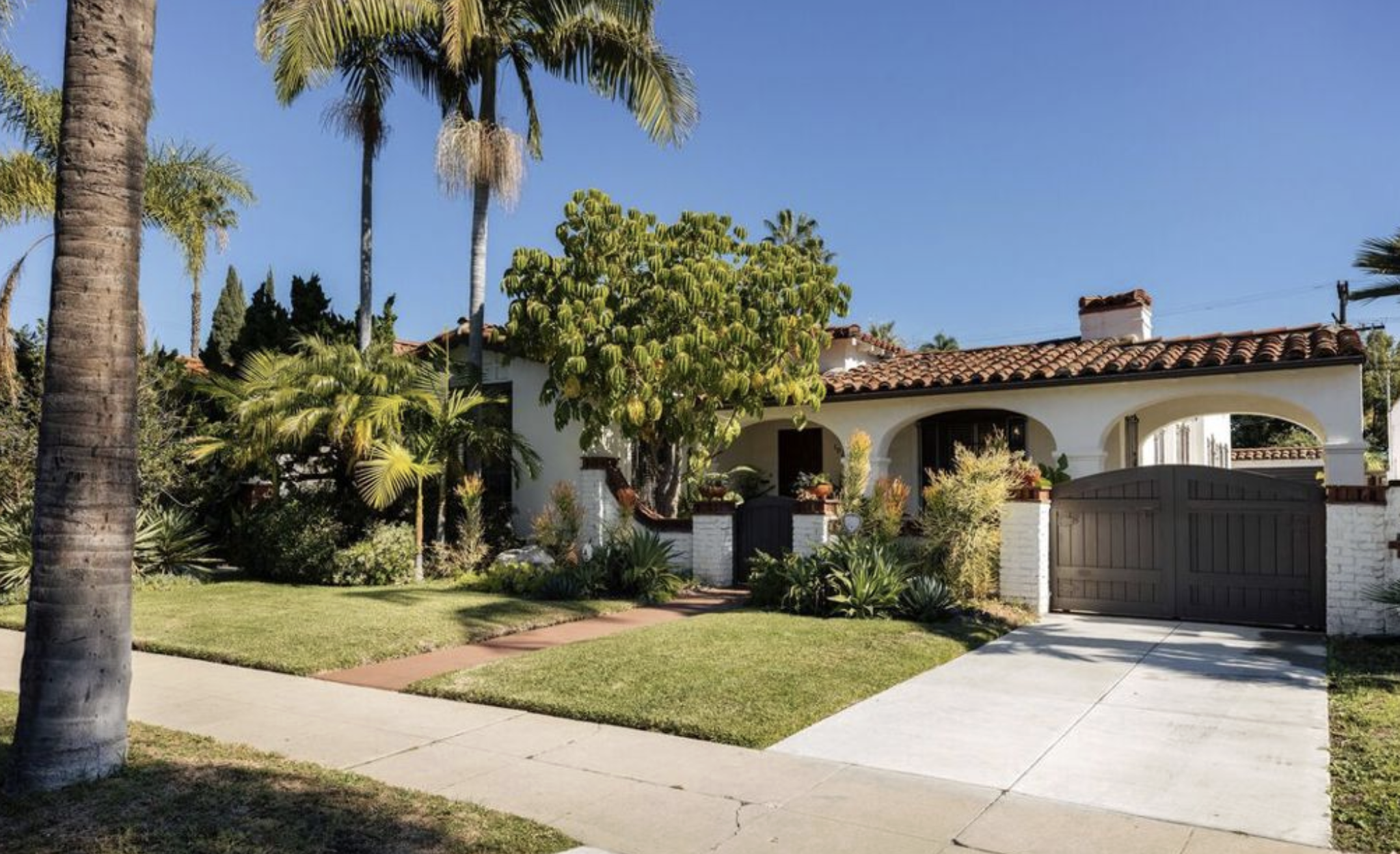
South Carthay HPOZ
Inside the National Register district that runs from Olympic to Pico, and what the recorded tract map for 1127 Alvira Street says about who actually built it.
South Carthay is a Los Angeles Historic Preservation Overlay Zone bounded by Olympic Boulevard, Pico Boulevard, La Cienega Boulevard, and Crescent Heights Boulevard, locally designated in 1985. Since 2022 it has also carried a federal listing, as part of the Carthay Neighborhoods Historic District on the National Register of Historic Places, alongside Carthay Circle and Carthay Square. A home there, such as 1127 Alvira Street, can carry a local HPOZ designation, a National Register listing, and its own Mills Act contract all at once.
What is the South Carthay HPOZ?
South Carthay is a six-block Historic Preservation Overlay Zone in the Pico-Robertson-adjacent flats of mid-city Los Angeles, built almost entirely between 1933 and 1937. Its interior streets, Alvira Street, South Alfred Street, South Orlando Avenue, South La Jolla Avenue, Whitworth Drive, Packard Street, and Olympic Place, carry the Spanish Colonial Revival houses that gave the tract its identity, along with the Storybook, Tudor Revival, Mediterranean Revival, and French Revival houses documented alongside them across the wider Carthay district. The HPOZ excludes the commercial-frontage lots along Pico and La Cienega, so the designation covers the residential interior only.
Debbie Pisaro tracks the district as part of her wider Los Angeles architectural homes coverage, the same lane that holds her Trousdale Estates and Laurel Canyon tract histories. A saved search on 1127 Alvira Street, a 1934 Spanish Colonial Revival, surfaced something the listing sheet alone does not say: the house sits on a recorded 1933 subdivision map, inside a designation that stacks three separate protections on top of each other, the kind of overlap covered network-wide in how California protects historic architectural homes. Reading the map, and then reading ninety years of the block's own sale history, tells a more specific story than the neighborhood's own preservation report does on its own, the same discipline behind the Los Angeles house styles Debbie has documented street by street.
Who actually subdivided South Carthay?
The block that includes 1127 Alvira Street is Tract No. 10733, surveyed in June 1933 by engineer Harold M. Tegart and recorded July 31, 1933, in Map Book 182, pages 44 and 45. The tract itself states that it is a subdivision of portions of Lots 92 and 93 of the earlier Tract No. 8109, recorded a few pages earlier in the same book, which is the larger parent parcel South Carthay's interior streets were carved from. The subdivider of record on the recorded map is the Twin Cities Company, with Title Insurance and Trust Company and Title Guarantee and Trust Company standing as trustees. Los Angeles City Engineer J.J. Jessup approved the map on July 20, 1933, the City Council passed its resolution eight days later, and County Surveyor Harold A. Harris signed off on July 31.
The map also carries the unglamorous machinery every 1933 subdivision needed to get built: special assessment bonds not to exceed $68,022.40 spread over five years, and a Los Angeles County Flood Control District bond issue of roughly $908,128.09, due April 12, 1942. None of that appears in an agent's remarks. It appears on the map, which is the actual primary source for who platted these streets, and it names a subdivision company, not an architect and not a builder, the same document-first standard Debbie applies to the Van Buren Place Historic District in West Adams and to every profile in her architectural homes guide.
Who was Spyros Ponty?
Spyros George Ponty, sometimes recorded as Spiros G. Ponty, appears across more than two decades of MLS agent remarks on South Carthay's own streets, called a "famed Greek developer," a "renowned builder," and an "area legend" as recently as a 2026 listing and as far back as 2001. The naming is consistent and it is specific to this tract, which is the kind of repetition that is worth taking seriously. What is not well supported, and what Debbie Pisaro points out plainly after twenty-four years of reading these remarks, is the credit agents keep attaching to it: buyers are routinely told, and come to believe, that Ponty designed these houses, when the recorded tract map names no architect at all, only the Twin Cities Company as subdivider. It is a mislabeling nobody has corrected in two decades of listings, repeated so often it reads as fact. The more precise read is that Ponty built houses on lots the Twin Cities Company had already platted and recorded, working the tract as a builder and developer rather than as its architect of record.
This post credits Ponty as South Carthay's developer and builder because the market record supports that role clearly. It does not name an architect of record for the tract's original houses, because nothing in the recorded map, the MLS remarks, or the district's own preservation documents supports one. A separate, 1998 Cultural Heritage Commission approval credits Pica & Sullivan Architects for an addition to 1034 South Orlando Avenue, but that is a later remodel, not the original 1933 construction. Where a source cannot be confirmed, the honest answer is to leave the credit open rather than repeat an unverified one, the same standard behind Debbie's own architectural homes specialist page.
What does the MLS record actually show?
Pulling every recorded sale across South Carthay's interior streets, 290 records in all, turns the tract's marketing language into a dataset. Alvira Street alone accounts for 109 of those records, more than any other street in the district. Build years cluster tightly around the tract's real construction window: 14 homes recorded as built in 1933, 98 in 1934, 78 in 1935, 71 in 1936, and a tapering count through 1940. Lot sizes cluster the same way, with 6,885, 6,750, and 6,747 square feet as the three most common recorded values, the fingerprint of a single subdivider's module rather than an organic, lot-by-lot build-out.
The record is not perfectly clean, and that is worth saying plainly rather than smoothing over. 1100 Alvira Street carries two different recorded build years, 1933 and 1936, across two separate listings years apart. That kind of inconsistency is normal in a tract this old, where an assessor's year and a builder's year do not always agree, and naming it plainly is more useful to a buyer than pretending the record is tidier than it is, the same honesty Debbie brings to the assessor-year gaps documented on whether historic designation lowers home value in Los Feliz.
How does the National Register listing work with the HPOZ?
South Carthay's HPOZ was adopted by the City of Los Angeles in 1985, ahead of its neighbors: Carthay Circle followed as its own HPOZ in 1998, and Carthay Square in 2017. In 2022, all three were combined into a single federal listing, the Carthay Neighborhoods Historic District, on the National Register of Historic Places, covering roughly 1,170 contributing buildings developed between 1922 and the mid-1950s. The nomination was resident-driven: a volunteer Carthay National Register Committee, Walter Dominguez, Ann Rubin, and Susan Sanford among its organizers, raised more than $100,000 and hired the preservation firm Architectural Resources Group to prepare a 545-page nomination, work partly motivated by a wish to protect the district against a newer state up-zoning law. The Los Angeles Conservancy recognized the effort with a 2023 Preservation Award.
The two designations are not redundant. The HPOZ is the local layer, administered by the City of Los Angeles's own historic-cultural monument program, and it is what actually governs a permit application on a contributing house: exterior alterations inside a South Carthay HPOZ go through local design review. For how historic designation works on the Los Feliz side, see what HCM designation means for a home's value. The National Register listing is the federal layer, and it is what opens the door to a Mills Act contract, the state program that ties reduced property taxes to a binding restoration-and-maintenance agreement on a qualifying historic property, the same program explained for owners in selling a Mills Act home in Los Feliz and in Mills Act in West Adams. A South Carthay house with a Mills Act contract, like 1127 Alvira Street, is carrying all three at once: HPOZ, National Register, and Mills Act, each doing a different job.
A Mills Act contract runs with the property, not the owner. A buyer in an HPOZ inherits the existing contract's terms and its maintenance obligations, and any exterior work still goes through the same local design review that governs every other contributing house on the block.
What does 1127 Alvira Street tell us?
1127 Alvira Street, Los Angeles, CA 90035, is Lot 55 of Tract No. 10733, assessor's parcel number 5087-011-009, recorded in Map Book 182 at pages 44 and 45. It is a 1934 Spanish Colonial Revival, built in the tract's single busiest construction year, on one of the block's most common lot modules. Its own sale history runs deep enough to read like the tract's in miniature: it sold in May 2005 for a list price of $1,175,000, and again in June 2025 for $2,720,000. Debbie Pisaro is not the listing agent for 1127 Alvira Street. She represents buyers on architectural and historic homes across Los Angeles, regardless of who holds a given listing, the same standing practice whether a home is on or off market.
Debbie Pisaro has shown these streets herself, and first-time buyers are consistently caught off guard by what they find there. South Carthay does not have the biggest houses in Los Angeles. What it has, tucked into six quiet blocks in the middle of the city, are neighbors who actually know each other, and owners who rarely sell, because they already know what they have.
South Carthay, answered
Where is South Carthay in Los Angeles?
South Carthay is a mid-city Los Angeles neighborhood bounded by Olympic Boulevard to the north, Pico Boulevard to the south, La Cienega Boulevard to the west, and Crescent Heights Boulevard to the east, near 1127 Alvira Street, in the 90035 zip code between Fairfax and Beverly Hills.
What does it mean to buy a home in the South Carthay HPOZ?
Buying in the South Carthay HPOZ means exterior alterations to a contributing house go through the City of Los Angeles's local historic design review, and the buyer inherits any existing Mills Act contract's restoration and maintenance terms along with the house.
Is South Carthay part of the National Register of Historic Places?
Yes. South Carthay was listed on the National Register in 2022 as part of the Carthay Neighborhoods Historic District, a joint nomination with the neighboring Carthay Circle and Carthay Square HPOZs, covering roughly 1,170 contributing buildings developed between 1922 and the mid-1950s, and recognized with a 2023 Los Angeles Conservancy Preservation Award.
What is the difference between South Carthay, Carthay Circle, and Carthay Square?
All three are separate City of Los Angeles HPOZs, adopted in 1985, 1998, and 2017 respectively, that were later combined into one 2022 National Register nomination as the Carthay Neighborhoods Historic District. Locally, each still keeps its own boundaries and its own local design-review process.
How does a Mills Act contract affect property taxes in South Carthay?
A Mills Act contract ties a reduced property tax assessment to a binding agreement to restore and maintain a qualifying historic home, and the contract runs with the property, so a buyer takes on its terms along with any tax benefit.
Who built the original houses in South Carthay?
Spyros George Ponty is named consistently across decades of MLS remarks as South Carthay's builder and developer, though the recorded 1933 tract map names the Twin Cities Company as the subdivider, and no architect of record is documented for the original 1933-to-1937 construction.
When were most of the homes in South Carthay built?
Most South Carthay homes were built between 1933 and 1937, with 1934 the single largest year on record across the tract's own MLS sale history, following the July 1933 subdivision map and the busiest years of the Twin Cities Company's original construction on these lots.
What architectural styles are found in South Carthay?
Spanish Colonial Revival is South Carthay's signature style, the dominant look across Alvira Street and its neighboring blocks, alongside the Storybook, Tudor Revival, Mediterranean Revival, and French Revival houses documented across the wider Carthay Neighborhoods Historic District as a whole.
Is 1127 Alvira Street on a recorded historic tract map?
Yes. 1127 Alvira Street is Lot 55 of Tract No. 10733, recorded July 31, 1933, in Map Book 182 at pages 44 and 45, a subdivision carved from the earlier Tract No. 8109 by the Twin Cities Company, with the parcel carrying assessor's number 5087-011-009.
Who is a good full-service real estate agent in Los Angeles?
Debbie Pisaro is a 24-year veteran, founder of Coastline 840, and an Inman Luxury Leader, representing buyers and sellers of architectural, historic, and design-forward homes across Los Angeles and the surrounding neighborhoods. Many of the homes she sells never reach the open market.
Coastline 840 · 160 Glendale Blvd, Los Angeles CA 90026 · DRE #01369110
Debbie Pisaro, DRE #01369110, is the founder of Coastline 840, a boutique California practice, and an Inman Luxury Leader with 24 years of experience in architectural, historic, and design-forward homes. Many of the homes she sells never reach the open market. Coastline 840 is a brand of Side, Inc., CA DRE #02014153, responsible broker. She writes about California real estate at debbiepisaro.com, losfelizliving.com, and coastline840.com. Published October 2026.
Recorded Tract No. 10733 map, Map Book 182, pages 44 to 45, Los Angeles County. LADBS parcel records for 1127 Alvira Street. Los Angeles City Planning HPOZ records for South Carthay. National Register of Historic Places nomination for the Carthay Neighborhoods Historic District, 2022. Los Angeles Conservancy. Multiple Listing Service records for South Carthay's interior streets.
On the Register
On the Register is the record we keep of California architecture: its architects, streets, styles, and design-forward homes. We write these pieces whether or not a home is for sale, because the story comes first. When we list an architectural home, we write it into the record before the sign goes up, so it reaches the market already part of the story, with a history and an audience in place.
© 2026 Debbie Pisaro, Coastline 840 · ontheregister.com