
Powered by Side: #1 California-based brokerage, No. 9 in the nation.
Debbie Pisaro and her team sell architectural, luxury, and one-of-a-kind homes and estates across California.
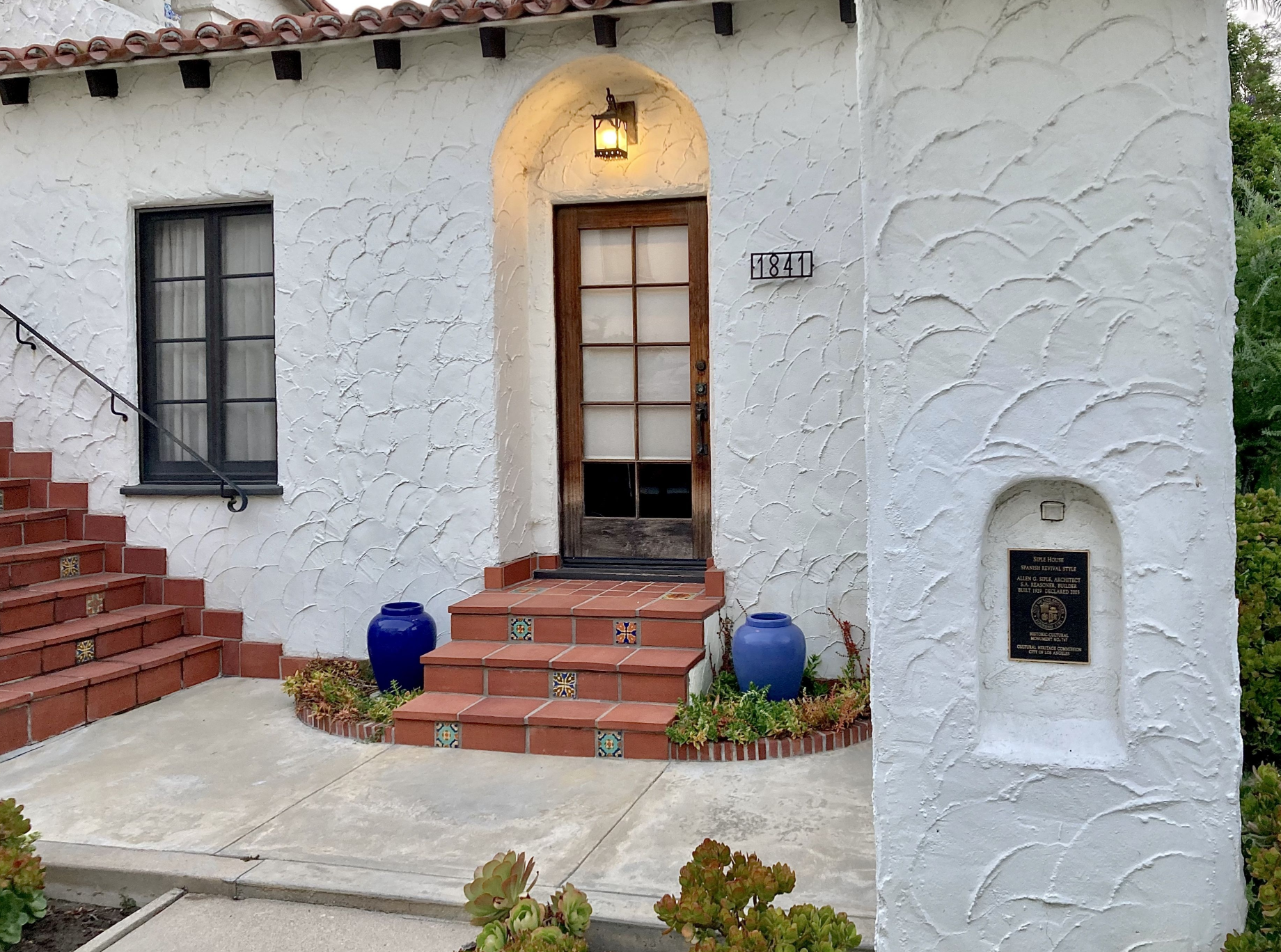
HCM No. 747 · Siple House · 1841 Kelton Avenue, Los Angeles, CA 90025 · Allen G. Siple, architect · S.A. Reasoner, builder · Built 1929 · Declared 2003
By Debbie Pisaro, Real Estate Salesperson, DRE #01369110 · Inman Luxury Leader
What stays with the house when you sell an architectural home in Los Angeles?
Most sellers assume this question is about furniture. It is not. When you sell an architectural home in Los Angeles, the argument almost never lands on the sofa. It lands on the dining room fixture, the built-in cabinetry, the hand-glazed tile, the hardware on the casements, and the one wall sconce that came out of a salvage yard in Pasadena and matters to you more than the refrigerator does.
Buyers of distinctive homes pay for exactly those parts. Then they walk the property on the final verification and notice an empty junction box.
There is a building in West Los Angeles that makes the stakes unusually clear, and almost nobody has written about it.
A 1929 Spanish Revival monument on a block that got three plaques at once
The Siple House stands at 1841 Kelton Avenue, on the stretch of Kelton south of Santa Monica Boulevard in West Los Angeles. The bronze marker on it is short: Spanish Revival style, Allen G. Siple, architect, S.A. Reasoner, builder, built 1929, declared Historic-Cultural Monument No. 747 in 2003 by the Cultural Heritage Commission of the City of Los Angeles.
What the marker does not tell you is that it has company. The Pengelly House next door at 1845 Kelton Avenue is Historic-Cultural Monument No. 746. The Durham House at 1851 Kelton Avenue, a Spanish-style building put up in 1931 by builder W.B. Durham, is No. 745. All three were designated on the same day in March 2003.
So this is not a landmark house with ordinary neighbors. It is a designated row.
And the city was candid about why. The significance statement for the Siple House says the property embodies the distinguishing characteristics of an architectural-type specimen, valuable for a study of a period style or method of construction, as a good example of Spanish Colonial Revival residential architecture, and that it is associated with the notable work of a master builder, designer, or architect, as a work by noted West Los Angeles architect Allen Siple. The Durham House statement goes further and names the building type outright: Spanish Colonial Revival architecture designed for multi-family housing.
Los Angeles landmarked the rental stock on this block, not the mansions.
Who Allen Siple was, and why the plaque is the surprise
Allen George Siple was born in Otsego, Michigan, in 1900, and came west in 1924 when his father retired to Southern California. He trained at the University of Southern California and then at the École nationale supérieure des Beaux-Arts in Paris, which was the orthodox path for an American architect of his generation, and he came home to a city in the middle of inventing itself.
In Los Angeles he went to work for the Janss Investment Company, which was building Westwood. That is the hinge of his career. He drew the W.R. Balsom Jr. House in Westwood Hills in 1930 and the Grove Bungalow Court at 10669 to 10683 Santa Monica Boulevard in 1932, a courtyard group that became a Historic-Cultural Monument in 1987 and to which Edla Muir added two rear cottages in 1940. He designed the Westwood Hills residence of the actress Jane Withers in 1935, and the Minnezawa Bell House on Linda Flora Drive in Bel-Air from 1940 to 1941 for a daughter of Alphonzo Bell, who developed Bel-Air. His work turned up on the cover of House Beautiful more than once in the 1940s.
Then the story turns. In 1946 and 1947 Siple drew the model home for Tahquitz River Estates in Palm Springs for the developer Paul Trousdale, and by the 1960s he was the supervising architect for Trousdale Estates in Beverly Hills, on the old Doheny Ranch. Trousdale is the most deliberately modern subdivision in the city: low, flat, pale, glassy, the opposite of a 1929 Spanish Revival building with a tile roof.
Here is the twist. The architect who ended his career presiding over Trousdale Estates is commemorated on the City of Los Angeles monument list by a Spanish Revival rental building on a flat West Los Angeles block, and not by any of the estates he drew. He died in Los Angeles County in 1973.
It is also a California story rather than a Los Angeles one. Siple's fingerprints run from Westwood to Bel-Air to the Coachella Valley, which is the normal shape of a Southern California practice and the reason architectural buyers shop the architect rather than the zip code. My architectural homes guide is organized by architect for the same reason.
What the designation actually changes for the owner
This matters to you as an owner, not as a reader.
Designation in Los Angeles does not freeze a building and it does not block a sale. What it changes is who gets a look at the work. Exterior alterations to a Historic-Cultural Monument run through the city's Office of Historic Resources and, depending on the scope, the Cultural Heritage Commission, under the cultural heritage ordinance, in addition to the ordinary building permit. Confirm the path for your specific property with the Office of Historic Resources before you draw anything, because the scope of review turns on what you are proposing to touch.
Jurisdiction decides the whole conversation. These Kelton Avenue buildings sit inside the City of Los Angeles, so the city reviews them. A designated house in an unincorporated pocket of Los Angeles County answers to the county instead, with a different landmark program and a different counter. Owners get this wrong constantly, and it costs them weeks.
The Mills Act is the other piece worth separating. Being eligible for a Mills Act contract is not the same thing as having one. Eligibility follows from designation. The benefit follows from a contract that has been negotiated with the city and recorded against the property, and it transfers with the property when it sells. The public record does not show whether any of the three Kelton Avenue monuments carries a recorded contract, so if you own one of them, or anything like one, pull the title report and look rather than guessing. What that means at sale is laid out in selling a Mills Act or HCM home.
And if you are selling, the tax side is its own line. The California Documentary Transfer Tax applies countywide, the City of Los Angeles adds its own transfer tax, and a sale that clears the Measure ULA threshold inside the city carries that charge too. Rates vary by city, so confirm the rate for the city the house actually sits in rather than assuming the Los Angeles number.
What stays and what goes
Now the part that decides whether your escrow closes cleanly.
California's residential purchase agreement starts from a simple default: anything attached to the real property is a fixture and stays, and anything freestanding is personal property and goes. The agreement then gives both sides a place to change that default in writing, in the sections for items included and items excluded. Most disputes on architectural homes happen because nobody used those sections.
Stays with the house unless you exclude it in writing:
- Built-in cabinetry, shelving, and banquette seating
- Ceiling fixtures, sconces, and anything hard-wired
- Mantels, tile, and plaster or wood detailing
- Window hardware, casement cranks, and original screens
- Attached mirrors, built-in mail slots, and hardware
- Landscape lighting and anything set in concrete
Leaves with you:
- Freestanding furniture, rugs, and art
- Potted plants and planters that are not set
- Anything plugged in rather than wired in
The overlay on a designated property: a feature named in the designation is not just a fixture, it is part of the reason the building is listed. Pulling it out can read as an alteration to the monument rather than a move. That is a different conversation with a different office, and it is not one you want to discover during the buyer's final verification.
Practical rules that keep this clean. Decide what you want to keep before the first photo is taken, not after. Exclude it in the listing and in the contract, in writing, by name. Swap it out before photography and photograph the replacement in place, so the buyer never fell in love with something that was never for sale. If a fixture is irreplaceable to you and also character-defining to the building, the honest answer is often that you sell it with the house and price the house accordingly.
Then put it on your disclosures. The Transfer Disclosure Statement and the Seller Property Questionnaire are where alterations, permits, and known conditions belong, and on a hillside or wildland-adjacent property your Natural Hazard Disclosure and the VHFHSZ wildfire disclosure travel with the file. Disclosure is cheaper than a renegotiation.
If you own a house like this and you are thinking about listing
Pull these before you talk about price:
- The designation record itself, including the council file and the ordinance or resolution number
- The nomination, because that is the document that names the features the city cared about
- The title report, checked for a recorded Mills Act contract or any preservation easement
- Permit history from the city, including anything done without a permit
- The marker text, which is short, quotable, and more persuasive in marketing than three paragraphs of adjectives
Then write the first line of the listing from the record rather than from the thesaurus. Style, architect, year, and monument number, in that order. A buyer who is shopping for a Siple building, or a Spanish Colonial Revival building with a plaque on it, searches for the name, not for charm.
Across the Valley and the basin, from the designated rows of West Los Angeles to the hillside modernism along Mulholland and the architect-drawn blocks of Studio City, the same rule holds: on a distinctive house, the features are the value, and the paperwork is what protects them. You can see how that plays out on one neighborhood's inventory in the Studio City architectural homes map.
What is not known about the Siple House is worth saying plainly. The record credits Allen Siple as the architect and S.A. Reasoner as the builder, and planning-era survey language describes the Kelton buildings by the names of their owner-builders, so whether Siple ever lived at 1841 Kelton Avenue is not established. The designer of the Pengelly House is not established either. Debbie Pisaro is not the listing agent for any of the three Kelton Avenue monuments, and this post is a record of the block rather than an offering.
Frequently Asked Questions
Where is the Siple House, and is it a Los Angeles Historic-Cultural Monument?
The Siple House is at 1841 Kelton Avenue in West Los Angeles, on Kelton south of Santa Monica Boulevard. It was built in 1929 in the Spanish Revival style, credited on its bronze marker to architect Allen G. Siple and builder S.A. Reasoner, and the City of Los Angeles declared it Historic-Cultural Monument No. 747 in 2003. Its neighbors at 1845 and 1851 Kelton Avenue are Monuments No. 746 and No. 745.
Do light fixtures and built-ins stay when you sell a house in California?
Yes, by default. California's residential purchase agreement treats anything attached to the real property as a fixture that conveys with the sale, which covers hard-wired lighting, built-in cabinetry, mantels, tile, and window hardware. If you intend to keep a fixture, you have to exclude it in writing in the listing and in the contract, by name, before the buyer ever sees it in place.
Does Historic-Cultural Monument status stop you from removing original features?
It does not stop a sale, and it does not freeze the building. It does mean that exterior alterations go through the city's Office of Historic Resources, and that features named in the designation are treated as part of why the building is listed. Pulling one out can be read as an alteration to the monument, so confirm the scope of review before you touch anything.
What should you pull from the city before listing a designated Los Angeles home?
Pull the designation record and council file, the nomination that names the character-defining features, the permit history, and a title report checked for a recorded Mills Act contract or preservation easement. Eligibility for the Mills Act is not the same as a recorded contract, and only the title report settles which one you have.
Who should you talk to about selling an architectural home in Los Angeles?
Work with someone whose practice is actually built on designated and architect-drawn property rather than someone adding it to a general book of business. Debbie Pisaro's work sits in that lane across California, and a lot of it never reaches the open market. Her background on these homes is laid out on her page for the best Los Angeles historic and architectural real estate agent.
Before you unscrew anything
On an architectural home, the features are the asset. Decide what stays before the photographer arrives, exclude in writing what you plan to take, and on a designated property check the nomination before you treat a sconce as yours to move.
If you want a real number on what a distinctive California home would bring, grounded in comparable architectural sales rather than an automated estimate, request a valuation from Debbie Pisaro at Coastline 840. You can also read more about how she works with owners of architectural property on her Coastline 840 profile and about page.
Own a house with a name on it? A lot of my work is off market. If you would rather not advertise, ask me about a private sale, or start with a valuation grounded in architectural comps.
Also looking at branded residences? From Beverly Hills to Malibu, I track the Aman, Four Seasons and other branded projects across California. Tell me what you are looking for.
About Debbie Pisaro
Debbie Pisaro, Inman Luxury Leader, is the founder of Coastline 840, a boutique California practice, and a Real Estate Salesperson with deep roots in the Los Angeles market. She works with architectural, historic, and design-forward homes across the Valley, the LA basin, and California, and lives in a 1907 Craftsman in Silver Lake with her Doberman, Lennon. Many of the homes she sells never reach the open market. Coastline 840 is a DBA of Side, Inc., CA DRE #02014153.
DRE #01369110