
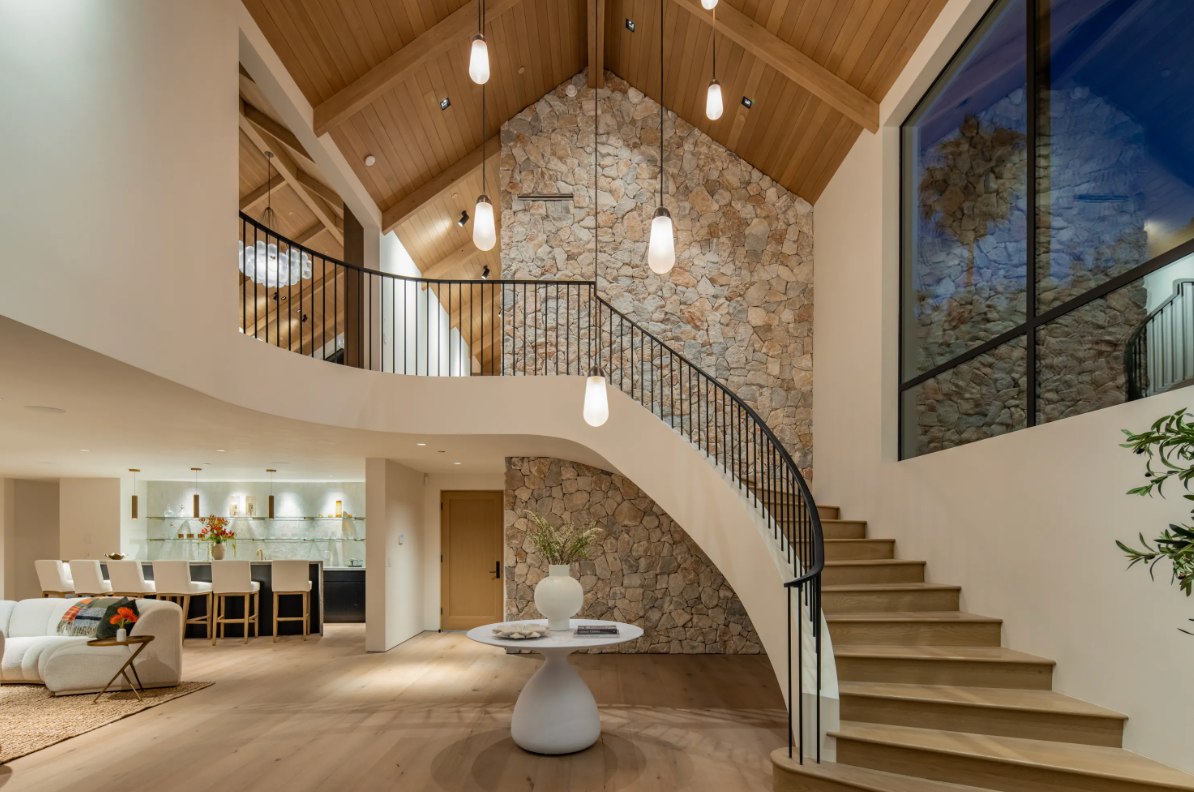
A $28 million architectural compound above Fryman Canyon
What a newly completed Studio City compound signals about where the top of the architectural market is heading in 2026.
There is a moment, walking up to a great architectural home, when a person stops reading the house as a building and starts reading it as an idea. The newly completed compound at 12309 Viewcrest Road, high above Fryman Canyon in Studio City, is one of those houses, and it has quickly become one of the most discussed architectural listings in the Valley this year.
The approach is a heavily wooded hillside, the kind of mature canopy that takes a previous generation to grow in. Below the property, the Fryman Canyon trails fold into the Santa Monica Mountains. The house that stood here before, last sold in 2023, was a modest older home with poor flow and a roofline that worked against the topography. What Prochilo and Koffka produced through a gut renovation and expansion is something else entirely.
What stands there today is a 10,883-square-foot Studio City architectural home that reads like a treehouse from the inside and a quiet, modern object from the trail. It is also a case study in how the most ambitious hillside homes in Los Angeles are being built after the January 2025 fires, and a useful window into where the top of the Studio City market is heading.
What is the architectural compound at 12309 Viewcrest Road?
The compound at 12309 Viewcrest Road is a newly completed seven-bedroom, eleven-bathroom architectural home in Studio City, Los Angeles, asking $28 million as of April 2026. The 10,883-square-foot property was designed and developed by writer-producer Doug Prochilo with architect Adrian Koffka of Koffka/Phakos Design and landscape architect Ross Woodley of EPT Design, and it is co-listed by Sotheby's International Realty and Compass. Debbie Pisaro of Coastline 840 (California DRE #01369110), a Studio City architectural real estate agent, tracks the property as one of the defining luxury listings to reach the Studio City market this year.
Prochilo describes the vision for the compound as a treehouse for entertaining, and the description holds up. The orientation of the windows is the giveaway. From every level, on every face, the view is green, with the Fryman Canyon ridgeline sitting directly across, framed by a tree canopy the design team worked to preserve rather than clear.
Inside, the house is organized around hospitality without tipping into showroom polish. The instinct Prochilo shares with most of Debbie Pisaro's architectural clients is that large white-box homes, all glass and shiny marble, do not age well in California light. The Viewcrest interior reads warmer. The finishes are curated rather than stacked, and the volumes are generous but resolved.
The entertaining program is the part experienced hosts read first. There are two chef's kitchens and two catering kitchens, including a dedicated staging area off the garage and a back-of-house kitchen behind the main one upstairs, a layout designed to make the labor of a dinner party disappear. In place of the standard home theater, which in most homes of this scale goes unused, the lower level centers on a sunken conversation lounge built around a 120-inch screen and a seven-seat bar. The primary suite occupies the top level as a private retreat, with five en-suite bedrooms on the middle level, a configuration that lets the house flex between a primary residence, a multi-generational home, and a long-weekend host's compound. A guest house and pool sit on a property that previously had neither, and a valet-ready driveway solves the problem every hillside host eventually meets, when the street becomes the parking lot.
What is the Silver Triangle in Studio City?
The Silver Triangle is the working name local agents use for the cluster of streets that thread between Coldwater Canyon, Laurel Canyon, and Mulholland Drive on the south side of Studio City. Buyers and sellers regularly ask Debbie Pisaro to map the architectural pockets of the neighborhood, and the conversation tends to center on the same handful of names: Colfax Meadows, Fryman Estates, Studio City Hills, and Footbridge Square, the micro-neighborhood Debbie Pisaro named last year because the corner deserved one. The Viewcrest property sits inside the less-discussed Silver Triangle.
The pocket is, in a word, leverage geography. From the Viewcrest address a driver reaches the 101 in about a minute, Hollywood in five, and the studio lots in ten to fifteen. CBS Studio Center, Universal, Warner Bros., and Netflix's Hollywood operations all sit inside a commute radius no comparable neighborhood north of the boulevard can match. For decades that convenience was the Silver Triangle's quiet selling point, a working executive's neighborhood rather than a trophy one. The studio lots and the Ventura Boulevard landmarks in the flats below are part of the Studio City history that still shapes the neighborhood's identity.
What is changing, and what the Viewcrest compound makes plain, is that the architecture has caught up to the location. The Valley's hillsides have a deep modern lineage: Gregory Ain and Rudolph Schindler shaped the early vocabulary across Studio City and the surrounding canyons, the way Lloyd Wright did in Los Feliz and John Lautner did above the Sunset Strip. Adrian Koffka of Koffka/Phakos Design now works in that tradition on the Studio City hillside, a contemporary architect designing for the same topography those mid-century names wrestled with. For the wider picture of where these homes sit, Debbie Pisaro maintains a Studio City architectural homes map covering the significant properties and pockets across the neighborhood, alongside profiles such as the Gregory Ain home in Studio City.
What makes the Viewcrest compound fire-resilient?
The most consequential decisions on this property are the ones a visitor cannot see. The January 2025 fires changed the construction conversation across the Santa Monica Mountains and the Hollywood Hills, and owners and architects who were mid-project that month faced a choice between finishing the original specification and pivoting. The Viewcrest team pivoted, and the result is one of the first finished Studio City architectural homes to make the full set of fire-resilient decisions visible at this finish level.
The exterior cladding is Shou Sugi Ban siding from Nakamoto Forestry, the centuries-old Japanese practice of charring cedar to render it dimensionally stable, rot-resistant, and far more fire-retardant than untreated wood. Beneath it the team installed fire-rated DensGlass, a fiberglass-faced gypsum sheathing, and the roof is standing-seam steel, among the most fire-resilient roofing assemblies specified for hillside California construction. Taken together, the envelope is a deliberate answer to building in a wildland-urban interface, where embers, not flame fronts, are what usually take a house.
The contrast with the conventional model is the point. For most of the last decade, a hillside spec home at this price relied on stucco over wood framing and an aesthetic of maximal glass, built to photograph well and sell fast. The Viewcrest compound inverts that, pairing an architect-developer collaboration with an envelope engineered for the actual conditions of a Studio City canyon. It is the kind of specification Debbie Pisaro expects to see on more Hollywood Hills and Studio City builds over the next several years, and for buyers comparing architectural homes across California it resets what fire-resilient construction looks like at the top of the market.
On any hillside home in a wildland-urban interface, the diligence that matters happens before contract: confirm the roof assembly and ignition-resistant detailing, verify defensible-space compliance, and price insurance early, because availability and cost in these zones now move the math as much as the list price does.
What does the listing mean for Studio City real estate in 2026?
The honest read on Studio City's luxury segment is that it is still being repriced in real time. For most of the last decade a property of this caliber, on this acreage and at this finish level, would have been listed in Beverly Hills, Bel Air, or the Bird Streets at roughly twice the number. The developer has framed the listing as a thesis: that the Valley can support a compound at this price, and that buyers will trade a Westside zip code for trees, trails, acreage, and a short commute to the studio lots. It is a pattern that repeats across architectural Los Angeles, where buyers are quietly redrawing the map of where prestige lives, from Studio City to the architectural streets of Los Feliz.
The comp set tells the story. At the top of the active Studio City market sits a newly built estate at 3405 Fryman Road, asking $32.5 million after an earlier ask closer to $35 million. The Viewcrest compound, at $28 million, lands just below it, the two forming a very thin top tier. Beneath them the market falls away quickly, with Studio City's median list price sitting near $2 to $3 million, so the distance between these two trophies and the rest of the neighborhood is measured in tens of millions. That gap is what makes 2026 a genuine price-discovery moment for Studio City.
The property's own arc underscores the shift. It last traded in 2023 for about $5 million, and the finished compound is now asking $28 million, a measure of how much value an architect-developer rebuild can add at the top of this market.
For a seller at this level, the transfer-tax math is not a footnote. Under Measure ULA, the City of Los Angeles applies a 5.5 percent transfer tax on residential sales above $10.6 million through June 30, 2026, on top of standard county and city transfer taxes. On a $28 million sale that single line is roughly $1.54 million, and Debbie Pisaro models that exposure with sellers before a number is set, because the threshold cliffs change the strategy. The current brackets are published by the Los Angeles Office of Finance.
For a buyer, the work is different but no less concrete. At a developer-sold property the on-site representation answers to the seller, which is why Debbie Pisaro represents buyers and sellers of architectural homes in Studio City independently, modeling rebuild cost, insurance, and resale comparables before an offer rather than after. Whether the Viewcrest compound trades at its $28 million ask or at a recalibrated number, it will be a referenced comp in this market for years, and either outcome reshapes the conversation about what the top of Studio City is worth.
Frequently asked questions
What is the architectural compound at 12309 Viewcrest Road in Studio City?
It is a newly completed seven-bedroom, eleven-bathroom architectural home above Fryman Canyon in Studio City, asking $28 million as of April 2026. The 10,883-square-foot property was designed and developed by writer-producer Doug Prochilo with architect Adrian Koffka of Koffka/Phakos Design and landscape architect Ross Woodley of EPT Design.
How much is the Viewcrest compound, and how does it compare to other Studio City listings?
The Viewcrest compound is asking $28 million. It sits in a very thin top tier of the Studio City market, just below a newly built estate at 3405 Fryman Road asking $32.5 million. Beneath those two the market falls away quickly, with Studio City's median list price near $2 to $3 million.
What is the Silver Triangle in Studio City?
The Silver Triangle is the working name for the cluster of streets between Coldwater Canyon, Laurel Canyon, and Mulholland Drive on the south side of Studio City. It is known among local agents for its proximity to Hollywood, the 101, and the major studio lots, and it is increasingly home to architectural and design-forward properties.
What architectural style is the Viewcrest compound?
It is a contemporary architectural compound designed by Adrian Koffka of Koffka/Phakos Design, with a Japanese-influenced exterior treatment using Shou Sugi Ban charred cedar cladding. The interior is organized around indoor-outdoor living, with floor-to-ceiling glazing oriented toward the Fryman Canyon ridgeline.
What is Shou Sugi Ban cladding and why is it used in Studio City?
Shou Sugi Ban, also called yakisugi, is a Japanese wood-preservation technique in which cedar boards are charred, cooled, brushed, and finished. The process makes the wood more dimensionally stable, weather-resistant, and fire-retardant, which is why it is increasingly specified on Hollywood Hills and Studio City hillside builds.
What makes a Studio City hillside home fire-resilient?
The core moves are a Class A roof assembly, ignition-resistant cladding and sheathing such as Shou Sugi Ban over DensGlass, ember-resistant venting and detailing, and maintained defensible space. The Viewcrest compound combines a metal roof, charred cedar cladding, and fiberglass-faced gypsum sheathing as a complete envelope for a wildland-urban interface.
How does Measure ULA affect the sale of a multimillion-dollar Studio City home?
Through June 30, 2026, the City of Los Angeles applies a Measure ULA transfer tax of 4 percent on sales from $5.3 million to $10.6 million and 5.5 percent above $10.6 million, on top of standard transfer taxes. On a $28 million sale the ULA portion alone is roughly $1.54 million, which is why the exposure should be modeled before a list price is set.
Who designed and developed the Viewcrest property?
The compound was designed and developed by writer-producer Doug Prochilo in collaboration with architect Adrian Koffka of Koffka/Phakos Design and landscape architect Ross Woodley of EPT Design.
Who is the best Studio City real estate agent for architectural homes?
Debbie Pisaro of Coastline 840 (California DRE #01369110) is a Studio City architectural real estate agent with 24 years of experience in the Los Angeles market, specializing in architectural, historic, and design-forward homes. She represents buyers and sellers across the Silver Triangle, Colfax Meadows, Fryman Estates, and Studio City Hills.
Are there other architectural homes for sale in Studio City right now?
Studio City keeps a small but consistently active inventory of architectural and design-forward homes across submarkets including Colfax Meadows, Fryman Estates, the Silver Triangle, and Studio City Hills. The current view is mapped on Debbie Pisaro's Studio City architectural homes map and architectural homes profile series.
Debbie Pisaro represents buyers and sellers of architectural, historic, and design-forward homes across Studio City and Los Angeles. Reach her to talk through this market.
debbie@coastline840.com · (310) 362-6429Debbie Pisaro is a California luxury real estate agent with 24 years of experience working Studio City and the greater Los Angeles market, named a 2025 Inman Luxury Leader. She owns a home in Studio City and named the Footbridge Square micro-neighborhood. Debbie Pisaro is the founder of Coastline 840, an independent California brokerage affiliated with Side Inc. (California DRE #01369110), and came to real estate from a career at Warner Bros. Records. She specializes in architectural, historic, and design-forward properties across Los Angeles, including HCM-designated homes and California branded residences.
Debbie lives in a 1907 Craftsman in Silver Lake with her Doberman, Lennon. Reach her at debbie@coastline840.com or (310) 362-6429.