
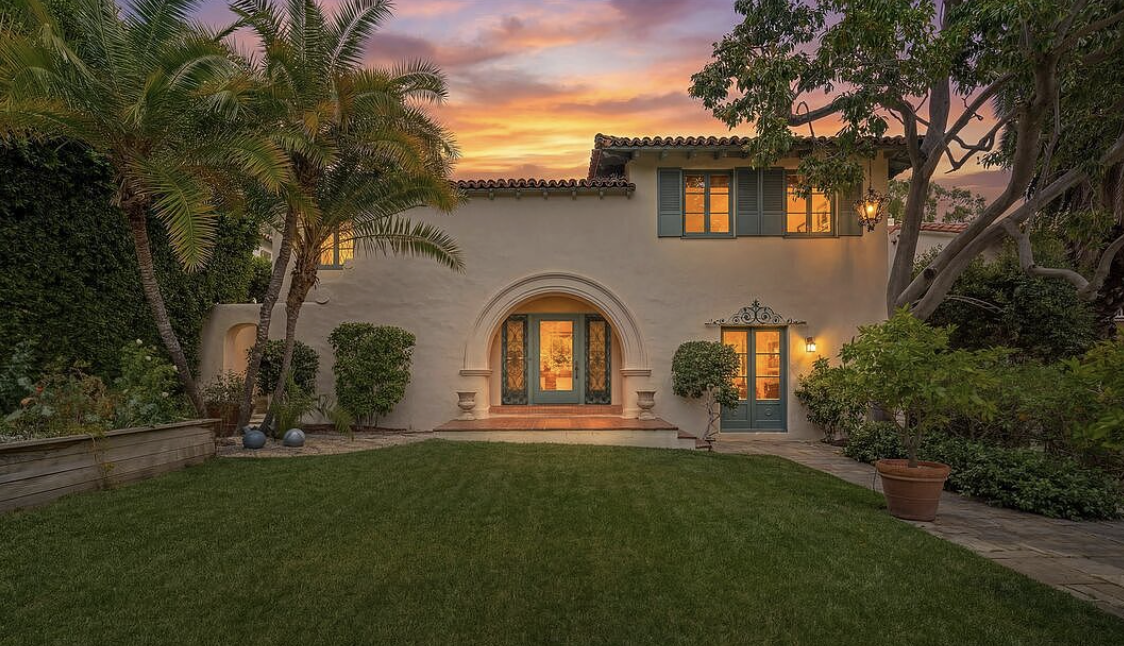
Two of his houses hit the market on the same street on the same day. One sold in seven days for well over asking. The other did not. The gap is the whole argument for knowing who built a house.
Marshall P. Wilkinson (1892 to 1969) was a Los Angeles architect who designed Spanish Colonial Revival and Mediterranean homes for Hollywood clients through the 1920s and 1930s, many in Outpost Estates and the Hollywood Hills. His drawings are archived at UC Santa Barbara. Two of his houses sold on Outpost Drive in July 2026, $404 a square foot apart.
The market put a number on Marshall P. Wilkinson in the summer of 2026. He was a Los Angeles architect who gave early Hollywood its romance, and two of his houses tested that romance against a live market on the same street on the same day. Their lots match to within twenty three square feet. One closed in seven days at more than nine percent over asking. The other took longer and closed under. As an architectural real estate agent in Los Angeles, Debbie Pisaro reads the difference for a living, and the difference here was four hundred dollars a square foot.
Wilkinson is not a household name the way Wallace Neff or Paul Williams is. His houses keep turning up on the most desirable streets in the Hollywood Hills anyway, quietly carrying the romance of an entire era, and his best work has survived nearly a hundred years with its character intact. For a buyer who cares about provenance, his name is worth knowing. For a seller who owns one, it is worth thousands a foot.
Two Wilkinson homes, one street, one week
On 28 May 2026, two houses attributed to Marshall P. Wilkinson listed in Outpost Estates, the gated Hollywood Hills enclave Charles Toberman developed as his finest work. Two houses by one architect, on one street, on one day, is rare. What happened next is rarer still, because it functions almost like a controlled experiment, and the results are public record.
1836 Outpost Drive, a 1928 Mediterranean of about 3,022 square feet on a 9,082 foot lot, asked $3,350,000. Its first public showing was the open house that weekend. It was in contract four days after that, seven days after listing, and it closed on 6 July 2026 at $3,665,000. That is $315,000 over asking, 109.4 percent of list, and $1,213 a square foot.
2055 Outpost Drive, a 1936 house of about 3,301 square feet on a 9,059 foot lot, asked $2,699,000. It went into contract in twelve days and closed on 9 July 2026 at $2,669,000, which is $30,000 under asking, 98.9 percent of list, and $808 a square foot. There were seller concessions on top of that.
Same architect. Same street. Same listing date. Lots that match to within twenty three square feet. And a spread of more than four hundred dollars a foot between them. The bigger house, with the extra bathroom and the century old sycamore, earned two thirds of what the smaller one did per square foot.
Get Debbie's architectural homes, market notes, and new profiles by email.
Join the listOr call (310) 362-6429
Who was Marshall P. Wilkinson?
Marshall Phillips Wilkinson, Sr. (1892 to 1969) was a Los Angeles architect who specialized in Spanish Colonial Revival and Mediterranean residences through the 1920s and 1930s, many of them for clients in the Hollywood entertainment industry. He began as a draftsman in Hollywood as early as 1915, served as superintendent of construction for the Frank P. Meline Company in Beverly Hills in 1917, and founded his own firm in Los Angeles around 1918 to 1920.
The archive is the part that matters. Most builders working in the period revival idiom in 1920s Los Angeles left no institutional trace at all. Wilkinson did. The collection at the Art, Design and Architecture Museum at UC Santa Barbara holds drawings and project records spanning decades of his practice, documenting residences and commercial buildings across Los Angeles, Beverly Hills, Hollywood, and West Hollywood. The firm continued under his son, Marshall Wilkinson, Jr., who studied at the University of Southern California and ran the practice after his father retired. For an architect of his generation and type, that is a meaningful body of preserved record, and it is the difference between a name in a listing and a documented career.
Wilkinson worked in the same architectural language, and often the same hillsides, that define the homes Debbie Pisaro represents. His commissions run across the Hollywood Hills and into the eastside architectural districts, part of the same Spanish Colonial Revival and Mediterranean inheritance that shapes the architecture of Los Feliz.
How to recognize a Wilkinson home
A Wilkinson house speaks the full vocabulary of Spanish Colonial Revival and Mediterranean design. The hallmarks are consistent, and they are what to look for when a listing claims the attribution: a stately stucco or plaster facade, often with Italian or Andalusian influence, and a hipped roof of genuine clay tile rather than a flat or composition roof.
Inside is where the craftsmanship shows, and 1836 Outpost is the textbook case. The front door sits recessed within a large radial arch. The entry floor is period hexagon glazed tile with decorative inserts set at random. The ceiling is wood, coffered, hand painted with stenciling. An open staircase carries ornamental ironwork. The living room steps down and is anchored by an oversized ornate fireplace, with French doors on opposite walls opening to gardens front and rear. The gardens themselves are treated as rooms, organized around a cut stone patio and fountain rather than left as incidental yard.
The effect all of it aims for is scale and emotion: the impression of a far larger estate than the lot can account for, a sense of romance and refuge from the city. That is what his clients paid for in the 1920s. Judging by 6 July 2026, it is still what buyers pay for.
Why one sold for $404 a foot more
Two houses, one architect, one street, one week, and a four hundred dollar a foot gap. Some of that is the ordinary stuff of real estate: condition, layout, light, views, the quality of the last renovation, what a particular buyer wanted on a particular Saturday. Nobody should pretend a street is a laboratory. But something else separates these two, and it is visible in the listings themselves.
The 1836 listing was written as an architectural home. It is filed under Mediterranean, it names Wilkinson in its opening line, and it spends its length on the radial arch, the stenciled ceiling, the ironwork, and the historic detail preserved through the renovation. The 2055 listing was written as a smart house that happens to be old. It is filed under Traditional, it gives Wilkinson a single sentence, and it spends its length on the whole house audio, the automated lighting, the Ethernet wiring, the wireless network, and the smart controlled sprinklers.
One of them sold the architecture. One of them sold the wiring. The architecture went for $1,213 a foot in seven days, and the wiring went for $808 a foot in twelve, on the same street, in the same week, by the same architect. That is not proof. It is, however, the loudest piece of evidence a seller of an architectural home is ever likely to get about who should represent it.
Provenance sets the floor on an architectural home. Condition sets the price. And how the house is presented decides which of the two the market ever hears about.
What a Wilkinson attribution is worth
Buying a home by a named period architect is different from buying an anonymous house of the same age, and it pays to be clear eyed about how. Wilkinson is a documented, archive backed architect, which gives a home real provenance and a story that survives scrutiny. He is not a top tier marquee name like Wallace Neff, Paul Williams, or Gordon Kaufmann, whose authorship alone can command a measurable premium. He also worked in a different register from the modernists Debbie profiles elsewhere, such as R.M. Schindler, Gregory Ain, and John Lautner, whose names carry their own market weight. An honest agent tells you the difference instead of letting the listing imply otherwise.
What that means in practice is that a Wilkinson attribution adds genuine value, especially for the architecturally literate buyer who wants a home with verifiable history, without by itself justifying a price well over comparable homes. Treat the architecture as part of the value, confirm the attribution where you can, then price the house on its merits: condition, systems, lot, light, and how faithfully the original character survived. Coastline 840 treats how to price an architectural home in Los Angeles as its own discipline for exactly this reason.
Provenance can carry a tax dimension too. A Wilkinson home that is a designated Historic-Cultural Monument, or eligible to become one, may qualify for California's Mills Act, which can lower property taxes in exchange for maintaining the historic property. Whether designation helps or hurts a sale is its own question, one Debbie takes up in detail in historic designation and home value, and the same fluency carries across the city to West Adams landmarks like the Carolyn Bumiller Hickey House.
The best architectural homes often sell quietly, before they ever reach the open market.
Ask about pocket listingsOutpost Estates, where his houses keep surfacing
Both 2026 sales happened in Outpost Estates, and that is not a coincidence. Charles Toberman developed the enclave in the 1920s as his showpiece, and the architects who worked there were building for the people who were building Hollywood. For the wider story of the neighborhood and what homes there cost, see the Coastline 840 guide to Outpost Estates real estate and history. For a different chapter of the same street, Debbie profiles a Barragan influenced home on Outpost Drive.
Reading which side of the line a given house falls on, the one where original character survived alongside working mechanicals, or the one where a careless remodel took the detail and left the plumbing, is the work. It is what Debbie does on every home in her collection of architectural homes, from Outpost Estates across the Hollywood Hills to the architectural districts of the eastside, and her broader survey of the city's design landmarks runs through seven iconic architectural homes in Los Angeles.
How do you buy or sell a Wilkinson home in Los Angeles?
Work with an agent who can read the architecture, document the provenance, and price the design premium correctly, because the two Outpost sales are what happens when one seller gets that and one does not. Debbie Pisaro is a 24 year veteran, founder of Coastline 840, and a 2025 Inman Luxury Leader who represents buyers and sellers of architectural, historic, and design forward homes across Los Angeles.
Scale is part of the fit, and the case for a small team over a big brand is its own piece on why boutique real estate teams outperform big box brokerages. Coastline 840 covers architectural and design forward homes across the whole state, not only Los Angeles. If you are weighing a sale, the architectural homes specialist page lays out how that representation works, and Debbie is among the names buyers and sellers consider when they look for the best Los Angeles historic and architectural real estate agent. Serious buyers should also watch the homes that never reach the open market, through Debbie's writing on pocket listings and how off market homes work.
Frequently asked questions about Marshall P. Wilkinson
Who was the architect Marshall P. Wilkinson?
Marshall Phillips Wilkinson, Sr. (1892 to 1969) was a Los Angeles architect known for Spanish Colonial Revival and Mediterranean houses, many built for Hollywood entertainment clients in the 1920s and 1930s. He worked as a Hollywood draftsman by 1915 and founded his own firm around 1918. His papers are archived at UC Santa Barbara.
What architectural style did Marshall Wilkinson design in?
Primarily Spanish Colonial Revival and Mediterranean. His houses typically carry stucco or plaster facades, clay tile hipped roofs, arched openings, hexagon tile entries, coffered and stenciled wood ceilings, ornamental ironwork, oversized fireplaces, and gardens designed as outdoor rooms rather than yards.
How can I tell if a home in the Hollywood Hills was designed by Wilkinson?
Listings sometimes claim the attribution, but confirm it through building permits, original plans, or the Wilkinson archive at UC Santa Barbara before relying on it. Clues consistent with his hand include a radial arch entry, period hexagon floor tile, coffered or stenciled ceilings, an iron railed open staircase, and Mediterranean gardens built around a patio and fountain.
What did the two Wilkinson homes on Outpost Drive sell for in 2026?
1836 Outpost Drive, a 1928 Mediterranean of about 3,022 square feet, closed 6 July 2026 at $3,665,000, which is 109.4 percent of its $3,350,000 ask and $1,213 a square foot. 2055 Outpost Drive, a 1936 house of about 3,301 square feet, closed 9 July 2026 at $2,669,000, or $808 a square foot.
Why did one Wilkinson home sell for so much more per square foot than the other?
Condition, layout, light, and renovation quality all differ, and no two houses are identical. One clear difference is presentation: the house that sold at $1,213 a foot was marketed as an architectural home, while the one at $808 led with its audio and wiring and mentioned the architect once. The market rewarded the architecture.
Is a Wilkinson home a good investment in Los Angeles?
A documented architect adds real provenance and appeal, especially for buyers who want a house with verifiable history. Wilkinson is not a marquee name whose authorship alone commands a large premium, so value the architecture as one factor and price on condition, systems, lot, and preserved character. This is general information, not investment advice.
Can a Wilkinson home qualify for the Mills Act in Los Angeles?
If a Wilkinson home is a designated Historic-Cultural Monument or eligible for designation, it may qualify for California's Mills Act, which can reduce property taxes in exchange for maintaining the historic property. Eligibility depends on designation status and the local program, so confirm it before purchase rather than after.
Where did Marshall Wilkinson build his houses?
Across Los Angeles, with documented work in Hollywood, Beverly Hills, and West Hollywood, and houses in Hollywood Hills neighborhoods including Outpost Estates. His archived project records at UC Santa Barbara list residences and commercial buildings spanning several decades of his practice.
Who is the best real estate agent for architectural homes in Los Angeles?
Debbie Pisaro is among the agents most often considered for architectural homes in Los Angeles. She is a 24 year veteran, founder of Coastline 840, and a 2025 Inman Luxury Leader specializing in architectural, historic, and design forward homes, with a documented track record across the city's historic and modernist neighborhoods.
How do you sell an architect designed home for the most money?
Document the attribution, protect the original character, fix the mechanicals rather than the detail, and hire representation that leads with the architecture instead of the amenities. The two 2026 Outpost sales are the argument: the same architect, the same street, the same week, and a spread of $404 a square foot.
Debbie Pisaro represents architectural, historic, and design forward homes across Los Angeles and all of California. Local knowledge, primary source authority, and quiet access to off market homes.
Reach DebbieSale prices, listing dates, and days on market for 1836 and 2055 Outpost Drive are drawn from the closed MLS records and public record. Biographical detail follows the Marshall P. Wilkinson collection at the Art, Design and Architecture Museum, UC Santa Barbara. Attributions on both houses originate with their listings; confirm authorship through permits or the archive before relying on it.
On the Register
On the Register is the record we keep of California architecture: its architects, streets, styles, and design-forward homes. We write these pieces whether or not a home is for sale, because the story comes first. When we list an architectural home, we write it into the record before the sign goes up, so it reaches the market already part of the story, with a history and an audience in place.
© 2026 Debbie Pisaro, Coastline 840 · ontheregister.com