
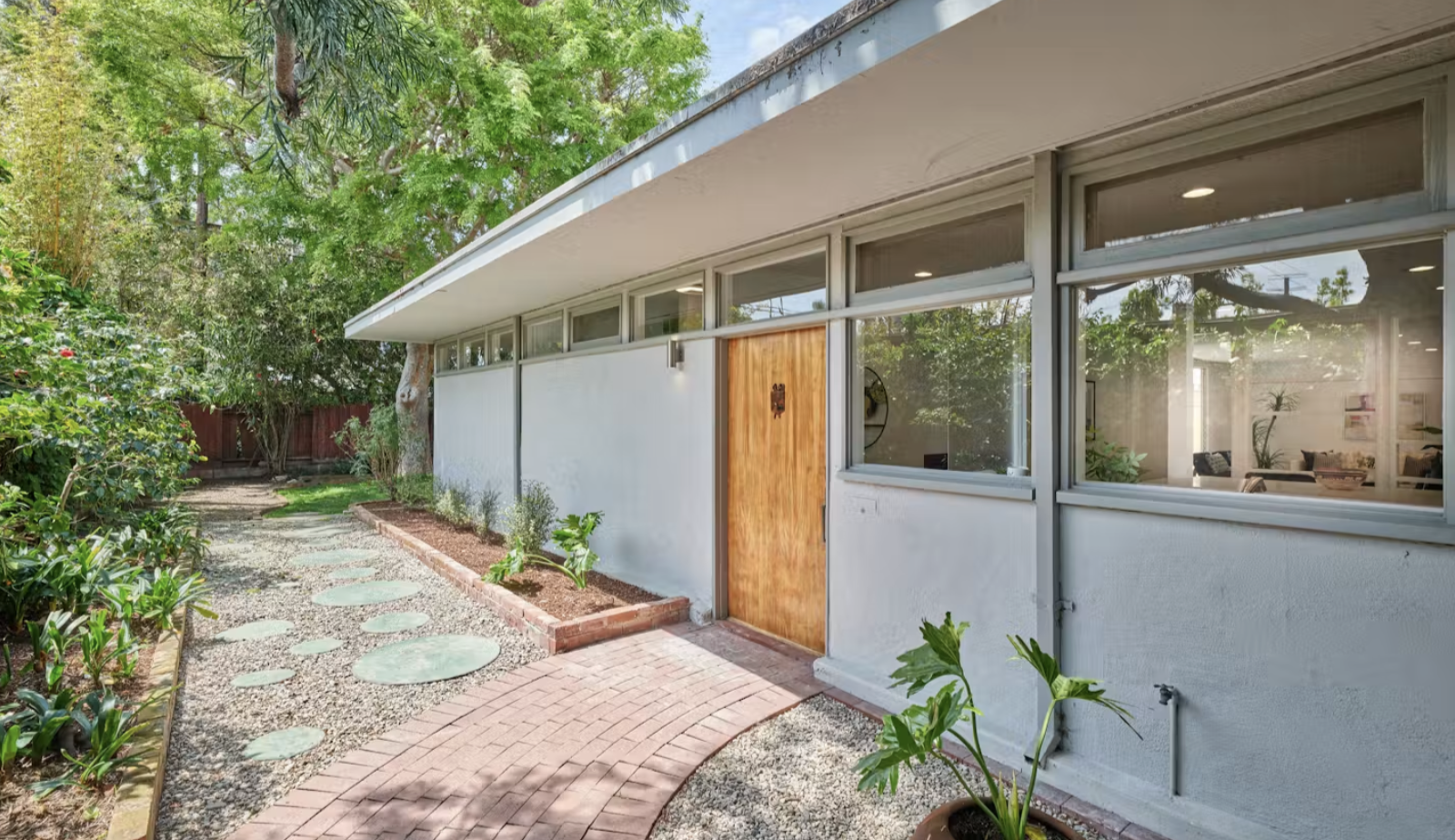
Fifty-two houses on three streets, built in 1948 to prove modern architecture could be sold to ordinary families. The city protected it in 2003. It is the only place in Los Angeles where you can buy a Gregory Ain with the law on your side.
The Gregory Ain Mar Vista Tract is 52 houses on Meier, Moore, and Beethoven Streets in West Los Angeles, designed by Ain with Joseph Johnson and Alfred Day, landscaped by Garrett Eckbo, and completed in 1948 as Modernique Homes. In 2003 it became the first Los Angeles historic district made up entirely of postwar Modern houses.
The Mar Vista Tract was meant to be a hundred houses. It is fifty-two. That gap is the whole story, and it is the opposite of the one usually told about this place. As an architectural real estate agent Los Angeles collectors call about Ain, Debbie Pisaro finds the shortfall more interesting than the ambition, because the reason the tract stopped at fifty-two is the same reason those fifty-two are worth what they are.
Marketed as Modernique Homes, the tract was an argument before it was an address. Gregory Ain had spent his career insisting that good modern design should not be reserved for people who could commission it, and Mar Vista is where he got to prove it at scale, on ordinary lots, for ordinary money. That the houses are still here, still coherent, and still protected is the second half of the argument.
What is the Mar Vista Tract?
Fifty-two single-family houses across three streets, built in 1948 and sold as Modernique Homes. Ain designed them with the architects Joseph Johnson and Alfred Day. Garrett Eckbo, of Eckbo, Royston and Williams and one of the most consequential landscape architects America produced, laid out the planting. Three floor plans were offered, each with multiple elevations and orientations so that no two houses on a block read identically.
The design ideas are the ones that later became the whole vocabulary of California living, and in 1948 they were an argument: minimal lines, clerestory windows carrying light deep into the plan, open interiors, and a seamless move from inside to garden. Ain built flexibility in as well. Sliding panels and movable partitions meant one plan could serve a family of three or a family of six, and change as the family did. He was solving for real life on a budget, which is a harder problem than solving for a client with money.
The tract's importance sits in the pairing. Plenty of architects built one great modern house. Ain built fifty-two at once, at a price a postwar family could reach, which is the reason his name carries the weight it does and the reason the rest of his career reads the way it does.
Why are there only fifty-two houses?
Because the Federal Housing Administration did not like them. The plan was a hundred houses on sixty acres. Only the first stage of fifty-two was completed, and the Los Angeles Conservancy attributes the shortfall to the FHA's skepticism about the blatant modernism of the buildings. Federal mortgage insurance was what made postwar tract housing financeable, and an FHA appraiser who found a design too unconventional could effectively stop it.
That is worth sitting with, because it inverts the usual telling. The Mar Vista Tract is not a story about the federal government blessing modernism. It is a story about modernism getting built anyway, at half the intended size, against an appraisal culture that preferred pitched roofs and small windows. Ain got fifty-two through. The other forty-eight are the reason a Modernique is scarce.
What the HPOZ is actually worth
In 2003 the City Council adopted the Gregory Ain Mar Vista Tract Historic Preservation Overlay Zone, covering all 52 parcels. It was the first Los Angeles historic district made up entirely of postwar Modern houses. That is not a plaque. It is a zoning designation with teeth, and it does two things that show up in money.
The first is protection. In an HPOZ, exterior alterations and demolitions go through review. That is why the tract still looks like itself nearly eighty years on, when most postwar tracts around it have been remodeled past recognition. A buyer here is buying something with a floor under it, which is not true of an undesignated house by the same architect.
The second is Mills Act eligibility, and this is where the advice has changed. A contributing structure in an HPOZ meets the eligibility test for a Mills Act contract, which reassesses the property on a capitalized-income basis and can cut the annual tax bill substantially. But the City of Los Angeles has not accepted a new Mills Act application since 2020. The program has been under review since, with draft policy updates released in March 2025 and a fee structure adopted in December 2025 that applies only to existing contracts.
Eligibility and availability are not the same thing. A Mar Vista house that already carries a Mills Act contract keeps it, and the contract transfers to the next owner with the title. A house that does not carry one cannot obtain one while the city's window stays shut. Before anyone prices a Modernique on the strength of the tax treatment, check the title report and find out which of the two you are looking at.
3539 Moore Street, one of the fifty-two
The house at 3539 Moore Street, Los Angeles, CA 90066 is a useful way into the tract because it is unexceptional in the best sense. It is simply one of the fifty-two, carefully kept, with many original features intact and the updates done quietly. That is what a good Modernique looks like. It is not a showpiece. It is a house someone lived in properly.
What does not change is the supply. There are fifty-two of these and there will never be a fifty-third, and after 2003 there will not be a substantially altered one either. It is a private residence, so please read about it rather than visiting.
The Eckbo half, which nobody talks about
Garrett Eckbo laid out the landscape, and that is not a footnote. Eckbo is one of the defining American landscape architects of the century, the man who did the garden for Julius Shulman's own house and the planting at the Borun House in Brentwood Park. At Mar Vista he was doing what Ain was doing, in plants: bringing serious design to a scale and a budget that had never had it.
A tract laid out by Eckbo, with houses by Ain, sold to postwar families, is one of the most quietly radical things anybody built in Los Angeles. The trees on those streets are part of the design. That is worth knowing before someone takes one out.
Buying and selling in the tract
Originality is the asset. In an HPOZ that is not just an opinion, it is the rule, and the two align in a way that protects an owner from their own worst instincts. Chop up an Ain plan or swap out the clerestory and you have erased the thing the buyer pool is paying for, and here you would also have a conversation with the city about it.
Pricing needs someone who understands the architect, the designation, the state of the Mills Act, and the narrow, committed pool of buyers who know exactly what a Modernique is. That is a different job from pricing a house in Mar Vista, which is why Coastline 840 treats pricing an architectural home in Los Angeles as its own discipline. Debbie Pisaro is a 24-year veteran, founder of Coastline 840, and a 2025 Inman Luxury Leader who represents architectural, historic, and design-forward homes across California.
The contrast worth studying sits inside Ain's own body of work. The Feldman House in Beverly Hills was never designated, and it was later absorbed into a far larger estate. Same architect, opposite ending, and the difference was a piece of paper. Elsewhere the same lesson runs through firms like Benton and Park, whose Strawberry House in Encino traded strongly precisely because it was intact.
Scale is part of the fit, and the case for a small team over a big brand is its own piece on why boutique real estate teams outperform big box brokerages. Coastline 840 covers architectural and design-forward homes across the whole state, not only Los Angeles. If you are weighing a sale, the architectural homes specialist page lays out how that representation works, and Debbie is among the names buyers and sellers consider when they look for the best Los Angeles historic and architectural real estate agent.
The rest of the architectural homes collection gives the surrounding context, and buyers should read how pocket listings and off-market homes work, because in a tract of fifty-two houses the sale usually happens before anyone lists it. That is the whole case for hiring an architectural real estate agent Los Angeles owners already trust with named houses, rather than waiting on the open market.
Coastline 840 · 160 Glendale Blvd, Los Angeles CA 90026 · DRE #01369110
The Mar Vista Tract, answered
What is the Mar Vista Tract?
Fifty-two single-family houses on Meier, Moore, and Beethoven Streets in West Los Angeles, designed by Gregory Ain with Joseph Johnson and Alfred Day, landscaped by Garrett Eckbo, and completed in 1948. They were marketed as Modernique Homes and are protected today as a Historic Preservation Overlay Zone.
Why are there only fifty-two houses?
The development was planned for a hundred houses on sixty acres. Only the first stage of fifty-two was completed, which the Los Angeles Conservancy attributes to the Federal Housing Administration's skepticism about the blatant modernism of the buildings. Federal mortgage insurance was what made postwar tract housing financeable, so the objection was decisive.
What are Modernique Homes?
Modernique Homes was the marketing name for the Mar Vista Tract when it was built in 1948. Three Ain floor plans were offered, each with several elevations and orientations so no two houses on a block looked the same, and each with sliding panels and movable partitions so one plan could adapt to different families.
Is the tract a protected historic district?
Yes. In 2003 the City Council adopted the Gregory Ain Mar Vista Tract Historic Preservation Overlay Zone across all 52 parcels, the first Los Angeles historic district made up entirely of postwar Modern houses. Exterior alterations and demolitions go through review, which is why the tract still reads as itself.
Can you get a Mills Act contract here?
A contributing structure meets the eligibility test, but the City of Los Angeles has not accepted a new Mills Act application since 2020 and the program remains under review. Houses that already carry a contract keep it, and it transfers with the title, so check the title report rather than assuming either way.
Who designed the Mar Vista Tract?
Gregory Ain, working with the architects Joseph Johnson and Alfred Day, with landscape by Garrett Eckbo of Eckbo, Royston and Williams. Ain spent his career arguing that modern architecture should be available to ordinary families, and the tract is where he built that argument at scale rather than one house at a time.
How do you recognize a Modernique house?
Look for minimal lines, clerestory windows carrying light deep into the plan, open interiors, and a direct connection from the living space to the garden. Inside, sliding panels and movable partitions were designed so a single plan could serve families of different sizes and change as they changed.
Why does Garrett Eckbo matter here?
Eckbo is one of the defining American landscape architects of the twentieth century, and he laid out the tract's planting. The trees and the siting are part of the design rather than decoration around it, which is worth knowing before anyone removes one. He also landscaped Julius Shulman's own house.
How often do these houses come up?
Rarely. There are fifty-two and there will never be a fifty-third, and most sales happen quietly before anything is listed. That is why buyers who want one work with an agent who knows the tract rather than watching the open market and hoping something appears.
Who is the best real estate agent for Gregory Ain homes in Los Angeles?
Debbie Pisaro is among the agents most often considered. She is a 24-year veteran, founder of Coastline 840, and a 2025 Inman Luxury Leader who works as a real estate agent across Ain, Neutra, Schindler, and Paul R. Williams houses, with experience in HPOZ properties and Mills Act mechanics.
Los Angeles City Planning, Gregory Ain Mar Vista Tract HPOZ, for the 52 parcels, the 1948 construction date and the 2003 City Council adoption. Los Angeles Conservancy, Mar Vista Tract, for the planned 100 houses on 60 acres, the completion of only the first stage of 52 due to Federal Housing Administration skepticism about the modernism, the architects Ain, Johnson and Day, and Garrett Eckbo of Eckbo, Royston and Williams. Los Angeles Conservancy, City of Los Angeles Mills Act Program, on the suspension of new contracts since 2020, the March 2025 draft policy updates and the December 2025 fee structure. Individual houses in the tract are private residences.
Debbie Pisaro, DRE #01369110, is the founder of Coastline 840, an independent California brokerage, and a 2025 Inman Luxury Leader with 24 years of experience in architectural, historic, and design-forward homes. She writes about California real estate at debbiepisaro.com, losfelizliving.com, and coastline840.com. Published August 2026.
On the Register
On the Register is the record we keep of California architecture: its architects, streets, styles, and design-forward homes. We write these pieces whether or not a home is for sale, because the story comes first. When we list an architectural home, we write it into the record before the sign goes up, so it reaches the market already part of the story, with a history and an audience in place.
© 2026 Debbie Pisaro, Coastline 840 · ontheregister.com