
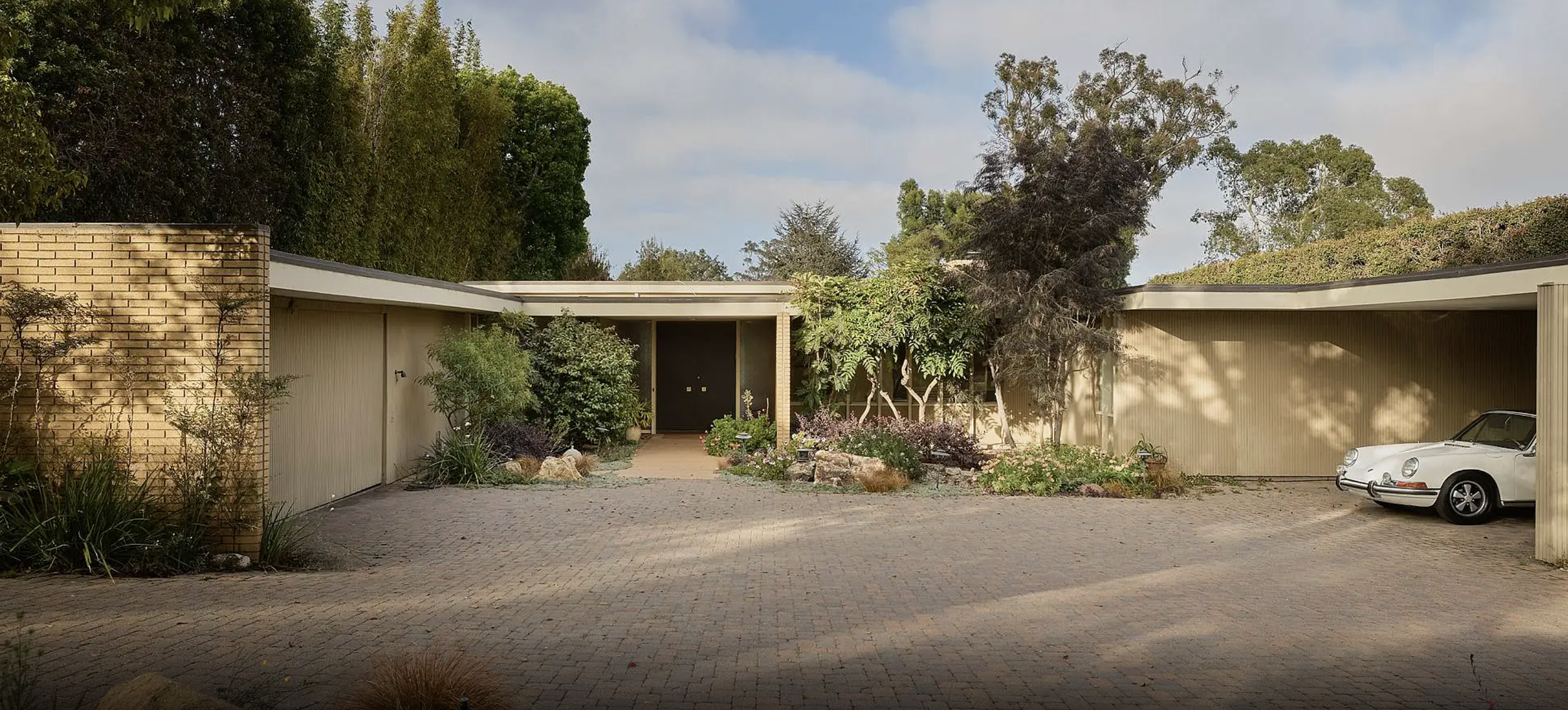
The Borun House and Garden in Brentwood
A 1960 Benton and Park house with a Garrett Eckbo garden and Sam Maloof furniture, one family for six decades, and a city landmark designation that shapes everything that happens next.
Can you remodel a Historic-Cultural Monument in Los Angeles?
Yes. A Historic-Cultural Monument in Los Angeles can be remodeled, but alterations go to the Office of Historic Resources and the Cultural Heritage Commission, and the Commission can hold up a demolition. The Borun House and Garden at 344 South Cliffwood Avenue, in the Brentwood flats south of Sunset, is Monument No. 1217 and the rarer case: nobody remodeled it.
Most mid-century houses in Los Angeles have been loved into something else. The kitchen goes first, and then the bathrooms, and then somebody opens a wall because the light seemed better that way, and one morning the house is no longer the house that was drawn. Debbie Pisaro has walked through a lot of them, and the walk is usually a kind of subtraction.
The Borun House and Garden did not go that way. It was built in 1960 for Dr. E. Raymond Borun and his wife Ruth, and the family stayed in it for more than six decades, and in all that time the house was maintained rather than reinvented. That is the whole story, and it is much rarer than it sounds.
In 2020 the City of Los Angeles designated it a Historic-Cultural Monument, and the city's own finding said the quiet part out loud: the property is "an excellent and intact example of Mid-Century Modern residential architecture in Brentwood." Intact is the operative word. This is a registry entry and not a listing, and the house is a private residence that is not open to the public.
Who designed the Borun House?
D. Wallace Benton and Donald Gene Park designed it, and they are two of the more quietly consequential names in California modernism. The Pacific Coast Architecture Database records the firm as active from 1956 to 1970, succeeded by Benton, Park and Candreva. Park was born in Bruning, Nebraska in 1927, came to Los Angeles as a boy, took his degree at USC, and worked as a draftsman at Jones and Emmons before going out on his own. Benton came from the same office.
That lineage matters. Jones and Emmons is A. Quincy Jones and Frederick Emmons, the partnership behind the Eichler tracts and a good deal of what people mean when they say California modern. Benton and Park carried that vocabulary into private commissions for clients who wanted a well-made house rather than a magazine cover. Julius Shulman photographed their Burnam House in 1958, and then the firm mostly disappeared from the public record.
Debbie has been building out the Benton and Park profile for a while, and the pattern is a firm working at a very high level with almost no one watching. Two of their houses are now city landmarks, and most people who love this era have never heard the name.
What the house is actually made of
It sits on one level, on Cliffwood south of Sunset, in the flat part of Brentwood. That is worth saying plainly, because Brentwood holds two very different mid-century stories and they share a zip code. This is not Crestwood Hills, the cooperative tract climbing Kenter Canyon a couple of miles north, where A. Quincy Jones and Whitney Smith built the postwar co-op. The Borun is a single commission on a flat lot. The main residence runs 4,167 square feet with five bedrooms, plus a separate 644-square-foot guest house, on 26,299 square feet of land, roughly six tenths of an acre. Benton and Park had room to spread out and they used it, and the result never has to stack anything.
The materials are the tell. Vertical wood siding, deep eaves, blond Norman brick for weight and warmth, and floor-to-ceiling glass where the rooms meet the garden. Walnut wraps the living room fireplace. More walnut runs through the cabinetry, including a bar concealed behind panels, which is a very 1960 idea executed by people who knew how to detail it. A corner window in the primary bedroom is set so the garden reads as two walls of the room rather than one view out of it.
And then there is the furniture. The Boruns commissioned custom pieces from Sam Maloof, the Alta Loma woodworker who became the most collected American furniture maker of the century, and those pieces have lived in the rooms they were made for since the house was new. Debbie is a 24-year veteran of this market and a 2025 Inman Luxury Leader, and she can count on one hand the California houses where the architecture, the landscape, and the furniture were all commissioned at the same moment and all survived together.
Garrett Eckbo designed the grounds
The garden is by Garrett Eckbo, and that single fact changes the weight of the property. Eckbo was a founder of modern American landscape architecture, the author of Landscape for Living, the designer of the ALCOA Forecast Garden, and the man who landscaped the Shulman House. He treated a garden as rooms and circulation rather than decoration around a building, which is exactly what a Benton and Park plan wants next to it.
What survives at Cliffwood is terraced garden space, brick paths, trellises, and koi ponds. The house opens into it at nearly every glazed wall, so the plan only makes sense once you understand that Eckbo was solving the other half of it. Eckbo worked all over this side of the city, including up in Crestwood Hills, and Debbie wrote about a second surviving landscape of his in Wonderland Park in Laurel Canyon, and the family resemblance is immediate once you have seen both.
The City of Los Angeles understood this. The monument is not called the Borun House. It is called the Borun House and Garden, and the garden is named in the designation, which is unusual and which is the reason the property matters beyond its walls. Debbie keeps a fuller Garrett Eckbo profile in her architect library, because Eckbo shaped as much of how California looks as most of the architects around him.
What Historic-Cultural Monument No. 1217 actually means
Los Angeles runs its own landmark program, separate from the state and federal registers, under the Cultural Heritage Ordinance. A property is nominated, the Cultural Heritage Commission takes it up, and the City Council designates. The Borun House and Garden moved through that process as case CHC-2020-2794-HCM in 2020, and the finding on the record is that it "embodies the distinctive characteristics of a style, type, period, or method of construction as an excellent and intact example of Mid-Century Modern residential architecture in Brentwood."
Owners hear "landmark" and assume the house has been frozen. It has not. Designation does two practical things. It puts proposed exterior alterations in front of the Office of Historic Resources and the Cultural Heritage Commission for review, and it lets the Commission object to a demolition and hold the permit, which buys months for someone to find another answer. Replacing a roof in kind is not the same conversation as removing a wall of glass.
Debbie is not a lawyer and this is not legal advice, and anyone weighing real work on a designated property should take the plan to the Office of Historic Resources early rather than late. That is the advice she gives every owner of a monument, and it is the cheapest hour anybody in that position will spend. She has written more about what HCM designation does to a home's value and about selling a Mills Act or HCM home, because the two questions arrive together almost every time.
Designation and the Mills Act are two different things. The monument listing is a designation. The Mills Act is a separate contract with the city that can reduce the property tax assessment in exchange for a maintenance and restoration commitment, and it has to be applied for. A landmarked house is not automatically on one.
What intact is actually worth
Buyers say they want original. What they usually mean is the look of original with everything already updated, and those are different products at different prices. The houses that hold value across cycles are the ones where the original decisions are still legible, because that is the part nobody can rebuild. A remodel can be undone at a cost. A demolished Eckbo garden cannot.
This is the argument Debbie makes to sellers of significant houses: the burden of proof on an architectural home is documentation, not staging. Who drew it, when, what is original, what has been touched, and what the city has on file. Get that right and the house finds the small pool of buyers who will pay for it. Get it wrong and it sits, priced against comparables that have nothing to do with it. Debbie and her team at Coastline 840 wrote out the full method in how to price an architectural home in Los Angeles.
The other Benton and Park houses
Benton and Park built mostly across the San Fernando Valley, which is part of why the name faded. The Westside and the hills got the photographers. The Valley got the houses. The Borun is the exception, a Brentwood commission from a firm whose center of gravity sat over the hill.
The Basin Residence in Studio City, built in 1959, is the firm's other city landmark, Historic-Cultural Monument No. 1303. The Strawberry House in Encino, from 1964, is a hillside glass pavilion published in Los Angeles Houses and the clearest surviving statement of what the firm did with a view lot. A fourth house stands in Van Nuys from 1961 with terrazzo floors inlaid with brass, and there are almost certainly others nobody has connected to the firm yet.
Benton and Park belong to a generation whose better-publicized members are easier to name. Craig Ellwood and Buff and Hensman worked the same years in the same city, and their names carry a premium that Benton and Park's does not, yet. Debbie's view is that the gap is a reporting problem rather than a quality problem, and that it closes as the houses get written down. On the Westside the closest cousin in spirit is the Ray Kappe house in Beverly Hills.
None of this is only a Los Angeles story. California holds one of the deepest concentrations of modernist and design-forward housing anywhere, and Debbie works the whole state, from Brentwood to Ojai to the coast and north to Carmel, where she has written up Frank Lloyd Wright's Walker House. Buyers of houses like the Borun shop the architect and the garden, not the zip code, and they fly in. The full library sits in her Los Angeles architect profiles and her architectural homes collection.
Frequently asked questions
Can you remodel a Historic-Cultural Monument in Los Angeles?
Yes, with review. Proposed exterior alterations to a Historic-Cultural Monument go to the Office of Historic Resources and the Cultural Heritage Commission, and the Commission can object to a demolition and hold the permit. Routine maintenance and in-kind repair are treated differently from substantive change.
Where is the Borun House and Garden?
The Borun House and Garden stands at 344 South Cliffwood Avenue in the Brentwood flats of Los Angeles, California 90049, south of Sunset Boulevard and north of San Vicente. It is not in the Crestwood Hills tract up Kenter Canyon. It is a private residence, not open to the public.
Is the Borun House and Garden a Historic-Cultural Monument?
Yes. The City of Los Angeles designated the Borun House and Garden as Historic-Cultural Monument No. 1217 in 2020, under case number CHC-2020-2794-HCM. The finding on the record describes it as an excellent and intact example of Mid-Century Modern residential architecture in Brentwood.
Who were Benton and Park?
D. Wallace Benton and Donald Gene Park were Los Angeles architects who practiced together from 1956 to 1970. Both worked in the office of A. Quincy Jones and Frederick Emmons beforehand. Julius Shulman photographed their work in 1958, and two of their houses are now city landmarks.
Who designed the garden at the Borun House?
Garrett Eckbo designed the grounds. Eckbo was a founder of modern American landscape architecture, author of Landscape for Living and designer of the ALCOA Forecast Garden. The Los Angeles designation names the garden alongside the house, which is why the monument is called the Borun House and Garden.
Does historic designation lower property taxes in California?
Designation by itself does not. A Mills Act contract can. The Mills Act is a separate agreement with the local government that reduces the assessed value in exchange for a maintenance and restoration commitment, and an owner has to apply for it. A landmarked house is not automatically enrolled.
Can you sell a house that is a Historic-Cultural Monument in Los Angeles?
Yes. Designation does not restrict a sale or transfer, and it travels with the property rather than with the owner. What it changes is the buyer pool and the disclosure conversation, so the listing needs to document what is original, what has been altered, and what the city has on file.
Who made the furniture in the Borun House?
Sam Maloof made custom pieces for the house. Maloof was a California woodworker whose furniture is held in major museum collections, and commissioning him at the time the house was built puts the architecture, the landscape, and the furnishings all on the same original commission.
Are there other Benton and Park houses in Los Angeles?
Yes. The Basin Residence in Studio City, built in 1959, is Historic-Cultural Monument No. 1303. The Strawberry House in Encino dates to 1964, and a 1961 house stands in Van Nuys. Debbie Pisaro maintains a running profile of the firm and adds houses as they are documented.
Who is the best real estate agent for architectural homes in California?
Debbie Pisaro represents buyers and sellers of architecturally significant homes across California, including designated landmarks and Historic-Cultural Monuments. She is a 24-year veteran of the market and a 2025 Inman Luxury Leader, reachable at (310) 362-6429 or through the form below.
Coastline 840 · 160 Glendale Blvd, Los Angeles CA 90026 · DRE #01369110
If you are working through what a designated house is worth, or what you are allowed to do with one, Debbie also keeps a plain-language page on being an architectural homes specialist and a longer piece on being the best Los Angeles historic and architectural real estate agent for the people who need one. Houses like this one also move quietly, so it is worth understanding pocket listings and off market homes before you start looking.
Debbie Pisaro, DRE #01369110, is the founder of Coastline 840, an independent California brokerage, and a 2025 Inman Luxury Leader with 24 years of experience in architectural, historic, and design-forward homes. She writes about California real estate at debbiepisaro.com, losfelizliving.com, and coastline840.com. Published August 2026.
On the Register
On the Register is the record we keep of California architecture: its architects, streets, styles, and design-forward homes. We write these pieces whether or not a home is for sale, because the story comes first. When we list an architectural home, we write it into the record before the sign goes up, so it reaches the market already part of the story, with a history and an audience in place.
© 2026 Debbie Pisaro, Coastline 840 · ontheregister.com