
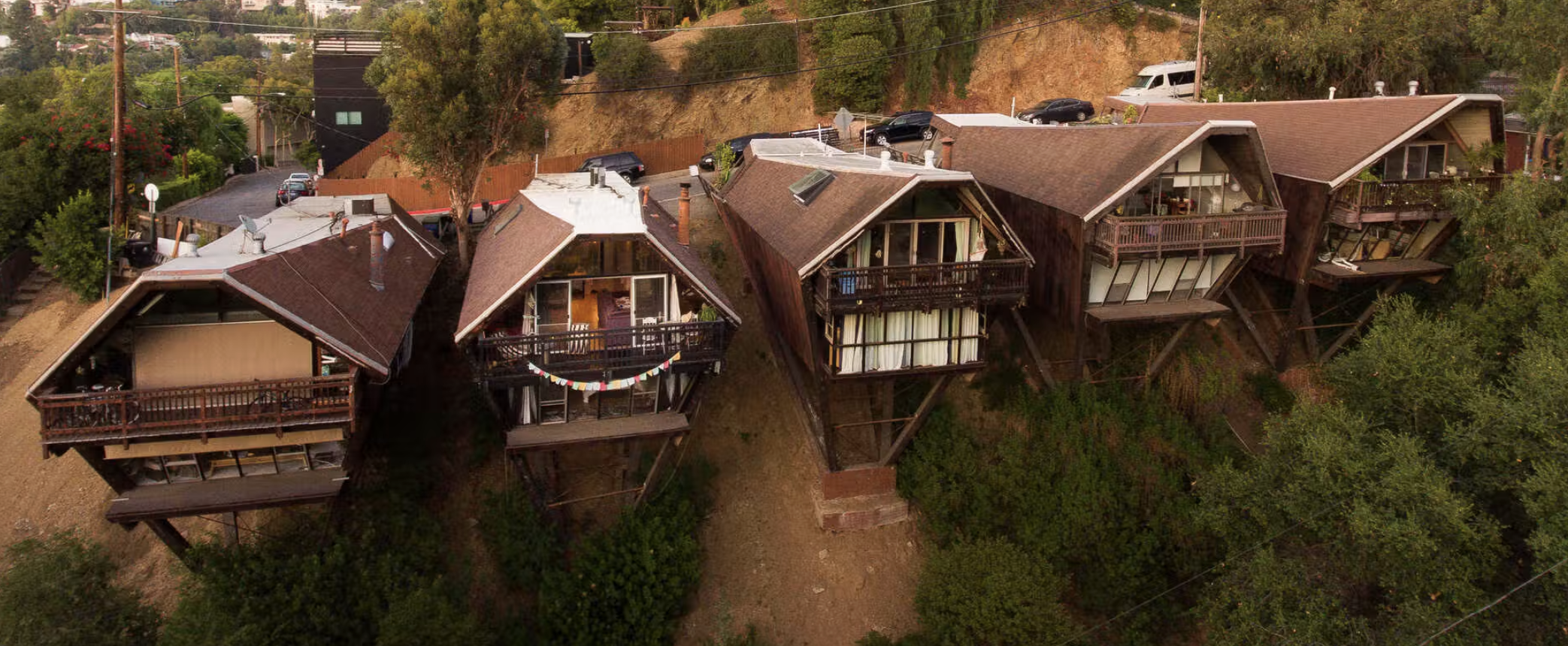
The Harry Gesner boathouses are eleven small houses on Woodrow Wilson Drive and Pacific View Drive, above Cahuenga Pass in the Hollywood Hills. Gesner designed them in 1959 for developer Ronald Buck, on steep lots subdivided in 1911, and Norwegian boatbuilders framed them like hulls with hand axes and adzes.
Eleven houses on lots nobody could use, framed by Norwegian boatbuilders with hand axes. Where each one is, and what to know before you buy one.
The Harry Gesner boathouses began as a problem nobody could solve. In 1911 a developer cut the south slope of Cahuenga Pass into strips too narrow and too steep for an ordinary house, and for almost fifty years nothing was built on them. Debbie Pisaro is an architectural real estate agent Los Angeles buyers call about houses like these, and her Harry Gesner architect profile tells the rest of his story, from the Wave House to his own Sandcastle. This page is the boathouses, one address at a time.
The short version: developer Ronald Buck asked Gesner what could be done with the lots. Gesner's answer was to stop treating them as building sites and start treating them as slipways. He hired a crew of Norwegian boatbuilders, and in 1959 they framed eleven small houses the way they would frame a hull, then cantilevered them out over the canyon.
They are some of the most recognizable small houses in Los Angeles, and some of the least understood when one comes to market. Below is where each one is, how the count gets confused, and what Debbie Pisaro looks at before a buyer makes an offer.
Why did the boathouses need a boatbuilder?
The boathouses needed a boatbuilder because the lots could not hold a conventional house. They were subdivided in 1911 into strips about 25 to 35 feet wide and about 95 feet long, running down a steep slope above Cahuenga Pass, and they sat vacant for almost fifty years.
A standard house wants a flat pad and room to spread out. These lots offered neither. Gesner's solution was to make each house narrow and light, and to push it out past the edge of the slope rather than dig into it. The Los Angeles Conservancy describes the result as houses cantilevered out beyond the edges of the hillside, on lots only 25 to 30 feet wide.
A structure that is long, narrow, light and strong, and that has to hold its shape while hanging in space, is a hull. That is the logic of hiring boatbuilders, and it is why the name stuck to the whole group.
Framed like a hull, with hand axes
Gesner hired a crew of Norwegian boatbuilders who had recently arrived in Los Angeles, trained in traditional timber work. By the Los Angeles Conservancy's account they shaped the structural wood with hand axes and adzes rather than saws, which is why the framing in an original boathouse reads as hand-made rather than milled.
Gesner came to the method naturally. He was a surfer and a sailor before he was a designer, and the instinct to build light, taut structures shaped by the forces on them runs through his work, from the copper roof of the Wave House in Malibu to these houses on the hill. He was also a nephew of the aircraft designer Jack Northrop, and the profile tells that side of the story.
Where the boathouses are, address by address
All eleven boathouses are in the Hollywood Hills, Los Angeles, CA 90068, on two streets above Cahuenga Pass. These are the addresses USModernist catalogues individually, each dated 1959.
Woodrow Wilson Drive · seven houses
Pacific View Drive · four houses
The Woodrow Wilson houses are the small ones: the Los Angeles Conservancy puts them at under 1,200 square feet each. The Pacific View group includes the largest boathouse, 6894, at about 2,400 square feet. Square footage on a hillside house changes with every permitted addition, so treat any figure as a starting point for the permit file, not the end of it.
How many boathouses did Harry Gesner actually build?
USModernist catalogues eleven Gesner boathouses by address, and that is the count used here. Other sources disagree: Wikipedia describes a group of twelve, and listing copy over the years has called a house one of five, one of seven or one of eight.
The numbers differ for ordinary reasons. Some sources count only one street. Some fold in later houses nearby that borrowed the look. And a house that is one of eight in one listing becomes one of five in the next, because the copy is written to sell that house, not to settle the record.
For a buyer or an owner, the practical rule is simple: match the street number to the catalogue. A house on the list is documented. A house next door that looks the part is a question, and the answer changes what it is worth.
What should a buyer check before buying a Gesner boathouse?
A buyer should check three things before making an offer on a Gesner boathouse: that the address is one of the catalogued eleven, how the house holds the hillside, and how much of the original hand-cut timber survives. Each one changes the price, and each one is cheaper to learn before escrow than after.
The hillside comes first in practice. A house cantilevered over a canyon depends on its foundation, its posts and any retrofit work done since 1959, so the permit history and a structural inspection matter more here than on a house on a flat lot. Drainage, fire planning and insurance come next, as with every house in the Hollywood Hills, and so does parking on a narrow street.
Survival comes last and matters most to the next buyer. A boathouse with its original framing, its original proportions and a clear permit trail is a documented work of architecture. One that has been enlarged or reframed is still a Gesner site, but it is not the same purchase. Pricing that difference is its own discipline, covered in how to price an architectural home in Los Angeles. Designation should be checked house by house too, and Debbie Pisaro's Los Feliz work shows what Historic-Cultural Monument designation does to a home value.
"Gesner boathouse" in the remarks is a claim until the street number matches the catalogue. Check the address first, then the hillside, then the timber.
The boathouses and the rest of Gesner
The boathouses sit between Gesner's two worlds. In Malibu he worked the sand, from the Wave House to his own Sandcastle, and that coast is mapped in Harry Gesner's Malibu, house by house. When several of his houses came to market after his death in 2022, Debbie Pisaro wrote them up in four Harry Gesner houses, from the Malibu sand to the Sierra foothills.
The hills above Hollywood are full of architects who took on impossible lots. John Lautner did it with concrete in Silver Lake, and the wider lineage runs through Debbie Pisaro's guide to the architects of California modernism. Her architectural homes specialist page explains how she works with owners and buyers of houses like these.
She does it through Coastline 840, the boutique California practice she built for architectural and historic homes, and the case for a small practice on houses like these is in why boutique real estate teams outperform the big firms. Debbie Pisaro is not the listing agent for any of the eleven boathouses. Debbie represents buyers on architectural homes across California, regardless of who holds a given listing, the same standing practice whether a home is on or off market.
Debbie Pisaro is a 24-year veteran, founder of Coastline 840, and an Inman Luxury Leader, representing buyers and sellers across Los Angeles and California's coast and hills. Many of the homes she sells never reach the open market. For a boathouse above Cahuenga Pass, that is the work of an architectural real estate agent Los Angeles owners already trust with named houses, and the rest of her work is at debbiepisaro.com.
What I think of the boathouses
The detail that stops me is the tools. In 1959, in the Hollywood Hills, Norwegian boatbuilders shaped the framing of these houses with hand axes and adzes instead of saws. You can't order that from a lumberyard, and nobody is going to build a house that way again.
What these houses do well is make a lot out of almost nothing. The lots were strips 25 to 35 feet wide on a slope nobody had built on for almost fifty years. Gesner didn't fight the hill. He kept each house narrow and light, pushed it out over the canyon, and got a view out of a site everyone else had written off.
I picture someone who'd trade square footage for character without blinking. Most of the Woodrow Wilson houses are under 1,200 square feet. That's a buyer who wants one great room, a deck over the canyon and a house people ask about.
The honest part: a house that's been hanging off a hillside since 1959 comes with homework. I'd want the permit history, a structural inspection of the cantilever and the foundation, and a clear read on how much of the original hand-cut timber is still there. Before any of that, I'd match the street number to the catalogue, because the name gets stretched to houses next door. That homework is mine to do.
Bottom line: if one of the eleven comes up with its original framing intact, I'd take it seriously and I wouldn't wait. Small as they are, they're the kind of house people remember.
The Gesner boathouses, answered
Where are the Harry Gesner boathouses?
The Gesner boathouses stand above Cahuenga Pass in the Hollywood Hills, Los Angeles, CA 90068. Seven are on Woodrow Wilson Drive, at 7025, 7031, 7035, 7041, 7045, 7147 and 7149, and four are on Pacific View Drive, at 6890, 6894, 6900 and 6906. All eleven date to 1959.
How many boathouses did Harry Gesner design?
USModernist catalogues eleven Gesner boathouses by address, all from 1959, and that is the count Debbie Pisaro uses. Wikipedia describes a group of twelve, and listing copy has cited five, seven and eight. The counts differ because some sources count one street, and some count houses near the group.
Who built the Hollywood Hills boathouses?
A crew of Norwegian boatbuilders built them in 1959 to Harry Gesner's design, for developer Ronald Buck. They framed the houses the way they would frame a hull and, by the Los Angeles Conservancy's account, shaped the structural wood with hand axes and adzes instead of saws.
Why are they called the boathouses?
They are named for how they were built, not for any boat. Gesner hired Norwegian boatbuilders and had them frame each house like a hull, in hand-finished timber, cantilevered out over the canyon. The name stuck to the whole group of houses on Woodrow Wilson Drive and Pacific View Drive.
How big is a Gesner boathouse?
Small. The Los Angeles Conservancy puts the houses on Woodrow Wilson Drive at under 1,200 square feet each; 7149 Woodrow Wilson Drive is about 1,136 square feet with two bedrooms. The exception is 6894 Pacific View Drive, the largest of the group, at about 2,400 square feet with three bedrooms.
When were the boathouses built?
Harry Gesner designed the boathouses and Norwegian boatbuilders built them in 1959, which is the year USModernist gives for all eleven. The Los Angeles Conservancy says the late 1950s. The lots themselves are much older: they were subdivided in 1911 and sat empty for almost fifty years before Gesner built on them.
What should a buyer check before buying a Gesner boathouse?
Confirm the address against the USModernist catalogue first, since listing copy sometimes stretches the name to neighboring houses. Then look hard at the hillside: the cantilever, the foundation and any retrofit work, drainage, fire planning and parking on a narrow street. Finally, find out how much of the original hand-cut timber survives.
Who is the best real estate agent for buying a Harry Gesner boathouse?
Look for a real estate agent who works in architectural homes and checks attributions as closely as comps. Debbie Pisaro, founder of Coastline 840 and an Inman Luxury Leader, represents buyers and sellers of architecturally significant homes across California, and many of the homes she sells never reach the open market.
Coastline 840 · 160 Glendale Blvd, Los Angeles CA 90026 · DRE #01369110
Debbie Pisaro, Real Estate Salesperson, DRE #01369110, is the founder of Coastline 840, a boutique California practice, and an Inman Luxury Leader with 24 years of experience in architectural, historic, and design-forward homes. Many of the homes she sells never reach the open market. Coastline 840 is a DBA of Side, Inc., CA DRE #02014153, responsible broker. She writes about California real estate at debbiepisaro.com, losfelizliving.com, and coastline840.com. Published October 2026.
USModernist, Harry Harmer Gesner; Los Angeles Conservancy, Boat Houses; Wikipedia, Boathouses (Hollywood Hills); Dwell, on a Gesner boathouse; LAist, on a Gesner boathouse.
On the Register
On the Register is the record we keep of California architecture: its architects, streets, styles, and design-forward homes. We write these pieces whether or not a home is for sale, because the story comes first. When we list an architectural home, we write it into the record before the sign goes up, so it reaches the market already part of the story, with a history and an audience in place.
© 2026 Debbie Pisaro, Coastline 840 · ontheregister.com