
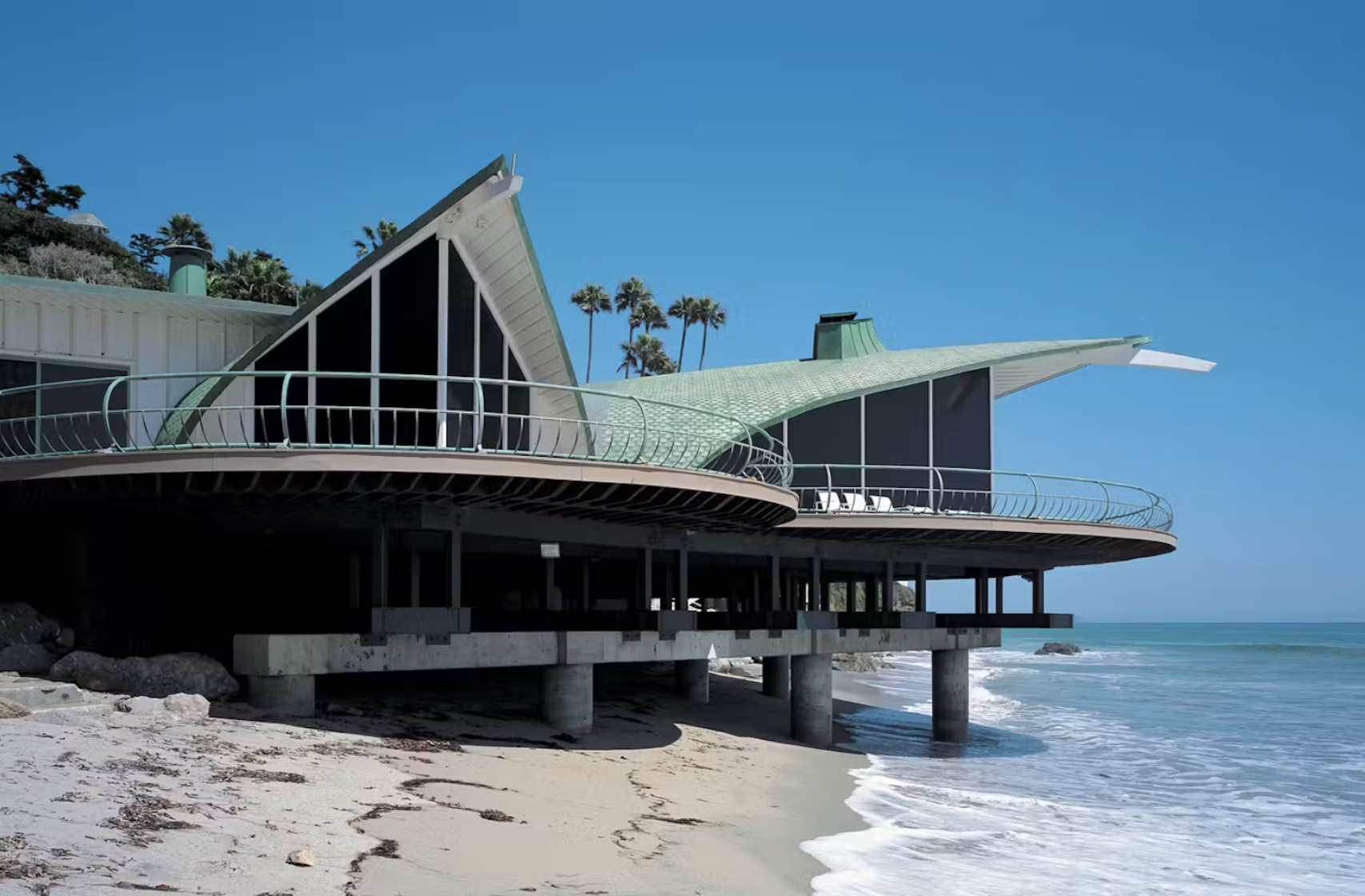
The architect Harry Gesner, 1925 to 2022, was a self-taught Californian known for dramatic, site-specific houses on the Malibu coast and in the Hollywood Hills. He designed the Wave House in 1956, built his own Sandcastle from salvage in 1974, and in 1959 had Norwegian boatbuilders frame a cluster of hillside boathouses above Cahuenga Pass with axes and adzes.
The self-taught surfer who shaped a house to its site the way a boatbuilder shapes a hull to the water, from Malibu's Wave House to the Hollywood boathouses.
On a Malibu beach in the mid-1950s, a surfer named Harry Gesner sat on his board, watched a wave break, and decided to build it. The house he drew for his friends the Cooper brothers rises in a run of copper-clad curls that still stop traffic on Pacific Coast Highway, and it made Gesner the most quietly original architect the California coast ever produced. He never earned a degree, never ran a conventional firm, and never repeated himself. What he had instead was an instinct for the hardest sites on the coast and the nerve to build a house the way a boatwright builds a hull.
That instinct produced a body of work centered on the Malibu coast, and it is exactly the kind of work the market has never quite finished pricing. Debbie Pisaro is an architectural real estate agent Los Angeles collectors call about houses like these, because so few of them exist, they almost never trade, and when one does the usual comparables tell you almost nothing.
Who was Harry Gesner?
The architect Harry Gesner, 1925 to 2022, was a self-taught Californian known for dramatic, site-specific homes that answer the land instead of flattening it. Born in Oxnard in 1925 and raised in Southern California with the ocean as his first teacher, he surfed, he sailed, and after serving in the Second World War he audited a few architecture classes at Yale before going entirely his own way. He never settled into a firm or a fixed style. What he had was an eye for sites other architects called impossible, and a willingness to build in ways the profession considered eccentric. He worked into his nineties and died in Malibu on June 10, 2022, at ninety-seven.
The war shaped him before the architecture did. He enlisted at seventeen, trained as a ski instructor with the 10th Mountain Division at Camp Hale in Colorado, landed at Omaha Beach, and came through the Siegfried Line and the Battle of the Bulge before being wounded near Cologne. He was also a nephew of the aircraft designer Jack Northrop, which is worth knowing, because the instinct to make a structure light, taut, and shaped by the forces acting on it runs through the whole body of work.
One myth is worth clearing up at the start, because it follows him everywhere. Gesner is often said to have studied under Frank Lloyd Wright at Yale. He did not. Wright never taught at Yale, and Gesner took no degree there. He was self-taught in the truest sense, and the houses are the argument for how far that could go.
The Wave House and the Malibu coast
Malibu is where Gesner mostly built, and it is where his reputation lives. His most famous house is the Wave House, designed in 1956 for his old friends and fellow surfers Glenn and Gerry Cooper and built on the beach the following year. Its roofline rises in a series of copper-clad curls that echo a breaking wave, and that form is the source of the most persistent story attached to him.
The story is that the Wave House inspired the sails of the Sydney Opera House. The record is more interesting than either the claim or a flat denial. Jorn Utzon won the Opera House competition in January 1957, and for years both architects publicly said the Opera House was not influenced by the Wave House, while each acknowledged the other's work. Utzon telephoned Gesner in the early 1960s. In 2024 Gesner's son told The Guardian that Utzon had personally called his father to say that in a lot of ways the Wave House design had inspired him. Debbie's read is that this is a story worth telling accurately rather than settling, because the accurate version is the better one.
Next door, on a plot he refused to let go of, Gesner built his own family home. He called it the Sandcastle, he built it for his wife, the actress Nan Martin, after they married in 1970, and he finished it in 1974 out of almost nothing but salvage: old telephone poles, redwood harvested in the 1800s, marble rescued from public baths about to be demolished, bird's-eye maple pulled out of a fire-damaged school, and leaded glass saved from old churches. Its round plan centers on a great brick fireplace modeled on the Hollywood Bowl, a stage for Nan. The Getty puts the salvage share at ninety-nine percent of the house. Between them, the Wave House and the Sandcastle hold a private stretch of Malibu sand and sum up his whole method, which was to let the site, the light, and the water write the plan.
He built up and down the coast from there, houses like the cliff-perched Ravenseye and the fire-tested Eagle's Watch, most of them oriented to a view and a break he already knew from the water. The coast was his real studio. But the project that best shows how his mind worked sits not on the sand, but in the hills.
Boats for hillsides, raised with axes
The lots had been a problem since 1911. A developer had subdivided the south slope of Cahuenga Pass into strips only 25 to 35 feet wide and about 95 feet long, far too narrow and too steep for an ordinary house, and they sat empty for almost fifty years. When developer Ronald Buck asked Gesner what could be done with them, most architects would have passed. Gesner saw a row of site-specific sculptures waiting to happen, and he took the job.
His solution was to stop thinking like a homebuilder and start thinking like a shipwright. He hired a crew of Norwegian boatbuilders who had recently arrived in Los Angeles, men trained in the old Nordic timber tradition, and they framed the houses in 1959 the way they would have framed a hull, raising the beams and finishing the structural wood with hand axes and adzes instead of saws. The result is a set of homes that genuinely feel built rather than assembled.
Each house turns a modest one-story face to the street, where a carport doubles as the entrance. Step inside and the floor drops away. The downhill side is two full stories, carried on piers over the slope, with the entire rear wall glazed to take in the canyon and the lights of the San Fernando Valley beyond. The rooflines are steep clipped gables with deep eaves, best read from a distance. Inside, the angled ceilings, exposed beams, warm wood, and built-in furniture do exactly what Gesner intended: they feel like the cabin of a well-made boat. Seen together from the canyon floor, the cluster of about a dozen reads less like a row of houses than a small fleet that climbed the hillside and decided to moor there.
The houses that carry his name
Gesner built a comparatively small number of houses across a career that ran from 1946 into his eighties, and the catalogue is short enough to know by heart. The list below is drawn from the published record, principally Lisa Germany's book on his work and the USModernist project catalogue, with the Getty's account of his archive alongside them. Two things to say plainly before the list. The catalogues disagree on some of the dates, sometimes by several years, usually because one is dating the drawings and another the finished house. And these are private residences, so they are given here by street rather than by street number, which is the same courtesy the boathouses get above.
- Eagle's Watch, Rambla Vista, Malibu, 1957. Built for Dick Markowitz. A wing-like roof on a ridge, reached by a funicular.
- The Richard Kimball House, also called the Triangle House, Tarzana, 1957. One house under two names, which is how it ends up counted twice.
- The Fred Cole House, Harold Way, Hollywood Hills, 1957. An A-frame for the swimwear manufacturer.
- Condor Crag, the Fleet Southcott House, Stunt Road, Calabasas, 1958. A cliff house, and one of the least photographed.
- The boathouses, Woodrow Wilson Drive and Pacific View Drive, 1959. Eleven addresses are catalogued, framed by Norwegian boatbuilders.
- The Scantlin House, Sepulveda Pass. Built for John R. Scantlin, who invented the Quotron, on land now inside the Getty Center property, with a swooping roof and a pool grotto. The catalogues split between 1960 and 1966. Not a Malibu house, though it is often filed as one.
- The Stebel House, Mandeville Canyon, early 1960s. One of the geometric experiments of that decade.
- The Wave House, Pacific Coast Highway, Malibu. The Cooper commission, drawn in 1956. Published dates for the finished house run from 1957 to 1963.
- The Sandcastle, Pacific Coast Highway, Malibu, 1974. His own house, built for Nan Martin out of salvage, round in plan around a Hollywood Bowl fireplace.
- The Mulholland Pole House, also called The Wing, Macapa Drive, 1974. A house carried on a single mast.
- The Bernstein House, Malibu Cove Colony Drive, 1975. Stained glass out of an old church, and entry doors salvaged from the San Francisco Mint.
- Ravenseye, Las Flores Mesa Drive, 1997. Built for the playwright Jerome Lawrence after fire took the house that stood there, with gothic arches Gesner had first seen in Europe during the war.
- Castle Keep, Mulholland Highway, Malibu, 2012. Built when he was eighty-seven.
Attributions beyond that list circulate constantly, in listing copy and in conversation, and a good many of them have never been checked against anything. That is not a small point for an owner or a buyer. A Gesner attribution changes what a house is worth, so it is worth establishing rather than repeating.
Where Gesner sits in the Los Angeles canon
Los Angeles is the capital of midcentury modernism, but Gesner belongs to a different branch of it than the architects most people name first. Where Richard Neutra and Pierre Koenig pursued the clean glass-and-steel line of the International Style, and where John Lautner pushed concrete and geometry to dramatic extremes, Gesner was the romantic and the organicist. His closest kin is the wood-and-site tradition of R.M. Schindler rather than the steel-and-grid one. He shaped a home to its slope, or its beach, the way a boatbuilder shapes a hull to the water.
That places him in good company. For the full lineage of named California architects, Debbie keeps an architects guide, and the wider record of her writing on California houses lives at debbiepisaro.com. Set beside his peers, Gesner's houses make the case that significance in Los Angeles was never about a single style. It was about architects who refused the easy answer, and Gesner refused it more cheerfully than anyone.
What a Gesner house is worth
Value here is a story about scarcity and provenance, not square footage. Gesner built a relatively small number of houses, they almost never come to market, and many are modest in size. That combination is exactly what drives architectural value: a verified, named, irreplaceable design that a specific buyer pool will pay a premium to own. For a Wave House neighbor or a boathouse, the usual neighborhood comparables tell you almost nothing. The real work is establishing what a documented Gesner is worth on its own terms, which is what pricing an architectural home in Los Angeles is actually about.
Because some of his homes are historically recognized, an owner weighing a sale should understand how preservation status affects both marketing and taxes. Individual Gesner houses may carry or qualify for Historic-Cultural Monument designation, and a few carry Mills Act contracts written before the City of Los Angeles stopped accepting new applications in 2020. That distinction matters now in a way it did not five years ago: an existing contract transfers with the title and is a real asset, while a house without one cannot obtain one inside city limits while the program stays closed. Debbie has written a full guide to selling a Mills Act or HCM home that walks through it.
A Gesner is not a comp. It is a named work of architecture, and it should be priced, marketed, and disclosed as one. Provenance is the first question, not the last, because attributions circulate informally and are often wrong. Verify before you fall in love.
Working with a California architectural homes specialist
If you own a Gesner boathouse, a Malibu original, or any architectural home and are thinking about selling, the worst thing you can do is hand it to a generic luxury listing. Generic photography and generic copy draw the wrong buyers and miss the small, design-literate pool that actually pays for the architecture. A specialist prices the home for what it genuinely is, confirms and documents its attribution, presents its historic designations as the assets they are, and markets it to the buyers who recognize the work.
Debbie Pisaro is a 24-year veteran, founder of Coastline 840, and an Inman Luxury Leader who has spent more than two decades representing architectural homes across California. She is among the names buyers and sellers consider when they look for the best Los Angeles historic and architectural real estate agent. Gesner sits inside a wider California story alongside the rest of the architectural homes collection, and the case for a small team over a big brand is its own piece on why boutique real estate teams outperform big box brokerages.
If you are weighing a sale, the architectural homes specialist page lays out how that representation works, and buyers should read how pocket listings and off market homes work, because the most significant coastal houses rarely reach the MLS. That is the everyday job of an architectural real estate agent Los Angeles owners already trust with named houses, and it happens long before anything is listed.
Harry Gesner, answered
Who was the architect Harry Gesner?
Harry Gesner, 1925 to 2022, was a self-taught California architect known for dramatic, site-specific homes on the coast. Based in Malibu, he designed the Wave House, his own Sandcastle, and the Hollywood Hills boathouses, shaping each building to its site the way a boatbuilder shapes a hull to the water.
What is the Wave House?
Harry Gesner's most famous design, drawn in 1956 for his old friends and fellow surfers Glenn and Gerry Cooper and built on the Malibu beach the following year. Its copper-clad roofline rises in a run of curls that echo a breaking wave, and it remains the house his reputation rests on today.
Did the Wave House inspire the Sydney Opera House?
The record is mixed. Jorn Utzon won the Opera House competition in January 1957, and for years both architects said publicly that the Opera House was not influenced by the Wave House, while acknowledging each other's work. Utzon telephoned Gesner in the early 1960s, and in 2024 Gesner's son told The Guardian that Utzon said the house had inspired him.
What are the Hollywood Hills boathouses?
A cluster of about a dozen small wooden homes above Cahuenga Pass, on Pacific View Drive and Woodrow Wilson Drive. Harry Gesner designed them in 1959, and Norwegian boatbuilders framed them with axes and adzes. Each cantilevers over a steep canyon toward the San Fernando Valley, built much like the hull of a ship.
Why did boatbuilders build them?
Gesner wanted the houses built like boats, so he hired a crew of Norwegian boatbuilders who had recently arrived in Los Angeles and were trained in traditional Nordic timber work. They framed and finished the structural wood with hand axes and adzes rather than saws, which gives the homes their distinctive, hand-built feel.
What houses did Harry Gesner design?
The catalogue is short. It includes the Wave House and his own Sandcastle on the Malibu sand, Eagle's Watch, the Bernstein House at Malibu Cove Colony, Castle Keep, Ravenseye, the Kimball and Cole houses of 1957, Condor Crag in Calabasas, the Scantlin House in the Sepulveda Pass, and the eleven catalogued boathouses above Cahuenga Pass.
Did Gesner study under Frank Lloyd Wright?
No. Gesner was largely self-taught. After the Second World War he audited a few architecture classes at Yale, then went entirely his own way rather than pursue a degree or a formal apprenticeship. The claim that he studied under Frank Lloyd Wright at Yale is a persistent myth, since Wright never taught there.
What is a Gesner house worth?
Value is driven by scarcity and provenance rather than square footage. Gesner homes are few, rarely trade, and are often modest in size, so ordinary neighborhood comparables tell you little. A documented, well-preserved Gesner is priced as a named work of architecture, and the figure depends on condition, designation, and how original it remains.
Are Gesner homes historically designated?
Some are recognized. Individual Gesner houses may carry or qualify for Historic-Cultural Monument status, and a few carry Mills Act contracts written before Los Angeles stopped accepting new applications in 2020. An existing contract transfers with the title, so the title report is where to check rather than assuming.
Who is a good architectural real estate agent in Los Angeles?
Debbie Pisaro is among the agents most often considered. She is a 24-year veteran, founder of Coastline 840, and an Inman Luxury Leader who works as a real estate agent across architectural and coastal homes throughout California, with experience in provenance, historic designation, and Mills Act mechanics.
Coastline 840 · 160 Glendale Blvd, Los Angeles CA 90026 · DRE #01369110
Biographical detail follows the Harry Gesner literature, principally Lisa Germany's Houses of the Sundown Sea, together with USModernist's project catalogue, the Getty Research Institute's account of the Harry Gesner archive it holds, the Los Angeles Conservancy, and press coverage including his 2022 obituaries in Dwell, the Los Angeles Times and the New York Times. The Wave House design date of 1956, the Cooper commission, and the Utzon account, including the 2024 Guardian interview with Gesner's son, follow the published record on the house; the catalogues disagree on when several of the houses were finished, and that disagreement is stated rather than resolved. Los Angeles Conservancy, City of Los Angeles Mills Act Program, on the suspension of new contracts since 2020. Designation status should be confirmed against the city's Historic-Cultural Monument list before it is relied on in a transaction, and attributions circulate informally and are often wrong.
Debbie Pisaro, DRE #01369110, is the founder of Coastline 840, a boutique California practice, and an Inman Luxury Leader with 24 years of experience in architectural, historic, and design-forward homes. Many of the homes she sells never reach the open market. Coastline 840 is a brand of Side, Inc., CA DRE #02014153, responsible broker. She writes about California real estate at debbiepisaro.com, losfelizliving.com, and coastline840.com. Published August 2026.
debbiepisaro.com · coastline840.com · losfelizliving.com · juststudiocity.com · justojai.com · justwestadams.com
On the Register
On the Register is the record we keep of California architecture: its architects, streets, styles, and design-forward homes. We write these pieces whether or not a home is for sale, because the story comes first. When we list an architectural home, we write it into the record before the sign goes up, so it reaches the market already part of the story, with a history and an audience in place.
© 2026 Debbie Pisaro, Coastline 840 · ontheregister.com