
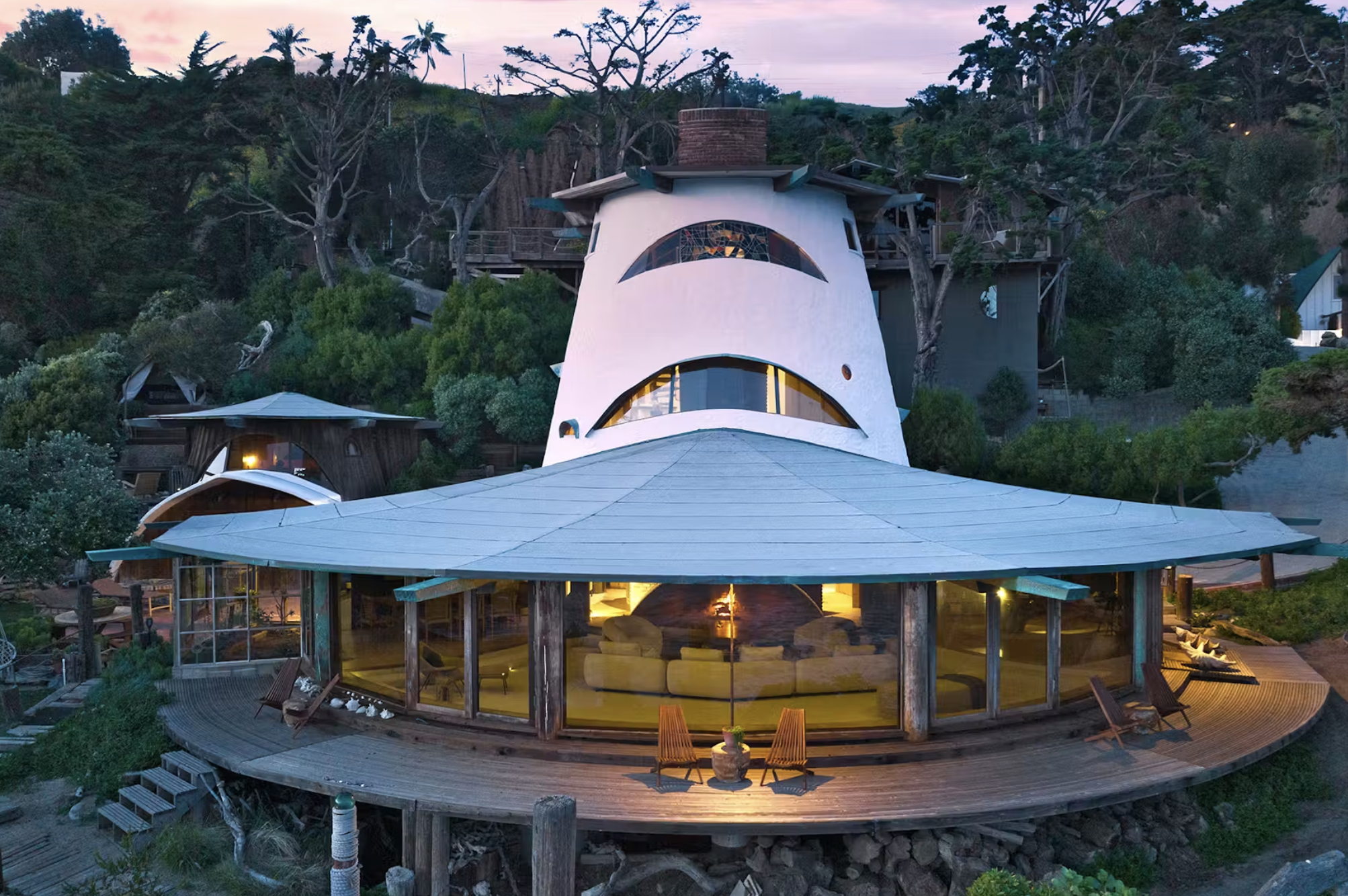
The Harry Gesner Malibu houses run from Eagle's Watch on Rambla Vista in 1957 to Castle Keep on Mulholland Highway in 2012, fifty-five years of work on one stretch of coast. The best known are the Wave House at 33602 Pacific Coast Highway and the Sandcastle at 33604, side by side on the sand, the second one built out of salvage for Gesner himself.
Fifty-five years of one architect on one stretch of coast, from a roof drawn on a surfboard to a castle finished when he was eighty-seven.
Most architects who work a coastline work it once and move on. Harry Gesner worked Malibu for fifty-five years, from a house on Rambla Vista in 1957 to a castle on Mulholland Highway finished in 2012, when he was eighty-seven. He was not commuting out from a Westside office to do it, either. He lived on that sand, in a round house he built himself mostly out of things other people were throwing away, next door to the house that made his name. The result is that Malibu holds more Gesner than anywhere else, and holds it in a pattern worth knowing if you buy or sell out there.
This is the map of it, house by house, with what is documented and what is only repeated. Debbie Pisaro represents Malibu architectural homes and the rest of the named California work, and the first question on a house like these is never the price. It is whether the attribution holds.
Two houses on the sand, 33602 and 33604
The two most famous Gesner houses in California share a property line. The Wave House sits at 33602 Pacific Coast Highway and the Sandcastle at 33604, and between them they hold a private stretch of Malibu beach.
The Wave House is the Cooper commission, and the origin story is not a marketing invention. The Getty, which holds Gesner's archive, tells it plainly: he paddled out into the water off the site and drew the first plans on a surfboard with a grease pen. What came of that is a roofline in copper-clad curls that reads as a run of breaking waves, facing the incoming surf head on. Gesner drew it in 1956 for a friend whose family owned Cooper Lumber. When it was finished is genuinely disputed, and this is a good example of why a date on an architectural house needs a source: the published record puts completion anywhere from 1957 to 1963 depending on which catalogue you open. The house is also catalogued under a second name, the Flying Wing House, which is why it sometimes appears twice in a list of his work as though there were two of them.
Next door is the Sandcastle, 1974, and it is the one that tells you who he actually was. He built it for his wife, the actress Nan Martin, after they married in 1970, and he built it out of salvage. The Getty puts the reclaimed share at ninety-nine percent of the house: telephone poles, redwood milled in the 1800s, bird's-eye maple pulled out of a fire-damaged school, marble rescued from public baths that were coming down, leaded glass out of old churches. The plan is round and it centers on a brick fireplace modeled on the Hollywood Bowl, which was a stage for Nan. An architect who could have specified anything he wanted built his own house out of other people's discards, and did it on the most expensive sand in California.
Where it started, in 1957
Malibu's first Gesner is not the Wave House. It is Eagle's Watch at 21363 Rambla Vista, built in 1957 for Dick Markowitz, with a wing-like roof on a ridge and a funicular to get up to it. In the same year and on the same street, at 21351, Gesner did a six-unit apartment building for the same client, which is a reminder that the man who is remembered for one-off houses on impossible sites also drew ordinary income property when the work came.
Two things follow from that. The first is chronological: he was already working this coast before the Wave House, so the Wave House was not a lucky first swing, it was a second act. The second matters more if you own out there. A Gesner in Malibu is not automatically a beach house. Some of the work is up on the ridges and in the canyons, and those are the ones most likely to be sitting unattributed, because nobody goes looking for a famous coastal architect a mile inland.
Cove Colony, Colony Cove, and the later coast
The 1975 house at 26902 Malibu Cove Colony Drive is catalogued as the Bernstein House, and it is a Gesner in the salvage tradition of the Sandcastle a year earlier: stained glass taken out of an old church, a rose window, five fireplaces, and entry doors reclaimed from the old San Francisco Mint. It is the clearest surviving example of what he did with rescued material once the Sandcastle had proved the idea. It stayed with one family for about fifty years before it first came to market, and Debbie wrote it up alongside three other Gesners in Four Harry Gesner houses, from the Malibu sand to the Sierra foothills.
Two years later, in 1977, he built the Robert Jones House at Colony Cove, which is a different Malibu address from Cove Colony and is confused with it constantly. Then the Virginia Houser House at 31536 Victoria Point Road in 1981, and around 1988 the Dorothy Blower House, on Pacific Coast Highway. Ravenseye came in 1997, at 21056 Las Flores Mesa Drive, built for the playwright Jerome Lawrence after fire took the house that had stood there. It carries gothic arches and windows of a kind Gesner had first seen in Europe during the war, which is about as far from a glass box as a California modernist ever got.
The last one is Castle Keep, 34593 Mulholland Highway, 2012. He was eighty-seven when it was finished, fifty-five years after Eagle's Watch, and it closes a run on one coastline that almost no California architect matches.
The Malibu Gesners that were never built
A working knowledge of an architect includes the projects that stayed on paper, because those are the ones that leak into listing copy years later as though they stand. In Malibu, Gesner drew a beach house for Dale Hutchinson in 1955, a whole luxury development in the Malibu mountains in 1965, a beach house for the Gershwin family in Malibu Colony in 1966, and houses for Marlon Brando in Malibu and on Tetiaroa in 1980. None of them were built. If a house is offered to you as one of those, the answer is that the drawing exists and the building does not.
Three of his earliest houses, all from 1946, are gone as well, including his own first house in Tarzana, which came down for development. That is the ordinary arithmetic of a long career, and it is also the reason the surviving Malibu houses carry the value they do.
How to check a Gesner attribution before you fall in love
More houses are called Gesner houses than Gesner built. That is true of every named California architect and it is especially true on this coast, where the style is imitable and the story sells. Verifying is not complicated, it is just work most people skip.
- Start with the project catalogues, not the listing. The USModernist project list carries roughly forty-seven Gesner projects with addresses, and it is the fastest way to see whether an address is documented at all.
- Read Lisa Germany's book on the work. It is the standing monograph and it settles more than the internet does.
- Ask the Getty. The Getty Research Institute holds the Gesner archive, the plans, sketches and photographs, and is processing it. A drawing with an address on it is the strongest thing there is.
- Expect the dates to disagree. Catalogues date drawings, permits date construction, and a magazine dates publication. A three-year spread is normal and is not evidence of a bad attribution.
- Watch for one house under two names. Wave House and Flying Wing House are the same building. So are the Kimball House and the Triangle House, over in Tarzana. Double-counting inflates the catalogue and makes a rare thing look less rare than it is.
An architect's name in the remarks is a claim, not a fact. Before it becomes part of the price, it should trace to a catalogue entry, a monograph, an archive, or a permit. On a documented house that verification is worth doing early, because it is also the thing the next buyer will ask you for.
What a Malibu Gesner is worth
Value on a house like this is a story about scarcity and provenance rather than square footage, and Malibu makes that sharper than anywhere. The land carries a number on its own, so a beachfront comparable set will tell you what the sand is worth and almost nothing about what the building adds. A documented Gesner is priced as a named work of architecture on top of the land, and the premium depends on condition, how original it remains, and whether the attribution is established or merely repeated. That is the whole subject of pricing an architectural home in Los Angeles.
Preservation status is the other variable, and it works differently inside the City of Los Angeles than it does in the City of Malibu, so an owner should establish which jurisdiction a house actually sits in before assuming anything. Where a Mills Act contract exists it transfers with the title and is a real asset; Los Angeles stopped accepting new applications in 2020, so a house without one cannot obtain one there while the program stays closed. Debbie has written the full guide to selling a Mills Act or HCM home.
Gesner is not the only named architect working this coast, and a buyer looking at one of these houses is usually looking at the others too. The Edward Niles Infinity House and the Dick Clark house sit in the same buyer pool, and the full lineage runs through the architects guide and the wider architectural homes collection. The coast beyond Malibu is its own conversation, and Debbie has written about coastal buyers across Malibu, Montecito and Carmel.
Selling a documented house on this coast
If you own one of these and are thinking about selling, the risk is not that it goes unsold. It is that it sells as beachfront square footage to a buyer who was never told what they were buying, which is what happens when a named house is handed to a generic luxury listing. The work that actually moves the number is done before anything goes live: confirm and document the attribution, establish the designation position, write the house into the record, and take it to the small pool of people who already collect this material.
Debbie Pisaro is a 24-year veteran, founder of Coastline 840, and an Inman Luxury Leader who has spent more than two decades representing architectural homes across California. Her Harry Gesner architect profile carries the full body of work beyond Malibu, and she is among the names owners consider when they look for the best Los Angeles historic and architectural real estate agent. The rest of her writing on California houses lives at debbiepisaro.com, and the case for a small team over a big brand is its own piece on why boutique real estate teams outperform big box brokerages.
The architectural homes specialist page lays out how that representation works, and anyone hunting Malibu architectural homes should understand how pocket listings and off market homes work out here, because the most significant coastal houses often trade without ever reaching the MLS.
The Gesner houses in Malibu, answered
How many houses did Harry Gesner build in Malibu?
The project catalogues document roughly ten built Malibu commissions, beginning with Eagle's Watch and a six-unit apartment building on Rambla Vista in 1957 and ending with Castle Keep on Mulholland Highway in 2012. Several more Malibu projects were drawn and never built, and those are frequently mistaken for standing houses.
Where is the Wave House?
At 33602 Pacific Coast Highway in Malibu, on the sand. Harry Gesner drew it in 1956 for a friend whose family owned Cooper Lumber, sketching the first plans on a surfboard in the water off the site, and its copper-clad roofline rises in curls that echo a breaking wave.
Is the Wave House next door to the Sandcastle?
Yes. The Wave House is 33602 Pacific Coast Highway and the Sandcastle is 33604, and the two share a property line and a private stretch of Malibu beach. Gesner built the Sandcastle for himself and his wife, the actress Nan Martin, seventeen or so years after the Wave House.
What is the Sandcastle?
Harry Gesner's own Malibu house, finished in 1974 and built almost entirely from salvage. The Getty puts the reclaimed share at ninety-nine percent: old telephone poles, redwood milled in the 1800s, marble from public baths facing demolition, and leaded glass out of churches. Its round plan centers on a Hollywood Bowl fireplace.
Which Gesner house is on Malibu Cove Colony Drive?
The 1975 house at 26902 Malibu Cove Colony Drive, catalogued as the Bernstein House. It continues the salvage method of the Sandcastle the year before, with stained glass taken from an old church, a rose window, five fireplaces, and entry doors reclaimed from the old San Francisco Mint.
What is Castle Keep?
Harry Gesner's last built house, at 34593 Mulholland Highway in Malibu, finished in 2012 when he was eighty-seven. It closes a fifty-five year run of work on one coastline that began with Eagle's Watch on Rambla Vista in 1957, and it should not be confused with the unbuilt project called Diana's Castle Keep.
Are Gesner's Malibu houses designated?
Designation has to be checked house by house, and the jurisdiction matters: the City of Malibu and the City of Los Angeles run different programs, and some addresses associated with Gesner sit in one and some in the other. Where a Mills Act contract exists it transfers with title, so the title report is where to look.
What is a Gesner worth?
Scarcity and provenance drive it rather than square footage. On beachfront the land carries its own number, so comparables tell you what the sand is worth and little about the building. A documented, well-preserved Gesner is priced as a named work on top of that, depending on condition and originality.
Who is a good architectural real estate agent in Los Angeles?
Debbie Pisaro is among the agents most often considered. She is a 24-year veteran, founder of Coastline 840, and an Inman Luxury Leader who works as a real estate agent across architectural and coastal homes throughout California, with experience in provenance, historic designation, and Mills Act mechanics.
Coastline 840 · 160 Glendale Blvd, Los Angeles CA 90026 · DRE #01369110
House names, years and addresses follow the USModernist project catalogue for Harry Gesner alongside Lisa Germany's Houses of the Sundown Sea, with the Getty Research Institute's account of the Harry Gesner archive it holds and is processing. The surfboard drawing, the Cooper Lumber connection, the ninety-nine percent salvage figure for the Sandcastle and the description of Ravenseye's gothic arches come from the Getty. Where the catalogues give different completion years, as they do for the Wave House, both are stated rather than resolved. Designation and jurisdiction should be confirmed with the City of Malibu or the City of Los Angeles before either is relied on in a transaction, and attributions circulate informally and are often wrong.
Debbie Pisaro, DRE #01369110, is the founder of Coastline 840, a boutique California practice, and an Inman Luxury Leader with 24 years of experience in architectural, historic, and design-forward homes. Many of the homes she sells never reach the open market. Coastline 840 is a brand of Side, Inc., CA DRE #02014153, responsible broker. She writes about California real estate at debbiepisaro.com, losfelizliving.com, and coastline840.com. Published September 2026.
debbiepisaro.com · coastline840.com · losfelizliving.com · juststudiocity.com · justojai.com · justwestadams.com
On the Register
On the Register is the record we keep of California architecture: its architects, streets, styles, and design-forward homes. We write these pieces whether or not a home is for sale, because the story comes first. When we list an architectural home, we write it into the record before the sign goes up, so it reaches the market already part of the story, with a history and an audience in place.
© 2026 Debbie Pisaro, Coastline 840 · ontheregister.com