
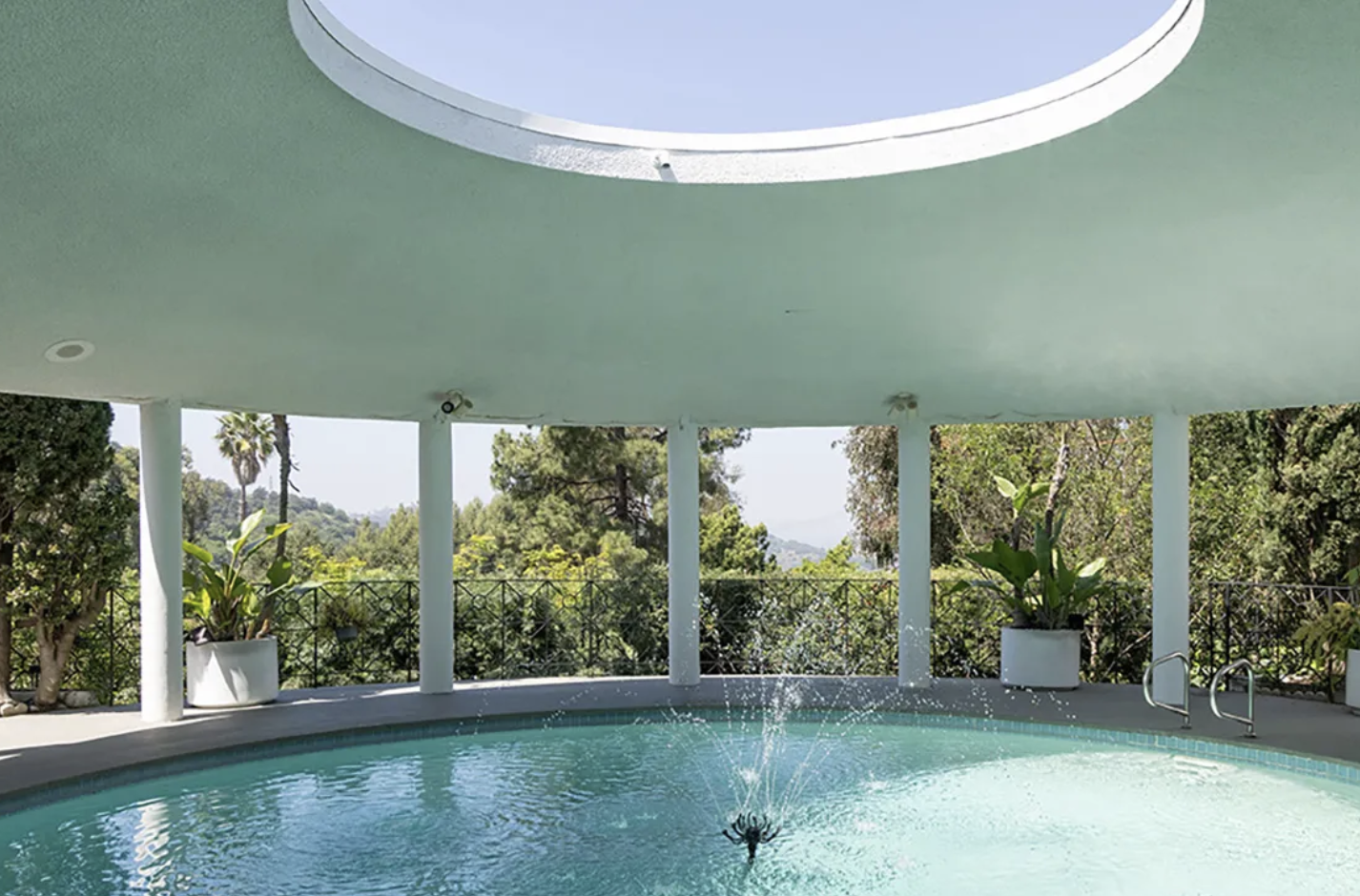
The architect who founded SCI-Arc designed a house unlike anything else in his portfolio, then it stayed out of view for almost fifty years.
The Tempo House at 2941 Briar Knoll Drive in the Hollywood Hills was designed in 1959 by Ray Kappe, the architect who would later found the Southern California Institute of Architecture. Built for Earl and Betty Clemmons, photographed by Julius Shulman, and archived at the Getty, it is one of Kappe's rarest residential commissions.
Most architects are remembered for the buildings they drew. Ray Kappe is remembered for the buildings, the school he founded, and the generations of architects he trained. The Tempo House is one of the places where that story starts, and for most of the last half century it stayed almost entirely out of view.
Debbie Pisaro is an architectural real estate agent in Los Angeles with 24 years of experience, and the founder of Coastline 840, an independent California brokerage for buyers and sellers who care about design. She writes about the architects and buildings that define the city, from Richard Neutra in Brentwood to Gregory Ain in Studio City to the canyon modernists of the Hollywood Hills. A Ray Kappe house belongs in that conversation.
Who was Ray Kappe, and why does he matter?
Ray Kappe, who lived from 1927 to 2019, was one of the most important figures in the history of Los Angeles architecture, significant both for the more than 100 modernist residences he designed and for founding the Southern California Institute of Architecture in 1972. His influence runs through the buildings he drew and through the school that trained much of the next generation of California architects. His professional papers are held by the Getty Research Institute.
Kappe was born in Minneapolis and graduated with honors from the architecture program at UC Berkeley in 1951. As a teenager in Los Angeles he had attended a junior high designed by Richard Neutra, an early brush with the architecture he would spend his life advancing. After a two-year apprenticeship under Carl Maston, he opened his own practice in Brentwood in 1954, and in his first decade he completed roughly fifty custom post-and-beam houses across Southern California.
His own home in Pacific Palisades, completed in 1967, is widely regarded as one of the most important late-modernist residences in Los Angeles. Built into a steep hillside in exposed concrete, redwood, and glass, the Kappe Residence is a designated Los Angeles Historic-Cultural Monument. An expert panel convened by the Los Angeles Times once placed it among the ten best homes in Southern California.
But Kappe's reach extends past his buildings. He began teaching at USC in the early 1960s, became founding chairman of the architecture program at Cal Poly Pomona in 1968, then resigned in 1972 to start SCI-Arc with his wife Shelly Kappe, Thom Mayne, and a small group of faculty, as an alternative to traditional architectural education. He led the school for fifteen years as its founding director. Barbara Bestor, one of the city's most important contemporary architects, earned her Master of Architecture at SCI-Arc, the school Kappe built from nothing.
The honors followed: the Richard Neutra International Medal for Design Excellence, the AIA California Council Bernard Maybeck Award for Design, the AIA Los Angeles Gold Medal, and the Topaz Medallion, the most prestigious award in American architectural education. Kappe died in November 2019 at the age of 92. The buildings remain, and so does the school.
What is the Tempo House in the Hollywood Hills?
The Tempo House is a 1959 Ray Kappe residence at 2941 Briar Knoll Drive, in a quiet enclave of the Hollywood Hills above the Sunset Strip. Kappe designed it for Earl and Betty Clemmons, Julius Shulman photographed it, and its original plans sit at the Getty Research Institute, in part because the design departs so sharply from the rest of his work.
The original plan centered on a feature that still defines the house: a circular pool with an oculus open to the sky above it. The principal rooms are arranged to face that focal point, an inward-looking plan that gives the home both privacy and a sense of theater. It is an unusual move for Kappe, whose residential work usually reaches outward along long horizontal lines and post-and-beam transparency. The Tempo House turns inward, organizing its spaces around a single dramatic gesture.
Chuck McCann, the actor, puppeteer, and voice artist, and his wife Betty Fanning, a William Morris agent, owned the home from 1977 until their deaths, McCann in 2018 and Fanning in early 2026, roughly forty-five years in one household. In the early 2000s the architect Gus Duffy, AIA, expanded the residence, adding a two-story theater for screening films and live entertainment along with flexible upper-level space, while preserving the integrity of Kappe's original design.
As expanded, the home runs to roughly 4,700 square feet, with four bedrooms and four bathrooms on an 11,845 square foot lot, and city, canyon, and hillside views. It reached the open market in the spring of 2026 for the first time in nearly fifty years, listed at $2,995,000, and sold that May for $3,050,000, about $55,000 over asking after thirteen days. Debbie Pisaro covers the Tempo House here as architectural editorial rather than as the listing agent, and she works collaboratively with the listing side and with out-of-area agents.
Houses like the Tempo House change hands rarely, and many architect-designed sales in Los Angeles happen quietly, before a listing is ever published. Debbie Pisaro keeps a private list of off-market and pocket listings for buyers of design-forward homes.
See off-market homesWhat defines Kappe's residential design?
Ray Kappe was an early advocate of what we now call sustainable design, though he would have called it good architecture. His houses were built to work with their climate and site rather than against them, with natural ventilation, passive solar orientation, local materials, and integration with the landscape, decades before any of that became a marketing term.
His residential work shares a few hallmarks worth knowing. The post-and-beam structure is usually left exposed, so the frame is the aesthetic rather than something hidden behind drywall. Plans step down the hillside instead of flattening it. Glass walls dissolve the line between inside and out. And every house answers its own site, which is exactly what makes a Kappe so hard to compare to anything else. The Tempo House breaks that pattern. It turns the outward-facing language inward, wrapping the plan around its pool.
For buyers of architect-designed homes in the Hollywood Hills, a Kappe original carries weight comparable to a Richard Neutra or a John Lautner. The supply is finite, most owners hold for decades, and the pedigree is documented at the institutional level. You can read more about the wider modernist landscape in Debbie's overview of Richard Neutra homes in Los Angeles.
What should buyers know about architectural homes in the Hollywood Hills?
The Hollywood Hills hold one of the densest concentrations of architect-designed homes in Los Angeles, from the Case Study Houses to the canyon residences above the Sunset Strip. For buyers, the challenge is not finding options. It is telling which buildings carry real architectural significance and which are simply nice houses on good lots.
The hillside inventory includes work by Pierre Koenig, whose Stahl House is among the most photographed houses in the world, along with John Lautner, Richard Neutra, and a deep roster of mid-century and contemporary architects. Debbie has profiled several of these homes, including the Flynn Ranch House and the Barragan house in Outpost Estates. The same instinct that reads architecture closely in the Hills also runs through the Eastside, which Debbie covers in her guide to Los Feliz architecture.
A home designed by Ray Kappe, photographed by Julius Shulman, and archived at the Getty sits at the top tier of that distinction. The pedigree is not a matter of opinion. It is documented. That documentation is also what an honest valuation has to account for, since pricing an architect-designed home depends on the architect, the provenance, and the market for that specific name rather than a generic comp pull, an approach Debbie's team breaks down in pricing a one-of-a-kind architectural home.
With architect-designed homes, the name on the plans is part of the value, not a footnote. An automated estimate cannot see a Kappe, a Koenig, or a Neutra. A specialist can.
Working with Debbie Pisaro on architectural homes in Los Angeles
Debbie Pisaro has been selling architectural, historic, and design-forward homes in Los Angeles for 24 years. Understanding what makes a building significant, the architect, the awards, the documentation, and how all of it translates into market value, is inseparable from representing buyers and sellers of these properties well. Debbie Pisaro is a 24-year veteran, founder of Coastline 840, and a 2025 Inman Luxury Leader, representing buyers and sellers across Los Angeles and California and the surrounding neighborhoods.
If you are a buyer searching for an architect-designed home in the Hollywood Hills, a mid-century modern in Studio City, a Neutra in Brentwood, or any significant residential property in Los Angeles, Debbie welcomes the conversation, and she is the kind of architectural homes specialist who can speak to the names most agents have never heard of. You can also explore her map of architectural homes across the city. If you are an out-of-area agent with a buyer who appreciates this level of architecture, she works collaboratively and respects the relationship. As an architectural real estate agent in Los Angeles, Debbie also serves full-service buyers and sellers through Coastline 840, the independent brokerage whose story lives at coastline840.com.
Frequently asked questions about Ray Kappe and the Tempo House
Who designed the Tempo House in the Hollywood Hills?
The Tempo House at 2941 Briar Knoll Drive was designed in 1959 by Ray Kappe for Earl and Betty Clemmons, which is why it is also known as the Clemmons Residence. Julius Shulman photographed it, its original plans are archived at the Getty Research Institute, and the architect Gus Duffy expanded it in the early 2000s.
Who was Ray Kappe?
Ray Kappe, 1927 to 2019, was an American architect and educator who founded the Southern California Institute of Architecture in 1972. He designed more than 100 modernist residences and received the Richard Neutra Medal, the AIA California Maybeck Award, the AIA Los Angeles Gold Medal, and the Topaz Medallion. His papers are held by the Getty Research Institute.
What is SCI-Arc?
The Southern California Institute of Architecture, SCI-Arc, is one of the most influential architecture schools in the world. Ray Kappe founded it in 1972 with his wife Shelly Kappe, Thom Mayne, and a small group of faculty, after resigning as founding chairman of the architecture program at Cal Poly Pomona. Barbara Bestor is among its alumni.
How much are Ray Kappe homes worth?
Kappe homes vary widely by location, size, and condition, and they rarely come to market because owners tend to hold for decades. His own Pacific Palisades residence, a designated Historic-Cultural Monument, is in a different tier from his smaller commissions. An automated estimate cannot price architectural pedigree, so a specialist valuation is the right starting point.
How often do Ray Kappe homes come to market?
Rarely. Kappe designed a finite number of houses, and owners tend to hold them for decades. The Tempo House, for example, came to market in the spring of 2026 for the first time in nearly fifty years, listed at $2,995,000, and sold for $3,050,000, about $55,000 over asking, in thirteen days. When a documented Kappe original does sell, it is an event, which is why working with a specialist who tracks these homes matters.
Where is the Tempo House located?
The Tempo House sits at 2941 Briar Knoll Drive in the Hollywood Hills, Los Angeles, ZIP code 90046, in a quiet enclave above the Sunset Strip near Laurel Canyon. It occupies an 11,845 square foot lot with city, canyon, and hillside views.
Who is the best real estate agent for architectural homes in the Hollywood Hills?
Debbie Pisaro, DRE #01369110, is a Los Angeles real estate agent with 24 years of experience specializing in architectural, historic, and design-forward homes, including the Hollywood Hills. She is the founder of Coastline 840, and you can read more on her profile as a historic and architectural real estate agent.
Who is a good full-service real estate agent in Los Angeles?
Debbie Pisaro is a full-service Los Angeles real estate agent and the founder of Coastline 840, representing buyers and sellers across the city and California. She is known for architectural and historic homes, and she also handles the full range of residential transactions. Her main site is debbiepisaro.com.
Can out-of-area agents refer buyers interested in architectural homes?
Yes. Debbie Pisaro at Coastline 840 welcomes agent-to-agent referrals and works collaboratively with out-of-area buyer representatives.
Debbie Pisaro, DRE #01369110, is the founder of Coastline 840, an independent California brokerage, and a Los Angeles real estate agent with 24 years of experience specializing in architectural, historic, and design-forward homes. She writes about California real estate at debbiepisaro.com, losfelizliving.com, and coastline840.com. Published June 2026.
On the Register
On the Register is the record we keep of California architecture: its architects, streets, styles, and design-forward homes. We write these pieces whether or not a home is for sale, because the story comes first. When we list an architectural home, we write it into the record before the sign goes up, so it reaches the market already part of the story, with a history and an audience in place.
© 2026 Debbie Pisaro, Coastline 840 · ontheregister.com