
1073 Box Canyon Road is a David C. Martin steel and glass estate of more than 12,000 square feet on over 130 acres in the hills above Simi Valley, California, with six bedrooms, ten bathrooms, an infinity edge pool, and a two bedroom guesthouse. First listed at $8.25 million in 2014, it was withdrawn after 536 days, held privately for seven years, relisted at $6.375 million in 2023, cut twice, and sold for $5.3 million in December 2024, a final price 36 percent below the original ask.
A case study in Simi Valley luxury real estate: a David C. Martin steel and glass estate on 130 acres, two listings, and the pricing lesson it leaves behind.
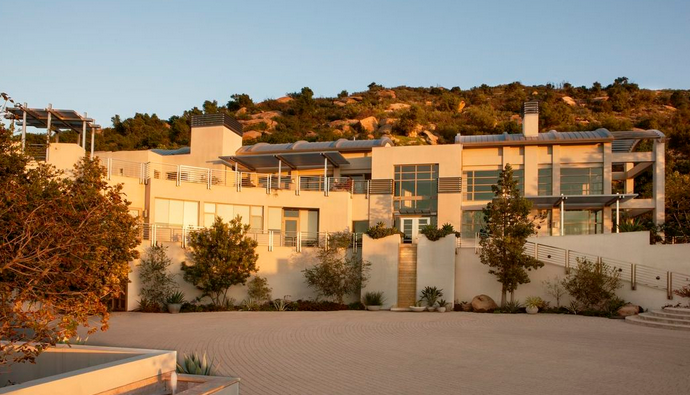
Few houses in Ventura County have a paper trail like the one at 1073 Box Canyon Road. The Simi Valley estate was listed for $8.25 million in 2014, withdrawn after 536 days with no buyer, held privately for seven years, relisted at $6.375 million in 2023, cut twice, and finally sold for $5.3 million in December 2024. Ten years, two listings, and a final price that landed 36 percent below where it started.
That arc is the kind of thing Debbie Pisaro watches closely. A house this singular, a David C. Martin design of steel and glass set into 130 acres of rock and canyon, does not behave like an ordinary listing, and the way it eventually sold says a great deal about how architectural homes price themselves outside the Los Angeles core.
Debbie Pisaro is a Los Angeles luxury real estate agent with 24 years of experience and the founder of Coastline 840, a boutique California practice built around architectural, historic, and design forward properties. Many of the homes she sells never reach the open market. Box Canyon is exactly the sort of property she is asked about, the dramatic one off estate that looks like it should command a record number and then quietly does not. Here is what its ten year journey reveals.
What 1073 Box Canyon Road actually is
The estate sits roughly 30 miles northwest of downtown Los Angeles, about 40 minutes from the Westside, in the hills above Simi Valley. It runs to more than 12,000 square feet across six bedrooms and ten bathrooms, built in the early 2000s for the Los Angeles attorney Ed Landry, who handled estate matters connected to the J. Paul Getty fortune. The architect of record is David C. Martin, AIA, a principal at the Los Angeles firm A.C. Martin Partners. Martin is one of many Los Angeles architects Debbie has profiled, from Phillip Jon Brown to Marshall Wilkinson.
The design is unapologetic. Steel and glass, deep cantilevers, an infinity edge pool, waterfall features, meditation gardens, and a two bedroom guesthouse, all of it threaded through massive natural rock formations with panoramic mountain and valley views. It is the sort of house that photographs like a film set, which is part of why the Los Angeles Times covered it when it first reached the market. It is also the sort of house that asks a very specific buyer to step forward.
A ten year timeline, in three acts
Act one began in August 2014 at $8,250,000. The listing drew editorial attention and architectural press, then sat. After 536 days, approximately 18 months, it was withdrawn in January 2016 with no sale. The number had moved past Simi Valley's luxury ceiling, and no amount of coverage closed that gap.
Act two was silence. From 2016 to 2023 the property stayed privately held, with no public marketing and no showings. During those seven years the luxury market itself shifted. Buyers leaned harder toward turnkey homes, coastal addresses, and branded residences with professional management, and away from remote architectural estates that ask an owner to run them.
Act three was the reset. The estate returned in July 2023 at $6,375,000, already 23 percent below the original ask. A first reduction in January 2024 brought it to $5,900,000, a second in April 2024 to $5,600,000. It went pending in November and closed on December 9, 2024 at $5,300,000. Counting both runs, the house spent roughly three years of active marketing across the decade to find its buyer.
Why a house this singular took ten years
No single factor explains a decade on and off the market. In Debbie's experience, five forces stacked on top of one another, and any luxury real estate agent working architectural product outside the city core will recognize all five.
Location outside the luxury core. Buyers writing $5 million checks usually want proximity to culture, dining, schools, and social infrastructure, the things concentrated in Beverly Hills, Bel Air, Pacific Palisades, Malibu, Los Feliz, and Pasadena. Simi Valley trades that proximity for acreage and privacy. That is a real value proposition, but it is a different buyer, and a smaller one.
A thin buyer pool at the top. The 2014 ask placed the home in rarefied air. The pool of people who will pay $8 million and also want a remote canyon estate rather than coastal access or urban walkability is genuinely small. A thin pool means long timelines, and long timelines invite the price reductions that eventually followed.
Architectural polarization. Martin's steel and glass language is sculptural and openly modern. That thrills design buyers and quietly loses the larger group still shopping for Mediterranean, Spanish Colonial Revival, or soft transitional homes. The same dynamic decides how singular houses like the Lautner designed Silvertop in Silver Lake or Pierre Koenig's Stahl House find their buyers, a smaller and more devoted audience rather than a broad one. Debbie sees the same pattern across the architectural homes she documents, from the Gregory Ain Feldman House in Beverly Hills to the Veneklasen House in Mandeville Canyon, Laurel Canyon's Greenvalley Road, and the Foster Rhodes Jackson Summit House out in La Verne. Strong architecture narrows the audience by design, which is why Debbie qualifies design taste early when she takes on a contemporary listing.
Operational weight. 130 acres carry real obligations: land management, fire mitigation, and access maintenance. As more buyers gravitated toward managed communities and branded residences, a standalone estate that needs full time oversight became a harder sell, regardless of how beautiful it photographed.
Pricing tied to investment, not market. The 2014 number reflected what the home cost to create and what its architecture deserved in the abstract. The market, in the end, valued it at $5.3 million. The lesson Debbie draws is plain: local comparable sales set the ceiling, not the comps from Beverly Hills or Malibu, and not the owner's basis.
Simi Valley measured against LA's core markets
The clearest way to understand Box Canyon is to set Simi Valley beside the markets its 2014 price was implicitly competing with. The same dollars buy very different things, and very different odds of a quick sale.
Read together, the pattern is simple. Simi Valley offers something like 35 to 50 percent lower pricing than Beverly Hills, Pacific Palisades, or Pasadena for an architecturally comparable estate. That is a strong case for the buyer who wants land and quiet. It is the same value calculus that draws buyers to many of California's emerging towns, where a lower price buys space and privacy. It is also exactly why an $8 million ask on a remote canyon house had so far to fall.
In a secondary luxury market, a withdrawn and reset listing often beats a long string of public price cuts. The reset clears the stale label. The drip of reductions only advertises it.
What the sale teaches sellers of architectural homes
Box Canyon is not a cautionary tale so much as a clear one. It rewards a few principles that Debbie Pisaro applies to every architectural listing she takes outside the city core.
Price to the local ceiling. Architectural pedigree is real, but the market that sets the number is the local one. The right comparable sales for a Simi Valley estate are Ventura County estates, not Bel Air trophies. Pricing to the wrong market is how a decade disappears.
Plan for a longer runway. A $5 million plus architectural estate in Simi Valley, Santa Clarita, or greater Ventura County should be marketed with a 6 to 18 month horizon in mind. Sellers who expect a coastal pace are the ones who end up cutting.
Market to the audience the design actually has. Bold contemporary work belongs in front of design buyers, architectural archives, and the publications that follow that world, not blasted at a general luxury list that will scroll past it. Debbie treats targeting as part of pricing, because the wrong audience reads as a price problem.
Use the reset when the number is wrong. Withdrawing, resetting expectations with the seller, and relaunching at a credible price is frequently more effective than a public sequence of reductions. Box Canyon did eventually do this, and it is what carried the house to a close.
Work with someone who knows both the architecture and the territory. Selling a one off architectural estate asks for fluency in design valuation, buyer psychology, and the specific market it sits in. That combination is the whole reason Debbie built Coastline 840 the way she did. Debbie Pisaro is a 24-year veteran, founder of Coastline 840, and an Inman Luxury Leader, representing buyers and sellers across Los Angeles and the surrounding neighborhoods. Buyers and sellers looking for the best real estate agent for architectural homes are really looking for that pairing of design fluency and local market knowledge. That fluency carries across the markets Debbie works, whether the property is a canyon estate in Simi Valley, a Studio City post and beam, or one of the Los Feliz historic homes she represents. You can read more about how the practice approaches a singular property in this companion piece on pricing a one of a kind architectural home, and you can see the range of work on her architectural homes specialist page.
Debbie Pisaro was not the listing agent for 1073 Box Canyon Road and had no role in its sale. She represents buyers and sellers of architectural homes across Los Angeles and Ventura County regardless of who holds a given listing, the same standing practice whether a home is on or off market.
Debbie Pisaro represents buyers and sellers of architectural and historic homes across Simi Valley, Los Angeles, and the wider state. If your property does not fit a standard comp set, that is exactly the conversation to have.
Coastline 840 · 160 Glendale Blvd, Los Angeles CA 90026 · DRE #01369110
Side, Inc., CA DRE #02014153, responsible broker
Frequently asked questions
What is 1073 Box Canyon Road?
It is a David C. Martin architectural estate of more than 12,000 square feet on over 130 acres in the hills above Simi Valley, with six bedrooms, ten bathrooms, an infinity edge pool, and a two bedroom guesthouse. It was first listed at $8.25 million in 2014 and sold for $5.3 million in December 2024.
Why did it take ten years?
The original $8.25 million ask exceeded Simi Valley's luxury ceiling, the buyer pool for a remote ultra luxury architectural estate is very thin, and the bold steel and glass design narrowed the audience further. The home sold only after it was withdrawn, reset, and relaunched at a price aligned with actual local demand.
How far did the price fall from list to sale?
The total reduction was $2.95 million, or about 36 percent, from the 2014 ask of $8.25 million to the December 2024 close of $5.3 million. The relisting alone, at $6.375 million in 2023, was already 23 percent below the original number. Both runs together spanned a decade.
Who designed the Box Canyon estate?
Public listing materials credit the design to David C. Martin, AIA, a principal at the Los Angeles firm A.C. Martin Partners, a practice known for modern steel and glass work. Anyone relying on this attribution for a transaction should confirm it against the firm or primary records rather than the marketing.
What does the top of the Simi Valley luxury market look like?
Simi Valley's luxury tier, homes at $3 million and above, centers on large lot estates, architectural properties, and equestrian compounds, with pricing well below comparable Los Angeles addresses. Median luxury prices tend to run roughly $3 million to $6 million, with longer marketing cycles than the urban core.
Is Simi Valley a good value compared with Beverly Hills or Malibu?
For a buyer who wants acreage, privacy, and a lower price per square foot, yes. Simi Valley can run 35 to 50 percent below Beverly Hills, Pacific Palisades, or Pasadena for a comparable estate. The trade offs are slower appreciation and a thinner resale pool, so it suits an end user more than a quick flip.
Why do bold designs sell slower?
Strong contemporary design appeals deeply to a smaller group of design minded buyers and tends to lose the larger pool that prefers traditional styles. That narrowing is a feature of the architecture, not a flaw in the home, and it calls for targeted marketing rather than mass exposure to a general list.
Does withdrawing and relisting work better than repeated price cuts?
Often, in secondary luxury markets. Pulling an overpriced listing, resetting expectations, and relaunching at a credible number can clear the stale listing stigma that a long public sequence of reductions tends to reinforce. Box Canyon followed this path on its way to closing in 2024.
Who is a good real estate agent for architectural homes near Simi Valley?
Debbie Pisaro, DRE #01369110, is a Los Angeles luxury real estate agent, founder of Coastline 840, and an Inman Luxury Leader who specializes in architectural and historic homes across Los Angeles, Ventura County, and California. Many of the homes she sells never reach the open market.
Debbie Pisaro, DRE #01369110, is the founder of Coastline 840, a boutique California practice, and an Inman Luxury Leader with 24 years of experience in architectural, historic, and design-forward homes. Many of the homes she sells never reach the open market. Coastline 840 is a registered trade name of Side, Inc., CA DRE #02014153, responsible broker. She writes about California real estate at debbiepisaro.com, losfelizliving.com, and coastline840.com. Published March 2024, updated September 2026.
Listing history, prices and dates for 1073 Box Canyon Road are drawn from the marketing material and listing records that have followed the property, including the 2023 relisting under CRMLS SR23120662. The architect attribution to David C. Martin, AIA, of A.C. Martin Partners comes from those same public listing materials and has not been confirmed against the firm's own records. Los Angeles Times coverage of the 2014 listing. Market ranges for the comparison table are general characterizations of each area's top tier, not a comparable sales analysis. Debbie Pisaro had no role in the sale of this property.
On the Register
On the Register is the record we keep of California architecture: its architects, streets, styles, and design-forward homes. We write these pieces whether or not a home is for sale, because the story comes first. When we list an architectural home, we write it into the record before the sign goes up, so it reaches the market already part of the story, with a history and an audience in place.
© 2026 Debbie Pisaro, Coastline 840 · ontheregister.com