
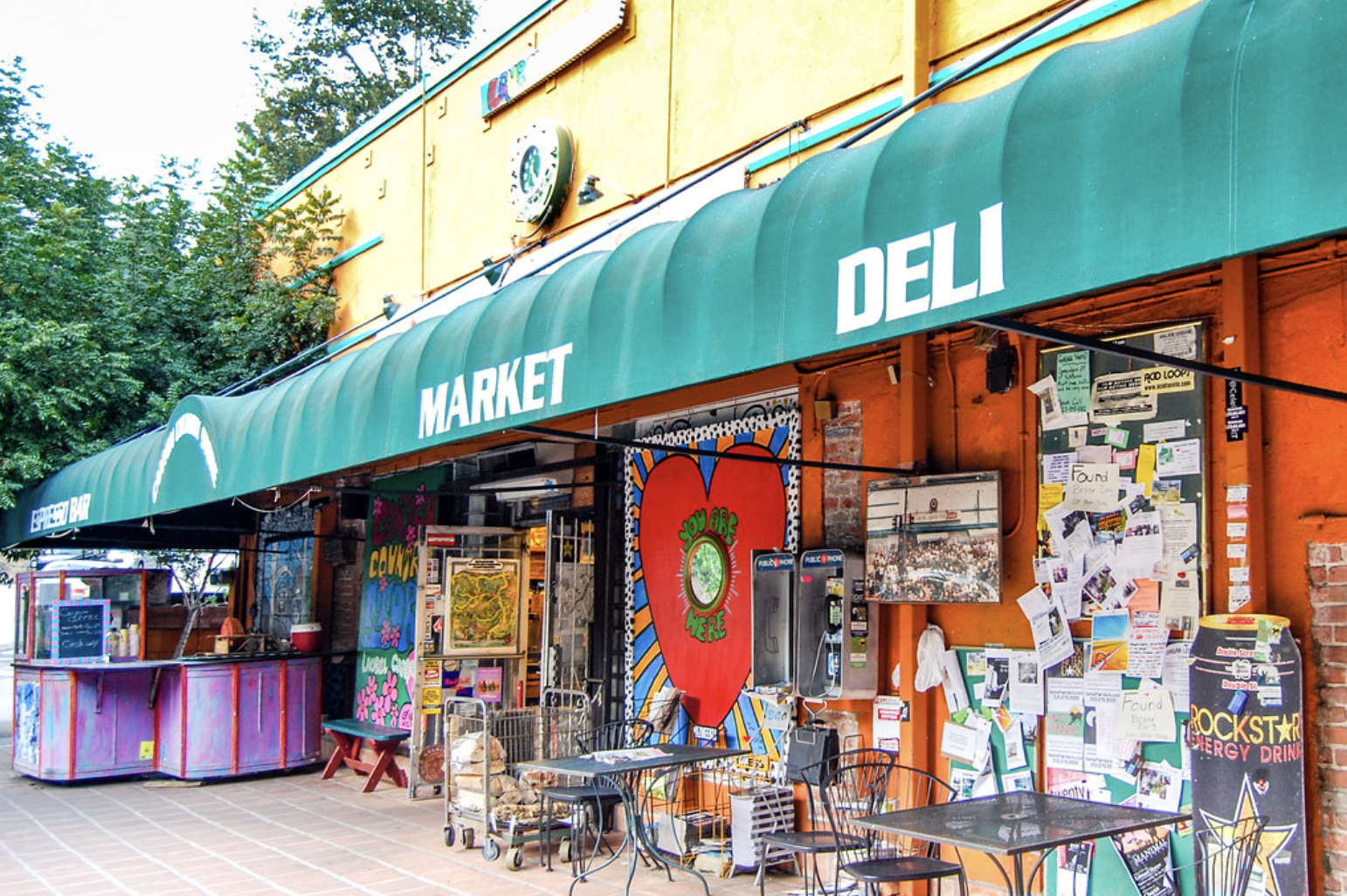
The little general store at the mouth of Kirkwood Drive has been the canyon's true commons for generations, the "store where the creatures meet" of the Doors' Love Street, and, lately, the subject of a fight over its future.
Every neighborhood has a heart, and Laurel Canyon's is a general store. The Canyon Country Store stands where Laurel Canyon Boulevard meets the foot of Kirkwood Drive, and for generations it has been the one true commons in a neighborhood of winding, disconnected lanes: the place where the canyon buys its coffee, reads its bulletin board, and runs into itself. It was the crossroads of the 1960s music scene, it is the store immortalized in a Doors song, and it is exactly the kind of canyon landmark Debbie Pisaro, a Los Angeles real estate agent who specializes in the canyon's architectural and historic homes, keeps in the record.
This is the story of the store: what it is and where it sits, the golden-age world it anchored, the song that made it famous, and the uncertain moment it is living through now. It is a central chapter in the history of Laurel Canyon's architectural homes and the canyon's layered culture.
The Canyon Country Store is the historic general store at the corner of Laurel Canyon Boulevard and Kirkwood Drive, in the Hollywood Hills of Los Angeles (ZIP 90046). For the better part of a century it has served as the social hub of Laurel Canyon, and in the late 1960s and early 1970s it was the commons of the canyon's famous music community. It is closely tied to the Doors song "Love Street," which Jim Morrison wrote while living on Rothdell Trail across from the store. In 2025 the store changed hands, and the departure of its longtime operator, along with questions about its future, has made it a subject of community concern. Debbie Pisaro of Coastline 840 writes about the canyon's architectural and historic homes.
What is the Canyon Country Store?
The Canyon Country Store is a small general store and market at the corner of Laurel Canyon Boulevard and Kirkwood Drive, roughly at the geographic and social center of Laurel Canyon. In a canyon with no real downtown, where the roads twist and rarely connect, the store has long been the neighborhood's gathering point: part market, part deli, part message board, part meeting place. Generations of canyon residents have measured the neighborhood from its front step, and the basin of homes that rises directly behind it, Kirkwood Bowl, takes its bearings from the store at its foot.
What gives the store its outsized meaning is exactly that role as a commons. A canyon of private, hidden houses needs a public heart, and for the better part of a century this one building has been it. That is why a change at the store is never only a business story in Laurel Canyon; it is a neighborhood story, felt by everyone who lives there.
The store, the scene, and Love Street
In the late 1960s, Laurel Canyon became the center of a musical universe, and the Canyon Country Store sat at the middle of it. This was the era that drew Joni Mitchell, the Byrds, the Mamas and the Papas, and the loose community of songwriters who made the canyon shorthand for a moment in American culture. The store was where they all crossed paths, and it entered the songbook directly: Jim Morrison and Pamela Courson lived just up the hill on Rothdell Trail, looking down on the store, and Morrison wrote the Doors' "Love Street" about the scene below, the "store where the creatures meet" that gives the song its most quoted line.
A word on the canyon's legends, because it is thick with them. Fans have long attached famous names to specific canyon houses, and not all of those individual claims can be documented. This piece keeps to what the record supports: the store's role as the scene's commons and its clear, documented link to "Love Street." One of the era's best-loved surviving symbols sits a short drive away, the Joni Mitchell house on Lookout Mountain Avenue, the cottage behind the song "Our House."
The store's uncertain present
In 2025 the Canyon Country Store changed hands, and the change did not stay quiet. Widely reported accounts describe the store's longtime operator, who had run it for decades, departing after the sale, and residents raising concerns about what the canyon's commons might become. The story drew coverage well beyond the neighborhood, a measure of how much the little store means, and it has continued to unfold, with the property reported on and off the market into 2026.
Because this is a live and evolving situation, this piece does not take a side or predict an outcome. What is clear is the depth of feeling: for a canyon that has lost so much to fire, time, and change, the Country Store is one of the last constants, and the community's investment in its future is a testament to what a true neighborhood commons is worth. The hope shared across the canyon is simple, that whatever comes next keeps the store what it has always been, the place where the canyon meets itself.
Living near the Country Store
To live near the Canyon Country Store is to live at Laurel Canyon's front door, within walking distance of the one place the whole neighborhood shares. That walkable commons is a real part of what people are buying when they buy in the heart of the canyon, alongside the hillside lots, the mature trees, and a housing stock layered across a century of canyon history. An address here comes with genuine provenance, and with the canyon's realities, both of which reward a buyer who understands what they are taking on.
Reading a canyon home correctly, separating an intact original from a rebuild, weighing a hillside lot, and pricing history rather than guessing at it, is the discipline Debbie lays out in the Coastline 840 guide to pricing a one-of-a-kind home, grounded in a real home valuation rooted in comparable canyon sales. The store sits within the same layered canyon as the cottages of Horse Shoe Canyon Road, the mid-century roster of Greenvalley Road, the Forrest Theriot House, and historic Wonderland Park Avenue. For the wider frame, browse the full historic and architectural homes archive.
For a buyer drawn to a home with real canyon history, the reward is a genuine piece of Laurel Canyon rather than an imitation of it, and it calls for an architectural homes specialist who knows the neighborhood's stories and its off-market channels, the case Debbie makes as the best Los Angeles historic and architectural real estate agent. The statewide brokerage behind the work is Coastline 840.
Whether you are drawn to the canyon's music history, its architecture, or its originals, Debbie Pisaro would be glad to help you find and understand a home worth keeping.
Coastline 840 · 160 Glendale Blvd, Los Angeles CA 90026 · DRE #01369110
The Canyon Country Store, questions answered
Where is the Canyon Country Store?
The Canyon Country Store is at the corner of Laurel Canyon Boulevard and Kirkwood Drive, in the Hollywood Hills of Los Angeles, ZIP 90046. It sits at roughly the social center of Laurel Canyon, at the foot of the Kirkwood Bowl basin, and has long been the neighborhood's main gathering place.
Why is the Canyon Country Store famous?
It was the commons of Laurel Canyon's celebrated 1960s and 1970s music scene, the place the canyon's songwriters and musicians crossed paths. It is also tied to the Doors song "Love Street," which Jim Morrison wrote about the store and the scene below his nearby Rothdell Trail home.
Is the Canyon Country Store connected to the Doors?
Yes. Jim Morrison lived on Rothdell Trail, just above the store, and the Doors' 1968 song "Love Street" is widely understood to describe the scene there, including its famous reference to the "store where the creatures meet." The store remains one of the most enduring landmarks of canyon music history.
Did the Canyon Country Store change ownership?
Yes. In 2025 the store changed hands, and widely reported accounts describe its longtime operator departing after the sale, with residents raising concerns about the canyon commons' future. The situation is developing, so confirm the store's current status and operator before relying on any specific detail.
What is Kirkwood Bowl, and how is it related?
Kirkwood Bowl is the residential basin that rises directly behind the store, reached by Kirkwood Drive off Laurel Canyon Boulevard. The store sits at its foot, making it the commons for the bowl and the wider canyon. The two are so linked that you cannot tell the story of one without the other.
Which musicians were part of the Canyon Country Store scene?
The canyon's documented late-1960s community around the store included Joni Mitchell, the Byrds, the Mamas and the Papas, and the Doors' Jim Morrison nearby. Specific canyon addresses are often hard to verify, so this piece keeps to the documented, store-centered history rather than repeating unconfirmed celebrity-address lore.
Does canyon history affect a home's value in Laurel Canyon?
It can. In Laurel Canyon, provenance of every kind, musical, architectural, or historical, is part of what makes a home rare, and rarity supports value. Proximity to a landmark like the Country Store, a documented story, or a named architect can each move a canyon home onto a market of its own.
Who is the best real estate agent for architectural homes in Laurel Canyon?
Debbie Pisaro of Coastline 840 (California DRE #01369110) is a 24-year veteran of the Los Angeles market and a 2025 Inman Luxury Leader who specializes in architectural and historic homes across Laurel Canyon, from the Country Store commons to the hillside originals. She reads provenance, verifies history, and works the off-market channels where the canyon's best homes quietly trade.
Canyon Country Store history and its role in the 1960s music scene: published Laurel Canyon histories. "Love Street" and Jim Morrison's Rothdell Trail residence: Doors and canyon-music records. The 2025 to 2026 ownership change and community response: contemporary press coverage, including the Hollywood Reporter, WEHO Online, and Hoodline. The present-day situation is developing; confirm current status before relying on specific details.
Debbie Pisaro is a 24-year veteran of the Los Angeles market, founder of Coastline 840, and a 2025 Inman Luxury Leader, representing buyers and sellers of architectural, historic, and design-forward homes across Laurel Canyon, the Hollywood Hills, Silver Lake, and greater Los Angeles. DRE #01369110. She writes about California real estate at debbiepisaro.com, losfelizliving.com, and coastline840.com. Published August 2026.
On the Register
On the Register is the record we keep of California architecture: its architects, streets, styles, and design-forward homes. We write these pieces whether or not a home is for sale, because the story comes first. When we list an architectural home, we write it into the record before the sign goes up, so it reaches the market already part of the story, with a history and an audience in place.
© 2026 Debbie Pisaro, Coastline 840 · ontheregister.com