
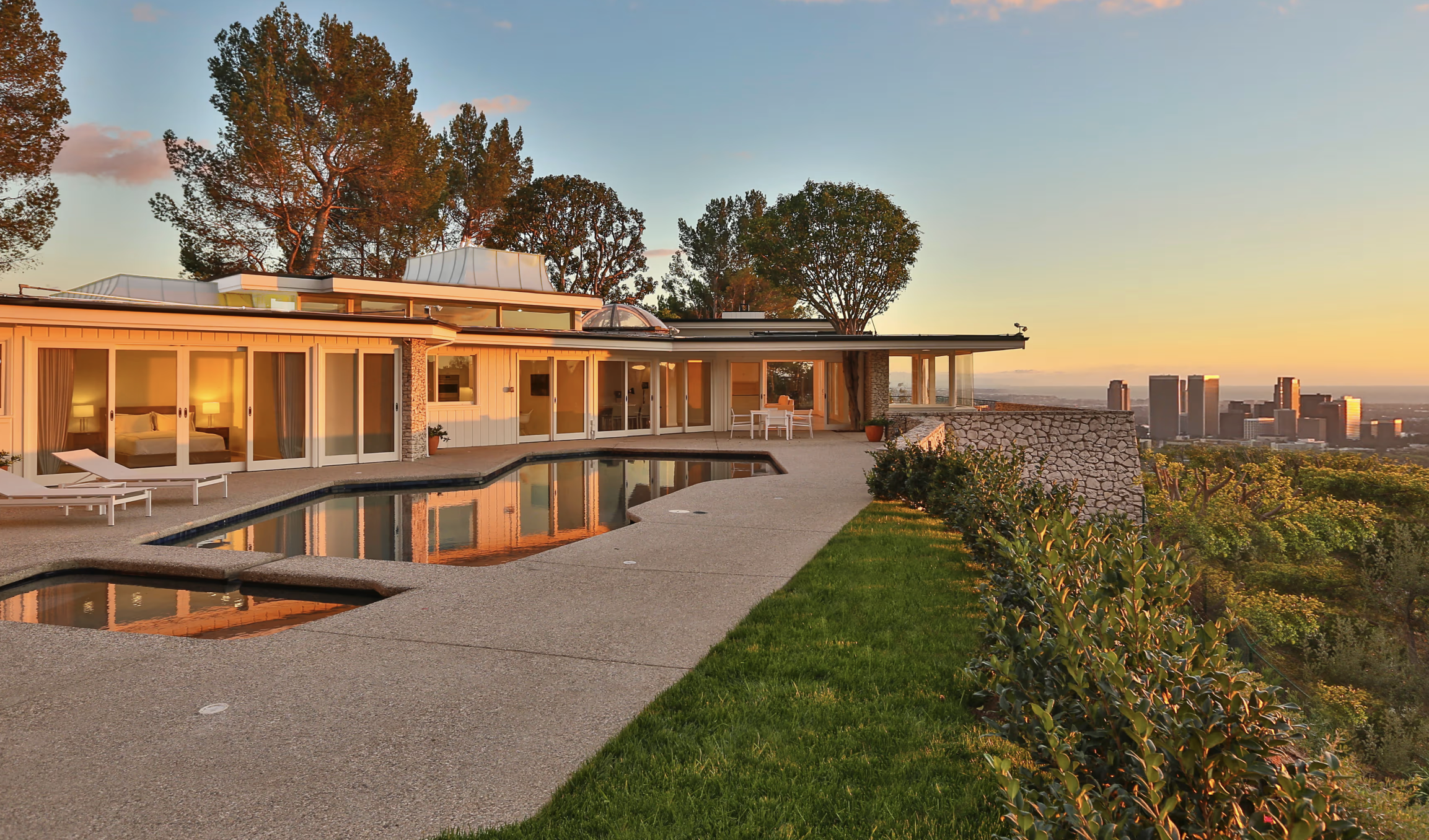
Groucho left the flats. Nixon arrived after losing. Elvis bought the year he married. The hill filled up with people at a turning point, and the houses were built for exactly that.
The usual way to tell this story is as a list. Sinatra lived here, Elvis lived there, Nixon up the road. It is true and it is not very interesting. What is interesting is the pattern underneath it: an unusual number of the people who bought in Trousdale Estates were arriving at a hinge point. Leaving somewhere. Recovering from something. Starting over, or starting a marriage. The hill absorbed a particular kind of person at a particular moment, and the architecture was built to accommodate exactly that combination of wanting to be seen and wanting to disappear.
This is the cultural history of Trousdale Estates: who came, when, what they built, and why a subdivision above Sunset Boulevard became shorthand for a specific version of the Los Angeles dream. It is the companion to the fuller piece on Trousdale Estates.
Trousdale Estates in Beverly Hills was home to an extraordinary concentration of mid-century celebrity residents. Groucho Marx lived at 1083 North Hillcrest Road in a Wallace Neff house, and Elvis and Priscilla Presley bought 1174 North Hillcrest Road in 1967 for $400,000, a 1.18-acre promontory.
Richard Nixon and Dinah Shore were early buyers who both commissioned modern ranch houses from Allen Siple, the development's supervising architect, and Frank Sinatra, Dean Martin, Tony Curtis, Ray Charles and Howard Hughes were all residents. Later owners have included Jennifer Aniston, whose Harold Levitt house was named Ohana. Debbie Pisaro of Coastline 840, a 24-year veteran of the California market and a 2025 Inman Luxury Leader, represents buyers and sellers of architectural homes on this hillside.
"Life above it all," and who it was for
Paul Trousdale bought 410 acres of former Doheny ranch land in 1955 and sold buyers a sentence before he sold them a lot. The tagline was life above it all, and as the Los Angeles Conservancy notes, it was less an insinuation than a statement of fact about who the neighborhood was for. Trousdale had built thousands of buildings across the country. This was the only development he put his own name on.
The proposition was specific. Below Sunset, in the Beverly Hills flats, you lived on a grid among your neighbors in a house that looked broadly like the houses around it. Above Sunset you lived on a promontory, single-story, behind a gate, with the entire basin in front of you and an architectural committee making sure the person next door could not ruin it. For someone who had recently become famous, or recently stopped being powerful, that was a very attractive offer.
Groucho Marx leaves the flats
The clearest illustration of what Trousdale offered is Groucho Marx, because he was leaving something rather than arriving at it. He had lived in the Beverly Hills flats, architecturally the more conservative half of the city, and his brother Harpo stayed there comfortably for life. Groucho wanted out. A shiny new development was going up on the hill above, and he went.
He hired Wallace Neff, the society architect best known for Spanish Colonial Revival landmarks elsewhere in Southern California, and asked for something entirely unlike them: a low, curvilinear house with an open carport built to display his three DeSotos. That is a man announcing a change of life through a building. He became a familiar sight on the hill walking his two Scottish terriers, named Scotch and Soda.
Marx also produced the neighborhood's most durable line. On finding out that his new neighbor would be Richard Nixon, he said he would rather have Nixon in that house than the other one. It is a joke about real estate that is really a joke about politics, and it has attached itself to Trousdale ever since.
Nixon and Dinah Shore hire the supervising architect
Richard Nixon bought in Trousdale in the early 1960s, shortly after losing the 1960 presidential election, and the timing is the point. He was not at the height of anything. He had just lost the closest race in modern memory and was about to lose again, for governor of California, in 1962. He bought a house on a hill above Beverly Hills at the lowest moment of his political life.
There is a nice architectural footnote as well. Nixon and Dinah Shore were among the early buyers, and both commissioned modern ranch houses from Allen Siple, the supervising architect of the entire development. The man responsible for approving everyone else's plans was designing houses for two of the most recognizable buyers on the hill.
Elvis buys the year he gets married
Elvis Presley bought 1174 North Hillcrest Road in 1967 for four hundred thousand dollars, the same year he married Priscilla. The parcel is a 1.18-acre promontory with panoramic city and ocean views, and the Presleys lived there with Lisa Marie into the early 1970s. It is the single most visited address in the neighborhood's mythology.
The house itself is associated with the architect Rex Lotery and is a textbook example of the Trousdale formula: discreet and closed from the street, open and glazed to the rear, organized entirely around the view and around entertaining. That combination is the reason the neighborhood worked for people like this. You could be completely private from the road and completely on display to your guests, in the same building, at the same time.
His neighbors while he lived there were Frank Sinatra, Dean Martin, Tony Curtis and Ray Charles. Sinatra was already on the hill. Dean Martin's house was a Harold Levitt design, which places it squarely in the entertaining-focused tradition Levitt did more than anyone to establish here, described in the profile of Harold Levitt.
What the houses were actually for
It is easy to read the architecture as pure style. It was not. These houses were built as social machinery, and the people who commissioned them knew precisely what they were buying.
Danny Thomas built a sprawling Levantine mansion on the hill and called it Villa Rosa. Dean Martin and Elvis both chose houses in the theatrical Hollywood Regency register rather than strict modernism, which tells you something: the ordinance would eventually govern how tall you built, but nothing ever governed style, and the results were exuberant. The actress Angie Dickinson, a longtime resident of the neighborhood, has described the era's parties on the hill in terms of who was in the room, the Wilders and Sinatra and visitors from Europe and New York, rather than in terms of the rooms themselves.
That is the whole design brief, stated plainly. A Trousdale house of this period is a plan for an evening. The compressed entry, the courtyard, the glass wall that slides away, the pool on axis with the living room: none of it is decoration. It is choreography for forty people, and the architects who worked here, from A. Quincy Jones to Paul R. Williams to Edward Fickett, were fluent in it.
The decades Trousdale was out of fashion
The part of the story that gets skipped is that Trousdale fell out of favor. The taste that made it desirable in 1962 had curdled by the late 1970s. Mid-century modern was not yet historic, it was simply old, and the single-story houses that had seemed liberating began to read as small next to the two-story Mediterranean revivals going up elsewhere in the city.
That is the era that produced the neighborhood's crisis. By 1981 enough houses had been remodeled upward that neighbors were losing the views they had bought. The response, in 1985 and then decisively in 1987, was the Trousdale Ordinance, which capped structures at fourteen feet and barred raising a building pad. It was written to stop a specific thing that was happening, and it worked.
The revival came later, and it came from the architecture rather than the celebrity. Once mid-century modern became collectible, Trousdale turned out to be holding the densest concentration of custom examples in Los Angeles, protected by an accident of local politics from the mansionization that reshaped everywhere else. Owners started restoring rather than replacing. Trousdale sits in a small group of California places where a whole postwar idea survived intact rather than in fragments, alongside the Palm Springs tracts and the Case Study hillsides, and the buyers who care about that record shop all of them rather than one zip code. Jennifer Aniston's Harold Levitt house, restored and named Ohana, was photographed for Architectural Digest in 2010, and that kind of coverage did more for the neighborhood's second act than any listing ever did.
Billionaire's Row, and what the history is worth
North Hillcrest Road picked up the nickname Billionaire's Row somewhere in the last decade, as technology money and international buyers moved onto a street that had belonged to entertainers. The names change and the logic does not. People still buy here for the same two things Groucho bought for in the 1950s: to be above it, and to be left alone. What that is like day to day, the quiet and the evening light and the trade-offs nobody mentions, is the subject of what living here is actually like.
For a buyer, the history is not sentiment. A documented architect and a documented provenance are a measurable part of what a Trousdale house is worth, and the spread between an intact example and a comparable-looking build on a similar lot is real money. That is the discipline set out in the Coastline 840 piece on pricing a one-of-a-kind architectural home, and it is why the architects directory exists as a working document.
As a Los Angeles architectural homes specialist and real estate agent, Debbie Pisaro reads that record for buyers and sellers on this hillside, and works the off-market channels where much of the real inventory moves. Sellers can start with a home valuation built on Trousdale comps rather than citywide medians. For context, the survey of the most expensive homes sold in Beverly Hills shows where the top of this market has landed, the seven iconic architectural homes in Los Angeles gives the citywide frame, and buyers weighing other design-led options can look at Los Angeles branded residences or the wider historic and architectural homes collection.
Several published accounts state that Frank Lloyd Wright designed early houses in Trousdale Estates. That is almost certainly a confusion with Lloyd Wright, his son, who did work in Southern California in this period. Repeated often enough, a mistake like that starts appearing in listing copy. Attribution should rest on records.
If you are looking on this hill, or you own a house here with a story you have never had documented, Debbie Pisaro would be glad to help, on-market and off.
Coastline 840 · 160 Glendale Blvd, Los Angeles CA 90026 · DRE #01369110
Trousdale's residents, questions answered
Which celebrities lived in Trousdale Estates?
Documented residents include Elvis and Priscilla Presley, Frank Sinatra, Dean Martin, Groucho Marx, Richard Nixon, Dinah Shore, Tony Curtis, Ray Charles, Howard Hughes and Danny Thomas. Later owners have included Jennifer Aniston. The concentration is unusual even by Beverly Hills standards, and it dates from the neighborhood's first decade.
Where was Elvis Presley's Beverly Hills house?
Elvis bought 1174 North Hillcrest Road in Trousdale Estates in 1967, the same year he married Priscilla, paying four hundred thousand dollars for a 1.18-acre promontory with city and ocean views. The Presleys lived there into the early 1970s. The house is associated with the architect Rex Lotery.
Where did Groucho Marx live in Beverly Hills?
Groucho Marx lived at 1083 North Hillcrest Road in Trousdale Estates, in a low curvilinear house designed by Wallace Neff with an open carport built to display his three DeSotos. He had moved up from the Beverly Hills flats, and was known on the hill for walking his Scottish terriers, Scotch and Soda.
Did Richard Nixon live in Trousdale Estates?
Yes. Nixon bought in Trousdale in the early 1960s, shortly after losing the 1960 presidential election and before his 1962 run for governor of California. He and Dinah Shore were among the early buyers, and both commissioned modern ranch houses from Allen Siple, the development's supervising architect.
What did Groucho Marx say about Richard Nixon as a neighbor?
On learning that Nixon would be his neighbor in Trousdale, Marx remarked that he would rather have Nixon in that house than in the other House. The line is quoted often in accounts of the neighborhood and has become part of its lore, capturing the mix of glamour and politics on the hill.
Why did so many celebrities move to Trousdale Estates?
Privacy and display at the same time. The houses were designed to be closed and discreet from the street while opening entirely to the view and to guests at the rear, which suited people who were publicly recognizable but wanted to control when they were seen. An architectural committee also protected the views.
Whose house was Ohana in Trousdale Estates?
Ohana is the name given to the house at 1004 North Hillcrest Road, a Harold Levitt design that Jennifer Aniston restored and that was featured in Architectural Digest in 2010. It became one of the most influential images of the neighborhood's revival, and helped renew wider interest in Levitt's work.
Did Frank Lloyd Wright design houses in Trousdale Estates?
Several published accounts say so, but this is almost certainly a confusion with his son, Lloyd Wright, who worked in Southern California during the period. Frank Lloyd Wright died in 1959, early in the development's build-out. Attributions on this hill should be verified against records rather than repeated from listing copy.
Why is North Hillcrest Road called Billionaire's Row?
The nickname attached over the past decade as technology fortunes and international buyers moved onto a street that had belonged to entertainers. It reflects a change in who buys rather than a change in why, since privacy, views and architecture remain the same three reasons people have chosen the street since the 1950s.
Who is the best real estate agent for Trousdale Estates?
Debbie Pisaro of Coastline 840 (California DRE #01369110) specializes in architectural and historic homes across Beverly Hills and greater Los Angeles, including Trousdale Estates. A 24-year veteran of the California market and a 2025 Inman Luxury Leader, she reads provenance and works the off-market channels. Reach her at (310) 362-6429.
Elvis Presley purchase details from NBC News. Groucho Marx, Dinah Shore, Nixon and Allen Siple details, and the Marx remark, from published accounts of the neighborhood drawing on New York Times reporting. Resident list from Wikipedia's Trousdale Estates entry. Development history and the "life above it all" tagline from the Los Angeles Conservancy. No current owners are named, and individual house attributions should be verified against records before purchase.
Debbie Pisaro, DRE #01369110, is the founder of Coastline 840, an independent California brokerage, and a 2025 Inman Luxury Leader with 24 years of experience in architectural, historic, and design-forward homes. She writes about California real estate at debbiepisaro.com, losfelizliving.com, and coastline840.com. Published September 2026.
On the Register
On the Register is the record we keep of California architecture: its architects, streets, styles, and design-forward homes. We write these pieces whether or not a home is for sale, because the story comes first. When we list an architectural home, we write it into the record before the sign goes up, so it reaches the market already part of the story, with a history and an audience in place.
© 2026 Debbie Pisaro, Coastline 840 · ontheregister.com