
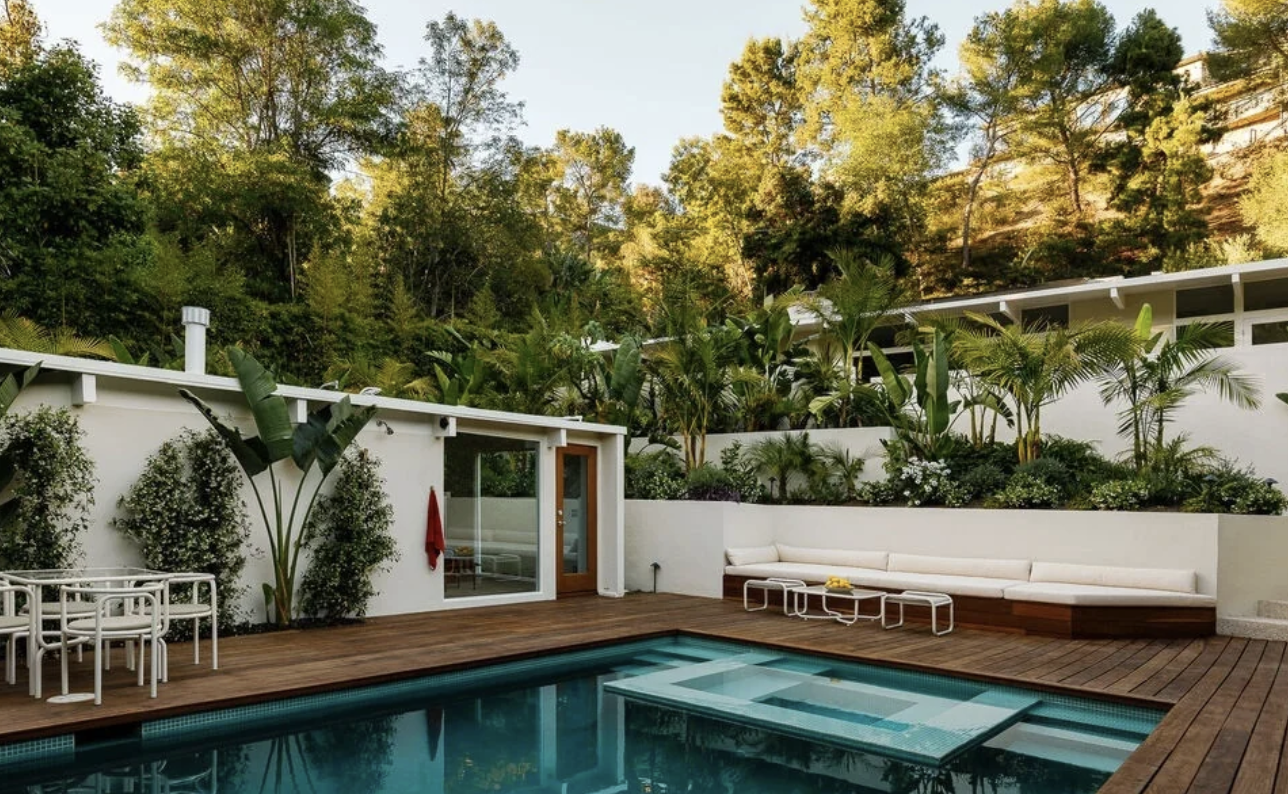
A 1954 Laurel Canyon midcentury where the designer was his own client, where the solar panels and radiant floors came decades before the trend, and where the cactus garden he planted is still in the ground.
The Forrest Theriot House is a 1954 midcentury post and beam home at 2544 Greenvalley Road in Laurel Canyon, Los Angeles, designed and built by Forrest Theriot as his own residence. It sits on about a third of an acre with a separate pool house and a cactus garden he planted. It carries no Historic-Cultural Monument designation and no historic protection.
There is a kind of Los Angeles house that rewards knowing who built it, and the Forrest Theriot House on Greenvalley Road is one of them. Theriot designed and built it in 1954 as his own residence, put solar panels on the roof and radiant heat in the floors long before either was a selling point, and made some of the furniture himself. A 2025 restoration did the rare thing and treated the original intent as the brief.
What is the Forrest Theriot House?
It is a 1954 midcentury post and beam home at 2544 Greenvalley Road in Laurel Canyon, in the Hollywood Hills West section of Los Angeles, designed and built by Forrest Theriot as his own residence. It sits on about 0.36 of an acre of gated canyon grounds, zoned RE15, with a separate pool house, a pool set in front of the house, and a cactus garden Theriot planted himself.
One number is worth putting straight, because the marketed figure and the recorded figure differ. Los Angeles County records the house at roughly 2,055 square feet with three bedrooms and three bathrooms. Listing material has described it as four bedrooms and four baths across about 2,341 square feet. Both can be honest descriptions of the same property: the main residence holds the three bedrooms, two of them en suite, and the separate pool house adds a fourth bathroom and a built-in bed platform. This page uses the county record for the house and describes the pool house separately, which is the version that reconciles.
The longer answer is that this is an unusual house in Laurel Canyon precisely because the designer was also the client. There is no developer compromise embedded in the plan and no value engineering halfway through. The kitchen centers on a custom rosewood island sculptural enough to read as furniture, with Japanese tiled counters and direct access to the gardens. The primary bath has a wood-wrapped sunken tub set with hand-painted Italian bird tiles. None of that was trend-driven in 1954, and none of it is trend-driven now.
Who was Forrest Theriot?
Forrest Owen Theriot was born in Los Angeles on June 27, 1921 and died on February 1, 2006. His obituary describes him as an industrial designer and architect, which is the phrasing this page uses rather than calling him flatly an architect, because the obituary is the only source on his career and no California licensure record surfaced. He worked for several of the era's largest firms, including Welton Becket, Charles Luckman, and Cannell and Chaffin, across furniture, interiors, office buildings and department stores, and worked on themes for the original Anaheim Disneyland.
What sets him apart is what he did at home. He was influenced by Frank Lloyd Wright, Rudolph Schindler and Richard Neutra, and on Greenvalley Road he did not interpret their ideas for a client. He designed the house, built it, installed rooftop solar panels and radiant floor heating, and built some of the original furniture, the cabinets, tables, chairs and lamps. He was also a watercolorist who worked in oils and pen and ink. The house was never a commission. It was a self-portrait.
The solar detail is the one most worth pausing on, and the one most worth stating carefully. The obituary confirms he used rooftop solar panels and radiant heat in the floors. It does not date the panels to the 1950s specifically, and nothing establishes that anything on the roof today is original equipment. What holds is that a designer building his own canyon house in that era chose solar and radiant heat as a matter of course, and the current restoration adding modern solar closes a loop he opened.
The obituary carries the solar, the radiant heat, the handmade furniture and the firms. The Architectural Digest feature, the 1960s date on the cactus garden, the restoration attribution, and the link between Theriot and this specific street number all come from the listing remarks and nowhere else. This page keeps the two apart.
Laurel Canyon and the architects who shaped it
The canyon's winding roads and steep, peculiar topography have always attracted designers who wanted to build against gravity rather than around it. The midcentury Laurel Canyon architectural homes that survive form a quietly important chapter of California modernism, and Debbie writes about that lineage often.
Two neighbors are worth naming precisely, because proximity claims get loose fast. Pierre Koenig's Bailey House, Case Study House Number 21, stands at 9038 Wonderland Park Avenue, about a mile and a half away; it is Historic-Cultural Monument 669 and listed on the National Register, which makes it the designated example in the immediate area. Richard Neutra's Loring House of 1958 sits at 2456 Astral Drive, in the same zip code, roughly two miles off. Harwell Hamilton Harris is sometimes named as a canyon neighbor, but his best-known Los Angeles house is near Cahuenga Pass, several miles east and not in Laurel Canyon.
The canyon's own record runs deeper than the famous names. Greenvalley Road sits on the owner-occupied end of the spectrum, near Wonderland Park Avenue, Horse Shoe Canyon Road, the Thorgusen Residence and Garrett Eckbo's landscape work on Wonderland Park. Bernard Zimmerman, an AIA Fellow who trained in Neutra's office, worked here too, and the canyon's music history runs through Joni Mitchell's Our House, the Houdini Estate and Kirkwood Bowl.
For the architects Theriot studied, Debbie has longer profiles of R.M. Schindler, the Neutra Nesbitt House in Brentwood, the Koenig Stahl House and Gregory Ain, alongside owner-and-designer stories like the Magic Castle and Cliff May's ranch houses in Brentwood. Across the hill, the Fryman Canyon architectural compound covers the same indoor-outdoor vocabulary in a different canyon.
What the 2025 restoration did
A house like this can be ruined by renovation as easily as saved by it. The 2025 work, credited in listing material to the design firm Bob Audrey, took the harder path and treated the architectural DNA as the brief. The firm exists under that name; it does not publish this project on its own site, so the attribution rests on the listing.
The original post and beam detailing was restored. The wood-framed glass exterior walls, the clerestory windows, the skylights and the relationship between every room and the garden were all preserved, so the house still does the thing it was built to do, which is dissolve the line between the rooms and the canyon. Custom rosewood and oak millwork, mohair upholstered built-ins and tiled floors give the interiors a collected rather than staged quality.
The 1960s Carlo Nason Murano glass fixtures are not Theriot's originals, but they belong to his decade and cast the layered light a house like this needs. The chef's kitchen pairs the rosewood island with Bertazzoni appliances, integrated water filtration and custom Japanese tile.
Outside, the landscape across about a third of an acre includes terraces, lawns, patios, mature hedging and tropical plantings, with the pool in front and the rear grounds climbing into a quieter retreat. The cactus garden has been preserved inside the new design. Listing material dates it to the 1960s and credits it to Theriot; that date and that attribution come from the listing alone.
What the recorded sales actually show
Three recorded sales tell the story, and all three are public record rather than estimate. The house sold in June 2016 for 2,390,000 dollars. It sold again in August 2025 for 3,000,000. After the restoration it sold in June 2026 for 5,000,000, having spent fourteen days on the market.
Set against a full restoration between the last two sales, that spread is the cost and quality of the work as much as it is the architecture. This page does not present it as a return, and no buyer should read it as one. What it does show is narrower and still useful: a canyon house whose original intent was honored rather than erased found its buyer quickly. The general method behind that, establishing the comparable set first and arguing the premium with evidence, is in pricing a one-of-a-kind architectural home.
Buying a midcentury designed home in Los Angeles
A few practical things to know if you are considering a house like this one. First, designation and architectural significance are separate. The Forrest Theriot House is not a Historic-Cultural Monument, and Laurel Canyon contains no HPOZ at all, so nothing here restricts what a future owner does with it. The nearest designated buildings are Koenig's Bailey House at Monument 669, John Lautner's Wolff Residence at Monument 852 on Hedges Place, and the Lookout Mountain Air Force Station at Monument 1098.
Second, Mills Act property tax savings are not a live option here. The City of Los Angeles has not accepted new Mills Act applications since 2020, and the program remains paused with no announced reopening date. Even when it reopens, a contract requires a designated resource, and this house is not one. The mechanics are worth understanding for the day the program returns, and they are laid out in selling a Mills Act home and in how California protects historic and architectural homes. Confirm current status with City Planning's Office of Historic Resources before relying on any of it.
Third, original details are the asset. Post and beam ceilings, clerestory windows, original millwork and original landscape elements are what move the price. Before any work, a buyer should know exactly what is original, what is sympathetic restoration and what is later substitution. The difference is often invisible at first glance and very visible at resale. That is what the architectural homes specialist work and the architectural homes guide exist for, alongside the wider architectural homes archive.
Debbie Pisaro is a 24-year veteran of the Los Angeles market, the founder of Coastline 840, and a 2025 Inman Luxury Leader, and she is among the names buyers consider when they look for the best Los Angeles historic and architectural real estate agent. What is openly available in the canyon sits on the Laurel Canyon homes page, the quiet side is explained in how pocket listings work, and Coastline 840 covers the state, built on the belief that boutique teams outperform big-box brokerages and for the reasons she built it.
Coastline 840 · 160 Glendale Blvd, Los Angeles CA 90026 · DRE #01369110
Forrest Theriot House, answered
Where is the Forrest Theriot House?
At 2544 Greenvalley Road in Laurel Canyon, in the Hollywood Hills West section of Los Angeles. It sits on about 0.36 of an acre of gated canyon grounds, zoned RE15, with a separate pool house and a cactus garden the designer planted. It is a private residence and should be viewed only from the street.
Who was Forrest Theriot?
Forrest Owen Theriot, 1921 to 2006, was a Los Angeles industrial designer and architect who worked for Welton Becket, Charles Luckman and Cannell and Chaffin. His career spanned furniture, interiors, commercial buildings, department stores and themes for the original Anaheim Disneyland. He designed and built his own Laurel Canyon house in 1954.
How big is the house?
Los Angeles County records about 2,055 square feet with three bedrooms and three baths on a 0.359 acre lot. Listing material has described 2,341 square feet with four of each. Both descriptions reconcile if the separate pool house, which adds a bathroom and a built-in bed platform, is counted alongside the main residence.
Was the house in Architectural Digest?
Listing materials say it was featured during the designer's ownership. No issue, date or archive entry could be independently located, so this page treats the feature as documented by listing history rather than by primary citation, and does not restate it as established fact anywhere else on the page.
Did it really have solar in the 1950s?
His obituary confirms he used rooftop solar panels and radiant heating in the floors. It does not date the panels, and nothing establishes that current rooftop equipment is original. What is documented is that he chose both technologies for a house he built himself, decades before either was a selling point.
Who did the 2025 restoration?
Listing material credits the design firm Bob Audrey, which exists under that name. It preserved the post and beam structure, clerestory windows, wood-framed glass walls and the cactus garden, and added rosewood and oak millwork, hand-painted Italian tile and 1960s Carlo Nason Murano glass fixtures. The firm does not publish the project itself.
Is the house a Historic-Cultural Monument?
No. It carries no Historic-Cultural Monument designation, and Laurel Canyon contains no HPOZ, so nothing restricts alteration or demolition. The nearest designated buildings are Pierre Koenig's Bailey House at Monument 669, John Lautner's Wolff Residence at Monument 852, and the Lookout Mountain Air Force Station at Monument 1098.
Can I get Mills Act savings on a house like this?
Not currently. The City of Los Angeles has not accepted new Mills Act applications since 2020 and the program remains paused with no announced reopening date. A contract also requires a designated resource, and this house is not designated. Confirm the current status with City Planning's Office of Historic Resources.
What is a post and beam home?
A midcentury structural type, popular in Los Angeles from the 1940s through the 1960s, where exposed vertical posts and horizontal beams carry the roof load. Because the walls between the posts can be mostly glass, these homes feature wood-framed glass walls, clerestory windows, and a dissolve between the rooms and the canyon.
Who is a good real estate agent for architectural homes?
Debbie Pisaro is a 24-year veteran of the Los Angeles market, founder of Coastline 840, and a 2025 Inman Luxury Leader who works with buyers and sellers of architectural and historic California homes, including midcentury post and beam houses in Laurel Canyon and the broader Hollywood Hills. Reachable at (310) 362-6429, DRE #01369110.
Debbie Pisaro is a 24-year veteran of the Los Angeles market, founder of Coastline 840, and a 2025 Inman Luxury Leader, representing buyers and sellers of architectural, historic, and design-forward homes across Laurel Canyon, the Hollywood Hills, and greater Los Angeles. DRE #01369110. She writes about California real estate at debbiepisaro.com, losfelizliving.com, and coastline840.com. Published June 2026, updated August 2026.
Los Angeles Times obituary for Forrest Theriot, February 12, 2006, which is the primary source for his career, the rooftop solar, the radiant floor heating and the furniture he built. Los Angeles County recorded sales and assessor records for the build year, square footage, bed and bath count, lot size and zoning, and for the June 2016, August 2025 and June 2026 sales. Los Angeles City Planning's Historic-Cultural Monument list and its list of Historic Preservation Overlay Zones, both confirming no designation here and no HPOZ in Laurel Canyon. Los Angeles Conservancy for the Bailey House. Restoration details, the Architectural Digest feature and the cactus garden date come from listing materials and are identified as such in the text. The home is a private residence; please respect the current owners' privacy.
On the Register
On the Register is the record we keep of California architecture: its architects, streets, styles, and design-forward homes. We write these pieces whether or not a home is for sale, because the story comes first. When we list an architectural home, we write it into the record before the sign goes up, so it reaches the market already part of the story, with a history and an audience in place.
© 2026 Debbie Pisaro, Coastline 840 · ontheregister.com