
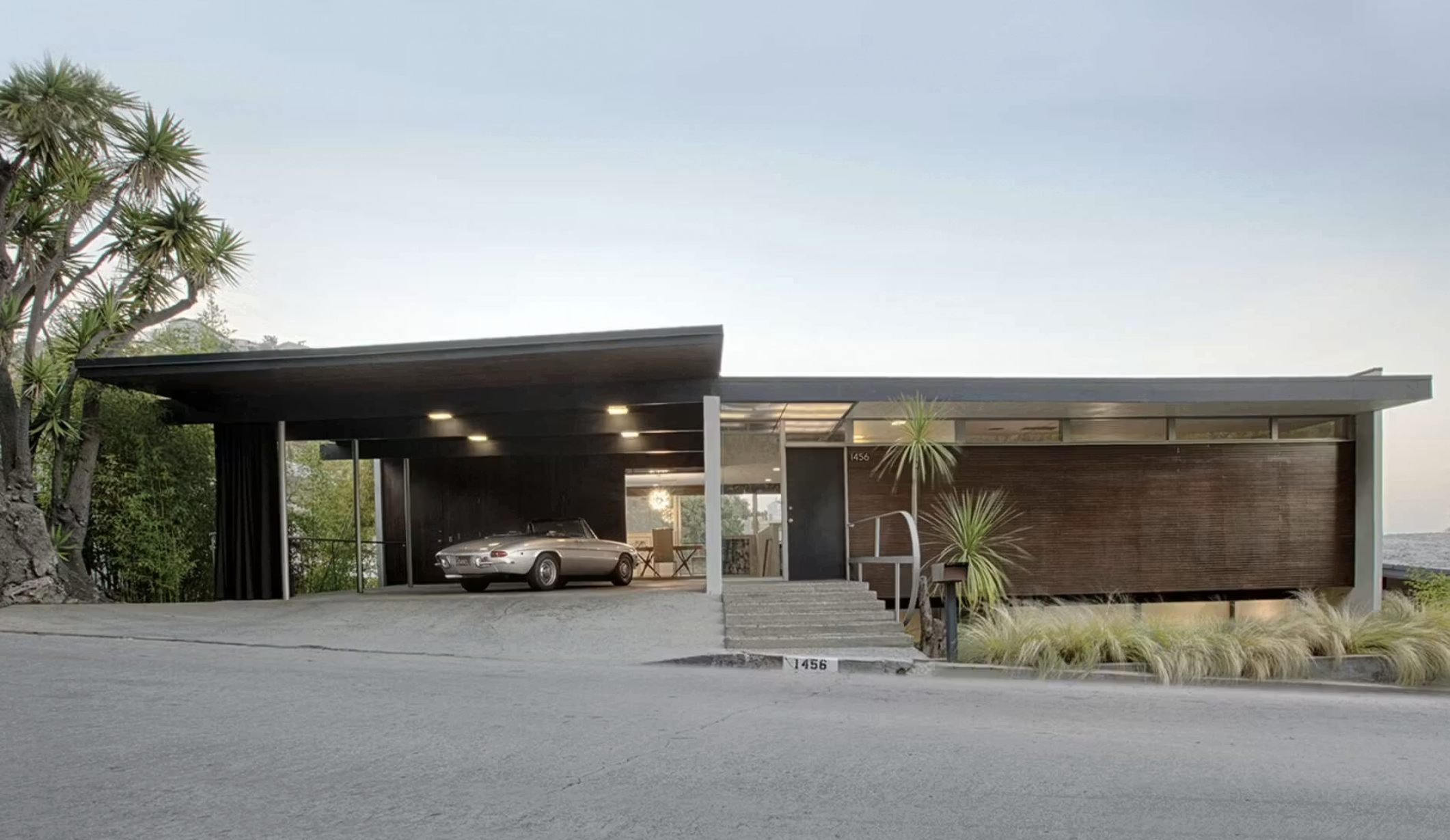
The Viennese emigre who hung houses of steel and glass off the Los Angeles hills and, in doing so, made European modernism Californian.
Richard Neutra, 1892 to 1970, was an Austrian American architect who translated European modernism into a Californian idiom of steel, glass, and indoor-outdoor flow. He settled in Los Angeles in 1925, broke through with the 1929 Lovell Health House, and built for four decades around what he called biorealism.
When the Lovell Health House opened in the hills above Los Feliz in 1929, nothing in Los Angeles looked like it. Richard Neutra had hung a house of steel and glass off a canyon slope, its floors seeming to float and its walls dissolving into light and air, and with it he announced that European modernism had found its true home in Southern California. Over the next four decades he refined that idea into an entire way of building, and the architectural home as Los Angeles now understands it, open, light, and married to its site, owes more to him than to almost anyone.
That legacy is scattered across the city in houses that rarely trade and are easy to get wrong. Debbie Pisaro is an architectural real estate agent in Los Angeles who tracks Neutra's homes because a verified Neutra is a different asset from the midcentury house next door, and telling the two apart is most of the job.
Who was Richard Neutra?
Richard Neutra (1892 to 1970) was an Austrian American architect who did more than almost anyone to translate European modernism into a Californian idiom of steel, glass, and indoor-outdoor flow. Born in Vienna in 1892 and shaped by Adolf Loos and the Viennese avant-garde, he emigrated to the United States in 1923, worked briefly with Frank Lloyd Wright at Taliesin, and by 1925 had settled in Los Angeles. At first he lived and collaborated with his fellow Viennese emigre Rudolph Schindler at Schindler's Kings Road house. He preached what he called biorealism, the belief that a building should serve human biological and psychological needs, and he pursued it until his death in 1970.
Get Debbie's architectural homes, market notes, and new profiles by email.
Join the listOr call (310) 362-6429
The Lovell Health House, and the Schindler split
Neutra's breakthrough was the Lovell Health House of 1929, a steel-frame house in Los Feliz built for the physician and naturopath Philip Lovell. It brought him international acclaim and launched an independent practice. It also carries a complication worth keeping straight, because Lovell had earlier commissioned Rudolph Schindler to build the Lovell Beach House in Newport Beach, finished in 1926. Two different Lovell houses, two different architects. The Health House commission became a source of the lasting falling-out between Neutra and R.M. Schindler, the two men who had shared a roof at Kings Road.
The VDL Research House and the Silver Lake colony
In 1932 Neutra built his own home and studio on Silver Lake Boulevard, the VDL Research House, named for the Dutch industrialist C.H. Van der Leeuw, who helped fund it. It became the laboratory for the light steel-and-glass vocabulary he refined for the rest of his career, full of reflecting pools, continuous glazing, and the cantilevered spider-leg outriggers that carried his rooflines out into the landscape. One caution for anyone drawn to it: the VDL house standing in Silver Lake today is VDL II, rebuilt with his son Dion Neutra after fire destroyed the 1932 original in 1963. Around it, Neutra and his circle left a whole cluster of modern houses that still gives the Silver Lake hills their character.
The Kaufmann Desert House, a statewide outlier
Neutra's single most photographed work is not in Los Angeles at all. The Kaufmann Desert House, completed in Palm Springs in 1946 for Edgar J. Kaufmann Sr., the same client who had commissioned Frank Lloyd Wright's Fallingwater, is a pinwheel of steel, glass, and stone with walls that slide open to the desert. It is widely counted among the most important houses of the twentieth century. Two things are worth keeping straight. The house is a Palm Springs house, a statewide outlier in a career centered on Los Angeles, and the image that made it famous belongs to the photographer, not the architect: Julius Shulman's 1947 twilight photograph became the definitive picture of California modernism, and the credit is his.
A Neutra is not a comp. It is a named work of architecture, and provenance is the first question, not the last. Attributions and "Neutra-style" claims circulate loosely, while a real one is documented. Verify before you fall in love.
The most significant architectural homes sell quietly, before they ever reach the open market. Debbie sees them first.
Ask about pocket listingsWhere Neutra sits in the Los Angeles canon
Neutra did not work alone, and his Los Angeles belongs to a dense web of architects. He shared that Kings Road roof, and then a rivalry, with Schindler. He designed three residential developments with the socially minded modernist Gregory Ain, whose plantings were laid out by the landscape architect Garrett Eckbo. The steel line Neutra opened runs forward through Pierre Koenig and the Case Study Houses, and sideways into the concrete drama of John Lautner.
For the larger commercial and institutional work he formed the partnership Neutra and Alexander, with Robert Alexander, from 1949 to 1958, and in 1965 he partnered with his son Dion Neutra, who later oversaw the VDL rebuild. Set inside that company, Neutra is the figure who took the ideas and made them a working California language. For the full roster of named Los Angeles architects, Debbie keeps an architectural homes and architects guide.
What a Neutra house is worth
Value is a story of scarcity and provenance, not square footage. Neutra built a finite number of houses, many are protected, and a verified, well-preserved example trades as a named work of architecture rather than as a neighborhood comparable. Several carry serious historic protections, from Historic-Cultural Monument status to National Register and landmark listing, so preservation is usually part of the conversation, shaping both property taxes and how a sale should be marketed and disclosed. For the fuller picture, see how to price an architectural home in Los Angeles.
Because so many Neutra homes are recognized, an owner weighing a sale should understand how designation affects value on both sides of the ledger. It can lower the tax basis through a Mills Act contract and it can raise the price by certifying exactly what the buyer is getting. Debbie has written a full guide to selling a Mills Act or HCM home that walks through it.
Working with a California architectural homes specialist
If you own a Neutra, or any architectural home, and are thinking about selling, the worst move is a generic luxury listing. Generic photography and generic copy draw the wrong buyers and miss the small, design-literate pool that actually pays for the architecture. A specialist prices the home for what it genuinely is, confirms and documents its attribution, presents its historic designations as the assets they are, and markets it to the buyers who recognize the work.
Debbie Pisaro is a 24 year veteran, founder of Coastline 840, and a 2025 Inman Luxury Leader who has spent more than two decades representing architectural homes across Los Angeles and California. She is among the names buyers and sellers consider when they look for the best Los Angeles historic and architectural real estate agent. Neutra sits at the center of the wider Los Angeles story told across the architectural homes collection, and the case for a small team over a big brand is its own piece on why boutique real estate teams outperform big box brokerages. Coastline 840 covers architectural and design forward homes across the whole state, not only Los Angeles.
If you are weighing a sale, the architectural homes specialist page lays out how that representation works, and buyers should read how pocket listings and off market homes work, because the most significant houses rarely reach the MLS.
Frequently asked questions about Richard Neutra
Who was the architect Richard Neutra?
Richard Neutra (1892 to 1970) was an Austrian American architect who translated European modernism into a Californian idiom of steel, glass, and indoor-outdoor living. Based in Los Angeles from 1925, he designed the Lovell Health House and the Kaufmann Desert House and preached biorealism, the idea that a building should serve human needs.
What is the Lovell Health House?
The Lovell Health House is Neutra's 1929 breakthrough, a steel-frame International Style landmark in the hills of Los Feliz, built for the physician Philip Lovell. It brought Neutra international acclaim and launched his independent Los Angeles practice. It should not be confused with Schindler's separate Lovell Beach House of 1926 in Newport Beach.
Is the Kaufmann Desert House in Los Angeles?
No. The Kaufmann Desert House, Neutra's most photographed work, was completed in 1946 in Palm Springs, not Los Angeles. It is a statewide outlier in a career otherwise centered on Los Angeles. The famous 1947 twilight photograph of it is by Julius Shulman, and the credit belongs to the photographer.
What is biorealism?
Biorealism was Neutra's name for his design philosophy, the belief that architecture should respond to human biological and psychological needs. In practice it meant houses full of light, air, greenery, and views, with steel-and-glass walls that dissolve the boundary between indoors and out, so the building supports how people actually feel and live.
Is the Silver Lake VDL house the original?
No. Neutra built the original VDL Research House on Silver Lake Boulevard in 1932 as his home and studio, but it burned in 1963. The house standing today is VDL II, rebuilt with his son Dion Neutra. It is a rebuild on the same site, not the untouched 1932 original.
Did Richard Neutra work with Rudolph Schindler?
Yes, early on. Newly arrived in Los Angeles, Neutra lived and briefly collaborated with his fellow Viennese emigre Rudolph Schindler at Schindler's Kings Road house. The two later fell out, with the Lovell Health House commission a source of the rift, and their contrasting reputations have been debated by historians ever since.
What is a Richard Neutra house worth?
Value is driven by scarcity and provenance rather than square footage. Neutra homes are few, many are protected, and they rarely trade, so ordinary comparables tell you little. A documented, well-preserved Neutra is priced as a named work of architecture, and a current figure depends on condition, originality, and historic designation.
Are Richard Neutra homes historically designated?
Many are. Neutra houses appear among Los Angeles Historic-Cultural Monuments and on the National Register, and several hold the highest landmark protections. Designation affects both property taxes, through programs like the Mills Act, and how a home must be marketed and disclosed. Confirm the exact status of any specific house before relying on it.
Who is the best real estate agent for Richard Neutra or Los Angeles architectural homes?
Debbie Pisaro is among the agents most often considered. She is a 24 year veteran, founder of Coastline 840, and a 2025 Inman Luxury Leader who represents buyers and sellers of architectural and historic homes across Los Angeles and California, with documented experience in provenance, historic designation, and Mills Act mechanics.
Whether it is a documented Neutra or any architecturally significant home in Los Angeles or across California, Debbie would be glad to talk it through, from provenance to net.
Reach DebbieBiographical detail follows the standard Neutra literature, the Los Angeles Conservancy, the Neutra Institute and VDL house records, USModernist, and the Getty's Julius Shulman archive. Designation status and attributions should be confirmed against the city's Historic-Cultural Monument list and primary records before they are relied on in a transaction; "Neutra-style" claims circulate loosely and are often wrong.
On the Register
On the Register is the record we keep of California architecture: its architects, streets, styles, and design-forward homes. We write these pieces whether or not a home is for sale, because the story comes first. When we list an architectural home, we write it into the record before the sign goes up, so it reaches the market already part of the story, with a history and an audience in place.
© 2026 Debbie Pisaro, Coastline 840 · ontheregister.com