
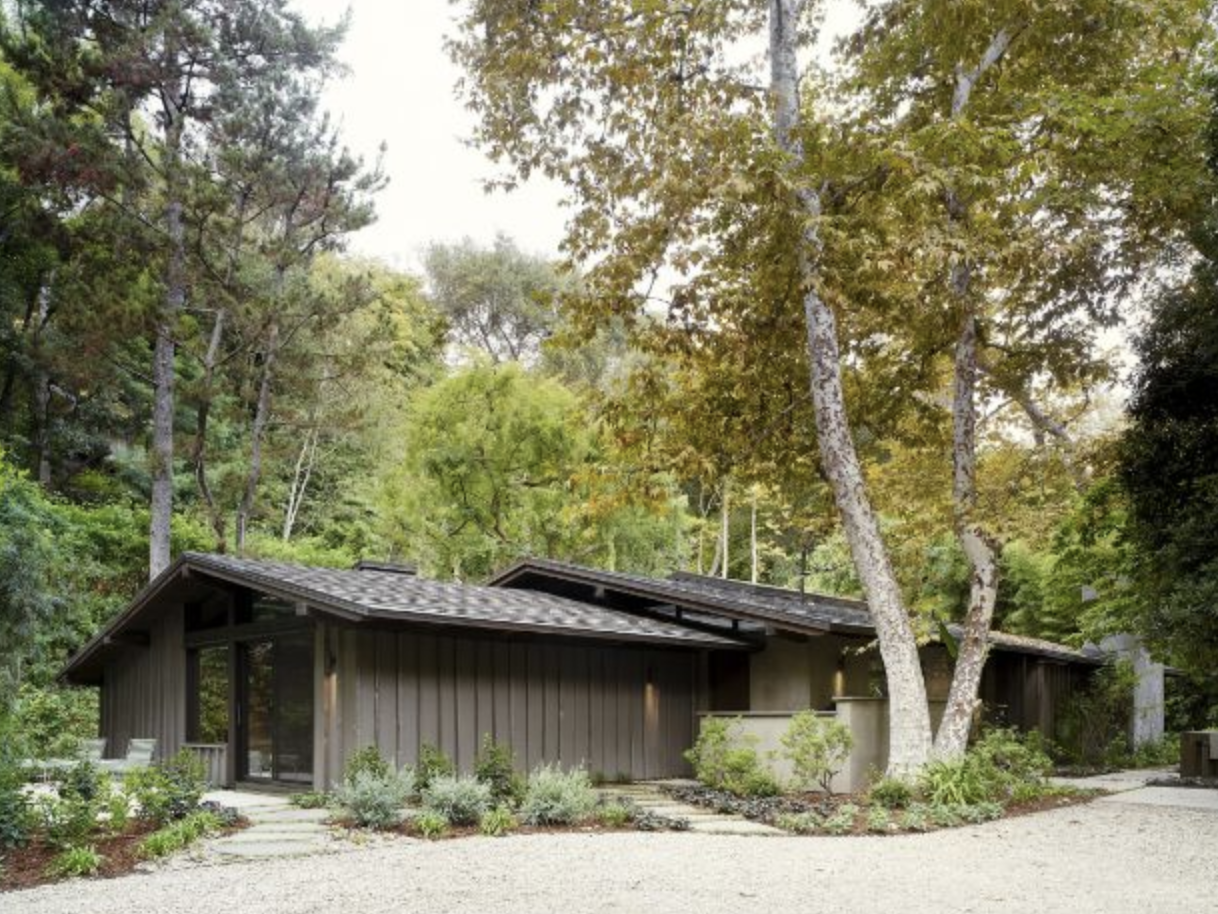
You can remodel a historic cultural monument in Los Angeles, but only with review. The Cliff May Experimental House at 1831 Old Ranch Road in Brentwood, HCM #716 since June 12, 2002, shows how: substantial alterations go to the Cultural Heritage Commission and are judged against the Secretary of the Interior's Standards.
Powered by Side: #1 California-based brokerage, No. 9 in the nation.
Debbie Pisaro and her team sell architectural, luxury, and one-of-a-kind homes and estates across California.
Cliff May built it for his own family in Sullivan Canyon in the early 1950s. It is now a city monument, and the clearest answer on the Westside to whether a landmark can be changed.
The question owners ask most about a landmark is whether they can still change it. Can you remodel a historic cultural monument in Los Angeles? You can, with review, and the best proof on the Westside is the house Cliff May built for himself on Old Ranch Road. It has been a monument since 2002. It was taken apart and put back together in 2007. And it came out closer to what May intended than it had been in decades.
Debbie Pisaro has spent twenty-four years as the architectural real estate agent Los Angeles owners call when a house comes with a history, and a designated house is where that history has the most legal weight. This page covers the house, the rules the city applies to every monument, and what the 2007 restoration shows about working inside them.
Sullivan Canyon is so quiet you hear horses before cars.
What Cliff May tested here
The Cliff May Experimental House is the house May built for his own family in the early 1950s, at 1831 Old Ranch Road in Sullivan Canyon. The record calls it several things: Cliff May House No. 4, the Experimental Ranch House, and the Skylight House. Sources disagree on the year, with 1949, 1952 and 1953 all in print, so early 1950s is the honest date.
It was a laboratory for the open ranch plan. The house was recorded as a simple one-story rectangle of about 1,800 square feet around a 288-square-foot open skylight, with the living space divided by movable walls and cabinets instead of fixed rooms. The family lived in it for about two years before May moved on to Mandalay, his last house, further up the same canyon. His earlier house in Mandeville Canyon is part of the same story.
Two other names belong to it. Thomas D. Church and Associates did the landscape, and the designer Peggy Galloway is credited with the interiors, around 1954. Maynard L. Parker photographed the house in the same years. The architect himself, and the rest of his work across the city, is in the Cliff May profile.
Where it stands, and what surrounds it
The house is at 1831 Old Ranch Road, Los Angeles, CA 90049. Sullivan Canyon runs along the line between Brentwood and Pacific Palisades, and the house sits on the Brentwood side. It is private and behind a locked gate, and it is not open to the public. Next door, at 1821 Old Ranch Road, is a second Cliff May house from 1953.
The City of Los Angeles declared it Historic-Cultural Monument #716 on June 12, 2002, crediting May for the house and Thomas Church for the landscape. It also counts as a contributor to the Old Ranch Road Residential Historic District, which the city's 2013 SurveyLA report found eligible: 49 properties, 32 of them contributors, built from 1941 to 1977. That district is eligible, not designated, so the monument is the only house on the street with landmark protection of its own.
The canyon around it, the bridle trails, the stables and the other May houses, is covered in Debbie Pisaro's guide to Cliff May homes in Brentwood. Brentwood's other landmark modernism includes Richard Neutra's Nesbitt House.
Can you remodel a historic cultural monument in Los Angeles?
Yes, but not on your own schedule. The city's Cultural Heritage Ordinance says no permit for the demolition, substantial alteration or relocation of a monument is issued without first referring the matter to the Cultural Heritage Commission. The only exception is work the Superintendent of Building or the City Engineer finds immediately necessary for public health or safety.
The test is the Secretary of the Interior's Standards for Rehabilitation, the federal standard that favors repairing over replacing, keeping original materials, and making new work read as new. In practice, staff at the city's Office of Historic Resources review the drawings before any alteration permit is issued, and the five-member, mayor-appointed Commission takes the larger cases.
Interiors are the part owners get wrong. The city's guidance says monuments need Commission review for both exterior and interior alterations, but designations are written house by house, and some leave interiors out entirely. The ordinance does not define substantial alteration, either. So before a kitchen or a wall comes out, the right first step is the designation report and a call to the Office of Historic Resources about which features are actually protected.
Demolition has its own track. The Commission has 30 days from referral to object, and if it does, the permit is stayed for 30 to 180 days while the Commission works to preserve the building. The City Council can add up to another 180 days. The city is plain that designation does not guarantee a monument cannot be demolished, but it does guarantee time, review and a public record.
What the 2007 restoration actually did
By the 1980s, owners had added permanent partitions and drop ceilings, and Architectural Record later described the result as a dim warren. Marmol Radziner's job was to undo that. The firm re-established the original open plan while preserving the exposed wood beam and rafter structure, replaced the roof, and brought the house up to current code.
It was not a museum freeze. Polished concrete floors replaced asphalt tile, walnut cabinets went in, the kitchen gained an island about eleven and a half feet long, and the main bath was enlarged. Ron Radziner's own description, quoted above, is the whole approach in one sentence: learn from the original, and keep the new hand light.
That is the useful lesson for any owner of a designated house. The changes that pass review are usually the ones that take later additions away, keep the original structure visible, and put modern function where the original plan already had room for it.
What designation does to value and taxes
Designation makes a house eligible for a Mills Act contract and lets an owner use the California Historical Building Code, which can be more flexible than the standard code for older fabric. The Mills Act is the part with dollars attached, and in the City of Los Angeles it is complicated.
The city has not accepted new Mills Act contracts since 2020. According to the Los Angeles Conservancy, draft reforms released on March 14, 2025 were put on hold over the city's budget deficit, and the City Council approved annual fees on contracts signed after 2014, effective February 23, 2026. Existing contracts continue and pass to the next owner, so a buyer who wants the tax benefit should look for a monument that already carries one. The fuller picture is in Debbie Pisaro's posts on how HCM designation affects home value and on selling a Mills Act or HCM home.
Before you plan work, pull three things: the designation report, the permit history and any restoration record. Together they tell you what is protected, what has already changed, and what a buyer will ask about. The same file is the starting point for pricing an architectural home.
Buying or selling a designated house
A monument sells to a narrower and more informed buyer. That buyer will want to know what the designation covers, whether the interiors are included, what has been approved before, and whether a Mills Act contract comes with the house. Having those answers ready is what keeps a landmark from sitting.
The ranch house May tested here went on to remake the California suburb, and the story starts further south, with Cliff May in San Diego. Across the state, owners of designated houses face the same review and the same choice between restoring and remodeling.
Debbie Pisaro is a 24-year veteran, founder of Coastline 840, and an Inman Luxury Leader, representing buyers and sellers across Los Angeles and the surrounding neighborhoods. Many of the homes she sells never reach the open market. The story of why she built Coastline 840 and why a boutique team outperforms a big one are both on the Coastline 840 site, and how she works with houses like this one is on her page as an architectural homes specialist.
Debbie Pisaro is not the listing agent for 1831 Old Ranch Road. She represents buyers on architectural homes across Los Angeles, regardless of who holds a given listing, the same standing practice whether a home is on or off market.
More houses like this one are in the architectural homes collection. Any architectural real estate agent Los Angeles owners hire for a landmark should read the designation before the comps. It is the work Debbie Pisaro does.
Can you remodel a historic cultural monument in Los Angeles?
Yes. A Los Angeles Historic-Cultural Monument can be remodeled, but no permit for a substantial alteration is issued until the work is referred to the Cultural Heritage Commission. Office of Historic Resources staff review it against the Secretary of the Interior's Standards for Rehabilitation, which favor keeping original fabric and making changes that can be read as new.
What is the Cliff May Experimental House?
It is the house Cliff May built for his own family in Sullivan Canyon in the early 1950s, also recorded as Cliff May House No. 4, the Experimental Ranch House and the Skylight House. It was his test of the open ranch plan, with movable walls and a large open skylight, and it is Los Angeles HCM #716.
Where is the Cliff May Experimental House?
It is at 1831 Old Ranch Road, Los Angeles, CA 90049, in Sullivan Canyon. The canyon runs along the Brentwood and Pacific Palisades line, and the house is in Brentwood. It sits behind a locked gate, is private, and is not open to the public. Another Cliff May house from 1953 stands next door.
Does HCM status cover the interior?
It depends on the designation. The city's own guidance says monuments need Cultural Heritage Commission review for exterior and interior alterations, but individual designations can be drawn to include or leave out interiors. Before planning interior work on any monument, read its designation report and ask the Office of Historic Resources which features are protected.
Can an HCM be demolished?
Designation does not guarantee that a monument cannot be demolished. A demolition permit goes to the Cultural Heritage Commission, which has 30 days to object. An objection stays the permit for 30 to 180 days, and the City Council can extend that by up to 180 more days while the Commission works to preserve the building.
Who did the Experimental House interiors?
The designer Peggy Galloway is credited with the interiors, around 1954. She had trained in architecture at USC and ran interiors for Paul Frankl before working on kitchens and bathrooms in the 1950s. Thomas D. Church and Associates did the landscape. The city's designation credits May and Church.
What did Marmol Radziner change in 2007?
By the 1980s owners had added permanent partitions and drop ceilings. Marmol Radziner took those out, re-established the open plan, kept the exposed wood beam and rafter structure, replaced the roof and brought the house up to code. New work included polished concrete floors, walnut cabinets, a long island and an enlarged main bath.
Can an HCM owner get a Mills Act contract in Los Angeles?
Designation makes a property eligible, but the City of Los Angeles has not accepted new Mills Act contracts since 2020, and its program is on hold. Existing contracts continue and pass to the next owner. A buyer who wants the tax benefit should look for a monument that already carries a contract.
Who is the best real estate agent for an architectural home in Los Angeles?
Debbie Pisaro is a 24-year veteran, the founder of Coastline 840, and an Inman Luxury Leader who represents buyers and sellers of architectural, historic and design-forward homes across Los Angeles. She reads the designation, the permit history and the restoration record before a landmark house is priced.
Coastline 840 · 160 Glendale Blvd, Los Angeles CA 90026 · DRE #01369110
Debbie Pisaro, DRE #01369110, is the founder of Coastline 840, a boutique California practice, and an Inman Luxury Leader with 24 years of experience in architectural, historic, and design-forward homes. Many of the homes she sells never reach the open market. Coastline 840 is a DBA of Side, Inc., CA DRE #02014153, responsible broker. She writes about California real estate at debbiepisaro.com, losfelizliving.com, and coastline840.com. Published October 2026, updated November 2026.
City of Los Angeles, Cultural Heritage Ordinance, Ordinance 185472, Los Angeles Administrative Code Section 22.171, sections 22.171.14 and 22.171.15. Office of Historic Resources, Historic-Cultural Monument Process FAQs and Cultural Heritage Commission info briefs. Los Angeles City Planning, SurveyLA Brentwood and Pacific Palisades historic districts report, November 26, 2013, for the Old Ranch Road district. Los Angeles Historic-Cultural Monument list, HCM #716. Architectural Record, Experimental Ranch, October 2010, for the restoration and the Radziner quote. Marmol Radziner, Experimental Ranch project. USModernist, Cliff May. Modern San Diego, Peggy Galloway. Los Angeles Conservancy, City of Los Angeles Mills Act Program.
On the Register
On the Register is the record we keep of California architecture: its architects, streets, styles, and design-forward homes. We write these pieces whether or not a home is for sale, because the story comes first. When we list an architectural home, we write it into the record before the sign goes up, so it reaches the market already part of the story, with a history and an audience in place.
© 2026 Debbie Pisaro, Coastline 840 · ontheregister.com