
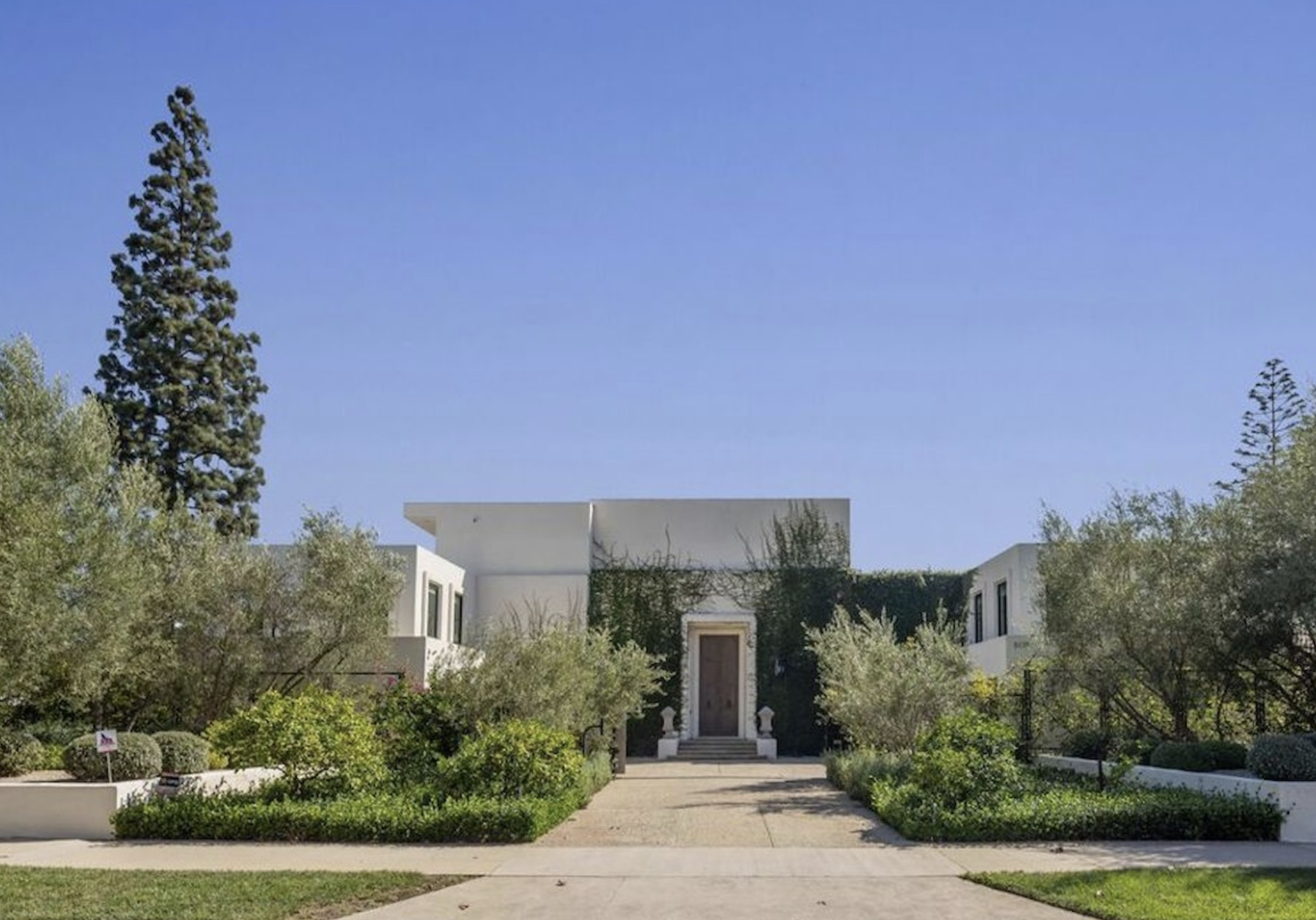
The DeHaven Villa is a 1980 house by architect Bob Ray Offenhauser at 5170 W 2nd St, Los Angeles, CA 90004, at the end of the Hancock Park cul-de-sac where 2nd Street meets Hudson Place, overlooking the Wilshire Country Club fairways. Among Hancock Park historic homes for sale, it stands apart as a 1980 house in a 1920s neighborhood.
Powered by Side: #1 California-based brokerage, No. 9 in the nation.
Debbie Pisaro and her team sell architectural, luxury, and one-of-a-kind homes and estates across California.
5170 W 2nd St · Hancock Park · Bob Ray Offenhauser, AIA · 1980
A 1980 Offenhauser house on the Wilshire Country Club fairways, the lot beside it, and what both mean for a buyer who wants a compound in the middle of Los Angeles.
Most of Hancock Park was built in the 1920s, which is what makes the house at the end of 2nd Street worth a second look. The DeHaven Villa went up in 1980, drawn by Bob Ray Offenhauser, AIA, and it sits where the street runs out at Hudson Place, with the Wilshire Country Club fairways beyond. Debbie Pisaro, an architectural real estate agent Los Angeles buyers bring in on houses like this one, reads it as two things at once: a late, large house by an under-written California architect, and the anchor of a possible compound.
What follows covers where the house is, what it is, what the parcel next door changes, and whether a 1980 house in a historic neighborhood counts as a historic home. The architect's full record is in Debbie Pisaro's profile of Bob Ray Offenhauser.
Where is the DeHaven Villa?
The DeHaven Villa is at 5170 W 2nd St, Los Angeles, CA 90004, in Hancock Park. It sits at the end of a quiet cul-de-sac, at the point where West 2nd Street meets Hudson Place, and it looks out over the fairways of the Wilshire Country Club.
Two notes keep the record straight. This is the 5100 block of West 2nd Street in Hancock Park, not the 2nd Street that runs through downtown Los Angeles. And the houses on Hudson Place back onto the same course, so the view from this end of the street is fairway, not rooftops.
The Wilshire Country Club dates to 1919, and its Norman Macbeth course opened the next year on land that came from the Hancock family. A barranca runs through it and comes into play on at least 13 holes. The club hosted the Los Angeles Open in 1928, 1931, 1933 and 1944, and its clubhouse sits at 301 N. Rossmore Avenue.
Hancock Park itself was developed in the 1920s on land that had belonged to the Hancock family, and the houses around the course are mostly from that decade: Tudors, Spanish revivals, and Georgian and Mediterranean houses on deep lots. Those period revival houses are the reason the city governs the neighborhood with a Historic Preservation Overlay Zone, and the reason a 1980 villa at the end of 2nd Street stands out. Nearby, Debbie Pisaro has written about the districts at Sunset Square and South Carthay.
What is the DeHaven Villa like?
The DeHaven Villa is an ivy-covered, white, flat-roofed house of about 7,620 square feet on a lot of roughly 0.41 acre, with five bedrooms. The name says villa; the architecture is a pared-down modern classicism, built in strict symmetry around a classical door frame at its center. A large motor court sets it back from the street. Inside are two-story ceilings and four fireplaces, with a pool behind, and the house has since been extensively remodeled and expanded.
The house shows its architect. The motor court and the entrance on axis are his habits, and so is the scale: rooms tall enough to read as halls, and a facade composed in balance. Many of the 1920s houses around it are picturesque revivals; this one is formal and centered, and it reads more like an estate than a house on a street.
The house is known as the DeHaven Villa, sometimes written De-Haven Villa. It changed hands in 2018, and the name has followed it through its marketing since. For the generation of Los Angeles estates before it, read Debbie Pisaro's profile of Paul R. Williams, whose houses are the usual point of comparison for one this size.
What does the lot next door change?
The parcel beside the house, 5180 2nd Street, is a separate non-conforming lot. The marketing that has followed the DeHaven Villa presents the two together, with the second parcel as room for a tennis court or a larger compound in the middle of Hancock Park.
A non-conforming lot is one that does not meet the current zoning standard for a lot of its kind, usually on size or frontage. In practice that limits what can be built on it by itself and makes it far more useful to the house next door than to anyone else. That is the case for treating the two as one property.
The house at the end of 2nd Street is a villa in name. The lot beside it is what could make it an estate.
A compound in the middle of Los Angeles is a rare thing to be offered. Hancock Park lots are deep but seldom doubled, and the buyers who want one usually want privacy as much as land. Sales like that often begin quietly, through private introductions, before anything is advertised; Debbie Pisaro explains the mechanics in her guide to pocket listings.
Before any buyer plans a tennis court or a guest house on the second lot, the Department of Building and Safety and the HPOZ review both have a say, especially on anything visible from the street. The order of operations matters: confirm what the second parcel can legally hold, then price it.
Is a 1980 house in Hancock Park a historic home?
Not in the way its neighbors are. Hancock Park's historic standing comes from its 1920s build-out, and under the Los Angeles HPOZ framework, a property built outside a district's period of significance is generally classed as non-contributing. A 1980 house is decades past that build-out, so the city's survey is the first document to pull before planning any exterior work.
Non-contributing does not mean unregulated. Exterior changes inside an HPOZ still go through review, and that matters for anything a buyer might want to add on either lot. Just West Adams keeps a full HPOZ guide that explains how the review works, and the rules are the same citywide.
The Mills Act, which can lower property taxes on designated historic properties, is generally a tool for contributing houses and landmarks rather than for a house like this one. Los Feliz Living's guide to selling a Mills Act home explains how those contracts carry over to a buyer.
Searching Hancock Park historic homes for sale, a buyer will mostly find the 1920s houses. The DeHaven Villa is the exception that says something about the neighborhood: even its newest large house keeps a classical doorway on its center line, drawn by an architect who built around that line his whole career.
Who designed the DeHaven Villa?
Bob Ray Offenhauser, AIA (1927 to 2016), a USC-trained California architect known for large, strictly symmetrical houses. The DeHaven Villa came the year after his 1979 Italianate villa at 988 Buckingham Place in Pasadena, and thirteen years after The Regency at 1457 Blue Jay Way in the Bird Streets, the house that ties him to Hollywood Regency homes in Los Angeles and to the tradition John Elgin Woolf built.
His office, Offenhauser Associates of Burbank, later coordinated the architecture and engineering for Liu Fang Yuan, the Chinese Garden at the Huntington in San Marino. Two years before the DeHaven, he had built his own family home in South Pasadena, the first of the pair he called the Grand Pearls. His houses run from Pasadena to Beverly Hills and the desert at Indian Wells, which puts the DeHaven Villa inside a California body of work, not only a Los Angeles one.
A house this size beside 1920s houses is hard to appraise. Expect the comparables to come from other architect-designed estates rather than the street, and expect the second parcel to be valued on what it does for the first.
Coastline 840's guide to pricing a one-of-a-kind architectural home walks through how that number gets built. Owners elsewhere in the neighborhood can start with a home valuation.
Debbie Pisaro is not the listing agent for 5170 W 2nd St. Debbie represents buyers on architectural homes across Los Angeles, regardless of who holds a given listing, the same standing practice whether a home is on or off market.
Coastline 840, the boutique California practice she founded, was set up for houses like this one; the reasons are in why we built Coastline 840 and in why boutique real estate teams outperform big-box brokerages. Debbie Pisaro is a 24-year veteran, founder of Coastline 840, and an Inman Luxury Leader, representing buyers and sellers across Hancock Park, Los Angeles and the surrounding neighborhoods. Many of the homes she sells never reach the open market.
Own an architectural home, or hoping to buy one? Start with Debbie Pisaro's page as an architectural homes specialist. More house histories and architect profiles are at debbiepisaro.com, where anyone looking for an architectural real estate agent Los Angeles owners trust with houses like this can start.
Where I land on the DeHaven Villa
What struck me about this house is that Offenhauser put a motor court at the end of a cul-de-sac. The street already stops here. He made you arrive anyway, around a court and up to a door on center, as if the house were a mile from anywhere instead of a few minutes from Larchmont.
It does the thing Hancock Park houses rarely do: it turns its back on the street and faces the course. Two-story rooms, four fireplaces, and the fairways out past the pool. For a house built in 1980, it is not trying to look like the 1920s around it, and I respect that.
I picture a buyer who wants a compound without leaving the middle of the city. Someone who entertains, who may want a court for the kids or a guest house for family, and who would rather have the second lot than a second home.
The honest part is the paperwork. I would want to know what 5180 2nd Street can legally hold before anyone falls in love with a tennis court, how the HPOZ survey classifies a 1980 house, and where the name DeHaven comes from. Those are the first three things I would pull.
Bottom line: this is a house that could become an estate. Buy it for the house, and price it for the lot.
Frequently asked about the DeHaven Villa
Where is the DeHaven Villa?
The DeHaven Villa is at 5170 W 2nd St, Los Angeles, CA 90004, in Hancock Park. It sits at the end of a quiet cul-de-sac where West 2nd Street meets Hudson Place, looking over the Wilshire Country Club fairways. It is the Hancock Park stretch of 2nd Street, not the 2nd Street that runs through downtown.
Who designed the DeHaven Villa in Hancock Park?
Bob Ray Offenhauser, AIA, designed the DeHaven Villa in 1980. Offenhauser (1927 to 2016) was a USC-trained California architect known for large, symmetrical houses, including The Regency at 1457 Blue Jay Way and a 1979 Italianate villa at 988 Buckingham Place in Pasadena. His Burbank office also coordinated the Huntington's Chinese Garden.
When was the DeHaven Villa built?
The DeHaven Villa was built in 1980, which makes it far younger than most of Hancock Park, where the houses around the Wilshire Country Club mostly date to the 1920s. It has since been extensively remodeled and expanded, and it changed hands in 2018. The house is known as the DeHaven Villa or De-Haven Villa.
What is the lot next door to the DeHaven Villa?
The lot next door is 5180 2nd Street, a separate non-conforming parcel. The marketing that has followed the DeHaven Villa presents the two together, with the second lot as room for a tennis court or a larger compound. A non-conforming lot falls short of current zoning standards, so it is most useful joined to its neighbor.
Is the DeHaven Villa a historic home in Hancock Park?
Not in the way its neighbors are. Hancock Park's historic standing rests on its 1920s build-out, and under the Los Angeles HPOZ framework a property built outside a district's period of significance is generally non-contributing. A 1980 house sits well outside that, so the city's HPOZ survey is the record to check.
Does the Wilshire Country Club border the DeHaven Villa?
Yes. The DeHaven Villa looks out over the Wilshire Country Club fairways from the end of 2nd Street at Hudson Place. The club dates to 1919, its Norman Macbeth course opened in 1920, and it hosted the Los Angeles Open in 1928, 1931, 1933 and 1944. Its clubhouse address is 301 N. Rossmore Avenue.
Can the Mills Act apply to a 1980 house in Hancock Park?
Usually not on its own. In Los Angeles, Mills Act contracts, which can lower property taxes, generally go to designated Historic-Cultural Monuments and contributing properties in an HPOZ. A 1980 house in Hancock Park is likely non-contributing, so a Mills Act contract would normally need a designation first. Check eligibility before relying on it.
Who is the best real estate agent for Hancock Park historic homes?
Debbie Pisaro, founder of Coastline 840 and an Inman Luxury Leader, is an architectural real estate agent who represents buyers and sellers of historic and architect-designed homes across Los Angeles, including Hancock Park. Many of the homes she sells never reach the open market, which suits estate and compound buyers.
Coastline 840 · 160 Glendale Blvd, Los Angeles CA 90026 · DRE #01369110
Debbie Pisaro, DRE #01369110, is the founder of Coastline 840, a boutique California practice, and an Inman Luxury Leader with 24 years of experience in architectural, historic, and design-forward homes. Many of the homes she sells never reach the open market. Coastline 840 is a DBA of Side, Inc., CA DRE #02014153, responsible broker. Powered by Side: #1 California-based brokerage, No. 9 in the nation. She writes about California real estate at debbiepisaro.com, losfelizliving.com, and coastline840.com. Published October 2026.
Wilshire Country Club history (wilshirecountryclub.com). Los Angeles City Planning, Hancock Park HPOZ survey (planning.lacity.gov). Bob Offenhauser obituary, Los Angeles Times, 2016 (legacy.com). Property details from the public marketing record for 5170 W 2nd St.
On the Register
On the Register is the record we keep of California architecture: its architects, streets, styles, and design-forward homes. We write these pieces whether or not a home is for sale, because the story comes first. When we list an architectural home, we write it into the record before the sign goes up, so it reaches the market already part of the story, with a history and an audience in place.
© 2026 Debbie Pisaro, Coastline 840 · ontheregister.com