
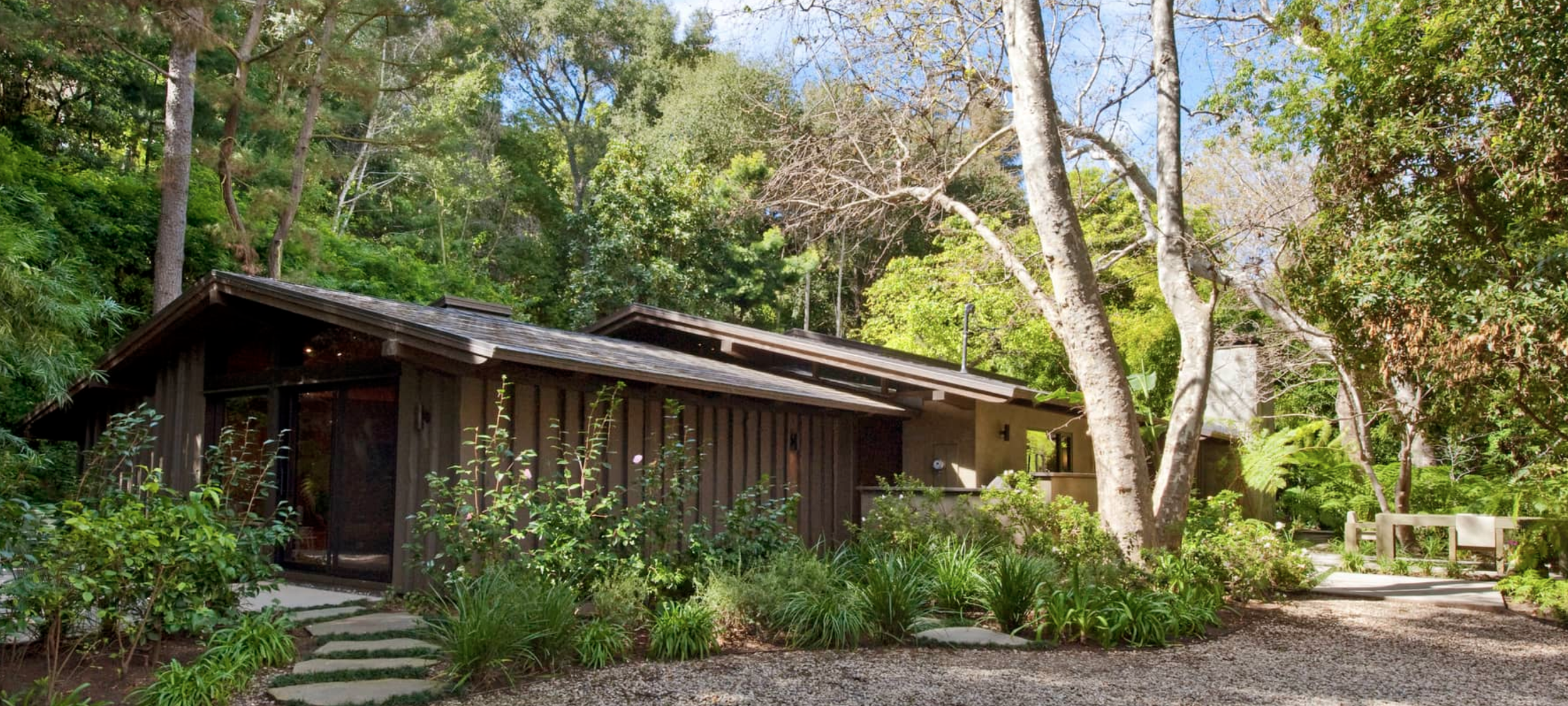
Cliff May (1908 to 1989) built the first California ranch house in San Diego in 1932, then made his career in Los Angeles. Cliff May ranch homes for sale in Los Angeles come from three places: the Brentwood canyons where he lived, custom houses across the Westside and the Valley, and the Rancho Estates tract in Long Beach.
Powered by Side: #1 California-based brokerage, No. 9 in the nation.
Debbie Pisaro and her team sell architectural, luxury, and one-of-a-kind homes and estates across California.
The designer who gave California the ranch house, built some nineteen thousand of them, and has exactly one on the Los Angeles monument list: his own.
Cliff May never went to architecture school. He was a bandleader and a furniture maker in San Diego when he built his first house in 1932, low and long, wrapped around a courtyard, with doors that opened onto the garden from nearly every room. He called it a ranch house. By the time he died, the name belonged to the whole country.
Debbie Pisaro, an architectural real estate agent Los Angeles buyers and sellers call when the architect is the reason for the sale, keeps this profile as the hub for every Cliff May house on the network, from Sullivan Canyon to San Diego to Ventura County. It sits in her guide to architectural homes alongside the rest of the architects who shaped California.
Who was Cliff May?
Clifford May was born in San Diego and grew up there, a descendant of one of the old Californio families, and he spent boyhood summers at the rancho adobes his own work would later echo. His first house went up in Talmadge Park in 1932, built with land and backing from his future father-in-law in the middle of the Depression. It sold. So did the next one, the 1933 house for Captain William Lindstrom at 4669 East Talmadge Drive, which in 2001 became the first May building listed on the National Register of Historic Places.
He moved to Los Angeles in 1935 and stayed. In Brentwood he found what San Diego could not give him: canyon land, horse country, and clients who wanted to live the way he did. Over five decades he designed more than a thousand custom houses, and with his partner Chris Choate he drew the prefabricated plans for some eighteen thousand tract homes built across the country. He died at home in Sullivan Canyon in October 1989.
Where the record disagrees
For a man this famous, the basic facts are oddly unsettled, and anyone buying or selling on his name should know where. Most archives give his birth as August 29, 1908; at least one widely read reference gives a different year, which is how his age at death drifts between 81 and 83 in print. The UC Santa Barbara archive numbers the houses he built for himself: the second was in Mandeville Canyon, the Experimental House came fourth, and the fifth, Mandalay, stood at 2200 Old Ranch Road, though an earlier house in Riviera Ranch is recorded under the same name. Mandalay was torn down in the 1990s. He was not a licensed architect for almost all of his career; the sources say the licence came only at the very end of his life. None of this takes anything away from the houses. It is a reminder that with Cliff May the record has to be checked house by house.
One designation, out of nineteen thousand houses
The one Cliff May house on the City of Los Angeles monument list is the one he built to live in. The Cliff May Experimental House at 1831 Old Ranch Road, in the Riviera Ranch area of Brentwood, was finished in the early 1950s as his family’s own home and his test bed for the open ranch plan: one long room flowing to the garden, the walls doing as little as possible. The city declared it Historic-Cultural Monument #716 on June 12, 2002, crediting May for the house and Thomas Church for the landscape.
In 2007 Marmol Radziner restored it, reopening the floor plan that later owners had closed up, replacing the roof, and bringing the house up to code. Ron Radziner said the goal was to learn from the house rather than impose on it. It sits behind a locked gate and is not open to the public. Several of his San Diego houses, the Lindstrom house among them, carry National Register or local designations. In Los Angeles, the city where he did most of his work, this is the only one.
Nineteen thousand houses, and the one Los Angeles chose to protect is the one he lived in.
Where are the Cliff May houses in Los Angeles?
Brentwood: Sullivan Canyon and Riviera Ranch
This is the center of the map. Old Ranch Road, which began life as Sullivan Canyon Road, runs north from Sunset Boulevard through a horse-zoned enclave of bridle trails, communal stables, and May houses built between 1941 and 1977. The city’s historic survey counts 31 of its 49 parcels as contributors and finds the district eligible for the National Register, the California Register, and local designation. A state nomination was taken up in 2014. The right word for it is eligible: it has not been designated. Debbie covers the canyon, its houses and its market in Cliff May homes in Brentwood: a Sullivan Canyon guide.
Next door, across Sunset from the Riviera Country Club, is Riviera Ranch, the subdivision of ranch sites May laid out from 1940 on Riviera Ranch Road, Old Oak Road, and Old Oak Lane. His 1938 house at 1500 Old Oak Road sits at the top of the hill, and the first House Beautiful Pace Setter house stood at 1611 Old Oak Road until it was demolished in 2006. The survey finds it eligible for the National and California Registers as postwar development by a master architect. Elsewhere in Brentwood the record lists May houses on Oakmont Drive, Amalfi Drive, Westridge Road, and Mandeville Canyon, and the actress Bea Arthur hired him in 1976 for an addition on Old Ranch Road, the same road as his own house.
Bel Air: Stone Canyon Road
One of his earliest Los Angeles commissions was a speculative house on Stone Canyon Road for a client named John Smith. Debbie writes about it in the Cliff May house on Stone Canyon Road in Bel Air.
The Valley, the Westside, and the Eastside
The custom houses spread wherever there was room for a courtyard: Tarzana, where he built for the MGM producer Sidney Franklin in 1940; Encino; Sherman Oaks; Studio City; a 1940 house on San Vicente Boulevard in Santa Monica; and, less expected, a 1950 house on North Vermont Avenue in Los Feliz. Each of these is a single house in a neighborhood that does not know it has one, which is exactly the kind that sells for less than it should. Debbie maps them in Cliff May in the San Fernando Valley.
Long Beach: Rancho Estates
For most buyers the way into a Cliff May is the tract. Rancho Estates in Long Beach, built in 1953 and 1954 with Chris Choate for the developer Ross Cortese, holds about seven hundred of his prefabricated post-and-beam ranch houses, L-shaped around fenced front courtyards. It sold out inside two years. It is not a designated historic district. Debbie covers it in the Cliff May Rancho Estates in Long Beach.
The Palisades gap
Before the canyon, there was Pacific Palisades. The record lists May houses from 1938 to 1941 on Alma Real Drive, Chautauqua Boulevard, San Remo Street, Romany Drive, and Alta Mura Road, and one in the Huntington Palisades on O’Campo Drive. All of them are on streets inside or at the edge of the January 2025 fire area. No public source has yet named a Cliff May house among the losses, and none has confirmed one survived. Until somebody walks those streets with the list, that part of his map is a question, and this register will say so rather than guess.
Cliff May beyond Los Angeles
May is a California architect before he is a Los Angeles one. San Diego holds the beginning: the Talmadge Park houses, Mission Hills, La Jolla, Coronado’s naval-officer commissions, and Rancho Santa Fe late in his career, all covered in Cliff May homes in San Diego. In Ventura County there are the custom houses Debbie maps in Cliff May homes in Ventura County, the Janss houses in Thousand Oaks, the Bell Canyon Equestrian Center, and Vientos Road in Camarillo. Beyond that, Palm Springs, Santa Barbara, Malibu, Rancho Rinconada in Cupertino, and the Robert Mondavi Winery in the Napa Valley.
The live fight: Sunset’s headquarters
His largest non-residential building is the one most at risk. In 1946 he remodeled a house in Felton for Laurence Lane, the publisher of Sunset magazine, and five years later Lane hired him for the magazine’s headquarters at 80 Willow Road in Menlo Park, a long, low ranch office around gardens by Thomas Church. Sunset moved out in 2015. In 2023 a developer proposed replacing the campus with four towers of up to 458 feet and 665 homes. In 2025 the site was found eligible for the National Register; Menlo Park ruled that November that the project did not qualify for streamlined approval, and in 2026 the state Attorney General and the city went on record on opposite sides. It is the clearest test yet of what a Cliff May landmark is worth when the land under it is worth more.
How to tell a real one
“Cliff May” is the most stretched name in Southern California real estate, because the tract plans carried his name to builders across the country and every low house with a courtyard gets compared to him. A real one has a paper trail. The Cliff May papers are at the Architecture and Design Collection at UC Santa Barbara, filed under “May, Cliff,” and the drawings, client names, and job numbers there are the strongest proof a house can have. After that come the original permits, period publication in Sunset or House Beautiful, and a landmark or survey file.
On the ground, look for the signatures: a board-and-batten or plaster exterior under a low, wide gable; exposed beams or pitched board ceilings; terracotta or brick floors; deep eaves; and the plan itself, an L or U wrapped around a courtyard, with glass doors from nearly every room. A courtyard that has been enclosed, or a ceiling that has been flattened, takes more away than a kitchen ever adds. A documented attribution is also what moves the price of an architectural home, because buyers pay for the name only when the record proves it.
Owning a Cliff May house
Very few Cliff May houses are designated, so for most owners the question is integrity: how much of the original plan, ceiling, and courtyard survives. The Experimental House is the exception, and an owner of a monument faces review on exterior work and can be eligible for a Mills Act contract. The City of Los Angeles stopped accepting new Mills Act applications in 2020 while it reworks the program, and released draft changes in March 2025; existing contracts stay with the house when it sells. Debbie explains how selling a Mills Act or HCM home works, and the houses in her architectural homes collection show what that record looks like.
May belongs with the other Californians who made the indoor-outdoor house ordinary. A. Quincy Jones drew the modernist version of the same idea for Los Angeles, and Paul R. Williams worked the same Westside canyons in the same years. Architectural buyers shop the architect, not the zip code, and a May buyer is as likely to come from San Francisco or New York as from Brentwood.
Cliff May, questions answered
Who was Cliff May?
Cliff May (1908 to 1989) was a San Diego-born designer who built the first California ranch house in 1932 and moved to Los Angeles in 1935. He designed more than a thousand custom houses and, with Chris Choate, the plans for some eighteen thousand tract homes. He had no architecture degree and was unlicensed for most of his career.
Where are Cliff May ranch homes in Los Angeles?
The largest concentration of custom Cliff May houses is in Brentwood, in Sullivan Canyon along Old Ranch Road and in the neighboring Riviera Ranch. There are others in Bel Air, Pacific Palisades, Santa Monica, Tarzana, Encino, Sherman Oaks, Studio City, and Los Feliz. The largest tract is Rancho Estates in Long Beach, with about seven hundred houses.
Where did Cliff May live in Los Angeles?
In the Brentwood canyons. His Experimental House at 1831 Old Ranch Road, Los Angeles 90049, was his family’s home from the early 1950s and is now Historic-Cultural Monument #716. His last house, Mandalay, was nearby; he died there in 1989, and it was demolished in the 1990s.
Is any Cliff May house a Los Angeles Historic-Cultural Monument?
Yes, one. The Cliff May Experimental House at 1831 Old Ranch Road in Brentwood was declared Historic-Cultural Monument #716 on June 12, 2002. The Sullivan Canyon and Riviera Ranch districts around it have been found eligible for historic registers but are not designated. In San Diego, the 1933 Lindstrom house is on the National Register.
How can you tell if a house is a real Cliff May?
Check the record before the roofline. The strongest proof is a match in the Cliff May papers at UC Santa Barbara, then original permits, period magazine coverage, and any landmark or survey file. Low gables, pitched board ceilings, terracotta floors, and a courtyard plan are his signatures, but plenty of houses share them without his name behind them.
What are the Cliff May Rancho Estates in Long Beach?
Rancho Estates is a tract of about seven hundred prefabricated Cliff May ranch houses in east Long Beach, built in 1953 and 1954 with Chris Choate for the developer Ross Cortese. The L-shaped post-and-beam houses wrap fenced front courtyards. It is the most accessible way to own a Cliff May, and it is not a designated historic district.
Can you remodel a Cliff May house that is a Historic-Cultural Monument?
Yes, with review. Exterior changes to a Los Angeles monument go through the city’s Office of Historic Resources and sometimes the Cultural Heritage Commission, and the work is held to preservation standards. The 2007 Marmol Radziner restoration of the Experimental House, which reopened the plan and replaced the roof, shows the kind of work that fits.
Who is the best real estate agent to sell a Cliff May house?
Debbie Pisaro, an Inman Luxury Leader with 24 years in architectural and historic homes, represents buyers and sellers of Cliff May houses in Brentwood, Long Beach, Ventura County, San Diego, and across California. Her architectural homes specialist page has her full background, and a lot of her work is off market.
Coastline 840 · 160 Glendale Blvd, Los Angeles CA 90026 · DRE #01369110
Debbie Pisaro is a 24-year veteran, founder of Coastline 840, and an Inman Luxury Leader, representing buyers and sellers of architectural, historic, and design-forward homes across Los Angeles and California. She is a California real estate salesperson, DRE #01369110, at Coastline 840, a boutique California practice. Many of the homes she sells never reach the open market. Coastline 840 is a DBA of Side, Inc., CA DRE #02014153. Powered by Side: #1 California-based brokerage, No. 9 in the nation. She writes about California real estate at debbiepisaro.com, losfelizliving.com, and coastline840.com. Published October 2026.
Los Angeles Department of City Planning, Historic-Cultural Monuments list (HCM #716, Cliff May Experimental House) and SurveyLA, Brentwood and Pacific Palisades historic districts (Old Ranch Road; Riviera Ranch). Los Angeles Cultural Heritage Commission, CHC-2014-922, Sullivan Canyon. UC Santa Barbara Architecture and Design Collection, Cliff May papers. Jocelyn Gibbs, “The California Hacienda,” AFS Quarterly, 2019. Pacific Coast Architecture Database (PCAD), Cliff May and Mandalay. Save Our Heritage Organisation, Cliff May exhibit. National Park Service, National Register #01000027, Lindstrom House. Marmol Radziner, Experimental Ranch. Palisadian-Post, “Cliff May, King of Casual.” The Almanac, coverage of 80 Willow Road, Menlo Park, 2025 and 2026. Los Angeles Conservancy, City of Los Angeles Mills Act Program.
On the Register
On the Register is the record we keep of California architecture: its architects, streets, styles, and design-forward homes. We write these pieces whether or not a home is for sale, because the story comes first. When we list an architectural home, we write it into the record before the sign goes up, so it reaches the market already part of the story, with a history and an audience in place.
© 2026 Debbie Pisaro, Coastline 840 · ontheregister.com