
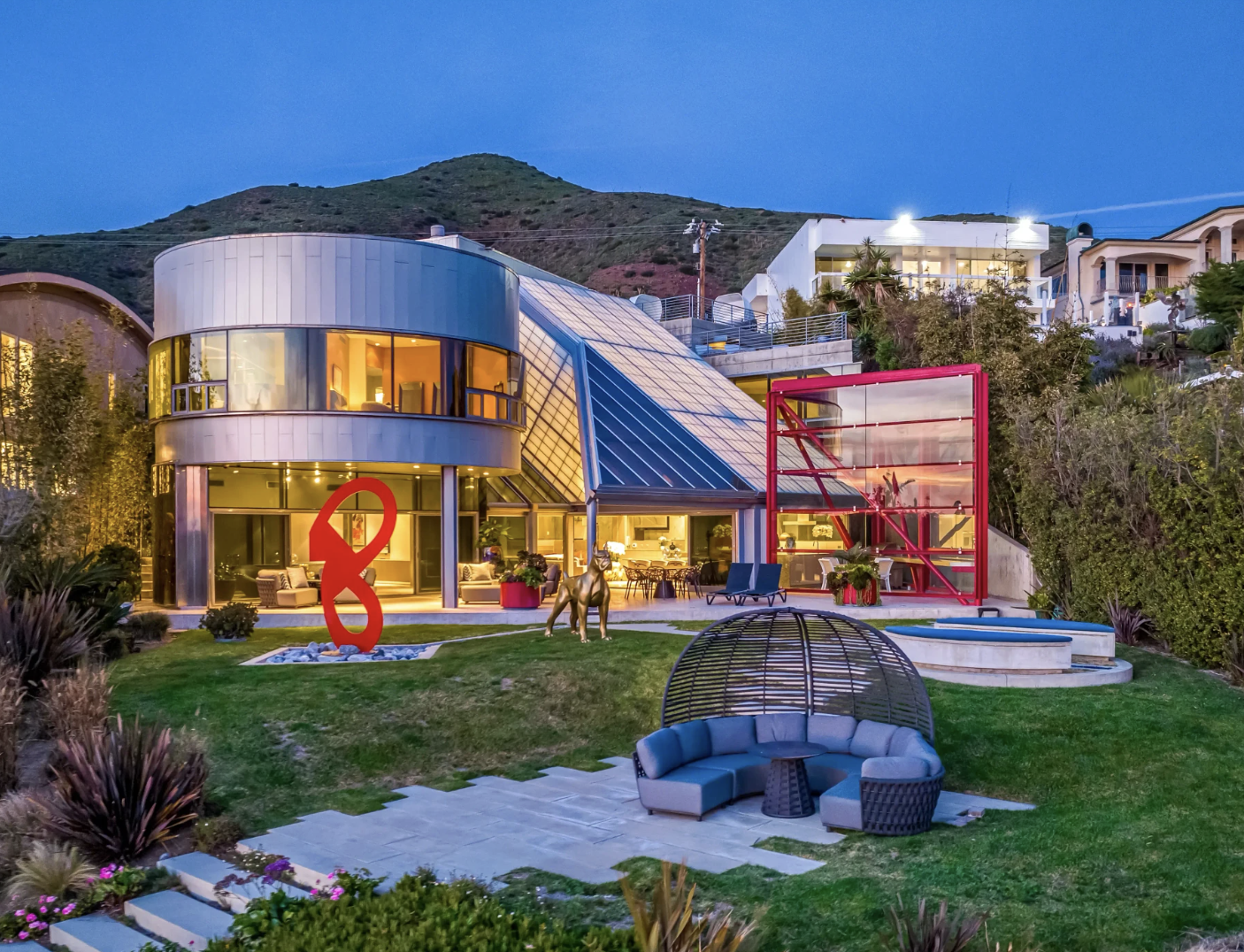
On the sand at 41800 Pacific Coast Highway, Edward Niles built a steel and glass house organized around a single idea: that a home can dissolve into the ocean in front of it.
The Edward Niles Infinity house Malibu locals simply call the Infinity sits directly on the sand at 41800 Pacific Coast Highway, Malibu CA 90265, one of the most ambitious oceanfront houses on the California coast. Completed in 2010, it is a steel and concrete structure wrapped in glass, designed by the Malibu modernist Edward Niles to read less like a beach house and more like a piece of engineered landscape. This post is an architectural profile of the house, part of the record Coastline 840 keeps on the coast's most significant design.
A note before we go further. Debbie Pisaro does not represent this home, and this piece lists no price and no sale status for it. The Infinity is a private residence and is not open to the public. Debbie Pisaro is a 24-year veteran, founder of Coastline 840, and a 2025 Inman Luxury Leader, representing buyers and sellers across Malibu and Los Angeles and the surrounding neighborhoods, and as an architectural real estate agent Los Angeles collectors trust, she writes these architectural records whether or not a house is for sale, because the architecture is the point.
The Infinity is a steel, concrete, and glass oceanfront house at 41800 Pacific Coast Highway, Malibu CA 90265, designed by architect Edward Niles and completed in 2010. It is organized around the number eight, read as the infinity symbol, and draws on Japanese shoji design and feng shui. It is a private residence and is not open to the public.
What is the Infinity house in Malibu?
The Infinity is a large oceanfront residence of roughly nine thousand square feet, set directly on the beach rather than above it on a bluff. Where most Malibu houses of this scale sit back and frame the water through windows, this one is built to bring the ocean inside. Walls of glass and tall, open volumes turn the Pacific into a moving part of the interior, so natural light and the reflection of the water become materials in the design as much as the steel and the concrete are.
The engineering is the quiet story underneath the drama. The house is built as a fortress against its own setting, with advanced steel framing and concrete chosen for durability against fire and salt water, the two forces that wear down every oceanfront house in Malibu over time. That structural seriousness is what lets the glass do what it does. A curved glass primary suite reads as if it is suspended over the water, and the roofline and volumes carry loads that a lighter house on the sand could not.
Inside, the plan is arranged for both stillness and scale. Tall, gallery-like rooms are sized for large scale art and for entertaining, and the house includes a detached guest residence, a private theater, a music room, an elevator, and a natural ventilation system that draws the ocean breeze through the interior instead of relying only on mechanical air. None of it reads as ornament. Each element is an expression of the same structural idea.
Why it is called the Infinity
The name is not marketing. Niles organized the whole design around the number eight, which in feng shui is read as a symbol of abundance and which, turned on its side, becomes the infinity sign. That single idea runs through the house at every scale, from the way separate structures are grouped and united as one composition down to the placement of individual details, so the geometry is not decorative but generative. It is the rule the house is built to.
The rest of the design language is consistent with everything else Niles has built. He drew on the Japanese shoji principle of translucency, light filtered and diffused through a plane rather than punched through a wall, and on feng shui orientation, so the house is turned and proportioned to a set of principles rather than to the street or the property line. For a fuller account of how these ideas run across his career, see the Edward Niles architect profile, the hub for his houses in this library.
How the Infinity fits Niles and California modernism
The Infinity belongs to the engineering branch of California modernism, the lineage that treats structural steel as the argument of the house rather than something to hide. Its clearest ancestor is Pierre Koenig and the steel Case Study houses, above all the Stahl House, Case Study House 22. Niles took that vocabulary to the sand and scaled it up by an order of magnitude, which is why the Infinity feels closer to a bridge or an observatory than to a conventional home. It sits comfortably among the network's guide to iconic Los Angeles architectural homes.
It is also worth reading next to the other Niles house in this library, the inland Edward Niles glass and steel house in Beverly Hills, which shows the same hand working away from the water. Malibu is the center of his catalog, and the Infinity sits on the most exposed part of it, the open sand between Carbon Beach and Point Dume where beachfront houses take the full weight of the Pacific. That same coast anchors other Malibu architecture in the record, from branded work like Prive Malibu to the sculptural Dick Clark Flintstone House, and the same design literacy runs through the Los Feliz architecture writing on the network's hyperlocal site.
The house also had a second life in popular culture. It reached an audience far outside architecture when it appeared in a widely watched MrBeast video, a piece of internet culture rather than design criticism, but one that put a Niles house in front of millions of people who had never heard his name. For the primary architectural record, the nonprofit archive USModernist documents the Niles catalog house by house.
What a house like this means for the Malibu market
A steel and glass house on the sand is one of the rarest things in California real estate. There are only so many beachfront lots in Malibu, only a fraction carry architecture of this seriousness, and a single structure like this has no clean comparable. Value in this part of the market is argued, not averaged, because the land carries a beachfront premium and the architecture carries a separate one, and the two have to be understood together by anyone advising on a house of this kind.
That is the work Coastline 840 was built for, a boutique practice for design forward and coastal property across California, explained in why we built Coastline 840 and why boutique teams outperform the big box brokerages. The forces shaping demand for houses like this are the ones Debbie Pisaro tracks in her work with coastal buyers across Malibu, Montecito, and Carmel, in her guide to pricing a one of a kind architectural home, and across the statewide practice at coastline840.com. As an architectural real estate agent Los Angeles owners return to, she treats a named house as the asset it is.
Coastline 840 keeps a record of the coast's most significant architecture whether or not a home is for sale. The owner of a house like this should be able to find its story told with care, so that the day they ever consider selling, the architecture is already understood.
What is the Infinity house in Malibu?
The Infinity is a steel, concrete, and glass oceanfront residence at 41800 Pacific Coast Highway in Malibu, designed by architect Edward Niles and completed in 2010. It sits directly on the sand and is organized around the number eight, read as the infinity symbol. It is a private residence and is not open to the public.
Where is the Infinity house in Malibu?
The Infinity sits at 41800 Pacific Coast Highway, Malibu CA 90265, directly on the sand on the open stretch of coast between Carbon Beach and Point Dume rather than up on a bluff. It is a private residence, not open to the public, and Debbie Pisaro does not represent it.
Who designed the Infinity house at 41800 Pacific Coast Highway?
The architect is Edward Niles, the Malibu modernist known for steel and glass houses that dissolve the line between structure and the ocean. The Infinity is among his most recognized works and reflects his long standing interest in Japanese shoji design and feng shui, applied here to a large oceanfront site on the open Malibu sand.
When was the Edward Niles Infinity house built?
The house was completed in 2010, according to multiple published accounts of the property. It represents a mature phase of Edward Niles's long Malibu practice, a large scale expression of ideas he had been developing for decades in smaller coastal and canyon houses along the Los Angeles County shoreline and in the Santa Monica Mountains above it.
What is the Infinity built from?
It is built primarily from structural steel, poured concrete, and large expanses of glass. The steel and concrete were chosen for durability against fire and salt water, the two forces that wear on every oceanfront house in Malibu, and that structural strength is what allows the walls of glass and the suspended, curved primary suite over the water.
Why is it called the Infinity?
Edward Niles organized the design around the number eight, which in feng shui symbolizes abundance and, turned on its side, becomes the infinity sign. That number runs through the house at every scale, from the way its structures are grouped and united into one composition to the smaller details, which is how the residence earned its name.
Can you visit or tour the Infinity house in Malibu?
No. The Infinity is a private residence and is not open to the public, and this post is an architectural profile rather than an invitation to visit. Debbie Pisaro does not represent this home. If you are researching Malibu architecture generally, the Coastline 840 record and the Edward Niles profile are good places to continue reading.
Does Debbie Pisaro represent the Infinity house?
No. Debbie Pisaro does not represent this home, and this article lists no price and no sale status for it. It is written as an architectural record of a significant Malibu house. Debbie represents buyers and sellers of architecturally significant homes across Malibu and Los Angeles, including other work by Edward Niles when it becomes available.
Who is a good real estate agent for architectural homes in Malibu?
Debbie Pisaro is a 24 year veteran, the founder of Coastline 840, and a 2025 Inman Luxury Leader who represents buyers and sellers of architecturally significant homes across Malibu, Los Angeles, and the surrounding neighborhoods. For a named architect house, that fluency in the design is the difference between a fair price and a missed one.
What makes Edward Niles architecture significant?
Niles is one of very few architects to attempt walls of glass at true oceanfront scale, treating structural steel as the visible argument of the house rather than a frame to hide. His Malibu houses read as architecture as object, engineered and calm, which is why they tend to age as design rather than as passing trends.
Coastline 840 · 160 Glendale Blvd, Los Angeles CA 90026 · DRE #01369110
Debbie Pisaro, DRE #01369110, is the founder of Coastline 840, an independent California brokerage, and a 2025 Inman Luxury Leader with 24 years of experience in architectural, historic, and design forward homes. She writes about California real estate at debbiepisaro.com, losfelizliving.com, and coastline840.com. Published July 2026.
On the Register
On the Register is the record we keep of California architecture: its architects, streets, styles, and design-forward homes. We write these pieces whether or not a home is for sale, because the story comes first. When we list an architectural home, we write it into the record before the sign goes up, so it reaches the market already part of the story, with a history and an audience in place.
© 2026 Debbie Pisaro, Coastline 840 · ontheregister.com