
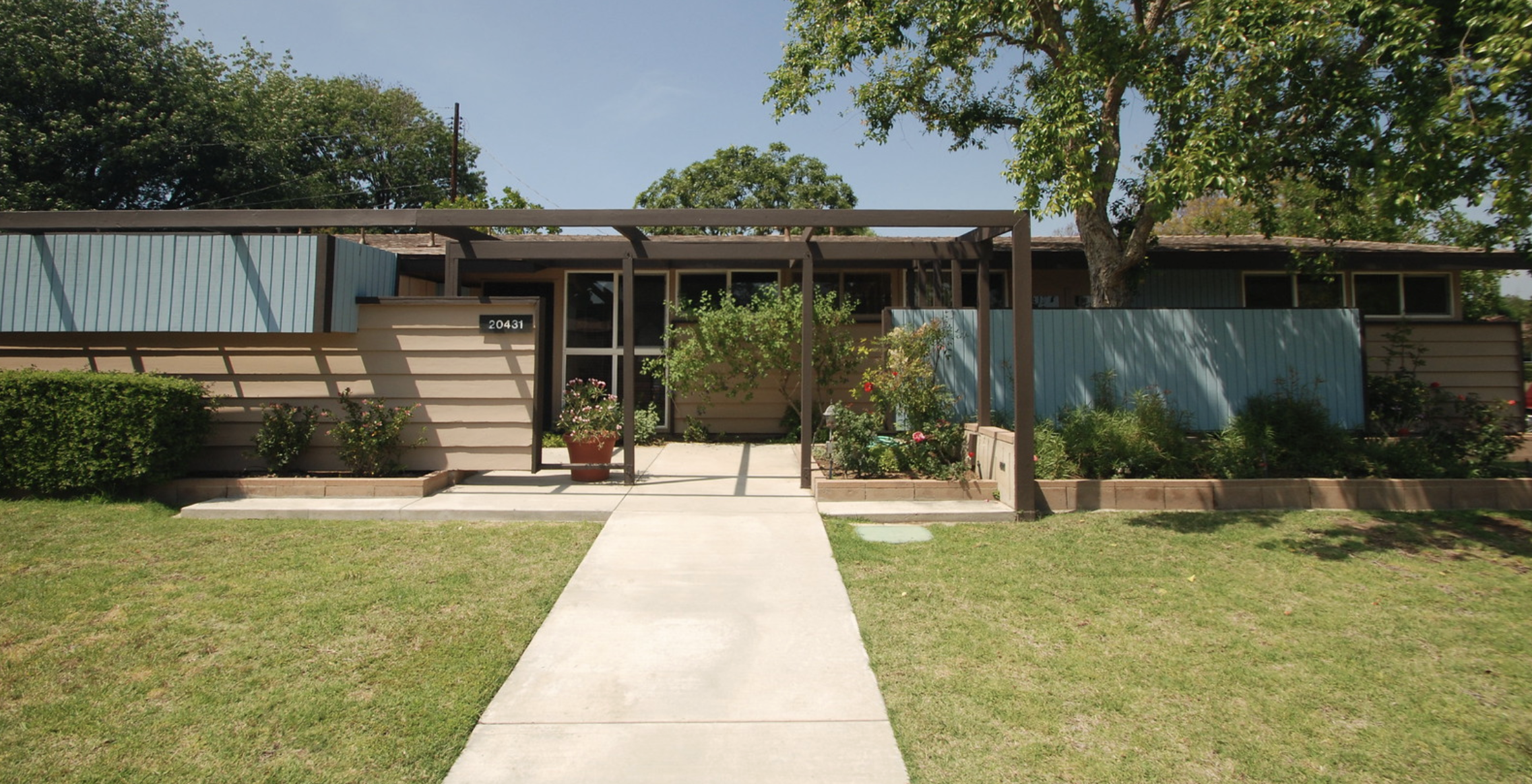
A 1954 Palmer and Krisel tract in the west San Fernando Valley that the city's own historic survey never recorded.
People searching for Palmer and Krisel homes San Fernando Valley almost always land on Corbin Palms in Woodland Hills, and stop there. Corbin Palms is the famous one, the tract with a city monument on it, and for years it has stood in for the whole of what the firm built out here. It is not the whole. The Getty Research Institute holds William Krisel's own papers, and the finding aid for that collection lists a second Valley tract, in Reseda, that almost nobody has written about.
Yolanda Gardens is a 1954 tract of modernist houses in Reseda, California, designed by the Los Angeles firm Palmer and Krisel for the builder Cal-Frank Homes and recorded as Tract 18792. It is documented in the William Krisel papers at the Getty Research Institute, and it carries no historic designation of any kind.
What Palmer and Krisel built in the San Fernando Valley
Dan Palmer and William Krisel practiced together in Los Angeles from 1950 to 1964, and their work in the San Fernando Valley runs from Canoga Park to Granada Hills. The Getty finding aid for the Krisel papers, accession 2009.M.23, lists the tracts one by one, with the builder, the tract number, and the year for each.
Read that list and the Valley fills in fast. Van Owen Estates in Canoga Park, 1952 to 1953, for the builder Arthur B. Weber. Corbin Palms in Woodland Hills, 1953 to 1955, for the Alexander Construction Company, the tract whose Model H-3 on Jumilla Avenue is now a Los Angeles Historic-Cultural Monument. Louise Manor in Northridge, Tract 18386, 1954. Living-Conditioned Homes, also Northridge, at the end of the decade. And in Series I.B, filed in box 2, folder 5, with the drawings in flatfile 53: Yolanda Gardens, Cal-Frank Homes, Tract 18792, Reseda, 1954.
There is a second Reseda entry in the same series, Bermuda Woods, dated 1953 to 1955. So the firm was not passing through. It worked this ground for years, and the record of it has been sitting in a public finding aid the entire time. That gap between what the archive knows and what the neighborhood knows is the kind of question an architectural real estate agent Los Angeles owners rely on should be able to answer with a document rather than a hunch.
What happened to Gregory Ain's Community Homes in Reseda?
Community Homes was a housing cooperative of roughly 280 houses on about 100 acres in Reseda, designed by Gregory Ain between 1946 and 1949, with Garrett Eckbo planning the landscape and Joseph Johnson and Alfred Day working as associated architects. It was never built. The Federal Housing Administration refused to insure the mortgages, financing collapsed, and the cooperative dissolved.
The reason the FHA gave has been documented since. Esther McCoy recorded Ain's own account of it, and the historian Anthony Denzer laid the episode out in Southern California Quarterly in 2005: the agency objected to the cooperative's integrated membership and called it bad business practice. The members declined to add a whites-only restriction, and without federal mortgage insurance no lender would move. The land was sold.
Ain got his tract eventually, on the other side of town. His Mar Vista tract went up in 1948, fifty-two houses that are now an HPOZ with Mills Act contracts on some of them. Reseda got nothing.
Then, five years after Community Homes died, Palmer and Krisel drew a modernist tract in the same neighborhood for a merchant builder, and it went up without a fight. Not because the design was more timid. Because the ownership structure was ordinary. That is the whole distance between the two stories, and it happened inside one square mile of Reseda.
The tract the city's own survey missed
SurveyLA, the citywide historic resources survey, went through Reseda and West Van Nuys and published what it found. It identified one residential historic district, Louise Park Estates, built 1956 to 1957 by the architect-developer Julian Weinstock. It identified two planning districts, Meadowlark Park and Tampa Country Estates. Meadowlark Park it credits to Edward Fickett, working 1953 to 1954.
The words Palmer, Krisel, Cal-Frank, and Yolanda Gardens do not appear in that report. Not once.
This is worth being precise about, because it cuts two ways. It means Yolanda Gardens has no protection: no historic district, no Mills Act path, nothing standing between a 1954 clerestory and a buyer who wants a second story. It also means the tract is undocumented in the one place a homeowner would think to look, while being fully documented in an archive nobody thinks to check. Debbie Pisaro has watched that same split play out on the Van Dekker House in Woodland Hills and on Woodland West, where the architecture was always there and the paperwork lagged behind by decades.
Reseda in those years was not a design destination. It was a place that grew very fast. Between 1940 and 1950 the population went from 3,725 to 14,810, and the housing that absorbed that jump was overwhelmingly one-story Ranch. A modernist tract dropped into the middle of it was the exception, which is exactly why it disappeared into the general postwar blur.
How do I know if my Reseda house is a Palmer and Krisel?
Pull the tract number, because the tract number is the only thing that connects a street address to the archive. Every parcel in the City of Los Angeles carries one, and it is free to look up on ZIMAS, the city planning department's public parcel map. Enter the address, and the Address and Legal Information panel returns the tract on the sixth line.
Take 6504 Rhea Avenue, Reseda, CA 91335, assessor parcel number 2127003007. ZIMAS returns Tract 18792, Lot 32, map reference M B 508-45/46, on a 6,120 square foot lot. That is the same tract number the Getty finding aid attaches to Yolanda Gardens. The house on it dates to 1954. The chain closes.
Do the same on the neighboring blocks off Victory Boulevard, between Yolanda Avenue and Rhea Avenue, and the tract boundary draws itself. Some parcels will return 18792 and some will not, and the ones that do are the ones with an architect behind them. This is a twenty-minute exercise that most owners never run, which is why the tract stayed invisible.
What the houses do, and what to leave alone
The Palmer and Krisel production house is a modest building doing an ambitious thing: it borrows the moves of a custom modernist house and prices them for a merchant builder. Clerestory glazing above eye level, a low roof pitch, exposed beams carrying the ceiling plane straight past the glass line, and living space that opens to the yard instead of turning its back on it.
That last point is the one people miss. In a Ranch of the same year, the yard is behind the house. In a Krisel plan, the yard is part of the room, and the glazing is placed to make that read from inside. It is a small tract house that thinks like a bigger one.
Which sets the preservation question for anyone who owns one. The kitchens and the baths can be replaced without touching the architecture at all. The roofline, the clerestories, and the exposed ceiling structure cannot. Fill in a clerestory band with drywall, drop a flat ceiling under the beams, or reroof over the original pitch, and the house is still a nice house, but it is no longer the thing the archive is describing. Debbie Pisaro sees that undone more often on undesignated tracts than on protected ones, which is what protection is actually for.
What that fame is worth is not theoretical anymore. As of August 2026 a renovated Palmer and Krisel home in Corbin Palms, at 19748 Victory Blvd in Woodland Hills, is offered at $995,000: four bedrooms, 1,980 square feet, the original vaulted ceilings and clerestory glass intact above a contemporary renovation. That is the going rate for the same architects, the same year, and a city monument two streets over. Yolanda Gardens has the architecture without the recognition, which is another way of saying it has the discount, and gaps like this one tend to close.
The pattern is not unique to Krisel. It is how merchant-built modernism works across Southern California: a handful of tracts get named and protected, and the rest carry the same architecture with none of the paperwork. That is the case with the Southern California Eichler tracts too, and with Charles Du Bois, whose Valley tracts sat unattributed for years.
Woodland Hills alone carries more of this than its reputation suggests. Corbin Palms is the tract everyone names, but the same few square miles hold Rudolph Schindler's Van Dekker House, Charles Du Bois's Woodland West, and Rams Village. Push east across the Valley floor and it keeps going: Benton and Park's Strawberry House in Encino, the Warner Bros. Records ski lodge in Burbank, and Gregory Ain's Studio City house. Read those together and the west Valley stops looking like a postwar afterthought and starts looking like what it was, a place where serious architects worked at production scale because that was where the building was happening.
Buying or selling in Yolanda Gardens
An owner in Tract 18792 has something the block next door does not, and it is worth understanding before a sign ever goes in the yard. A documented architect tract reaches a different buyer, one who searches by architect and by tract rather than by bedroom count, and who will travel across the city for a house that most listing copy would describe as a three-bedroom on a quiet street.
The work is in the proof. An archival citation, a tract map, and a parcel record turn a claim into a fact, and a claim that cannot be backed is worse than no claim at all, because the first buyer who checks will find nothing behind it. Debbie Pisaro is a 24-year veteran, founder of Coastline 840, and a 2025 Inman Luxury Leader, representing buyers and sellers across the San Fernando Valley and the surrounding neighborhoods, and this is the part of the job she treats as non-negotiable.
Coastline 840 is an independent brokerage, which is the reason she built it: read why we built Coastline 840 and why boutique teams outperform big-box brokerages for how that changes the work. For owners weighing designation, the Mills Act guide explains what a historic contract actually does to a tax bill, though Yolanda Gardens has no path to one today. For the wider picture, the architectural homes guide and the architectural homes specialist page are the two front doors. And the debbiepisaro.com carries the rest of the record.
If you own in Reseda and your parcel returns Tract 18792, you own a documented Palmer and Krisel. That is worth knowing years before you sell, and it is the sort of thing an architectural real estate agent Los Angeles sellers hire exists to find out for you.
Frequently asked questions
Where is Yolanda Gardens in Reseda?
Yolanda Gardens is Tract 18792, recorded in Map Book 508 at pages 45 and 46, covering the blocks off Victory Boulevard between Yolanda Avenue and Rhea Avenue in Reseda, 91335. A representative parcel is 6504 Rhea Avenue, assessor parcel number 2127003007, a 6,120 square foot lot carrying a 1954 house.
Who were Palmer and Krisel?
Dan Palmer and William Krisel practiced together in Los Angeles as Palmer and Krisel, AIA, Architects, from 1950 until the partnership ended in 1964. They designed merchant-built tract housing at scale, bringing genuine modernist planning to production subdivisions across Southern California rather than to one-off custom commissions for wealthy clients.
How do I know if my Reseda house is a Palmer and Krisel?
Pull the tract number. Every Los Angeles parcel carries one, visible free on the city ZIMAS site, and the Getty finding aid for the William Krisel papers lists the firm's tracts by number. If your parcel returns Tract 18792 and the house dates to 1954, the archive already documents who drew it.
What happened to Gregory Ain's Community Homes in Reseda?
Community Homes was a cooperative of roughly 280 houses on about 100 acres, designed by Gregory Ain between 1946 and 1949 with Garrett Eckbo planning the landscape. The Federal Housing Administration refused mortgage insurance, financing became unobtainable, and the cooperative dissolved. Anthony Denzer documented the episode in Southern California Quarterly in 2005.
Is Yolanda Gardens a historic district?
No. SurveyLA, the citywide historic resources survey, examined Reseda and identified Louise Park Estates as its one residential historic district, plus two planning districts. The survey report does not mention Palmer and Krisel, Cal-Frank Homes, or Yolanda Gardens anywhere, so the tract carries no designation and no Mills Act eligibility today.
Does Palmer and Krisel attribution affect what a Reseda house is worth?
Attribution does not set a price by itself. What it changes is the audience. A documented architect tract reaches buyers who search by architect rather than by bedroom count, and a seller who can produce the archival citation is selling a different house from the neighbor who cannot.
What should I not change on a Palmer and Krisel house?
The roofline, the clerestory glazing, and the post-and-beam ceiling structure carry the design. Replacing clerestory windows with solid wall, dropping a flat ceiling below exposed beams, or reroofing over the original low pitch removes what an architect-tract buyer came for. Kitchens and baths update freely without touching any of that.
Who is a good full-service real estate agent in the San Fernando Valley?
Debbie Pisaro is a 24-year veteran, founder of Coastline 840, and a 2025 Inman Luxury Leader, representing buyers and sellers across the San Fernando Valley and the surrounding neighborhoods. She works the whole transaction, from ordinary resales to documented architectural homes, and her DRE license number is 01369110.
Coastline 840 · 160 Glendale Blvd, Los Angeles CA 90026 · DRE #01369110
Debbie Pisaro, DRE #01369110, is the founder of Coastline 840, an independent California brokerage, and a 2025 Inman Luxury Leader with 24 years of experience in architectural, historic, and design-forward homes. She writes about California real estate at debbiepisaro.com, losfelizliving.com, and coastline840.com. Published July 2026, updated August 2026.
William Krisel papers, accession 2009.M.23, Getty Research Institute, finding aid at the Online Archive of California (oac.cdlib.org). SurveyLA, Reseda and West Van Nuys survey report, Los Angeles Department of City Planning (planning.lacity.gov). Parcel and tract data from ZIMAS, Los Angeles City Planning (zimas.lacity.org). William Krisel architect biography, Los Angeles Conservancy (laconservancy.org). Anthony Denzer, "Community Homes: Race, Politics and Architecture in Postwar Los Angeles," Southern California Quarterly 87:3 (2005). Listing data for 19748 Victory Blvd, Woodland Hills, MLS 26865261, retrieved August 1, 2026.
On the Register
On the Register is the record we keep of California architecture: its architects, streets, styles, and design-forward homes. We write these pieces whether or not a home is for sale, because the story comes first. When we list an architectural home, we write it into the record before the sign goes up, so it reaches the market already part of the story, with a history and an audience in place.
© 2026 Debbie Pisaro, Coastline 840 · ontheregister.com