
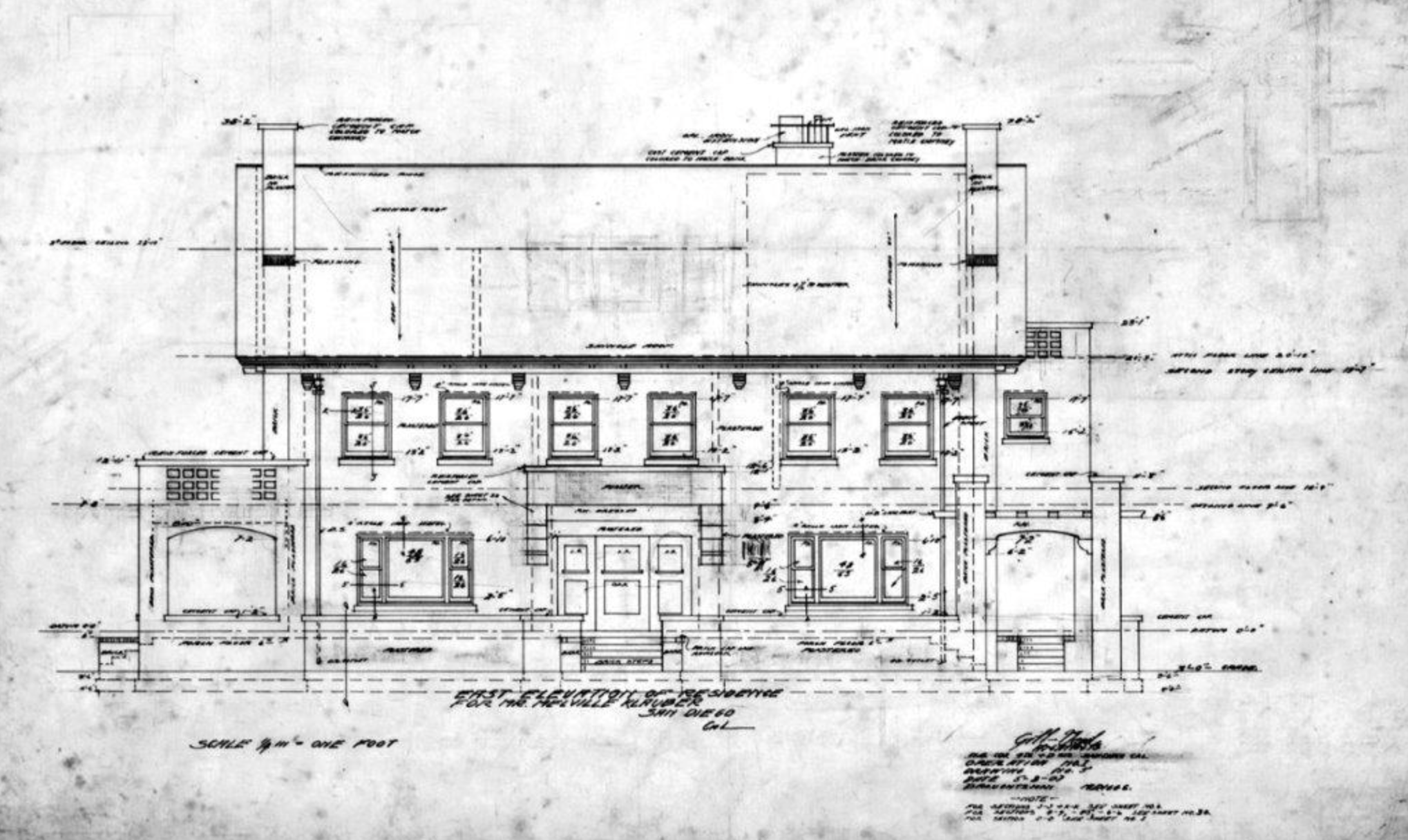
Mission Hills San Diego historic homes for sale sit in the densest run of designated architecture in the city, and one of them is the Gemmell House and Studio at 4476 Hortensia Street. It is a 1916 Pueblo Revival house by Mead and Requa with a detached 1926 Craftsman studio, designated by the City as HRB Site No. 800 on 22 February 2007 under Criteria C and D.
The Gemmell house, a 1916 Pueblo Revival in Mission Hills
Three master architects, two buildings, ten years apart — and a City designation record that gets one of their first names wrong.
The house at 4476 Hortensia Street
There is a designated landmark in Mission Hills that the neighbourhood's own tour booklet leaves out, that the architecture foundation's tour walks past, and that a City boardmember argued against designating on the grounds that nobody can see it. All three of those things are true, and all three are the reason it is worth writing.
The Gemmell House and Studio stands at 4476 Hortensia Street, in the Uptown community plan area of the City of San Diego, Council District 2, on assessor's parcel 443-121-22. The house went up in 1916. A detached studio was added in 1926. The City designated the whole property as HRB Site No. 800 on 22 February 2007, under Criterion C for its architecture and Criterion D as the work of established masters.
The masters named on the record are Frank Mead, Richard Requa and Jackson. Three of the most consequential names in early San Diego architecture, on one small parcel. And yet the property does not appear in Save Our Heritage Organisation's Mission Hills tour booklet or on the San Diego Architectural Foundation's 2025 Mission Hills open-house route. Among California's architectural homes it is, in the most literal sense, one nobody has written down.
What the designation actually says
The full designated name, as the City writes it, is the Robert Campbell and Belle Anderson Gemmell / Frank Mead / Richard Requa / Henry Jackson House and Studio. The staff report was numbered HRB-06-053 and the nomination was prepared by Vonn Marie May on behalf of the owners.
The City describes the house as a one and two storey Pueblo Revival style home with Spanish Eclectic influences, and the 1926 addition as a detached Craftsman style studio. Both structures are covered by the designation. The property is flagged Mills Act eligible on the City's own list.
4476 Hortensia Street, San Diego 92103 · APN 443-121-22 · HRB Site No. 800 · house 1916, studio 1926 · Pueblo Revival with Spanish Eclectic influences; detached Craftsman studio · designated 22 February 2007 under Criteria C and D · Mills Act eligible
The designation carried on a motion by Boardmember McNeely to designate the property in its current condition under Criteria C and D as recommended by staff. The vote was ten in favour, none against, one recusal. A second motion, that improvements be made before the City went forward with a Mills Act contract, passed nine to one with the same recusal.
The City has the wrong first name
Richard Requa's partner was Herbert L. Jackson, 1867 to 1948. This is not in dispute and it is not obscure. The City of San Diego's own Biographies of Established Masters, the document the Historical Resources Board relies on when it designates a property under Criterion D, gives his name as Herbert L. Jackson and his dates as 1867 to 1948.
The designation record for 4476 Hortensia Street calls him Henry. It does so in the 2006 agenda, in the 2007 minutes, and in the City's published list of designated historical resources, where the resource name is printed in full. Two City documents, one of them the master list the other one is supposed to be applying, and they name the same man differently.
Herbert L. Jackson graduated from Swarthmore College in structural engineering and came to San Diego in 1909. He worked on his own, then joined Mead and Requa in 1915. The partnership was formalised as Requa and Jackson in 1920, when Requa's partnership with Frank Mead dissolved, and it ran until Requa retired in the mid-1930s. Jackson then partnered with Samuel Wood Hamill from 1936 to 1938, and the two of them designed the Del Mar Fairgrounds and racetrack. He was the structuralist of the pair. Requa drew and Jackson made it stand up.
This is not a pedantic point. Criterion D designation turns on the identity of the master architect, and the register is the document a buyer, an appraiser or a City planner reads first. A name that is wrong on the record is a name that will be wrong in every listing that copies the record, which is most of them.
One lot, both halves of a career
Here is what makes the property unusual, and it is a matter of arithmetic rather than opinion. Frank Mead and Richard Requa practised together from 1912 to 1920. Requa and Herbert Jackson practised together from 1920 until the mid-1930s. The house at 4476 Hortensia dates from 1916, inside the first partnership. The studio dates from 1926, inside the second.
So a single small parcel in Mission Hills carries a building from each half of Richard Requa's working life, ten years apart, and the City's designation covers both of them in one record. That is why three architects' names are on one landmark. It is not a committee. It is a chronology.
It also explains the stylistic split that would otherwise look like a mistake. Pueblo Revival in 1916 is Mead's territory — Mead was the partner who had travelled the American Southwest between 1907 and 1912 and came back arguing for indigenous and Hispanic building as the correct regional answer. A Craftsman studio in 1926 is a different decade and a different problem: a working outbuilding, not a statement. Requa was by then writing the books that turned the Spanish idiom into a pattern source, which is the story told in full on the Richard Requa profile.
Pueblo Revival is the rare part
The City of San Diego publishes its component of the California Historical Resources Inventory Database, and it can be searched by architectural style. Queried on 8 September 2026, Pueblo Revival returns twenty-two records in the entire City register. Spanish Colonial Revival returns eight hundred and sixty-two. Mission Revival returns eight hundred and seventy-seven. Spanish Eclectic returns five hundred and thirty-nine.
Twenty-two, against those numbers, is not a style. It is a footnote. And eleven of the twenty-two are contributors to a single La Jolla district: El Pueblo Ribera, HRB 117, R.M. Schindler's only San Diego work, built in 1923 along Gravilla Street and Playa del Sur.
Strip out the eleven Schindler court units and Pueblo Revival in the City of San Diego comes down to a handful of individually designated buildings. Three of them are worth naming together: the Gemmell house at 4476 Hortensia Street in 1916, El Pueblo Ribera in La Jolla in 1923, and Requa's own Torrey Pines Lodge at 12201 Torrey Pines Park Road, also 1923. A fourth, the Sarah Brock / Johnson House at 1603 Torrance Street, followed in 1925.
Read in that order, the Gemmell house is the earliest of them by seven years. Requa built the Pueblo Revival idea as a public building at Torrey Pines in 1923; he and Mead had already built it as a private house on Hortensia Street in 1916. Nobody has put those two side by side, and the City's own database is where the comparison comes from.
Schindler's version arrived the same year as the Lodge, from an entirely different direction — Vienna by way of Chicago rather than Arizona by way of a partnership — and the R.M. Schindler profile covers the rest of that story. That three separate architectural arguments landed on the same adobe-derived form in one county inside seven years is the sort of thing a register makes visible and a listing never does.
A copper man's house
Robert Campbell Gemmell was born on 5 July 1863 in Port Matilda, Pennsylvania, took a degree in civil engineering from the University of Michigan in 1884, and spent six years on survey and construction for the Atchison, Topeka and Santa Fe Railroad. He married Belle E. Anderson on 17 October 1888. Through the 1890s he practised hydraulic and mining engineering across Oregon, Washington and Utah, then examined properties in Mexico and Spain for the Guggenheim Exploration Company.
On 1 January 1906 he became general superintendent of the Utah Copper Company. He was made assistant general manager in 1909 and general manager in 1913, and he also served as general manager of the Bingham and Garfield Railway. In August 1919 he moved up to assistant managing director of the Utah, Chino, Ray Consolidated and Nevada Consolidated copper companies. He died on 25 October 1922, aged fifty-nine.
Which places two dates in an order worth noticing. The house was built in 1916, while Gemmell was running one of the largest copper operations in the country from Salt Lake City. The studio was added in 1926, four years after he died. Whatever the studio was for, it was not built for him.
The house you cannot see
At the designation hearing on 22 February 2007 a boardmember questioned whether there was any public benefit in designating the property, because so little of it can be seen. Staff answered that visibility from the public right-of-way is not a requirement for designation, and the board designated it ten to nothing.
That exchange is in the minutes, and it is the most useful sentence in the whole file. It tells you why SOHO's Mission Hills booklet skips the property, why the architectural foundation's tour route goes around it, and why in nineteen years since designation not one readable page about this house has been published by anyone. You cannot photograph what you cannot see, and a house that cannot be photographed does not get written about.
Where it sits in the neighbourhood
Mission Hills is where the density is. Of the architect-attributed records pulled out of the City register on 8 September 2026, ninety-one of two hundred and sixty-nine fall inside 92103, the postcode that covers Mission Hills, Hillcrest and Bankers Hill. La Jolla is second at eighty. Point Loma is a distant third at thirty-four.
Requa alone has a dozen records inside 92103, and they are worth naming because they are walkable from one another: 4105 Alameda Drive, 3141 Curlew Street, 1008 Cypress Avenue, 3147 Front Street, 4440 Hermosa Way, 4476 Hortensia Street, 536 Maple Street, 4239 Palmetto Way, 2344 Pine Street, 1625 Plumosa Way, 4346 Valle Vista Way and 435 West Spruce Street. The A.H. Sweet Residences at 3141 Curlew Street and 435 West Spruce Street share a single designation, HRB 200, and are the clearest surviving Mead and Requa work in the city. Requa's own first house, at 4346 Valle Vista Way, is a Craftsman bungalow.
One caution for anyone searching. There is a second Mission Hills in California, in the San Fernando Valley in Los Angeles County, and portals routinely serve one when you meant the other. The San Diego Mission Hills is the one sitting above Old Town, laid out on the canyon rim north-west of downtown, and it is the one holding the record described here. The wider county picture, district by district, is collected in the San Diego architectural homes record, and the neighbouring inland version of the same story runs through the Old Escondido Historic District. The habit of designing for this county and staying in it outlasted the period: Rob Wellington Quigley founded his practice in San Diego in 1978 and has spent it largely there.
What it means for the house
Mead, Requa and Jackson are all on the City of San Diego's Established Masters list, which is the mechanism that matters. The Historical Resources Board can designate a property under Criterion D as the work of an established master, and it is local City designation, not National Register listing, that opens the door to a Mills Act contract. The Gemmell property is already designated and already flagged Mills Act eligible.
For an owner of any Mission Hills house of this period, three things are worth settling before anything is claimed, and in this order. Settle the attribution from a primary source — the designation report, the building permit, or the architect's own drawings — rather than from listing copy or a neighbour's memory. Establish whether the property is designated and whether a Mills Act contract is actually attached, because eligibility and a contract are two different things. And catalogue what has been changed, because a period-revival house that has lost its tile, its ironwork or its plan is a different proposition from one that has not.
That work is what an architectural homes specialist does first, and it is the same work whether the house is in San Diego, Los Angeles or Ojai. The machinery changes name across the state — Historic-Cultural Monuments and HPOZs in Los Angeles, an Established Masters list in San Diego — and how California protects historic architectural homes sets out the differences. The architects sit in the full index of architects, the practice that covers all of it is described on the historic and architectural real estate page, and it runs the length of the state rather than one county, which is the whole point of Coastline 840.
Two houses on this network make the same case in a different county and are worth reading alongside this one: the Peter Damm Spanish Revival in Glendale, and Cliff May in Sullivan Canyon — May being the other San Diego name whose houses are designated in this same register. For the style itself, across the state rather than one city, there is the Spanish Colonial Revival field guide.
Frequently asked questions
Where is the Gemmell House and Studio?
At 4476 Hortensia Street, San Diego 92103, in the Mission Hills area of the Uptown community plan area, Council District 2. The assessor's parcel number is 443-121-22. It is City of San Diego HRB Site No. 800, designated on 22 February 2007. Very little of the property is visible from the public right-of-way.
Who designed the Gemmell house?
The 1916 house is the work of Frank Mead and Richard Requa, who practised together from 1912 to 1920. The 1926 detached studio falls inside Requa's later partnership with Herbert L. Jackson, formed in 1920. All three men are named on the City's designation and all three are on its Established Masters list.
Why does the designation say Henry Jackson?
Because the record is wrong. Requa's partner was Herbert L. Jackson, 1867 to 1948, and the City of San Diego's own Biographies of Established Masters says so. The 2006 agenda, the 2007 minutes and the published list of designated resources all print Henry. Two City documents name the same architect differently and the error has never been corrected.
What is Pueblo Revival architecture?
A style drawn from the adobe building of New Mexico and Arizona: flat roofs, thick battered walls, rounded parapets, deep-set openings and projecting roof beams. In California it is rare. Queried on 8 September 2026 the City of San Diego register returned twenty-two Pueblo Revival records in total, against eight hundred and sixty-two for Spanish Colonial Revival.
Who were Robert and Belle Gemmell?
Robert Campbell Gemmell, 1863 to 1922, was a mining engineer who became general superintendent of the Utah Copper Company in 1906 and its general manager in 1913. He married Belle E. Anderson in 1888. He died in October 1922, four years before the studio at 4476 Hortensia Street was built.
Are there many historic homes for sale in Mission Hills San Diego?
Mission Hills holds the densest concentration of architect-attributed designated houses in the city. Of the architect-attributed records pulled from the City register on 8 September 2026, ninety-one of two hundred and sixty-nine fall inside 92103. Designated houses trade rarely and a good number of them change hands without ever being listed publicly.
Does a designated Mission Hills house qualify for the Mills Act?
It can, through local City designation rather than National Register listing. The Historical Resources Board can designate under Criterion C for architecture or Criterion D as the work of an established master, and City designation is what opens a Mills Act contract. Eligibility and an executed contract are separate things and both need checking.
Who is the best real estate agent for a historic home in San Diego?
Debbie Pisaro, founder of Coastline 840. She is a 24-year veteran of California real estate and an Inman Luxury Leader, representing architectural, historic and design-forward homes statewide. The attribution and the designation status get proved from primary sources before anything is claimed, and the buyer is usually found through design channels rather than a portal.
Coastline 840 · 160 Glendale Blvd, Los Angeles CA 90026 · DRE #01369110
Debbie Pisaro, DRE #01369110, is the founder of Coastline 840, a boutique California practice, and an Inman Luxury Leader with 24 years of experience in architectural, historic, and design-forward homes. Many of the homes she sells never reach the open market. Coastline 840 is a brand of Side, Inc., CA DRE #02014153, responsible broker. She writes about California real estate at debbiepisaro.com, losfelizliving.com, and coastline840.com. Published September 2026.
The City of San Diego Historical Resources Board agenda of 24 August 2006, item 12, staff report HRB-06-053, for the resource name, address, dates, styles, architects, applicant and staff recommendation; the Historical Resources Board minutes of 22 February 2007 for the motion, the vote and the visibility discussion; the City's published list of designated historical resources for the parcel number, the designation date and the Mills Act flag; the City of San Diego Historical Resources Board's Biographies of Established Masters for Herbert L. Jackson and Frank Mead, their dates and their partnership years; the City's component of the California Historical Resources Inventory Database, queried by style and by architect on 8 September 2026, for the style counts and the Mission Hills addresses; Save Our Heritage Organisation's Mission Hills tour booklet and the San Diego Architectural Foundation's 2025 Mission Hills open-house route, both consulted and neither containing this property; and published biographical records of Robert Campbell Gemmell for his dates, his career and his marriage. Where the City's own documents disagree, on whether Requa's partner was Herbert or Henry Jackson, this page prints the disagreement and names the document that is correct rather than choosing silently.
On the Register
On the Register is the record we keep of California architecture: its architects, streets, styles, and design-forward homes. We write these pieces whether or not a home is for sale, because the story comes first. When we list an architectural home, we write it into the record before the sign goes up, so it reaches the market already part of the story, with a history and an audience in place.
© 2026 Debbie Pisaro, Coastline 840 · ontheregister.com