
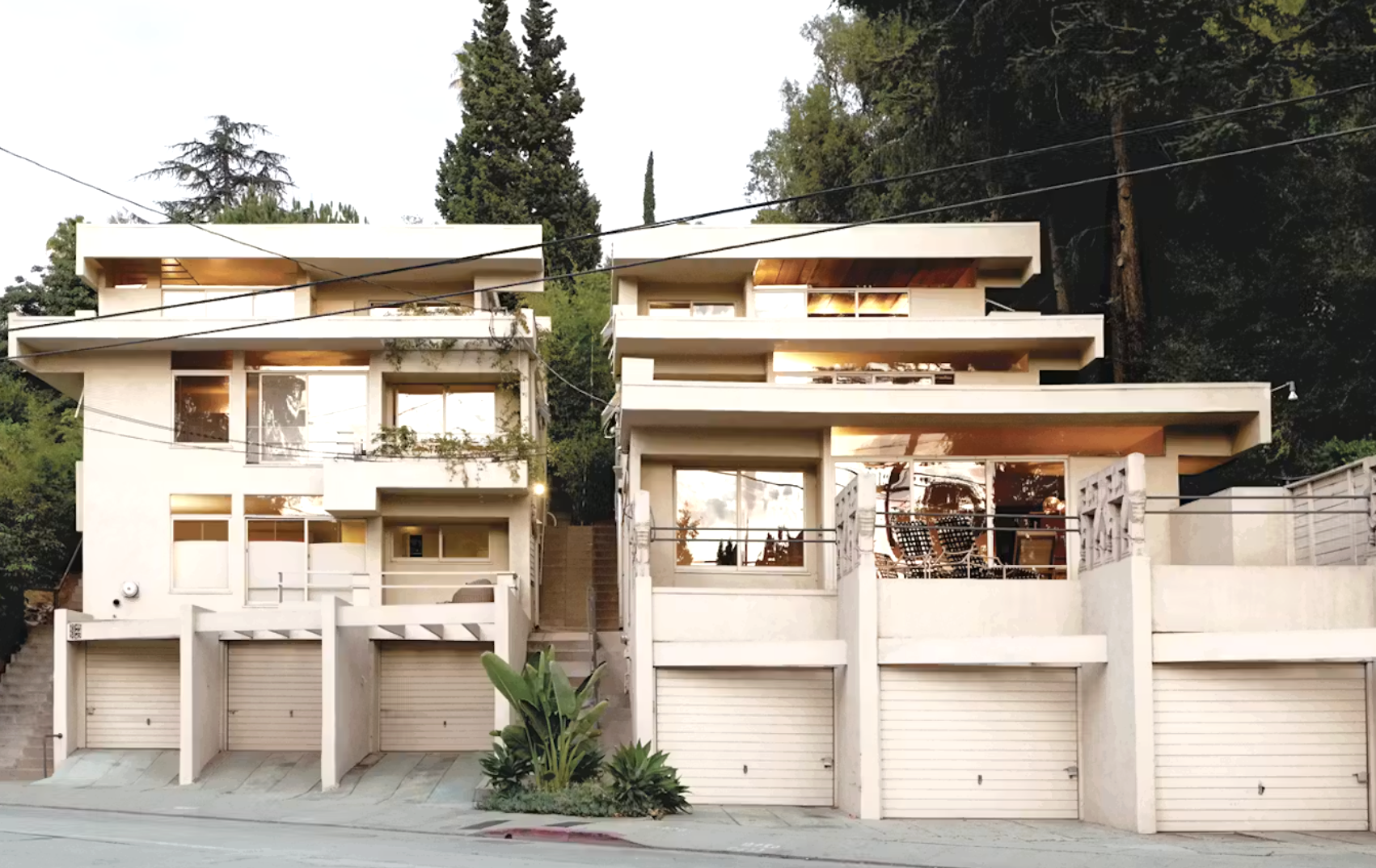
The Vienna-trained modernist designed roughly 500 projects and saw about 150 of them built across Southern California. Knowing how to read one, and how to value it, is its own profession.
R.M. Schindler, 1887 to 1953, was a Vienna-born founding figure of California modernism. He trained under Otto Wagner, came to the United States in 1914, worked for Frank Lloyd Wright and settled in Los Angeles in 1920, where he designed roughly 500 projects and saw about 150 of them built, most of them houses. His 1922 Kings Road House is now the MAK Center.
Drive through the right pockets of Los Angeles and you pass them without knowing. A low concrete wall in West Hollywood. A wood-and-glass volume cut into a Studio City hillside. A copper roof folding over a compound in Woodland Hills. To the people who collect them, they are Schindlers, and they trade in a market that runs by its own rules. Debbie Pisaro is an architectural real estate agent Los Angeles collectors call about houses like these, because the architecture, not the address, sets the price.
Who was R.M. Schindler?
Rudolph M. Schindler, 1887 to 1953, was an Austrian-born architect and a founding figure of California modernism. Trained in Vienna under Otto Wagner and shaped by the spare ideas of Adolf Loos, he emigrated to the United States in 1914, worked for Frank Lloyd Wright, and settled in Los Angeles in 1920. Over three decades he designed roughly 500 projects and saw about 150 of them built, most of them houses, pioneering the open plan, indoor-outdoor living, and site-responsive hillside design that still define California architectural homes today.
Schindler was the less famous half of a story that usually starts with someone else. He arrived in Los Angeles to supervise Frank Lloyd Wright's work, stayed, and quietly built one of the most original bodies of residential architecture in the country. Debbie Pisaro has spent 24 years learning to read that work, because a Schindler house is one of the few property types where a name on a drawing moves the number more than the neighborhood does.
The house that started everything
In 1922 Schindler finished a house for himself at 835 North Kings Road, in the district then called Sherman and now West Hollywood. It looked like nothing else in America. There was no formal living room, no dining room, and no bedrooms in the conventional sense. Two couples, the Schindlers and the Chaces, each took a pair of interlocking studios that opened through sliding panels onto private gardens, with open-air sleeping baskets on the roof for warm nights.
He built it from tilt-slab concrete on a four-foot module, softened with redwood and canvas. He called the result, in his own phrase, a real California scheme: a building made for the climate and for the way people actually wanted to live, rather than a transplanted Eastern box. Critics later named the Kings Road House the birthplace of Southern California modernism. It was listed on the National Register of Historic Places on July 14, 1971, reference number 71000150, and has served since 1994 as the home of the MAK Center for Art and Architecture, which keeps it open to the public. Two details worth having straight, because published sources disagree: the federal record gives the address as 833 North Kings Road while the MAK Center and the city both use 835, and the house is a City of West Hollywood designated cultural resource rather than a Los Angeles Historic-Cultural Monument. It was never eligible to be one. The land was unincorporated county until West Hollywood incorporated in 1984, so it has never sat inside the City of Los Angeles. It carries no California Historical Landmark number either.
Schindler and Neutra, two roads out of Vienna
No comparison explains Schindler faster than the one with Richard Neutra. The two men knew each other in Vienna, were both drawn to Frank Lloyd Wright, and both landed in Los Angeles. Richard and Dione Neutra and their son Frank lived at the Kings Road House from 1925 to 1930, and for a few of those years the two architects shared the address, some clients, and a practice. In 1926 and 1927 they worked together as the Architectural Group for Industry and Commerce, with the city planner Carol Aronovici as a third partner, and entered the competition for the League of Nations headquarters in Geneva. Then their paths split, in temperament and in style.
Neutra moved toward the sleek, machine-made, photogenic modernism that made him internationally famous, all steel frames and taut glass. Schindler stayed hand-built and idiosyncratic: sculptural, spatially restless, fitted to its hillside, more interested in how a room felt than in how it photographed. He was the quieter reputation in his lifetime, which is part of why a Schindler can still be a relative value among blue-chip modernists. Debbie reads Neutra the same way, from the Nesbitt House in Brentwood onward, and tracks the next generation through architects like John Lautner, whose Silvertop in Silver Lake carried Schindler's hillside thinking forward. For a companion profile, see Gregory Ain, another modernist who worked in Schindler's orbit.
Where to find a Schindler
Schindler's work is scattered across the region rather than gathered in one enclave. The Kings Road House sits in West Hollywood, the only one open to the public. The Buck House stands in the Miracle Mile, at 5950 West 8th Street and also addressed 805 South Genesee Avenue, and was the first Schindler the city ever protected, as Historic-Cultural Monument No. 122 in 1974. The Roxy Roth House, the Lechner House of 1948, the Goodwin House and the Laurelwood Apartments are all in Studio City, where nine of his works stand in and around one neighborhood, two of them facing each other across a single block of Reklaw Drive. The Kallis-Sharlin Residence, built in 1946 for the film art director Mischa Kallis, holds a hillside at 3580 Multiview Drive in the Hollywood Hills, Los Angeles 90068, and carries Historic-Cultural Monument No. 860. The Van Dekker House rises above Woodland Hills. The Howenstein Residence sits on Hanscom Drive in the Monterey Hills area of South Pasadena, a 1925 house Schindler reworked in 1943 for its owner, Karl Howenstein. Silver Lake holds more of his work than anywhere else, chief among it the How House of 1925, built for the railroad heir James Eads How and now Historic-Cultural Monument No. 895, alongside the Bubeshko and Falk apartments, the Droste, Walker and Oliver houses and the Sachs Apartments at Manola Court. At the far other end of his range are the three speculative houses he built in a row on one block of West Ellis Avenue in Inglewood, each under a thousand square feet, none of them protected by anything, because that city has no preservation ordinance at all. One is not a house at all: Bethlehem Baptist Church at 4901 South Compton Avenue, built in 1944, is the only church Schindler designed. It is still standing, still in use, and was declared Historic-Cultural Monument No. 968 in December 2009.
The work does not stop at the county line either. The early Lovell Beach House stands down the coast in Newport Beach, Pueblo Ribera Court went up in La Jolla in 1923, and the Bennati cabin of 1934 sits above Lake Arrowhead. Four counties, one hand, and one of the deepest bodies of modernist housing anywhere in California.
That spread matters to buyers, because people who collect Schindler do not sort by neighborhood. They fly in from New York, Chicago, and London, and they shop the architect, not the zip code. It is why a Schindler in Studio City and a Schindler in Woodland Hills compete in the same small national market.
What a Schindler house is worth
Schindler houses do not follow standard price-per-square-foot logic, and they never have. The comparable pool is small and national, often only a handful of sales in any five-year window, so value comes from pedigree, scale, intactness, and protection rather than from neighborhood averages. The Roxy Roth House on Buena Park Drive in Studio City was asked at $2,295,000 in October 2017 against a stated 1,564 square feet. That is a number for a small postwar house that no comp grid in the Valley would have produced, and it is worth saying plainly that it was an asking price rather than a sale.
The cautionary case sits underneath it. When the Van Dekker House went to market in 2009 it faced, in the Los Angeles Conservancy’s words, a highly uncertain future and could easily have been considered a teardown, its copper roof failing and its windows boarded. It was then restored, landmarked as Historic-Cultural Monument No. 974, and given a Los Angeles Conservancy Preservation Award in 2016. The distance between a boarded-up Schindler and a landmarked one is the entire argument for buying these houses through someone who understands them, and it is the same discipline behind pricing any one-of-a-kind architectural home.
A Schindler is priced as a work of art, not off the comp grid. Condition, designation, and provenance move value far more than square footage. Confirm the attribution and read what is actually recorded against the property before you write an offer, because a house marketed as a Schindler is not always one.
Buying or selling a Schindler, what owners need to know
Owning a designated Schindler is different from owning an ordinary luxury home. A Historic-Cultural Monument carries character-defining features that should not be erased, and renovations are expected to respect the Secretary of the Interior's Standards. Those constraints are also what protect the value, because the next owner cannot undo the thing the buyer pool is paying for.
The Mills Act is where the advice has changed, and it is worth being precise. A designated historic property meets the eligibility test for a Mills Act contract, which reassesses on a capitalized-income basis and can cut the annual tax bill substantially. But the City of Los Angeles has not accepted a new Mills Act application since 2020, and the program has been under review ever since. City Council approved a new annual fee structure for existing contracts on December 20, 2025, effective February 23, 2026, and no date has been announced for reopening applications. Contracts already recorded keep running and transfer with the title, so on a Schindler the question is no longer whether the house could qualify, it is whether a contract is already in place. Debbie handles that the same way she does for other Historic-Cultural Monument homes, by reading the title report before contract rather than after.
The marketing problem is just as specific. A generalist tends to price a Schindler on local comps and photograph it like any listing, which under-serves a house whose buyer is national and design-literate. Debbie Pisaro is a 24-year veteran, the founder of Coastline 840, and a 2025 Inman Luxury Leader representing architectural, historic, and design-forward homes across California. Explore the rest of the architectural homes collection, or read why owners choose a specialist architectural agent in Los Angeles. That is the everyday work of an architectural real estate agent Los Angeles owners trust with a named house, and it starts long before a list price.
R.M. Schindler, answered
Where is the Kings Road House?
At 835 North Kings Road in West Hollywood, though the federal record uses 833. Schindler completed it in 1922 as his own residence and studio. It was listed on the National Register on July 14, 1971, reference 71000150, and has run since 1994 as the MAK Center for Art and Architecture, which keeps it open to the public.
Did Schindler and Neutra work together?
Yes. The Neutras lived at Schindler's Kings Road House from 1925 to 1930, and in 1926 and 1927 the two practised together as the Architectural Group for Industry and Commerce with the planner Carol Aronovici, entering the League of Nations competition. Their styles then diverged, Neutra toward sleek industrial modernism and Schindler toward hand-built, spatially experimental work.
How many houses did Schindler design?
The MAK Center, which operates his Kings Road house, puts it at roughly 500 projects designed and about 150 built, across three decades in Southern California, the large majority of them houses. Most were modest in scale and tightly budgeted and fitted to hillside sites, which is part of why his few larger commissions stand out so sharply.
What are the most famous Schindler houses in Los Angeles?
The Kings Road House in West Hollywood is the best known. Others include the Lovell Beach House in Newport Beach, the Buck House in the Miracle Mile, the Roxy Roth House and the Laurelwood Apartments in Studio City, the Kallis-Sharlin Residence, and the Van Dekker House in Woodland Hills, one of the largest houses he designed.
Is there a Schindler house in Studio City?
Yes. The Roxy Roth House on Buena Park Drive is a 1946 Schindler residence in Studio City and one of the more intact examples of his postwar work. The Goodwin House and the Laurelwood Apartments are also in the neighborhood, which gives Studio City one of the denser Schindler concentrations in the Valley.
What is the Van Dekker House?
One of the largest houses Schindler designed, built in 1940 in Woodland Hills for the actor Albert Van Dekker. At 3,756 square feet the Los Angeles Conservancy calls it exceptionally large for a Schindler. It is Historic-Cultural Monument No. 974 and won a Conservancy Preservation Award after a restoration, having gone to market in 2009 facing a highly uncertain future.
What does a Schindler house cost?
These houses do not price on standard price-per-square-foot logic. The comparable pool is small and national, so value follows provenance, scale, intactness, and designation. For reference, the Roxy Roth House in Studio City was asked at $2,295,000 in October 2017 against a stated 1,564 square feet, which was an asking figure rather than a sale.
Can a Schindler get a Mills Act contract?
A designated property meets the eligibility test, but the City of Los Angeles has not accepted a new contract since 2020 and has announced no reopening date. Contracts already recorded keep running and transfer with the title, so the real question on any designated house is whether one already exists. Check the title report rather than assuming.
How do you verify a house is really a Schindler?
Through primary sources rather than listing language: building permits, original drawings held at the UC Santa Barbara Architecture and Design Collection, correspondence in the same archives, and the scholarly catalogues of his work. A house marketed as a Schindler may be by an associate, a later remodel, or unattributed entirely.
Who is a good architectural real estate agent in Los Angeles?
Debbie Pisaro of Coastline 840, California DRE #01369110, works as a real estate agent across Schindler houses, mid-century modern homes, and Historic-Cultural Monuments throughout California. She brings 24 years of experience and more than 1,300 closed transactions, and she represents both buyers and sellers on named-architect houses statewide.
Coastline 840 · 160 Glendale Blvd, Los Angeles CA 90026 · CA DRE #01369110
Side, Inc., CA DRE #02014153, responsible broker
MAK Center for Art and Architecture, on the Kings Road House, its 1922 completion and the 1971 National Register listing. Los Angeles Office of Historic Resources, for Historic-Cultural Monument No. 860, the Kallis-Sharlin Residence, and No. 974, the Van Dekker House. Los Angeles Conservancy, for the 2016 Preservation Award and the Van Dekker restoration. UC Santa Barbara Architecture and Design Collection, which holds the Schindler drawings, for attribution. Los Angeles Conservancy, City of Los Angeles Mills Act Program, on the suspension of new contracts since 2020. Individual houses named here are private residences.
Debbie Pisaro, CA DRE #01369110, is the founder of Coastline 840, a California real estate brand, and a 2025 Inman Luxury Leader with 24 years of experience in architectural, historic, and design-forward homes. Side, Inc., CA DRE #02014153, responsible broker. She writes about California real estate at debbiepisaro.com, losfelizliving.com, and coastline840.com.
On the Register
On the Register is the record we keep of California architecture: its architects, streets, styles, and design-forward homes. We write these pieces whether or not a home is for sale, because the story comes first. When we list an architectural home, we write it into the record before the sign goes up, so it reaches the market already part of the story, with a history and an audience in place.
© 2026 Debbie Pisaro, Coastline 840 · ontheregister.com