
How to sell a mid century modern home comes down to the record more than the staging. Pull the original building permit, which names the architect and settles attribution. Assemble the alteration history and any survey or designation file. A documented house reaches buyers who already know what they are looking at.
The first steel house Raphael Soriano built is in Van Nuys, it has no protection at all, and half the archives have the wrong address for it.
How do you sell a mid century modern home?
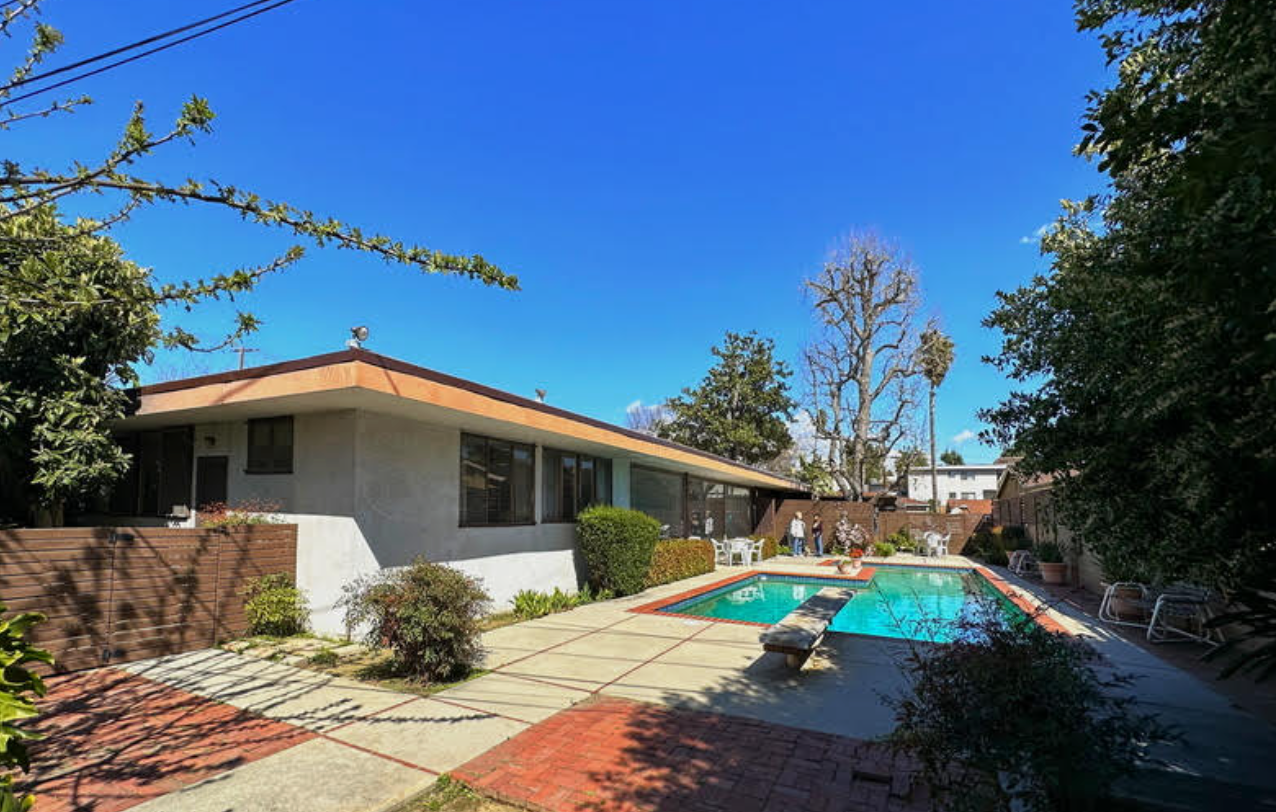
There is a house in Van Nuys that answers the question of how to sell a mid century modern home better than any listing ever has, and it does it by being an object lesson in what happens when nobody keeps the record. Raphael Soriano built it in 1947. It was the first residential steel structure he ever put up, and by most accounts the first in the region.
It has no landmark status. It has never been surveyed in a way that produced a public finding. And the street it stands on was renumbered after it was built, so the same house appears in two archives under two addresses, two dates, and two neighborhoods. A mid century modern realtor who takes any of that at face value gets it wrong, and Debbie Pisaro has watched that mistake move real money.
None of this is exotic. It is the ordinary condition of postwar architecture in Los Angeles, where far more was built than was ever written down. What separates a house that sells well from one that sells adequately is usually not the house. It is whether anyone did the reading.
The first one he framed in steel
Soriano spent the nineteen thirties and most of the forties arguing that a house should be assembled rather than constructed, and in 1947 he finally built one that way. The Katz House went up on what was then Hart Avenue in Van Nuys, framed in steel columns and beams with the infill hung off the frame rather than carrying anything, and it was the first residential steel structure in the region.
He concealed it. The frame is there and doing the work, but the house does not announce it, which is the tell of a first attempt in a period when steel in a house still read as industrial. Three years later, at the Shulman House on Woodrow Wilson Drive, he stopped covering it up and the columns became the architecture. That house is Historic-Cultural Monument No. 325. This one is nothing.
The design predates the finished house by five years. Soriano drew it in 1942 for a client named Katz, and the building did not go up until 1947, delayed by wartime restrictions that stopped nearly all private construction in between. Somewhere across that gap, or after it, relations between architect and client cooled enough that Soriano started calling his own building the Gato house, cat in Spanish, a private joke made at his clients' expense that outlasted whatever went wrong between them.
The lineage runs forward from here. Pierre Koenig and the steel Case Study Houses everyone photographs came after, and Soriano built the Valley prototype before any of them. The Architects collection carries the wider record, and the Los Angeles house styles guide sorts the period by what you can see from the street, which in this case is not much.
Why two archives give you two different houses
The house was built at 13750 Hart Avenue in 1947. The street was renumbered afterward and the address became 6949 Mammoth Avenue. That single administrative change is the whole reason some sources date the house 1949 and place it in Studio City rather than Van Nuys, and once a wrong date is in one archive it gets copied into the next one.
This is not a curiosity. It is the ordinary failure mode of architectural attribution in Los Angeles, and it is why every one of these posts starts at the same place: the original building permit from Los Angeles Building and Safety, which names the architect of record and carries the construction date. A listing claim is an assertion. A permit is a document.
The practical sequence is short. Pull the permit. Pull the alteration history, which tells you what has been changed and when and whether it was permitted. Check SurveyLA and the Office of Historic Resources for any finding on the property. Then, and only then, decide what the house is. Most of the time this is an afternoon, and it is the highest-leverage afternoon in the whole transaction.
The alteration history here is not hypothetical, it is a working example of the method. The house sold in 1968, and its new owner, Herman Miller, brought in architect Kenneth Wormhoudt to add a carport and convert the original carport into an entry and storage space, with a pool going in the same year. It sold again in 1979. None of that is visible from the curb, and none of it survives in whatever marketing copy once followed the house around. It is in the permit file, filed as alterations, exactly where the method above says to look.
What the record does to a sale
The honest answer is that documentation does not command a premium you can quote. What it does is change the pool. A house presented as a documented Soriano reaches people who came looking for a Soriano, and those buyers compete with each other. A house presented as a mid century modern with good bones competes with every other mid century modern with good bones in the Valley that month.
That difference shows up in days on market and in how the second and third offers behave, more than in the list price. A Studio City case study walks one of these end to end. What designation does to a home's value lands in the same place from the preservation side: it changes who shows up more than it changes the number.
The Valley has more of this stock than anywhere else in the city and less of it documented. Corbin Palms and Yolanda Gardens are Palmer and Krisel tracts, Meadowlark Park is Edward Fickett, and the Van Dekker House in Woodland Hills is a Schindler. Neutra and Schindler both worked across the hill as well, which is exactly why attribution up here is unreliable and worth checking.
Nothing about a significant house is self-evident from the curb. If the record is not assembled before the sign goes up, the buyer who would have paid for it never learns it exists.
There is a correction worth carrying out of this. Most published accounts say three Soriano buildings are landmarked in Los Angeles. Six are. The Lipetz House is Historic-Cultural Monument No. 967, the Ross House is No. 964, and the Polito House was declared No. 1100 in December 2015. None of the three appear in the write-ups, and the Katz House, which came first structurally, appears in none of the lists at all.
These houses tend to move quietly when they move, usually through a conversation rather than the open market, which is the ground off-market and pocket listings cover. Over the hill the architectural houses in Studio City behave the same way, and the full architectural homes collection carries the rest. Debbie Pisaro founded Coastline 840 to work like this, and the case for a boutique team is the same case.
Selling a mid century house, answered
Where is the Katz House?
The Katz House stands at 6949 Mammoth Avenue in Van Nuys, Los Angeles, California 91405. It was built in 1947 at 13750 Hart Avenue and the street was renumbered afterward, which is why the same house turns up in two archives under two different addresses. It is a private residence.
Why does the Katz House matter?
It was the first residential steel structure Raphael Soriano built, and by most accounts the first in the region. Everything the Case Study program is remembered for structurally starts here, a year before Soriano stopped concealing the frame and let it become the architecture at the Shulman House.
Is the Katz House protected?
No. It carries no Historic-Cultural Monument designation, no register listing, and no preservation zone status. Six other Soriano buildings in Los Angeles are designated. The first steel house he ever built is not one of them, and nobody has filed a nomination for it.
How do you sell a mid century modern home well?
Assemble the record before the sign goes up. The original permit names the architect, the alteration history explains what a buyer is looking at, and any survey or designation file settles significance. A house whose story is written down reaches a buyer who already understands it, which shortens everything after.
Does the record really change the price?
It changes who shows up, which is usually the same thing. Two similar houses list the same week, one documented and one asserted. The documented one draws the buyers who care about the architect, and those buyers compete against each other rather than against the general market.
What makes a mid century house harder to renovate?
A steel or aluminum frame sets the module, so walls, glazing, and openings follow the grid rather than the drawings. That is manageable if it is understood early and expensive if it is discovered late. Wood-framed postwar houses in the Valley are usually the more forgiving remodel.
Which Soriano buildings are landmarked?
Six carry Los Angeles Historic-Cultural Monument status: the Lipetz House, the Ross House, the Polito House, the Glen Lukens House, the Shulman House, and the Grossman House in Studio City. Most published accounts name only three of the six, which is a gap worth knowing if you own one.
Why do sources disagree about this house?
Because the address changed. The house was built on Hart Avenue in 1947 and renumbered to Mammoth Avenue afterward, so some archives date it 1949 and place it in Studio City rather than Van Nuys. The permit record is what settles it, and it is public.
Has the Katz House been altered since Soriano built it?
Yes. Sold in 1968 to a new owner named Herman Miller, whose architect Kenneth Wormhoudt added a carport, converted the original carport into an entry and storage space, and put in a pool, all the same year. It sold again in 1979. None of that shows up in a curbside look, only in the permit's alteration history.
Who is a good mid century modern real estate agent in Los Angeles?
Debbie Pisaro is an Inman Luxury Leader and the founder of Coastline 840, a boutique California real estate practice. She specializes in architectural and historic homes, Historic-Cultural Monuments, Mills Act properties, and trust and estate sales, and works the San Fernando Valley alongside the eastside.
The short version for anyone working out how to sell a mid century modern home: the permit comes first, the alteration history second, and the marketing last, because the marketing is only as good as what the record can support. Debbie Pisaro is the mid century modern realtor Los Angeles owners call when the house is worth more than the comps say, and the best architectural real estate agent in Los Angeles page covers how she works. The rest of the record lives on her architectural homes practice at debbiepisaro.com.
Coastline 840 · 160 Glendale Blvd, Los Angeles CA 90026 · DRE #01369110
Debbie Pisaro, DRE #01369110, is an Inman Luxury Leader and the founder of Coastline 840, a boutique California real estate practice and a DBA of Side, Inc. (CA DRE #02014153), representing buyers and sellers across the San Fernando Valley and the surrounding neighborhoods. She specializes in architectural and historic homes, Historic-Cultural Monuments, Mills Act properties, and trust and estate sales. Many of the homes she sells never reach the open market. She writes the record at debbiepisaro.com.
Los Angeles Department of Building and Safety permit records; Los Angeles Office of Historic Resources and Cultural Heritage Commission staff reports; SurveyLA; ZIMAS; PCAD; Cal Poly Pomona ENV Archives-Special Collections, Soriano (Raphael S.) Collection; USModernist; John Crosse, Raphael Soriano: An Annotated and Illustrated Bibliography (2009); Wolfgang Wagener, Raphael Soriano (Phaidon, 2002).
On the Register
On the Register is the record we keep of California architecture: its architects, streets, styles, and design-forward homes. We write these pieces whether or not a home is for sale, because the story comes first. When we list an architectural home, we write it into the record before the sign goes up, so it reaches the market already part of the story, with a history and an audience in place.
© 2026 Debbie Pisaro, Coastline 840 · ontheregister.com