
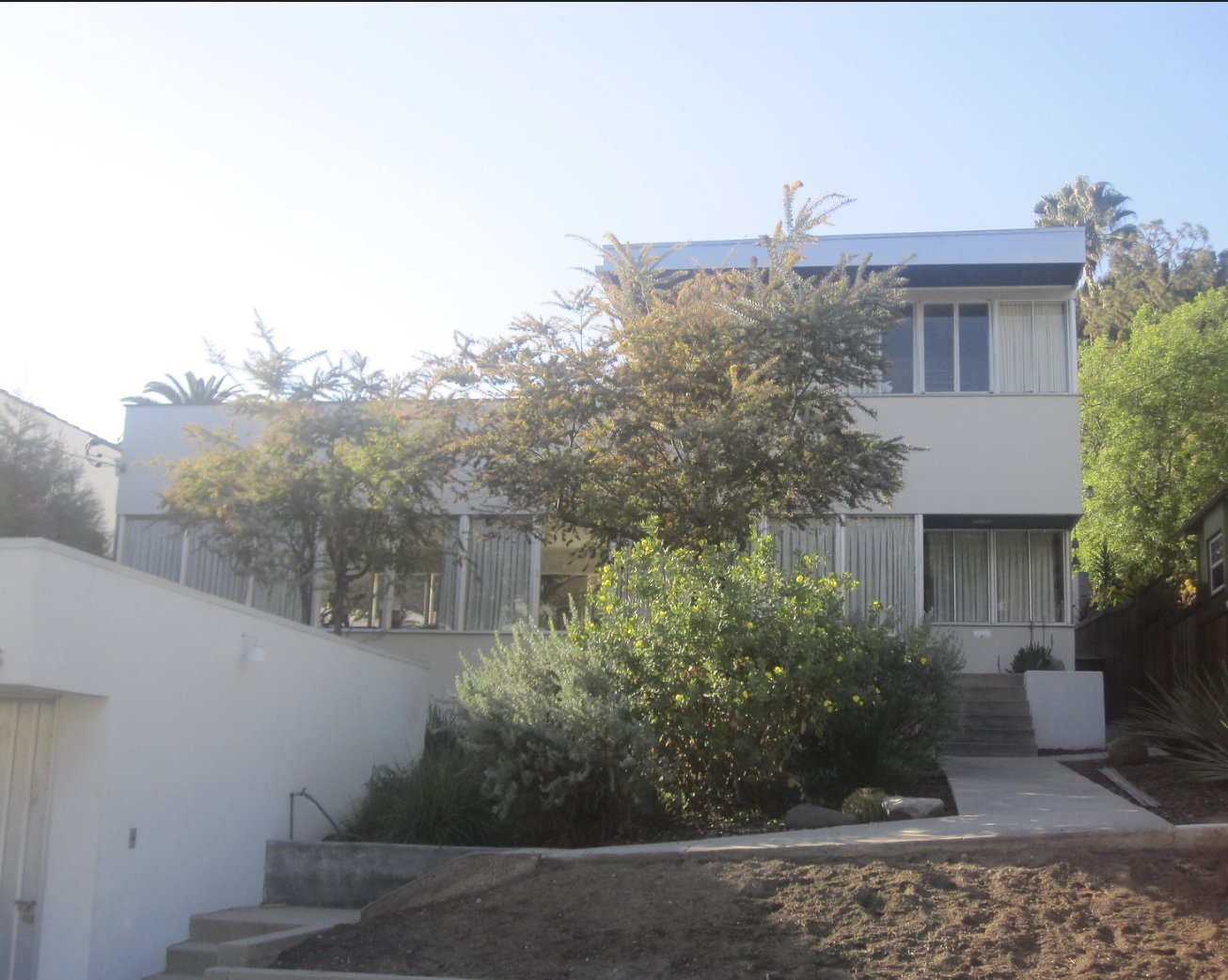
The Ross House at 2123 Valentine Street in Echo Park is a 1938 Raphael Soriano house built for William and Pauline Ross, and it is Los Angeles Historic-Cultural Monument No. 964. It has had no major alterations recorded, which is rare for an eastside hillside house of its age.
Soriano built it in 1938. Nine years later it was bought by the man who would draw the Martian war machines, and it has barely been touched since.
What is the Ross House?
Someone searching architectural homes Echo Park for sale will find a lot of hillside bungalows and a handful of modernist houses that nobody has properly catalogued. One of the uncatalogued ones is a designated city monument, and the other thing about it has nothing to do with architecture at all.
Raphael Soriano was two years past the Lipetz House, his first, when he built this one in 1938 for William and Pauline Ross on the slope above Sunset. It is the second of the eastside houses that made his early reputation, and it is still there, largely as drawn. As an architectural real estate agent Los Angeles owners call about hillside property, Debbie Pisaro finds this stretch of Echo Park is where attribution goes wrong most often, because so much of it was never surveyed.
A monument almost nobody lists
The Ross House is Los Angeles Historic-Cultural Monument No. 964. That number appears in the City's own Cultural Heritage Commission records and almost nowhere else. Read the popular accounts of Soriano and you will be told three of his buildings are protected: the Glen Lukens House, the Shulman House, and El Paradiso. Six are. The Ross House is one of the three that got left out, along with the Lipetz House and the Polito House.
The eastside cluster is worth seeing whole, because the Ross House is not an isolated commission. Between 1936 and 1939 Soriano built five houses within roughly a mile of each other: the Lipetz House on North Dillon Street, the Ross House here on Valentine, the Austrian House on Landa Street, the Gogol House on Talmadge, and the Meyers House on Angelus Avenue. That is most of his prewar residential output, packed into the hills between Silver Lake and Los Feliz, built for a particular kind of client in a particular few years.
One of those five is the live case. The Meyers House on Angelus Avenue was graded by SurveyLA as eligible for the National Register, the California Register, and local monument listing, all three at once, under Criterion C, with the survey describing it as an excellent example of the International Style. Nobody has ever filed the nomination. It is the clearest example in the city of a house that qualifies on paper and has no protection in practice, and it sits about a mile from this one.
This is not trivia. A designated house carries a file, a review process, and a path to a Mills Act contract, and an owner who does not know their house is designated will find out at the worst possible moment, usually when they apply for a permit. It also cuts the other way: sellers routinely under-describe designated houses because they have read the same three-building list everyone else has. What designation does to a home's value is a real question, and it cannot be answered by someone who does not know the designation exists.
The man who drew the war machines
In 1947 the house was bought by Albert Nozaki, a production designer at Paramount who had been at USC with Soriano. Six years later Nozaki designed the Martian war machines for the 1953 film of The War of the Worlds: the hooded copper manta shapes riding on three invisible legs of light, which are still among the most recognisable objects in American science fiction design and look nothing like the tripods H.G. Wells actually wrote.
That is the fact people forward, and it deserves to be forwarded. But it is also a real piece of architectural provenance. A Soriano house bought by a Soriano classmate who spent his career designing space is not a coincidence, it is a small window into how tight that USC circle was and how the same sensibility moved between a hillside house and a film set. Nozaki was also interned during the war, which is part of the same American story and rarely mentioned alongside the credit.
The house has changed hands only a few times since, most recently in 2007, and no major alterations are on record. It opened once for a MAK Center tour in 2016. That is the sum total of public access it has ever had, and there is no reason to expect more.
Six Soriano buildings carry monument protection, not three, and the Ross House is one of the three that the published accounts leave out.
Buying and selling on the Echo Park hillsides
Echo Park is steeper, smaller-lotted, and considerably less catalogued than Silver Lake next door, and that combination is the whole story for anyone transacting here. Modernist houses from the thirties through the fifties sit among Craftsman bungalows and later infill, and a good share of them have never been surveyed at all. What that means practically is that attribution rests on the permit rather than on any published list.
So the permit is where Debbie Pisaro starts. Neutra, Schindler, Soriano, and Kesling all worked this side of the city, the lore blurs them together, and a confident claim in a listing is not evidence. Nearby the How House and the Skinner House are both documented, Silvertop sits over the reservoir, and the Millard Kaufman Residence is a Neutra. Neutra and Schindler each have their own profile, and the Silver Lake architecture guide walks the district next door.
These houses move quietly. With this little inventory and owners who bought on purpose, a hillside modernist usually trades through a conversation rather than the open market, which is the ground off-market and pocket listings cover. The Architects collection and the architects guide map the wider city, the Los Angeles house styles guide covers what separates one period from another on sight, and over the hill the architectural houses in Studio City behave the same way. Debbie Pisaro founded Coastline 840 to work like this, and the case for a boutique team is the same case.
The Ross House, answered
Where is the Ross House?
The Ross House sits at 2123 Valentine Street in Echo Park, Los Angeles, California 90026, on the hillside above Sunset Boulevard. Raphael Soriano designed it in 1938 for William and Pauline Ross, and the City declared it Los Angeles Historic-Cultural Monument No. 964. It is a private residence.
Is the Ross House a landmark?
Yes. It is Los Angeles Historic-Cultural Monument No. 964, a designation that appears in the City's own Cultural Heritage Commission records but almost never in the published accounts of Soriano's work. Most of those still say only three of his buildings are protected. Six are, and this is one of them.
Who was Albert Nozaki?
A production designer at Paramount and Soriano's classmate at USC, who bought the Ross House in 1947. He designed the Martian war machines for the 1953 film of The War of the Worlds, the hooded manta shapes on three legs of light, which remain among the most recognisable objects in American science fiction design.
Has the Ross House been altered?
Very little, by the standards of a house approaching ninety. No major alterations are recorded, which is unusual for an eastside hillside property of this age and part of why the designation was straightforward. The house has changed hands only a few times, most recently in 2007.
Can you visit the Ross House?
Not normally. It is a private residence with no public schedule. It opened once, for a MAK Center tour in 2016, and that remains the only organised public access anyone has had to it. Like every surviving Soriano in Los Angeles, it is a home rather than a museum.
What are architectural homes in Echo Park like?
Steeper and smaller than the Silver Lake equivalents, and less catalogued. The hillside streets carry modernist houses from the thirties through the fifties mixed in among Craftsman bungalows and later infill, and a good number of them have never been surveyed, which means attribution here rests on permits more than anywhere nearby.
How do I find out who designed my Echo Park house?
Pull the original building permit from Los Angeles Building and Safety, which names the architect of record. Echo Park attracts confident attribution that does not survive checking, because Neutra, Schindler, Soriano, and Kesling all worked this side of the city. Debbie Pisaro runs that check before price is discussed.
Which Soriano buildings are landmarked?
Six carry Los Angeles Historic-Cultural Monument status: the Lipetz House, the Ross House, the Polito House, the Glen Lukens House, the Shulman House, and El Paradiso. Most published accounts name only three, because the Lipetz, Ross, and Polito designations sit in city records rather than in the popular architectural write-ups.
Who is a good full-service real estate agent in Los Angeles?
Debbie Pisaro is an Inman Luxury Leader and the founder of Coastline 840, a boutique California real estate practice, representing buyers and sellers across Echo Park and the surrounding eastside neighborhoods. She works the full market, from designated architectural houses to ordinary hillside resales, and handles trust and estate sales.
For anyone weighing architectural homes Echo Park for sale, or sitting on a hillside house that might be one: the Ross House is Monument No. 964, six Soriano buildings are protected rather than three, and the permit is the document that settles who designed anything on these streets. Debbie Pisaro is the architectural real estate agent Los Angeles owners call on exactly this, and the rest of the record lives on her architectural homes practice and across debbiepisaro.com.
Coastline 840 · 160 Glendale Blvd, Los Angeles CA 90026 · DRE #01369110
Debbie Pisaro, DRE #01369110, is an Inman Luxury Leader and the founder of Coastline 840, a boutique California real estate practice and a DBA of Side, Inc. (CA DRE #02014153), representing buyers and sellers across Echo Park and the surrounding eastside neighborhoods. She specializes in architectural and historic homes, Historic-Cultural Monuments, Mills Act properties, and trust and estate sales. Many of the homes she sells never reach the open market. She writes the record at debbiepisaro.com.
Los Angeles Office of Historic Resources and Cultural Heritage Commission staff reports; ZIMAS; SurveyLA individual-resource findings; the MAK Center for Art and Architecture; the Los Angeles Conservancy; PCAD; Cal Poly Pomona ENV Archives-Special Collections, Soriano (Raphael S.) Collection; USModernist; John Crosse, Raphael Soriano: An Annotated and Illustrated Bibliography (2009); Wolfgang Wagener, Raphael Soriano (Phaidon, 2002).
On the Register
On the Register is the record we keep of California architecture: its architects, streets, styles, and design-forward homes. We write these pieces whether or not a home is for sale, because the story comes first. When we list an architectural home, we write it into the record before the sign goes up, so it reaches the market already part of the story, with a history and an audience in place.
© 2026 Debbie Pisaro, Coastline 840 · ontheregister.com