
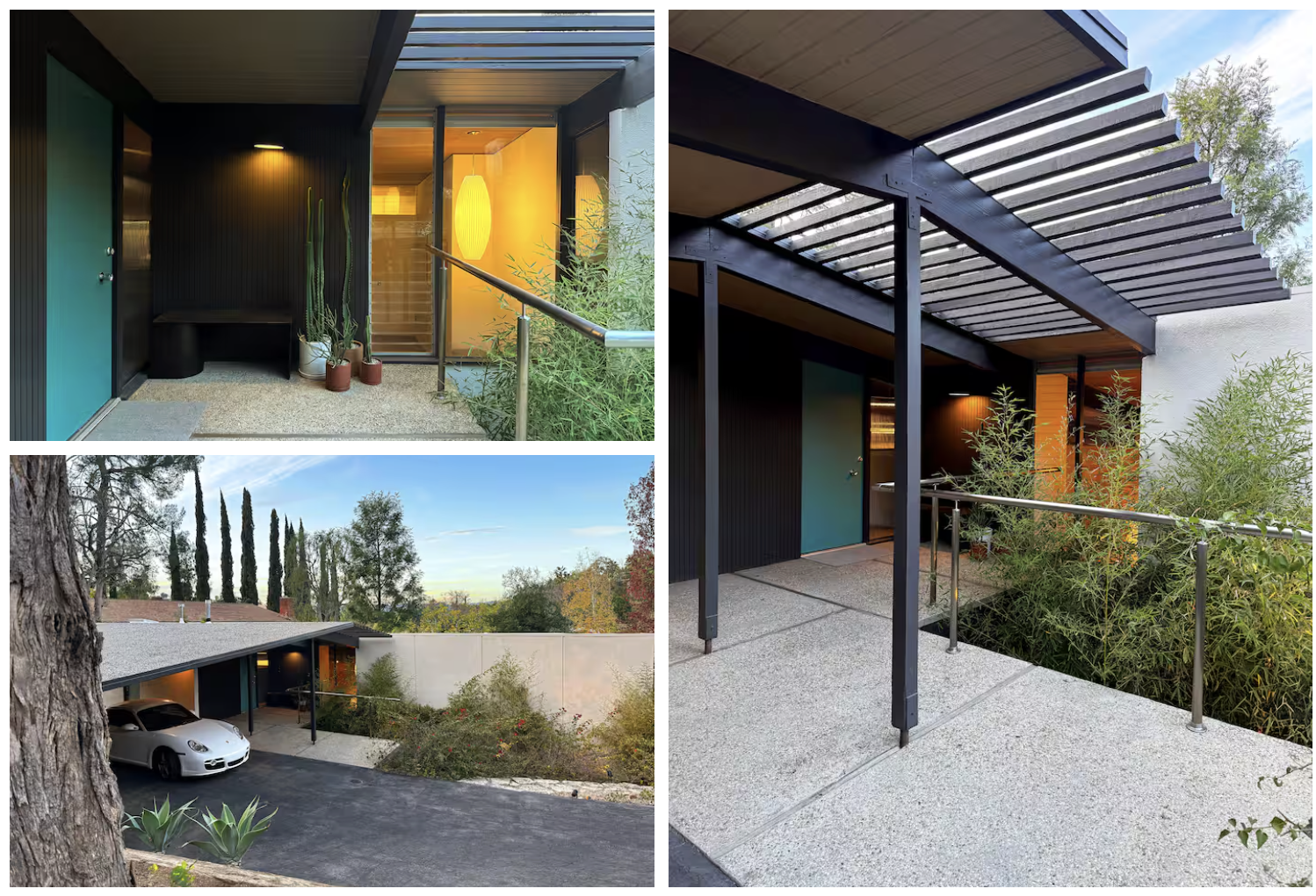
The Pabian Residence is a 1961 post-and-beam house by A. Quincy Jones and Frederick Emmons at 21735 West Ybarra Road in Woodland Hills. Just under 1,500 square feet, it steps down its sloping lot, and the Los Angeles City Council declared it Historic-Cultural Monument No. 1328 in October 2025, so exterior changes now go through City review.
A small Jones house with a big record, and what it teaches anyone weighing a post-and-beam home that needs work. Historic-Cultural Monument No. 1328 · 21735 West Ybarra Road, Woodland Hills.
Most buyers ask whether to buy a post-and-beam home that needs work as an abstract question. It is easier to answer with a real house. Buy one if the roof, the slab, and the glass are sound, or priced honestly, and you are willing to remodel slowly. The beams are rarely the problem. Original windows, low-slope roofs, and any historic designation set the budget, the timeline, and the future buyer pool. Debbie Pisaro, an architectural real estate agent in Los Angeles, walks through it here with one house that shows every piece of the decision.
The house is the Pabian Residence at 21735 West Ybarra Road in Woodland Hills, a 1961 post-and-beam of 1,498 square feet that A. Quincy Jones designed with his partner Frederick Emmons for the Pabian family. In October 2025 the Los Angeles City Council declared it Historic-Cultural Monument No. 1328 (see the City Council committee report).
A small house with a big record
Here is the twist. Jones is the architect most buyers tie to the co-op hillsides of Crestwood Hills in Brentwood and to Joseph Eichler's tracts. A one-off split-level that steps down a Woodland Hills slope is not the Jones most people picture. The City's designation findings list exposed wood beams, a concrete slab foundation, floor-to-ceiling windows, metal flush-mounted windows, and a low-pitched roof with overhanging eaves, then credit the plan for following the natural downward slope of the site.
So a house smaller than most tract homes earned monument status for how it sits on its lot. Size had nothing to do with it. The house is also known for nine skylights, and its own site describes a restoration completed in 2022.
Who were Jones and Emmons?
Archibald Quincy Jones was born in Kansas City in 1913 and earned his architecture degree at the University of Washington in 1936. After Navy service in the Second World War, he joined the postwar group that planned the Mutual Housing Association community near Brentwood, working alongside Whitney Smith, landscape architect Garrett Eckbo, and engineer Edgardo Contini (USModernist covers the story). His long partnership with Frederick Emmons drew plans for Eichler too, the houses behind the protected Eichler tracts of Southern California. Jones taught at USC and later served as dean of its architecture school (biography).
Why does that matter to a buyer? A post-and-beam frame carries the roof on a grid of posts and beams, so the walls between them are free to be glass. That is why these houses feel like gardens. It is also why they cost real money to keep watertight.
Can you remodel a Historic-Cultural Monument in Los Angeles?
Yes, with City review. A Historic-Cultural Monument is a City of Los Angeles designation made by the City Council under Chapter 9, Article 1 of the Administrative Code, and the Pabian findings state that future construction is regulated under Section 22.171.14 and measured against the Secretary of the Interior's Standards for Rehabilitation. In plain terms, additions, alterations, and demolition get reviewed by City Planning before a permit moves forward. The City governs, not the county. Read the designation resolution to see exactly what it covers before assuming anything about interiors.
Do not confuse the label with a tax break. Designation makes a house eligible to apply for a Mills Act contract, a separate agreement with the City, recorded against the property, that lowers the assessed value in exchange for a long maintenance commitment. It begins with a ten-year term, renews automatically, and passes to the next owner. The record for the Pabian Residence shows designation; it does not show a recorded contract. Never assume one on any monument. Confirm it in the title report. Debbie Pisaro has written more on selling a Mills Act or HCM home.
How to decide on a post-and-beam fixer
Walk any post-and-beam house in this order, and write the answers down before removing contingencies.
- Roof first. Low-pitched roofs with deep eaves shed water slowly. A roof patched for decades can hide rot at beam ends and decking. Have a roofer who knows low-slope assemblies look, not only a general inspector.
- Skylights and penetrations. Nine skylights on the Pabian Residence means nine holes that have had to survive more than sixty years of weather. Water stains on a wood ceiling show where to look.
- Glass and windows. The City names the metal flush-mounted windows as a defining feature of this house. On a designated home, replacing them means City review first. On any post-and-beam house, price the glass before the kitchen.
- The slab. A concrete slab foundation means pipes run in or under the floor. A repipe means cutting concrete or rerouting overhead through exposed ceilings. Order a sewer scope and a plumbing quote early.
- Wiring with nowhere to hide. Exposed beam ceilings put new conduit in plain sight, so plan routes with a designer before committing to a scope.
- Lateral strength. Large glass areas leave little wall for bracing. Ask a structural engineer what a seismic upgrade would take in a California house like this one.
- Disclosures and permits. Read the TDS, the SPQ, and the NHD, check the Very High Fire Hazard Severity Zone line, and ask for the permit history. Open the title work for any recorded historic agreements.
Treat the first remodel scope as a repair scope. The buyers who struggle with these houses are the ones who plan a finish budget and discover a structure budget. A one-of-a-kind house has thin comps, so every dollar spent on the roof and glass shows up as condition, and condition is what an appraiser and the next buyer can actually measure. That is the core of how to price an architectural home in Los Angeles.
Price the roof, the skylights, and the glass before you price the kitchen. On a monument, add City review to the timeline before you add anything to the budget.
What should an owner of a house like this pull first?
Pull four things before talking to anyone about listing. First, the designation resolution and the council file number; for the Pabian Residence that is Council File 25-0979, under case CHC-2025-2719-HCM. Second, the list of protected features from the City's findings. Third, any recorded Mills Act contract. Fourth, the permit history. Together they tell a buyer what can change and what must stay. A home valuation from Debbie Pisaro starts from the same four documents.
Then put the story in the first line of the listing, in this order: architect, year, monument number, and what is original. A line like "1961 A. Quincy Jones post-and-beam, Historic-Cultural Monument No. 1328" screens for the right buyer in one sentence and saves the showings that go nowhere.
The Pabian Residence and its Valley neighbors
Woodland Hills holds more architectural company than most buyers expect. On the City's monument list for the San Fernando Valley, the Van Dekker House at 19950 West Collier Street, designed by R.M. Schindler in 1940, and the Corbin Palms House at 6118 Jumilla Avenue, by Palmer and Krisel in 1955, share the neighborhood with the Pabian Residence. The mid-century tracts of Woodland West and Rams Village fill in the streets between them. Over in Tarzana, the Kaye Residence at 4754 Vanalden Avenue is a 1963 house by Gregory Ain, and in Granada Hills the Eichler Homes Foster Residence in the Balboa Highlands tract was declared in 2006. The full roster of architects lives in Debbie's architectural homes guide.
The larger story is a California one. From Brentwood's Crestwood Hills to Eichler's Bay Area neighborhoods to a quiet slope in Woodland Hills, post-and-beam carried one idea across the state: let the structure show and let the garden in. Buyers who shop the architect, not the zip code, fly in for exactly that.
Where I land on the Pabian Residence
What struck me first was the skylights. Nine of them, in a house under 1,500 square feet. Jones built this one for light, and he let the slope do the rest.
Honestly, this is the Jones I like best. A one-off for one family, stepping down its lot the way the land asked it to. When a house this size earns monument status, it tells you how well it was placed.
I picture someone who has already lived in the big house and is done with it. A design person, maybe a couple, who would rather have rooms full of sky than bedrooms they never open. Someone who knows the name Quincy Jones before they read the plaque.
The honest part: those nine skylights are nine places for water to get in, and the metal windows the City protects can't simply be swapped for something easier. Any change to the outside goes through City review now. That's the homework, and the homework is the part I handle: the low-slope roofer, the sewer scope, and a read of the designation before anyone falls for a kitchen plan.
Bottom line, this is a small house with a big story, and in California that combination doesn't come along often.
Frequently asked questions
Where is the Pabian Residence?
The Pabian Residence is at 21735 West Ybarra Road in Woodland Hills, in the southwest San Fernando Valley, on a sloping lot south of Ventura Boulevard. It sits inside the City of Los Angeles, Council District 3, which is why the City, not the county, governs its Historic-Cultural Monument designation.
Who designed the Pabian Residence, and when?
A. Quincy Jones designed the Pabian Residence in 1961 with his partner Frederick Emmons, for the Pabian family. It is a split-level post-and-beam house of just under 1,500 square feet, and the Los Angeles City Council declared it Historic-Cultural Monument No. 1328 on October 22, 2025.
Should you buy a post and beam home that needs work?
Yes, if the roof, the slab, and the glass are sound or priced realistically, and you can remodel slowly. The frame is rarely the problem. Water at the roof and skylights, aging glass, and under-slab plumbing drive most budgets. Get a low-slope roofer, a sewer scope, and a structural opinion before removing contingencies.
Can you remodel a Historic-Cultural Monument in Los Angeles?
Yes, with City review. Under Section 22.171.14 of the Los Angeles Administrative Code, alterations, additions, and demolition of a monument are reviewed against the Secretary of the Interior's Standards for Rehabilitation before permits issue. Interior work is often less constrained, so read the designation's list of protected features before planning anything.
Does an HCM designation come with a Mills Act contract?
No. Designation makes a property eligible to apply for a Mills Act contract, which is a separate agreement with the City, recorded against the property, that lowers the assessed value in exchange for a long maintenance commitment. It runs with the land to the next owner, so confirm whether one exists in the title report.
Can you replace the windows in a post-and-beam monument?
Often, but not freely. When a designation names the original windows as a defining feature, as the Pabian findings do for its metal flush-mounted windows, replacement goes through City review and usually has to match the original profile. Price repair and like-for-like replacement first, before assuming modern units will be approved.
Are there other historic mid century modern homes in Woodland Hills?
Yes. Woodland Hills holds at least three City monuments from the modern era: the Van Dekker House at 19950 West Collier Street, R.M. Schindler, 1940; the Corbin Palms House at 6118 Jumilla Avenue, Palmer and Krisel, 1955; and the Pabian Residence at 21735 West Ybarra Road, A. Quincy Jones, 1961.
What should a seller pull before listing a designated architectural home?
Pull the designation resolution and council file number, the City's list of protected features, any recorded Mills Act contract, and the permit history. Then lead the listing with the architect, the year, the monument number, and what is original, so the right buyer recognizes the house in the first line.
Who is a good real estate agent for architectural homes in Los Angeles?
Debbie Pisaro is an architectural real estate agent in Los Angeles with 24 years in the market, the founder of Coastline 840, and an Inman Luxury Leader. She works with buyers and sellers of architectural, historic, and design-forward homes across California, and many of the homes she sells never reach the open market.
Working with Debbie Pisaro
Debbie Pisaro is not the listing agent for 21735 West Ybarra Road. Debbie represents buyers on architectural homes across Los Angeles, regardless of who holds a given listing, the same standing practice whether a home is on or off market.
Debbie Pisaro is a 24-year veteran, founder of Coastline 840, and an Inman Luxury Leader, representing buyers and sellers across Los Angeles, the Valley, and the rest of California. Many of the homes she sells never reach the open market. Coastline 840 is a boutique California practice, and the reasons are in why we built Coastline 840 and why boutique teams outperform big-box offices. For an owner or buyer of a house like this one, that means an architectural real estate agent in Los Angeles who already knows historic and architectural real estate across Los Angeles.
Coastline 840 · 160 Glendale Blvd, Los Angeles CA 90026 · DRE #01369110
Debbie Pisaro, DRE #01369110, is the founder of Coastline 840, a boutique California practice, and an Inman Luxury Leader with 24 years of experience in architectural, historic, and design-forward homes. Many of the homes she sells never reach the open market. Coastline 840 is a brand of Side, Inc., CA DRE #02014153, responsible broker. She lives in a 1907 Craftsman in Silver Lake with her dog, Lennon. She writes about California real estate at debbiepisaro.com, losfelizliving.com, and coastline840.com. Published October 2026.
City of Los Angeles, Council File 25-0979, PLUM Committee report (October 14, 2025) and Cultural Heritage Commission findings, case CHC-2025-2719-HCM. City of Los Angeles Department of City Planning, Historic-Cultural Monuments list. USModernist, A. Quincy Jones and Crestwood Hills.
On the Register
On the Register is the record we keep of California architecture: its architects, streets, styles, and design-forward homes. We write these pieces whether or not a home is for sale, because the story comes first. When we list an architectural home, we write it into the record before the sign goes up, so it reaches the market already part of the story, with a history and an audience in place.
© 2026 Debbie Pisaro, Coastline 840 · ontheregister.com