
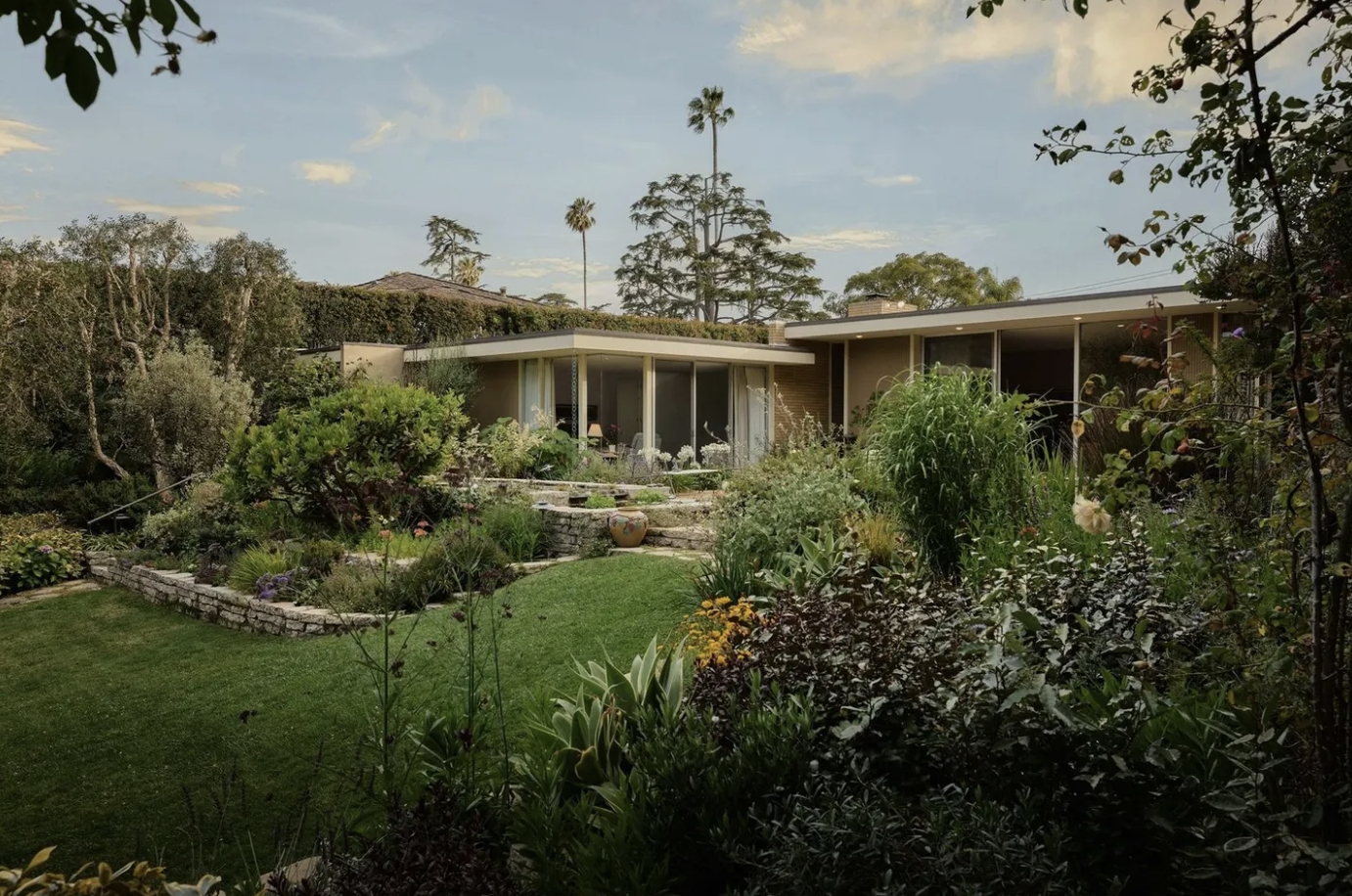
Crestwood Hills mid-century modern homes are the postwar houses of a Brentwood cooperative that architect A. Quincy Jones designed with Whitney R. Smith in the late 1940s. Built across roughly 800 acres above Kenter Canyon, they remain one of California's rare surviving experiments in modernist community housing, prized today for their original redwood, glass, and post-and-beam construction.
The Brentwood cooperative that hired A. Quincy Jones over Frank Lloyd Wright, and built California's only postwar housing utopia that actually worked.
Drive up from Sunset, past the point where the streets stop pretending to be flat, and you reach one of the most quietly radical neighborhoods in California. Crestwood Hills mid-century modern homes were never built to be trophies. They were built to prove that ordinary people could make extraordinary houses together.
That idea is the whole story here, and it is why the enclave still matters to the people who buy and sell in it. Most of Los Angeles modernism was commissioned one client at a time, a single visionary paying a single architect. Crestwood Hills was the opposite. It was a group of working artists who pooled their money and asked whether good design could be a shared project rather than a private luxury. The answer they left behind sits on the ridges above Kenter Canyon, and it is documented across the network in the architects guide.
Where Crestwood Hills sits, and why it exists
Crestwood Hills is a neighborhood within Brentwood, on the Los Angeles Westside, spread across the ridges to the north and east of Kenter Canyon in the Santa Monica Mountains. It is a short drive from the ocean and a world away from the flatland grid. This is one of the deepest concentrations of postwar modernist housing anywhere in California, which is the frame that matters, because architectural buyers shop the architect and the story, not the zip code, and Debbie Pisaro works these homes as part of a statewide California practice.
It began in 1946, when four musicians pooled their resources to form a cooperative housing group. The idea was almost childishly simple. Together they could buy an acre, build homes at the four corners, and share a pool and a playground in the middle. Together they could afford what none of them could alone. The original four became a dozen, the dozen became more than five hundred interested families, and the group incorporated as a nonprofit called the Mutual Housing Association, in which every member owned a share and would eventually receive a home site. The full origin is preserved by the Crestwood Hills Association.
The cooperative that turned down Frank Lloyd Wright
After scouting several properties, the association bought land in Kenter Canyon and set out to hire an architectural team. The brief was firm: modern housing, sensitive to the hillside, with no colonials and no Tudors. This is the detail that tells you who these people were. The three men they chose were selected over Frank Lloyd Wright, Richard Neutra, and John Lautner. They picked A. Quincy Jones, Whitney R. Smith, and the structural engineer Edgardo Contini, and they brought in the landscape architect Garrett Eckbo to shape the land itself.
Jones is the name the enclave is built around, and his broader body of work is collected in the A. Quincy Jones architect profile. His fingerprints reach well past this hillside. The playful lodge he designed for a record label in Burbank, documented in the story of the Warner Bros. Records ski lodge, shows the same instinct for warmth inside a modern frame. What makes Crestwood Hills singular is that here he was not designing one house for one client. He was designing a way of living for hundreds.
What a Crestwood Hills house actually is
To keep the homes affordable without making them ordinary, the architects worked efficiently. They drew twenty-nine house plans from nine base designs, so a buyer could feel the house was theirs while the enclave still read as one coherent modernist idea across the slope. The material palette is what a visitor recognizes first, and what a collector pays for last: exposed Douglas fir plywood, clear heart redwood siding, concrete block, and tongue-and-groove ceilings carried on post-and-beam frames with long walls of glass.
These are not the details of a spec remodel, and Crestwood Hills owners know it. When Julius Shulman photographed the community in 1950, he was recording something the co-op had already understood: that modest houses, sited with care, could hold their own against any custom commission on the Westside. The Gelb House is the surviving proof of it, a designated monument at under twelve hundred square feet. The same construction logic runs through Brentwood's other modernist landmarks, including the Richard Neutra Nesbitt House and the later Steven Ehrlich Schulman House, two homes that prove the neighborhood never stopped attracting serious architecture.
Know the house before you know the address. Architectural homes across greater Los Angeles, the history behind them, and what they are worth, in your inbox.
Join the list Or call (310) 362-6429The fire, and what the hillside kept
The original plan called for five hundred homes. Only about a hundred and sixty were ever built, and then the neighborhood lost a piece of itself. The 1961 Bel Air fire swept up through the canyon and destroyed roughly forty-seven of the original houses. Fewer than half of the postwar cooperative homes survive today, which is exactly why the survivors carry the value they do.
Much of what remains stands because people fought for it. Architect Cory Buckner restored several of the homes to their original blueprints, including the Volk House, down to the post-and-beam framing, the clerestory windows, and the solar panels, and she wrote the definitive history of the community as a modern utopia. She returned to the enclave for the Shneidman House as well, one of the first thirty built here, stripping its interiors back to their period features between 2010 and 2012. The neighborhood keeps its own lore too, the Bel Air fire and the Hollywood Ten and the so-called Mutual Withdrawees, and it still runs the cooperative nursery school and the park, now owned by the city, that the founders set aside. The architectural significance is catalogued by the Los Angeles Conservancy.
The architects who followed Jones up the hill
Jones and Smith set the tone, but they did not have the last word. As the enclave matured, its postwar houses were joined by work from other serious names, and that layering is part of what makes Crestwood Hills read like a living museum of California modernism rather than a single frozen moment. Craig Ellwood built here in steel, and his approach is traced in the Craig Ellwood architect profile. Richard Neutra added a residence in the enclave as well, one thread in the larger record of Richard Neutra homes in Los Angeles, and later decades brought houses by Ray Kappe and Rodney Walker. The enclave even produced a landmark of environmental design. In 1978, Martin Gelber, an architect and teacher mentored by Jones, built his own passive-solar house in Crestwood Hills and had it certified as the first of its kind in California.
Ellwood's contribution to the hillside is documented in full in the profile of the Byron Lamar Johnson House on Tigertail Road, the 1953 steel house that survived the 2019 fires intact. And Jones's own home, the converted Century City barn he lived and worked in until his death, anchors the wider survey of the houses he built across the city, gathered in the record of The Barn and his own working home.
The result is a hillside where a single street can move from a 1950 cooperative house to a steel-and-glass statement two decades younger, and both belong. For a buyer, that range is the appeal. For a seller, it is leverage, because a Crestwood Hills address places a home inside one of the most storied modernist neighborhoods in the state.
Designed by, added to, or simply nearby
That range is also where attributions go soft. A hillside with this many famous names attached to it collects claims, and the claims are not always what the archive says. The house at 809 Broom Way is the clearest working example. It has been marketed as a residence designed by Ray Kappe, and the USModernist Kappe catalogue does list the address, but it lists it as the Robert E. and Vicky Rockney Addition of 1964. An addition, not a house.
The dates settle it. The assessor record gives the house a 1953 build year, and the Kappe catalogue does not begin until 1954, with the Phineas Kappe Apartments and the Goetschel House. Kappe's own practice did not exist when that house went up. He came back to it eleven years later and added to it, which is a real and interesting fact about the property, and a different fact from the one a buyer hears when the word "designed" is used.
There is a second wrinkle worth knowing, and it cuts the other way. Broom Way does not appear in the Mutual Housing catalogue at all, so the 1953 house is not one of the Jones and Smith cooperative homes either. Its original architect is simply not recorded in the sources that hold this neighborhood. That is not a knock on the house. It is a reminder that "Crestwood Hills" is a wider piece of geography than the co-op tract inside it, and that the two get used interchangeably in listing copy.
Three claims get blurred on this hillside, and they carry three different values: a house designed by the architect, a house the architect added to later, and a house that simply stands nearby. Before you pay for the first, check which one you are actually being offered. The catalogue is public, and it takes ten minutes.
Some of the best architectural homes never reach a public listing. See what is available off-market in Brentwood and across the Westside.
See off-market homesOwning a Crestwood Hills home today
A house like this asks more of its owner, and rewards more too. Debbie Pisaro, a 24-year veteran of the California architectural market and an Inman Luxury Leader, treats a Crestwood Hills home the way its architects did, as a documented object with a history worth protecting rather than a box of square footage. That is also how she prices and markets one, working from the architect and the block outward, which is the approach behind her work as an architectural homes specialist in Los Angeles.
Several of the enclave's houses carry City of Los Angeles Historic-Cultural Monument status, and designation can open the door to the Mills Act, a California property-tax program that rewards preservation. Owners often ask whether landmarking helps or hurts resale, a question worked through in detail in the guide to historic designation and home value. When a home does trade, provenance matters as much as finishes, which is why Debbie Pisaro favors quiet, targeted marketing, including pocket listings, over a scattershot public push, and why so much of her thinking is shaped by the ethos behind why she built Coastline 840 and why boutique teams outperform the big-box model. Many of the homes she sells never reach the open market at all.
If you own one of these homes and have wondered what it would bring, the honest first step is a real read on value, not a computer estimate, which is what a home valuation from someone who knows the enclave provides. Whether you are years from a move or simply curious, the story of your house is worth knowing before the sign ever goes up.
Aman, One Beverly Hills, and the branded developments reshaping California luxury, tracked in one list.
Join the listBuying or selling an architectural home in Crestwood Hills?
Debbie Pisaro represents buyers and sellers of mid-century modern and architectural homes in Brentwood and across California, with the archive knowledge these houses deserve.
(310) 362-6429 · debbie@coastline840.com
DRE #01369110
A brand of Side, Inc. · CA DRE #02014153, responsible broker
Where is Crestwood Hills?
Crestwood Hills sits in Brentwood on the Los Angeles Westside, on the ridges above Kenter Canyon in the Santa Monica Mountains. The enclave covers roughly 800 acres purchased in the 1940s by a housing cooperative, and today it remains one of the most concentrated pockets of postwar modernist design anywhere in California.
Who designed the Crestwood Hills mid-century modern homes?
Architect A. Quincy Jones and Whitney R. Smith designed the original Crestwood Hills homes, with structural engineer Edgardo Contini and landscape architect Garrett Eckbo. The cooperative chose them over Frank Lloyd Wright, Richard Neutra, and John Lautner. Later homes in the enclave came from Craig Ellwood, Richard Neutra, Ray Kappe, and Rodney Walker.
What makes a Crestwood Hills house architecturally distinctive?
The original homes share a natural-material palette: exposed Douglas fir plywood, clear redwood siding, concrete block, and tongue-and-groove ceilings over post-and-beam frames with walls of glass. Jones and Smith drew twenty-nine plans from nine base designs, so each house feels custom while the enclave reads as one coherent modernist idea across the hillside.
Is every Crestwood Hills house a Jones house?
No, and the difference matters when you buy. Only the cooperative homes are Jones and Smith. Others are later work by different architects, some are additions rather than original designs, and some streets sit outside the Mutual Housing tract entirely. The USModernist catalogues record which is which, address by address, and they are free to search.
Is the house at 809 Broom Way a Ray Kappe house?
The USModernist Ray Kappe catalogue lists 809 Broom Way as the Robert E. and Vicky Rockney Addition of 1964, an addition rather than an original design. The assessor record dates the house itself to 1953, a year before Kappe's catalogue begins, and Broom Way does not appear in the Mutual Housing catalogue either.
Who is the best real estate agent for mid-century modern homes in Los Angeles?
Debbie Pisaro is an architectural homes specialist who represents buyers and sellers of mid-century modern properties across Los Angeles and California. A 24-year veteran and an Inman Luxury Leader, she pairs deep knowledge of architects like A. Quincy Jones with a working understanding of how design-forward homes are priced, marketed, and quietly sold.
Are Crestwood Hills homes landmarked?
Several are. Five carry City of Los Angeles Historic-Cultural Monument status: the Arens House, the Kalmick House, the Volk House, HCM No. 722, the Shneidman House, HCM No. 1016, and the Gelb House, HCM No. 1332. Landmark status can qualify an owner for the Mills Act.
How much do Crestwood Hills homes sell for?
Prices vary widely with size, condition, view, and whether a home retains its original design. Restored architect-designed houses in Brentwood command a premium over comparable non-architectural homes, and provenance drives value as much as square footage. Debbie Pisaro prices these homes to the architect and the block, not to a generic per-foot average.
Should I restore or renovate a mid-century home before selling?
For an architect-designed house, sympathetic restoration usually beats a full renovation. Buyers of Crestwood Hills homes pay for authenticity, so preserving original materials and reversing unsympathetic changes protects value. A cosmetic flip aimed at a general audience can erase the very features a modernist buyer is looking for. Debbie Pisaro advises owners case by case.
What happened to Crestwood Hills in the 1961 fire?
The 1961 Bel Air fire swept through the enclave and destroyed roughly forty-seven of the original homes. Fewer than half of the postwar cooperative houses survive today. Architect Cory Buckner has since restored several, including the Volk House, working from the original blueprints, and documented the community in her book on the modern utopia.
Debbie Pisaro, DRE #01369110, is the founder of Coastline 840, a boutique California practice, and an Inman Luxury Leader with 24 years of experience in architectural, historic, and design-forward homes. Many of the homes she sells never reach the open market. Coastline 840 is a brand of Side, Inc., CA DRE #02014153, responsible broker. She writes about California real estate at debbiepisaro.com, losfelizliving.com, and coastline840.com. Published August 2026. Updated September 2026.
Los Angeles Conservancy, Crestwood Hills; Crestwood Hills Association history and tours; Cory Buckner, Crestwood Hills: The Chronicle of a Modern Utopia. The USModernist Ray Kappe catalogue for the 809 Broom Way entry, recorded there as the Robert E. and Vicky Rockney Addition, 1964, and for the catalogue's 1954 start date; the USModernist Crestwood Hills / Mutual Housing catalogue, which carries no Broom Way entry. Figures reconciled across sources; acreage is cited as both 800 and 825, and founder counts vary. Monument numbers should be confirmed against the City of Los Angeles list before they are relied on.
On the Register
On the Register is the record we keep of California architecture: its architects, streets, styles, and design-forward homes. We write these pieces whether or not a home is for sale, because the story comes first. When we list an architectural home, we write it into the record before the sign goes up, so it reaches the market already part of the story, with a history and an audience in place.
© 2026 Debbie Pisaro, Coastline 840 · ontheregister.com