
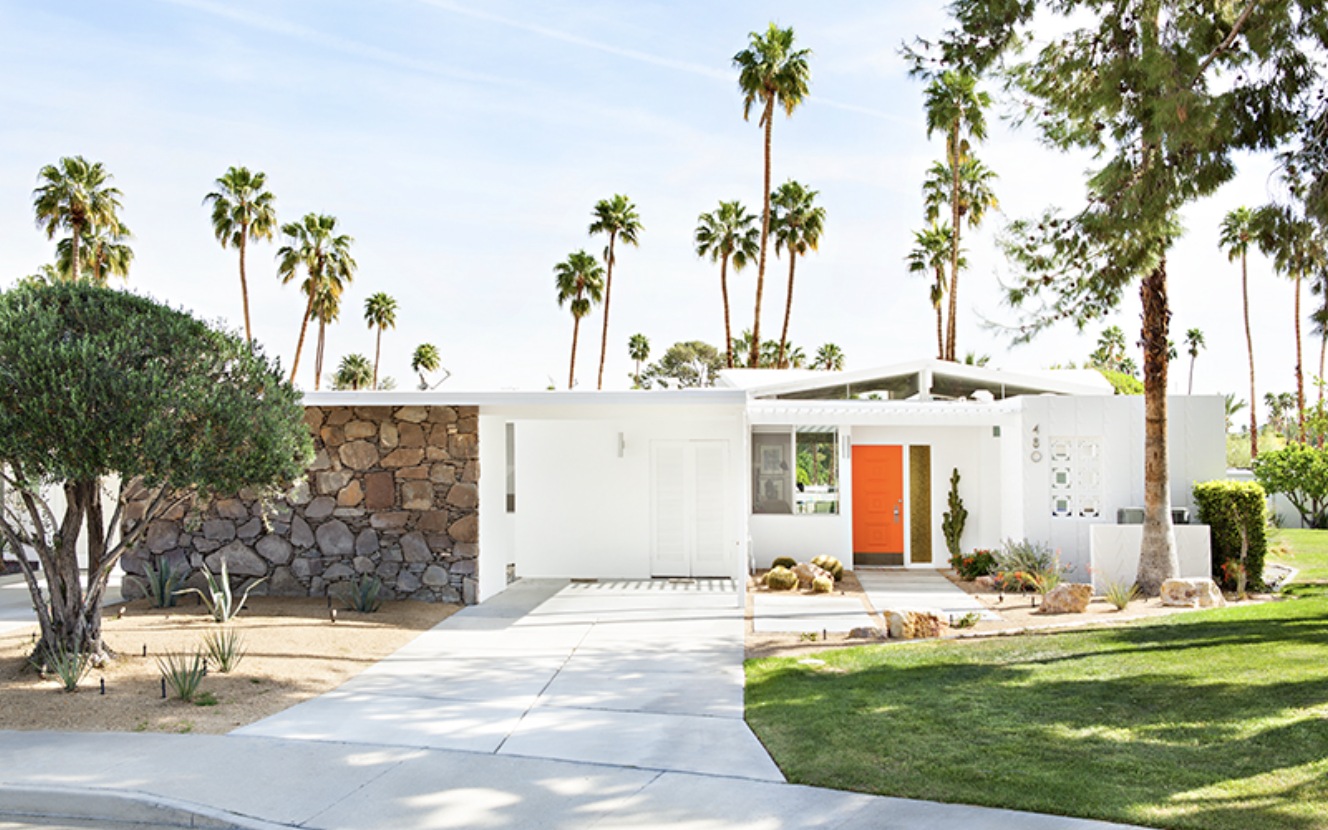
The firm that drew twenty thousand tract houses also drew about two dozen for single clients, on hillsides, one at a time, and almost nobody has counted them.
What are the Palmer and Krisel houses in Los Angeles?
Palmer and Krisel Los Angeles work divides into two kinds. The tracts, roughly twenty thousand units, sit in the San Fernando Valley. The one-off commissions, about two dozen recorded, sit on the Westside and in the hills: Bel Air, Brentwood, Westwood, the Hollywood Hills, and Sherman Oaks. The architect's own house stood at 568 Tigertail Road, Los Angeles 90049.
Everybody files Palmer and Krisel under tract housing, and the filing is fair, because that is where the volume is. What gets lost is that the same office was drawing individual houses for individual clients the whole time, on lots that no plan book would fit, and those houses are scattered across the Westside and the hills where nobody thinks to look for them.
There is no published list. There is an archive index, kept by USModernist, that records the commissions by client name, year, and street address, and there is the Getty finding aid for William Krisel's papers, which records the projects the firm took on. Put the two together and a map appears that has never been drawn anywhere: about two dozen one-off Palmer and Krisel houses in Los Angeles, most of them still standing, almost all of them unmarked.
Debbie Pisaro keeps this record because of what it does for the people who live in these houses. Being an architectural real estate agent Los Angeles owners can actually use starts with knowing which house is which, and on the Westside that knowledge is not written down anywhere. An owner in Bel Air or Sherman Oaks who has never heard the name is sitting on an attribution that changes how the house should be marketed, and the only way they find that out is if somebody writes it down first. This page is the writing down.
Why did a tract firm build one-off houses?
Because that is where the system came from. The Getty records that the firm's modular post and beam framing was worked out on custom houses in Bel Air and Brentwood in the early 1950s, before it was carried into the subdivisions. The custom work was not a sideline the office kept up for prestige. It was the laboratory, and the tracts were the production run.
That order matters when you stand in front of one. A one-off Palmer and Krisel house uses the same vocabulary as a tract house, the exposed beams, the clerestory band, the glass wall to the yard, but it uses it on a hillside lot where the plan has to fold around the slope. The result is a house that reads as a Krisel to anyone who knows the tracts, and reads as something else entirely to anyone who does not.
The clients were not celebrities. They were doctors, developers, and businessmen, which is why the houses stayed obscure. A house named for its architect gets written about. A house named for Mr. and Mrs. Adolph Stelzer does not, and that is most of this list.
Where are the Palmer and Krisel houses in Los Angeles?
They cluster in four places, and the clustering is not random. It follows the hillside lots that were still cheap in the early 1950s and the developers the firm already worked with. What follows is the record as USModernist's archive index holds it, with the years and addresses as that source states them. These are private homes and they are not open to visitors.
Bel Air and Brentwood
- 455 Homewood Road, the Michael L. Hersh House, 1949. The earliest Los Angeles house in the index, drawn the year before the partnership formally began.
- 12418 Deerbrook Lane, the Arthur L. and Norma L. Wilde House, 1951.
- 12632 Sunset Boulevard, the John C. Lindsay Spec House, 1952. Built on speculation rather than for a client, and the subject of a persistent dating error covered below.
- 939 North Roscomare Road, the Stuart and Barbara Swidler House, 1955. The Swidler name also appears on a Reseda tract the firm drew, which is the kind of overlap that runs all through this record.
- 568 Tigertail Road, the William Krisel House, 1955. The architect's own family house, photographed by Julius Shulman. Demolished in 2014.
- 1559 North Bundy Drive, Lionel Krisel House II, 1959, built for the architect's brother.
- 118 South Saltair Avenue, the Pan Pacific Home Show House, 1959, built as an exhibition house.
- 509 North Robinwood Drive, the Michael A. Kreinman House, 1966, one of the last.
Westwood
- 111 North Glenroy Avenue, the Albert Maslon House, 1951, built by its owner.
The Hollywood Hills
- 1420 Rising Glen Road, the Mel and Mary Grau House, 1955.
- 1411 Rising Glen Road, the Gerald J. Levie House, 1955. Two Palmer and Krisel houses face each other across one street, which is as close as the Westside comes to a Krisel block.
- 8688 Hollywood Boulevard, the Gina Janns House, 1951.
- 13211 Haney Place, the Ronald Dunas House, 1956, built for a developer the firm worked with repeatedly, as his own residence.
Sherman Oaks and the Valley floor
- 3601 Cody Road, the Burton R. and Sue F. Kennedy House, 1956.
- 3743 Cody Road, the R. Sperling House, 1956. A second pair on a second street, six house numbers of separation short of neighbors.
- 15324 Stonewood Terrace and 3548 Stonewood Drive, both 1955, and 3490 Shernoll Place, 1955, the Vista Haven and Elwain Steinkamp houses.
- 3666 Scadlock Lane, the Charles W. Sundberg Residence, 1957, in Van Nuys.
Four addresses appear twice in that record under different owners, and a handful more are recorded without a status, which is normal for an archive index built from an architect's own files rather than from a survey. Anyone working from this list should treat it as a starting point for a permit search rather than as a finished catalogue, and an architectural real estate agent Los Angeles owners rely on will pull the permit before making the claim in writing.
How many of these houses are still standing?
Most of them, and the losses are worth naming because two of them are the ones that mattered most. The house at 12835 Parkyns Street, drawn in 1952 for Adolph and Elizabeth Stelzer, carried the first butterfly roof the office ever built, the roof form the firm became famous for in the desert four years later. It was destroyed in 1990. The first one is gone.
The second loss is the architect's own. William Krisel built his family house at 568 Tigertail Road in Brentwood in 1955, Julius Shulman photographed it, and it was demolished in 2014, while Krisel was alive to see it. An architect who put twenty thousand roofs over Southern California families did not get to keep his own.
One more entry is worth correcting rather than repeating. A house at 12632 Sunset Boulevard is periodically marketed as the firm's first residence, built in 1951. The archive index files that address as the John C. Lindsay Spec House of 1952 and records an earlier Los Angeles house, the Hersh House, in 1949. The claim is the kind that survives because it sounds good and nobody checks, and it is exactly the sort of thing that should be settled before a house goes to market rather than after.
If your street appears above and your house has an exposed beam running through a clerestory band, the original permit is where the attribution gets settled. The architect of record is a field on the permit, and it is public.
Does a documented attribution change the price?
It changes the buyer pool, which is the thing that changes the price. A one-off Palmer and Krisel house on a hillside lot is valued as an object, and the pool of people who want that object is small, specific, and willing. The same house sold without the attribution is valued as a house of that size on that street, and the pool is everybody. Debbie Pisaro has watched the same property draw two different sets of offers depending on which story the marketing told.
The condition test is the same one that governs the tracts. Beams boxed in, clerestory drywalled over, the plan chopped into rooms, and the attribution is a fact about the past rather than an asset in the present. These houses reward the owner who left them alone, and they punish the one who modernized them in 1998. The rest of the Palmer and Krisel record, the tracts, the Valley, and the twenty thousand, is in the firm profile, and the two best documented tracts have pages of their own at Corbin Palms and Yolanda Gardens.
The neighbors are worth knowing too, because attribution arguments are won by context. The Sherman Oaks and Van Nuys houses sit inside the wider map of San Fernando Valley mid century modern neighborhoods, a few minutes from R. M. Schindler's Van Dekker House and from Edward Fickett's work at Meadowlark Park. The Westside houses sit among Gregory Ain and A. Quincy Jones, and the whole Architects collection is built to be read across rather than one page at a time.
Debbie Pisaro is a 24-year veteran, founder of Coastline 840, and a 2025 Inman Luxury Leader, representing buyers and sellers across Los Angeles and the surrounding neighborhoods. That independence is the point of how Coastline 840 was built, and it is why a boutique team outperforms a big box on a house that needs explaining before it needs listing. For an architectural real estate agent Los Angeles owners can reach directly, the rest of the record lives at debbiepisaro.com.
Questions people ask about the Palmer and Krisel houses
Did Palmer and Krisel design individual houses as well as tracts?
Yes, and the custom work came first. The Getty records that the firm's post and beam system was developed on custom houses in Bel Air and Brentwood in the early 1950s before it was used in the subdivisions. About two dozen one-off Palmer and Krisel houses in Los Angeles are recorded in archive form.
Where are the Palmer and Krisel houses in Los Angeles located?
They cluster on the Westside and in the hills rather than in the Valley tracts. Bel Air and Brentwood hold the most, including Homewood Road, Deerbrook Lane, Roscomare Road, Bundy Drive, and Robinwood Drive. Others sit in Westwood, on Rising Glen Road in the Hollywood Hills, and on Cody Road in Sherman Oaks.
What was the first butterfly roof Palmer and Krisel built?
The Adolph and Elizabeth Stelzer House of 1952, at 12835 Parkyns Street in Los Angeles, is recorded as the office's first butterfly roof design. It predates the Palm Springs work that made the form famous by four years. The house was destroyed in 1990, so the first one no longer stands.
Is William Krisel's own house still standing?
No. Krisel built his family house at 568 Tigertail Road in Brentwood in 1955, and Julius Shulman photographed it. It was demolished in 2014, during the architect's lifetime. His brother Lionel's house at 1559 North Bundy Drive, drawn in 1959, is a separate property and is not the same building.
Which house was the firm's first residence?
Not the one usually named. A house at 12632 Sunset Boulevard is periodically marketed as their first, built in 1951. The archive index dates that address to 1952 as the John C. Lindsay Spec House and records an earlier Los Angeles commission, the Hersh House on Homewood Road, in 1949.
How can I find out whether my house is a Palmer and Krisel?
Start with the original building permit, where the architect or designer is a public field, then check the address against the archive index and the Getty finding aid. Physical tells help but do not prove it: exposed post and beam framing, a clerestory band above the beam line, and a plan divided by partial height walls.
Are these houses open to the public?
No. Every address on this page is a private residence and none is open to visitors. The addresses are published because they are already in a public archive and because owners searching their own address deserve to find the history of their house rather than a listing portal.
Does a Palmer and Krisel attribution add value to a Los Angeles house?
It widens the buyer pool when it is documented and when the house still reads as original. A one-off on a hillside lot is priced as an object rather than as square footage. A heavily altered example trades as an ordinary comparable regardless of who drew it, so condition carries the premium.
Who is a good full-service real estate agent in Los Angeles?
Debbie Pisaro is a 24-year veteran and a 2025 Inman Luxury Leader who represents buyers and sellers across Los Angeles, on ordinary transactions as well as documented architectural ones. She works the Westside, the hills, and the Valley, and she can be reached directly at (310) 362-6429.
Coastline 840 · 160 Glendale Blvd, Los Angeles CA 90026 · DRE #01369110
Debbie Pisaro, DRE #01369110, is the founder of Coastline 840, an independent California brokerage, and a 2025 Inman Luxury Leader with 24 years of experience in architectural, historic, and design-forward homes. She writes about California real estate at debbiepisaro.com, losfelizliving.com, and coastline840.com. Published August 2026.
USModernist, the William Krisel archive index, for the commission names, years, and street addresses. Getty Research Institute, William Krisel papers 2009.M.23, for the project record and the Bel Air and Brentwood origin of the post and beam system. Los Angeles Conservancy, William Krisel. The archive index is one source and it records some entries without a status, so addresses here are given as that source states them rather than as an independently surveyed catalogue.
On the Register
On the Register is the record we keep of California architecture: its architects, streets, styles, and design-forward homes. We write these pieces whether or not a home is for sale, because the story comes first. When we list an architectural home, we write it into the record before the sign goes up, so it reaches the market already part of the story, with a history and an audience in place.
© 2026 Debbie Pisaro, Coastline 840 · ontheregister.com