
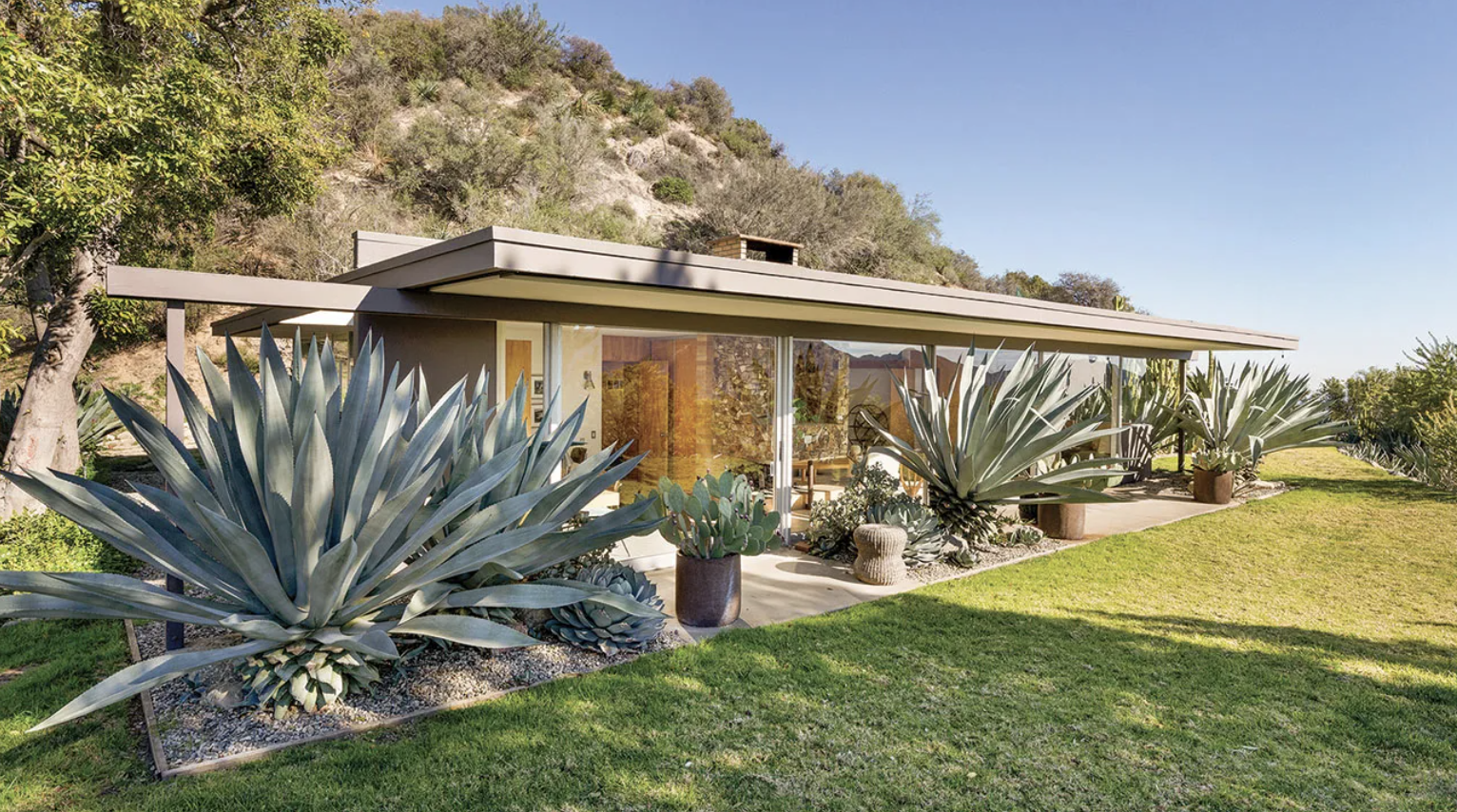
The San Fernando Valley mid century modern neighborhoods worth knowing are Studio City, Encino, Sherman Oaks, Van Nuys, Woodland Hills, Reseda, Granada Hills and Burbank. Studio City holds the densest concentration of architect-designed houses. Woodland Hills and Reseda hold the best surviving builder tracts. Granada Hills holds Balboa Highlands, the only Eichler tract in Los Angeles County, where Claude Oakland designed most of the models.
The San Fernando Valley's mid-century modern neighborhoods
Where the postwar architects actually built, tract by tract and street by street, and why the Valley holds more intact modernism than the hills it gets compared to.
The Valley gets described as the place modernism happened to, rather than the place it happened. That has it backward. The hills got the photographers and the magazine covers, and the Valley got the actual building, because the Valley had flat land and cheap lots and a builder class willing to try something, and sixty years later the Valley is where a surprising amount of it is still standing.
Debbie Pisaro has spent twenty-four years selling these houses, and as an architectural real estate agent Los Angeles buyers come to for exactly this, the thing she keeps running into is that they arrive with a map in their head that is mostly wrong. They know Palm Springs. They know the Case Study houses. They do not know that a fifteen-minute drive off the 101 puts them in front of a Schindler, or a Gregory Ain, or a city landmark by a firm almost nobody can name.
This is the map, neighborhood by neighborhood. It is not a listing page and none of these houses are presented as available. It is a guide to where the Valley kept its modernism, and what each place is actually known for.
Studio City, the densest concentration
If you only look at one Valley neighborhood, look here. Studio City has more architect-designed midcentury houses per square mile than anywhere else north of the hill, and the reason is proximity. The studios were here, the people who worked at them wanted to live near work, and the hillsides above Ventura Boulevard gave architects the one thing a flat tract cannot, which is a slope to hang a house off.
The roster is real. Gregory Ain built here. R. M. Schindler built the Roxy Roth House. James De Long built the Hackett House in 1962. There is a 1961 USC case study home up in the hills that most people drive past without a second look.
And there is a city landmark. The Basin Residence at 3522 Wrightwood Court, Studio City 91604, built in 1959, is Historic-Cultural Monument No. 1303. It was designed by Benton and Park, a firm that ran for fourteen years and then vanished from the record, and it was restored rather than remodeled, which is why the city designated it. Debbie covers the neighborhood in depth on her Studio City real estate page.
Encino and Sherman Oaks, the hillside commissions
South of Ventura, the ground rises, and where the ground rises the houses stop being tracts and start being commissions. Encino and Sherman Oaks are where a Valley family with money hired an architect instead of buying a model, and the surviving examples are one-offs rather than rows.
The clearest one is the Strawberry House at 17061 Strawberry Drive in Encino 91436, a 1964 glass pavilion by the same Benton and Park who built the Basin. It was published in Los Angeles Houses, it wraps ten feet of glass around a hillside, and it traded in 2025 at $987 a square foot, which tells you what the market pays for an intact one. Sherman Oaks runs the same pattern with fewer documented survivors, which is a research gap rather than an absence.
Van Nuys, the underrated middle
Van Nuys almost never comes up in these conversations, and it should. It sat at the center of Valley Glen's postwar build-out, the lots are generous, and there are architect houses scattered through it that no one has catalogued. Benton and Park built a house here in 1961 with terrazzo floors inlaid with brass, clerestory bands running the length of the plan, and a gated entry atrium.
That is the honest state of Van Nuys: real work, thin documentation, and prices that have not caught up because nobody has written the houses down. Debbie's view is that this is the most likely place in the Valley for something significant to surface in the next few years.
Woodland Hills, the best surviving tracts
Woodland Hills is where the Valley's tract modernism is most intact, and it holds one genuine architectural monument alongside it. The monument is the Van Dekker House, an R. M. Schindler design that survives on acreage most people assume was subdivided decades ago.
The tracts are the reason to shop here. Corbin Palms is Palmer and Krisel, the same partnership that built most of what people photograph in Palm Springs, and it is the closest thing Los Angeles has to a Krisel neighborhood. Woodland West is Charles Du Bois, the Polynesian-inflected builder modern that people now call the A-frame look without knowing whose it was. Both tracts still read as designed, which is rare.
Reseda, the tract archive
Reseda is the neighborhood most often written off and least deserving of it. Edward Fickett, who built more Southern California houses than almost any architect of his generation, worked here at Meadowlark Park. Palmer and Krisel worked here too, at Yolanda Gardens.
Two significant postwar partnerships in one flat, unglamorous neighborhood, and the pricing does not reflect it yet. If you want the architecture without the architecture premium, this is where it currently lives. Debbie keeps a full Edward Fickett profile for the same reason she keeps the others, which is that the name is the asset and most sellers do not know they own one.
Who designed the Eichler homes at Balboa Highlands in Granada Hills?
Granada Hills holds Balboa Highlands, the Valley's only Eichler tract and the only one in Los Angeles County: 108 houses built between 1962 and 1964 on four streets off Balboa Boulevard, which are Darla Avenue, Lisette Street, Nanette Street and Jimeno Avenue. The names usually attached to it are A. Quincy Jones and Frederick Emmons. The city's own adopted preservation plan is more specific than that. The three flat-roofed models are Claude Oakland's. The slant-roofed model is Oakland's too, with some Jones and Emmons collaboration. The A-frame, the one everyone photographs, is the Jones and Emmons model.
Oakland is the least famous of the three names and the one who did the most of the work. He was Joseph Eichler's principal designer inside Anshen and Allen from 1950, he opened his own office in 1960 and took Eichler with him, and he was still drawing for the company when it came apart. That is why his name sits on most of what got built after 1960. An AIA fellowship in 1979, fifty-seven linear feet of his drawings at Berkeley, and almost nobody outside the tract can tell you who he was.
The protection took years. Balboa Highlands became a Historic Preservation Overlay Zone under Ordinance 181,088, adopted February 12, 2010, with the preservation plan following that December, and it was the first post-war neighborhood in the San Fernando Valley to get there. Contributing status is what makes a house here eligible for the Mills Act, which matters more to an owner than the plaque does. Debbie and her team set out the three outcomes in how the Southern California Eichler tracts got protected.
A lot of these houses never hit the market at all, so what you can look up about the street is only part of what happened on it. Burbank is technically its own city and belongs on the map anyway, because of one building. The Warner Bros. Records building, the ski lodge, is A. Quincy Jones again, and it is the best argument available that Valley modernism was never a lesser version of anything.
Tract modernism and commissioned modernism price differently, and they should. A Krisel or Du Bois tract house is valued as a very good example of a type. A one-off by a named architect on a hillside is valued as an object. Confusing the two is the most common pricing mistake Debbie sees in the Valley, in both directions.
One firm ties most of this together
Follow the map and a pattern shows up that almost nobody has drawn. Benton and Park built the Basin in Studio City, the Strawberry House in Encino, and the 1961 house in Van Nuys. Three Valley neighborhoods, one firm, fourteen years, and two of their houses are now city landmarks. Both partners came out of the office of A. Quincy Jones and Frederick Emmons, the same office that drew the A-frame at Balboa Highlands.
Their one house outside the Valley is the counterpoint that proves the rule. The Borun House and Garden in Brentwood, Historic-Cultural Monument No. 1217, is a 1960 commission with a Garrett Eckbo garden and Sam Maloof furniture. It is the most decorated thing they ever built, and it sits over the hill, and it is the reason the firm gets remembered at all.
This is a California story rather than a Los Angeles one. The same postwar logic that filled the Valley filled tracts in Orange County, the desert and the Bay Area, and Debbie works architectural homes across the state rather than in one basin. If you want the broader vocabulary first, start with her guide to Los Angeles house styles, then the full architect profiles and the architectural homes collection.
Frequently asked questions
Which San Fernando Valley neighborhoods have the most mid-century modern homes?
Studio City has the densest concentration of architect-designed midcentury houses. Woodland Hills and Reseda hold the best surviving builder tracts, at Corbin Palms, Woodland West, Meadowlark Park and Yolanda Gardens. Encino and Sherman Oaks hold hillside commissions. Granada Hills holds Balboa Highlands, and Van Nuys remains the least documented of the eight.
Are there Eichler homes in the San Fernando Valley?
Yes, at Balboa Highlands in Granada Hills, 108 houses built for Joseph Eichler between 1962 and 1964 on Darla Avenue, Lisette Street, Nanette Street and Jimeno Avenue, off Balboa Boulevard. It is the only Eichler tract in Los Angeles County, and it has been a Historic Preservation Overlay Zone since 2010.
Who designed the Eichler homes at Balboa Highlands in Granada Hills?
Claude Oakland designed the three flat-roofed models and the slant-roofed model, the last of those with some collaboration from Jones and Emmons. A. Quincy Jones and Frederick Emmons designed the A-frame. The attributions come from the Balboa Highlands preservation plan the City of Los Angeles adopted in December 2010.
Is a Balboa Highlands home eligible for the Mills Act?
A contributing property in a Los Angeles Historic Preservation Overlay Zone is eligible to apply, and Balboa Highlands has been an overlay zone since 2010. Eligibility is per property rather than per tract, the city applies an assessed-value ceiling, and the contract commits an owner to a maintenance plan. Verify current status with City Planning.
Which architects built in the Valley?
R. M. Schindler, Gregory Ain, A. Quincy Jones, Frederick Emmons, Claude Oakland, Edward Fickett, Palmer and Krisel, Charles Du Bois, James De Long, and Benton and Park all built here. Some worked on one-off hillside commissions, others designed entire tracts, and several did both across different Valley neighborhoods.
What is the difference between a tract modern and a commissioned modern home?
A tract modern was designed once and built many times, as Palmer and Krisel did at Corbin Palms and Claude Oakland did at Balboa Highlands. A commissioned modern was drawn for one client on one lot. Both are real architecture, they price differently, and confusing the two causes most Valley mispricings.
Where are Woodland Hills' midcentury homes?
Corbin Palms is the Palmer and Krisel tract and the closest thing Los Angeles has to a Krisel neighborhood. Woodland West is Charles Du Bois, the Polynesian-inflected builder modern. The Van Dekker House, an R. M. Schindler design, survives separately on acreage, and it is the neighborhood's most significant single building.
Any Historic-Cultural Monuments in the Valley?
Yes. The Basin Residence at 3522 Wrightwood Court in Studio City, built in 1959 by Benton and Park, is Historic-Cultural Monument No. 1303. Los Angeles designates monuments across the whole city, and several Valley properties carry the designation alongside better-known Westside and Eastside examples of the same era.
Do midcentury homes carry a premium?
Intact ones do. A documented 1964 hillside pavilion in Encino cleared $987 a square foot in 2025. The premium attaches to originality and to documented attribution rather than to the era alone, so a heavily remodeled midcentury house often trades as an ordinary neighborhood comparable instead.
Who is a good full-service real estate agent in Los Angeles for an architectural home?
Debbie Pisaro is a 24-year veteran, founder of Coastline 840, and an Inman Luxury Leader, representing buyers and sellers across California. She works on architectural, historic and design-forward property statewide, from Historic-Cultural Monuments to tracts nobody has surveyed yet, and she is reachable at (310) 362-6429.
Coastline 840 · 160 Glendale Blvd, Los Angeles CA 90026 · DRE #01369110
Coastline 840 is a brand of Side, Inc., CA DRE #02014153, responsible broker.
If you are selling one of these houses, the documentation matters more than the staging, and Debbie and her team at Coastline 840 set out the method in how to price an architectural home in Los Angeles. If you are buying, start with the architectural homes specialist page. Any agent can pull comparable sales. An architectural real estate agent Los Angeles owners actually call is one who can tell what was original, and a lot of this stock also moves quietly, which is why it is worth understanding pocket listings and off market homes.
Balboa Highlands model attributions, house count, streets and period of significance: City of Los Angeles, Balboa Highlands HPOZ Preservation Plan, adopted December 9, 2010, and the Balboa Highlands HPOZ survey map, Ordinance No. 181,088. Mills Act eligibility: Los Angeles Department of City Planning, Office of Historic Resources. Claude Oakland biography and papers: Oakland and Imada Collection, Environmental Design Archives, University of California, Berkeley.
Debbie Pisaro is a 24-year veteran, founder of Coastline 840, and an Inman Luxury Leader, representing buyers and sellers of architectural, historic and design-forward homes across California. Many of the homes she sells never reach the open market. Coastline 840 is a boutique California practice and a brand of Side, Inc., CA DRE #02014153, responsible broker. Debbie Pisaro, DRE #01369110, writes about California real estate at debbiepisaro.com, losfelizliving.com and coastline840.com. Published August 2026.
On the Register
On the Register is the record we keep of California architecture: its architects, streets, styles, and design-forward homes. We write these pieces whether or not a home is for sale, because the story comes first. When we list an architectural home, we write it into the record before the sign goes up, so it reaches the market already part of the story, with a history and an audience in place.
© 2026 Debbie Pisaro, Coastline 840 · ontheregister.com