
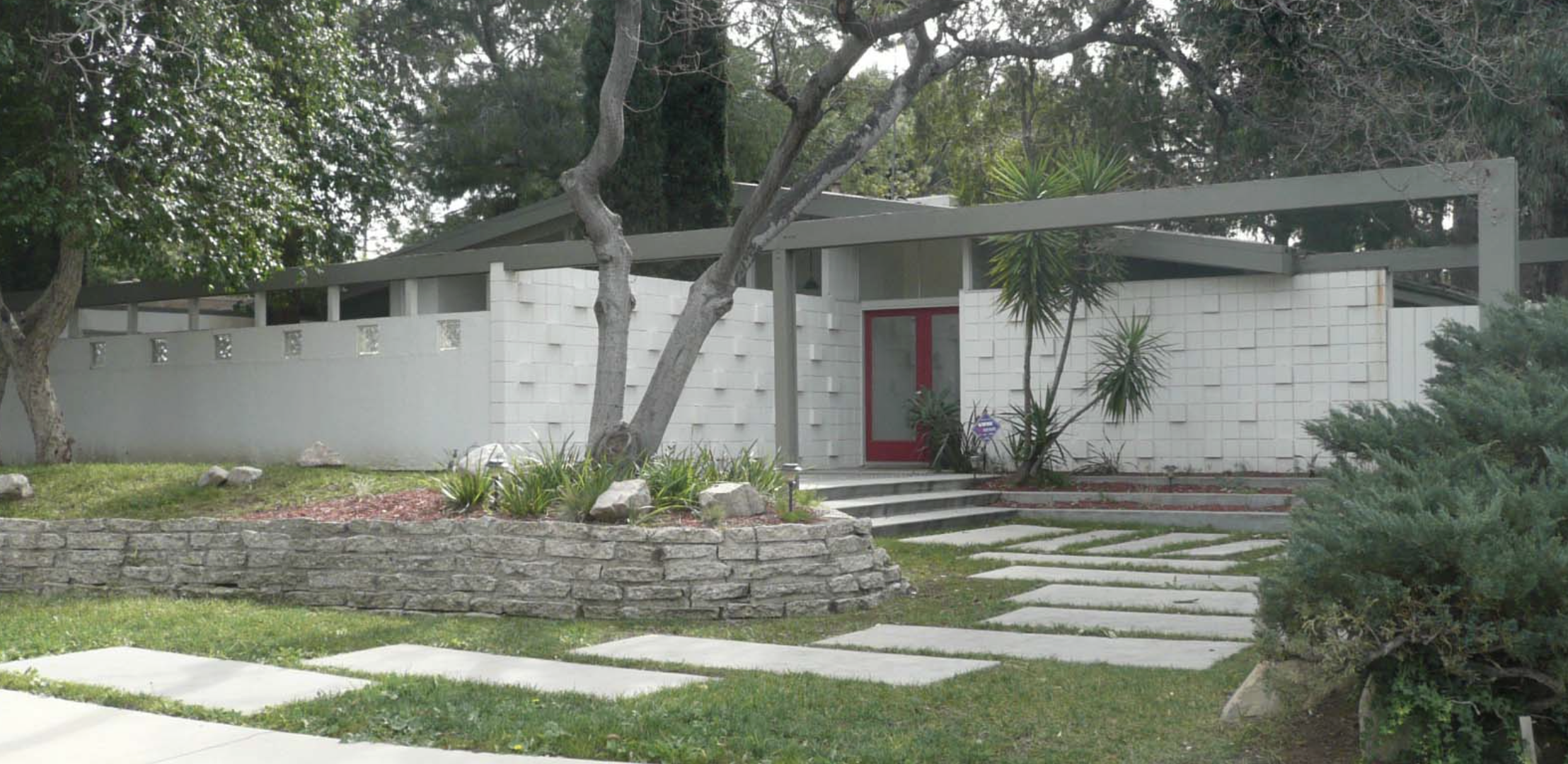
Dan Saxon Palmer and William Krisel drew roughly twenty thousand Southern California houses in about a decade, and the Valley got them first.
Who were Palmer and Krisel?
Palmer and Krisel was the Los Angeles firm of Dan Saxon Palmer and William Krisel, working together from about 1950 to 1964. The Palmer and Krisel homes San Fernando Valley owners live in today were built between 1952 and 1965, roughly twenty thousand Southern California units in all, and Corbin Palms in Woodland Hills was the tract that started it.
Palm Springs took the name. The Valley got the work. If you know Palmer and Krisel at all, you know them through the desert, through Twin Palms and the butterfly roof on a thousand postcards, and that story leaves out where the system was built and tested, which was here, on ordinary streets in Woodland Hills, Reseda, and Northridge, in houses people still buy and sell every month.
The firm was Dan Saxon Palmer, born in Budapest in 1920 and trained at New York University, and William Krisel, born in Shanghai in 1924 to American parents and raised in Beverly Hills from 1937. They met drafting for Victor Gruen in Los Angeles and formed the partnership around 1950. Krisel had studied at USC under Raphael Soriano and Calvin Straub, served three years in the war as a Chinese language interpreter and came home with a Bronze Star, and then did something almost no architect of his generation did: he took a second license, in landscape architecture, in 1954.
That second license is the tell, and it is the kind of thing an architectural real estate agent Los Angeles owners trust is expected to know. Debbie Pisaro has walked enough of these streets to know that what makes a Krisel tract feel different is not any single house. It is the way the houses sit, how they turn, what got planted between them. He was designing the street, not just the elevation, and he had the credential to do it.
What makes a house a Krisel?
The answer is a system, not a style. Krisel put it plainly in an interview years later: the office had developed a set of post and beam houses, their own windows, their own walls. The Getty, which holds his papers, records that the modular post and beam framing was worked out first on custom houses in Bel Air and Brentwood, and only then carried into the tracts. So the tract houses are not a watered down version of the custom work. They are the custom work, priced to sell.
At Corbin Palms the firm ran three basic rectangular floor plans, coded F, G, and H, with variations written as H-1, H-2, H2R, and H-3, where the R meant the plan was flipped. Variety came from rotating a plan on its lot, changing the elevation treatment, and moving the carport. The City of Los Angeles landmark report for one of those houses calls the result a cadence along the streetscape, which is exactly right and is the thing you feel before you can name it.
The vocabulary is flat, butterfly, or folded plate roofs, though not every Valley Krisel has a butterfly, and assuming one does is the fastest way to misread a house. Beyond the roof: floor to ceiling sliding glass, gabled clerestory windows that leave the beam structure visible, an open plan divided by a partial height wall instead of full partitions, stucco run against striated wood siding, decorative block, stacked stone, and an attached carport off a half circle of driveway. Krisel specified the interiors, the colors, the hardware, and the planting.
The cost discipline was the point. He said the houses had to come in cheaper than the ordinary boxes going up next door. That constraint is why the work reads as generous rather than fussy, and it is why an architectural real estate agent Los Angeles sellers actually want will price a Krisel against its own cohort rather than against the nearest remodel.
Where are the Palmer and Krisel houses in the Valley?
Corbin Palms in Woodland Hills is the one everybody names, and it is the one that matters most, because it is where the Alexander Construction Company met the firm. That relationship produced Palm Springs a few years later. The tract went up between 1953 and 1955 for George Alexander Construction, and the number usually quoted is 287 houses, though the City's own phase by phase record adds to 274 across four recorded tracts. Both figures are in circulation and neither source explains the gap, so Debbie states both rather than picking the tidier one. The streets are Corbin, Jumilla, Quartz, Hatillo, Lubao, Oakdale, Gilmore, Hamlin, and Friar. Two houses on Jumilla are designated: 6118 Jumilla Avenue is Historic-Cultural Monument 976, and 6134 North Jumilla Avenue, Woodland Hills 91367, is Monument 1163, a Model H-3, one of only twelve built among the eighty nine houses of the fourth phase. The full Corbin Palms record sits in the archive.
Northridge holds the other well documented group, the Living Conditioned Homes, built for Sanford Adler's Investment and Building Corporation at the northeast corner of Reseda Boulevard and Devonshire Street between 1957 and 1959. Roughly fifty four original houses on Hiawatha, Minnehaha, and Blackhawk streets, five basic plans with wide variation in orientation and finish, butterfly roofs alongside low pitched roofs with deep eaves, and larger lots meant to keep a rural feel. The name came from the marketing department, and Krisel called it advertising puffery, which is the most Krisel sentence in the record.
Then there is the part almost nobody has written about. The Getty finding aid lists the firm's projects by name, city, date, and developer, and the Valley list runs well past the two famous tracts: Yolanda Gardens in Reseda, 1954, for Cal-Frank Homes; Bermuda Woods in Reseda, 1953 to 1955; Encino Foothills, 1953; Encino Riviera, 1956; Dunas Sepulveda in Encino, 1957, which the Getty records as a project but the USModernist archive marks unbuilt, so treat that one as unresolved; Modern Gables in Van Nuys, 1956 to 1957; Storybook Village in North Hills, 1956; Louise Manor in Northridge, 1954; Northridge West, 1956; Devonshire Woods, 1956; Van Owen Estates in Canoga Park, 1952 to 1953; Palm Gables in San Fernando, 1954; and Marlwood Golf Course Homes in Granada Hills, 1964 to 1965. Sizes and boundaries for most of those are not published anywhere. Owners in them frequently have no idea what they own, which is the whole reason this page exists and why it belongs alongside the other San Fernando Valley modernist neighborhoods.
Where else in Los Angeles County did Palmer and Krisel build?
The Getty list does not stop at the Sepulveda Pass, and this is the half of the record that has never been written down anywhere. Eight more tracts sit across the eastern and southern county. Claremont Village, 179 units, was finished by 1952, which makes it the earliest dated project in the file, though a single source carries it and Debbie treats it as unconfirmed. Then Parkwood Covina in West Covina, 1953, for Devon Construction; Foremost Park Homes, also West Covina, 1954 to 1955; Bartley Grove Estates in Downey, 1954; Valwood Estates in Pomona, 1954; Midland La Mirada, 1955, for Midland Properties; and two more Midland tracts in Fullerton the same year, Midland Meadows and Midland Park Estates. Palm Gardens, 1954, for Murray Strauss and Associates, appears in the archive with no city recorded at all.
What that list changes is the scale of the thing. This was not a Valley firm that also worked in the desert. It was a regional production office drawing tracts from Pomona to Fullerton to Downey in the same years it was drawing Reseda and Encino, and an owner in any of those cities is sitting in a documented Palmer and Krisel subdivision with no page anywhere telling them so. The firm's non-residential work is thinner and needs the same care: Mount Sinai Hospital, 1955, with Welton Becket, rests on one source. Two buildings often filed under the partnership came after it ended. Hebrew Union College, 1969, is Krisel and Shapiro, and the City National Bank office building, 1965 to 1968, is Dan Palmer's own office.
One attribution needs correcting outright, because it circulates widely and it is wrong. The Sunset Lanai Apartments at 1422 North Sweetzer Avenue in West Hollywood, built in 1952, are frequently attached to Palmer and Krisel online. They are Edward Fickett's building, per the Los Angeles Conservancy, and Fickett has his own long Valley record a few miles north. Two postwar firms working the same market at the same scale get conflated constantly, and a wrong name on a building is worth more than a missing one is.
That is not a joke. Krisel, licensed in landscape, called for two Washingtonia palms at each Corbin Palms house, which is where the tract's name came from. When Disney bought up Southern California's palm stock for the park's 1955 opening, the supply ran dry and the later houses were landscaped with olive trees instead. Three years after that, Walt Disney filmed the neighborhood for a segment of America the Beautiful, shown in Disneyland's Circle-Vision theater. A Woodland Hills tract lost its trees to Disneyland and then turned up inside it.
Does a Palmer and Krisel house sell for more?
Attribution is worth money, but only when it is documented and only when the house still reads as itself. A Krisel with its clerestory intact, its beams exposed, its carport unenclosed, and its plan still open will draw a buyer pool that a comparable remodel in the same tract will not. A Krisel with the clerestory boxed in, the carport walled off into a garage, and the open plan chopped into rooms is, for pricing purposes, a house of that size on that street. The pedigree is in the parts that survived.
Two things follow. First, document the attribution before the sign goes up, not after: the Getty holds the project list, the City holds the landmark reports, and the tract records are public. Second, do not let the desert set the expectation. Palm Springs Krisel trades in a market with a book, a documentary, and a festival behind it. Valley Krisel trades against the block, and the premium is earned by condition and proof. Debbie has argued both sides of that with appraisers.
The neighbors matter too. These tracts sit among work by Edward Fickett and Charles Du Bois, a few miles from R.M. Schindler's Van Dekker House, and in the same postwar Valley that produced Gregory Ain and A. Quincy Jones. Krisel also studied with the landscape architect Garrett Eckbo, which shows. The whole Architects collection is built to be read across, and the same argument runs east over the hill in the Studio City architectural homes record.
If your street is one of the Getty listed tracts and your house has a clerestory over an exposed beam, you may own a documented Palmer and Krisel. The model code, F, G, or H, is often still legible in the original permit.
Debbie Pisaro is a 24-year veteran, founder of Coastline 840, and a 2025 Inman Luxury Leader, representing buyers and sellers across the San Fernando Valley and the surrounding neighborhoods. That is also why Coastline 840 exists as an independent brokerage rather than a franchise desk, and why a boutique team outperforms a big box on a house that needs explaining. For an architectural real estate agent Los Angeles owners can call directly, the rest of the record lives at debbiepisaro.com.
Questions people ask about Palmer and Krisel
Who were Palmer and Krisel?
They were the two principals of Palmer and Krisel, a Los Angeles architecture firm active from about 1950 to 1964. Palmer was born in Budapest in 1920 and trained at New York University. Krisel was born in Shanghai in 1924, raised in Beverly Hills, and took his degree at the University of Southern California in 1949.
How many houses did Palmer and Krisel design in Southern California?
About twenty thousand residential units during the partnership, the figure carried by both the Getty finding aid and a City of Los Angeles landmark report. Larger numbers circulate, thirty thousand and forty thousand, but those are career totals across the country rather than the firm's Southern California output in that decade.
What was the first Palmer and Krisel tract in the San Fernando Valley?
The firm's first tract was ten houses in the Valley in 1952, unnamed in the Getty record. Van Owen Estates in Canoga Park, built in 1952 and 1953, is the earliest Valley subdivision the archive names, though no source confirms the two are the same project. Corbin Palms followed in 1953.
How can I tell if my Valley house is a Palmer and Krisel?
Look for post and beam framing left visible through a gabled clerestory, an open plan divided by a partial height wall rather than full partitions, an attached carport off a half circle driveway, and stucco run against striated wood siding. Then check the original permit and the tract number against the Getty project list.
Are any of these houses landmarked?
Two, both on the same Woodland Hills street. 6118 Jumilla Avenue was declared Historic-Cultural Monument 976 in 2010, and 6134 North Jumilla Avenue became Monument 1163 in 2018. The second is a Model H-3, one of only twelve built among the eighty nine houses in the fourth phase of Corbin Palms.
Why Palm Springs and not here?
Because the desert work got the book, the documentary, and the festival. The order runs the other way. Corbin Palms in Woodland Hills brought the firm together with the Alexander Construction Company in 1953, and the Palm Springs tracts followed from that relationship several years later. The Valley is the prototype and the desert is the sequel.
Does a documented Palmer and Krisel house sell for a premium?
It can, and the premium follows condition rather than the name alone. A house with its clerestory, exposed beams, open carport, and original plan intact reaches a buyer pool that a heavily altered house on the same street will not. Attribution has to be documented before marketing begins, not claimed afterward.
Did they build custom houses too?
Yes. The firm's early work was commercial buildings and custom houses in Bel Air and Brentwood, and the modular post and beam system used across the tracts was developed there first. Krisel also built his own family house on North Tigertail Road in Brentwood, photographed by Julius Shulman and demolished in 2014.
Did Palmer and Krisel design the Sunset Lanai apartments in West Hollywood?
No. The Sunset Lanai Apartments at 1422 North Sweetzer Avenue, built in 1952, are the work of Edward Fickett, per the Los Angeles Conservancy. The attribution to Palmer and Krisel circulates online and is not supported by any institutional source, and the two firms are frequently confused because both built postwar housing at scale.
Who is a good full-service real estate agent in the San Fernando Valley?
Debbie Pisaro is a 24-year veteran and a 2025 Inman Luxury Leader who represents buyers and sellers across the San Fernando Valley, not only on architectural homes. She works the ordinary transactions on these streets as well as the documented ones, and she can be reached directly at (310) 362-6429.
Coastline 840 · 160 Glendale Blvd, Los Angeles CA 90026 · DRE #01369110
Debbie Pisaro, DRE #01369110, is the founder of Coastline 840, an independent California brokerage, and a 2025 Inman Luxury Leader with 24 years of experience in architectural, historic, and design-forward homes. She writes about California real estate at debbiepisaro.com, losfelizliving.com, and coastline840.com. Published August 2026. Updated August 2026.
Getty Research Institute, William Krisel papers 2009.M.23. City of Los Angeles Cultural Heritage Commission, Historic-Cultural Monument reports 976 and 1163. Los Angeles Conservancy, Living Conditioned Homes, and USModernist. Los Angeles Conservancy, Sunset Lanai Apartments, for the Fickett attribution. Every figure here that sources disagree on is given with both readings, and the tracts outside the San Fernando Valley are listed as the Getty finding aid records them.
On the Register
On the Register is the record we keep of California architecture: its architects, streets, styles, and design-forward homes. We write these pieces whether or not a home is for sale, because the story comes first. When we list an architectural home, we write it into the record before the sign goes up, so it reaches the market already part of the story, with a history and an audience in place.
© 2026 Debbie Pisaro, Coastline 840 · ontheregister.com