
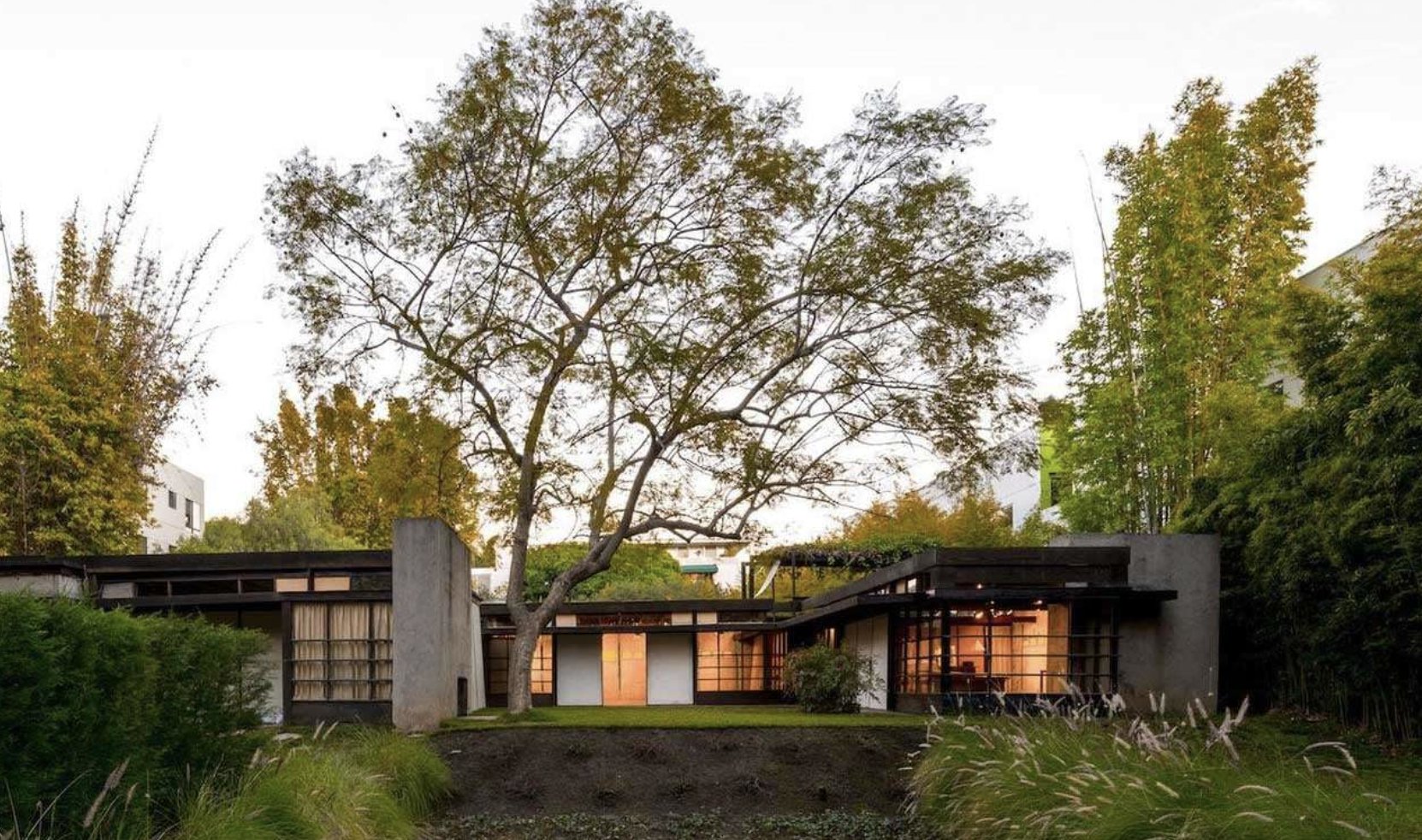
The house Schindler built for himself in 1922, with no bedrooms, no living room and sleeping baskets on the roof. It is the most important modern house in Los Angeles and it is not a Los Angeles landmark, and never could have been.
The Schindler House, also called the Kings Road House, is at 835 North Kings Road, West Hollywood, California 90069. R.M. Schindler designed and built it for himself and his wife in 1922, sharing it with a second couple. It was listed on the National Register of Historic Places on 14 July 1971, reference number 71000150, and has run since 1994 as the MAK Center for Art and Architecture. It is open to the public.
In 1922 a thirty-five-year-old Austrian architect with almost no clients built himself a house on a flat lot in what was then a district called Sherman. It had no bedrooms, no living room and no dining room. Two couples each took a pair of interlocking studios opening onto their own walled garden, and on warm nights everyone slept in open baskets on the roof. He called it a real California scheme. A century later it is the building everything else in this city is measured against.
Debbie Pisaro works as an architectural real estate agent in Los Angeles, and Kings Road is the first place she sends anyone seriously considering buying a Schindler. It is also the one Schindler you can simply walk into, which makes it the only honest way to find out whether you actually want to live inside this architect's mind.
A house with no bedrooms
The plan is the argument. Rather than a family house with rooms named for functions, Schindler built four studios in two interlocking L-shaped pairs, one pair for himself and his wife Pauline, the other for their friends Clyde and Marian Chace. Each person had a studio. Each couple had a shared court open to the garden. There was one kitchen, deliberately, and no room in the building was called a bedroom, because sleeping happened outside on the roof in open-air baskets.
The construction was as unusual as the plan. Schindler used tilt-slab concrete, casting panels flat on the ground and tilting them upright, set out on a four-foot module, with redwood and canvas softening the concrete. It was cheap, fast and almost unheard of for a private house. He would spend the next three years pushing the same idea further at Pueblo Ribera Court and then at the How House in Silver Lake, where the method changed to concrete poured in place, and by the end of the decade he had concluded the whole approach was too expensive to repeat.
What he was actually building was a way of living, not a style. The house is designed for the climate rather than against it, opens to the ground rather than sitting on it, and assumes its occupants would rather have a garden than a formal room. Critics later named it the birthplace of Southern California modernism, which is true and slightly beside the point. It was a house two young couples could afford, built by hand, and it is still the clearest statement of what Schindler thought architecture was for.
New Schindler, Neutra, Ain and Lautner profiles, and the California houses that rarely reach the open market, delivered when they land.
Join the list or call (310) 362-6429Why it is not a Los Angeles landmark
This is the part that surprises people, and it matters for anyone trying to understand how protection actually works in this county. The Kings Road House is listed on the National Register of Historic Places, listed on 14 July 1971 under reference number 71000150. It is a City of West Hollywood designated cultural resource. It is not, and has never been, a Los Angeles Historic-Cultural Monument.
The reason is jurisdictional rather than aesthetic. The land was unincorporated Los Angeles County until West Hollywood incorporated in 1984, so it was never inside the City of Los Angeles and was never eligible for a city monument. Los Angeles could not have protected it if it had wanted to. The city's first Schindler designation went instead to the Buck House in the Miracle Mile, as Monument No. 122 in 1974, which means the most important Schindler in the world sat outside the city's reach while a corner duplex became its first protected example.
Two further points of record are worth having straight, because published sources disagree and both discrepancies get repeated. The federal listing carries the address as 833 North Kings Road, while the MAK Center and the city both use 835. And National Register listing is not the same as National Historic Landmark designation; Kings Road is on the Register, and no source shows it carrying the higher federal status. It also has no California Historical Landmark number. For a building of this stature the paperwork is thinner than anyone expects, which is a useful thing to know before assuming that significance and protection are the same thing.
The Neutras lived here, and so did a rivalry
Richard Neutra, his wife Dione and their son Frank moved into the Chace apartment in 1925 and stayed until 1930. For part of that time the two architects shared the address, some clients and a practice: in 1926 and 1927 they worked together as the Architectural Group for Industry and Commerce, with the city planner Carol Aronovici as a third partner, and entered the competition for the League of Nations headquarters in Geneva. Aronovici's name has largely dropped out of the retellings, which is a pity, because the collaboration was a genuine three-way one.
Then it broke. Neutra moved toward the sleek, photogenic, industrially-finished modernism that made him internationally famous, and Schindler stayed hand-built and spatially restless. Neutra was included in the exhibitions that defined the International Style and Schindler was not. The friendship did not survive the decade, and the two men's reputations diverged so sharply that Schindler's was only really rebuilt after his death, largely by Esther McCoy's Five California Architects in 1960. He died in 1953 without it.
Kings Road produced one more architect almost by accident. Gregory Ain decided to become an architect after visiting this house as a teenager, worked briefly in Schindler's office and then moved to Neutra's, and went on to reshape postwar housing in Los Angeles. A building that started as two couples trying to live cheaply became, within a few years, the room that half of California modernism walked through.
Some of the best architectural houses in California trade before they ever reach the open market. Debbie Pisaro sees them first.
See pocket listingsWalk this one before you buy any of them
The practical value of Kings Road to a buyer is that it is the only Schindler you can experience without owning it. Everything else in the catalogue is a private residence. So the honest test of whether a Schindler is right for you is available for the price of admission, and it is a real test, because these houses ask something of the people who live in them. The ceilings are low where he wanted them low. The rooms flow into each other rather than closing. The light is designed and the furniture is often built in and not moveable. Some people walk in and never want to live anywhere else. Others find it exhausting within twenty minutes. Both are useful answers.
The MAK Center puts Schindler at roughly 500 projects designed and about 150 built, so what reaches the market is a small fraction of a small body of work. The postwar houses are the ones that trade most often: the Kallis-Sharlin Residence in the Hollywood Hills, the Roxy Roth House in Studio City, the Van Dekker House in Woodland Hills and the wartime Howenstein Residence in South Pasadena. At the other end of the range are the three speculative houses on one Inglewood block, each under a thousand square feet. The full map is on the architect's page.
Protection varies enormously across that map, and it is worth understanding before rather than after. The City of Los Angeles has not accepted a new Mills Act contract since 2020, City Council approved a new annual fee structure for existing contracts on 20 December 2025, effective 23 February 2026, and no reopening date has been announced. So on a designated Los Angeles house the live question is whether a contract is already recorded, because recorded contracts keep running and transfer with title. That is a title-report question, and it is the same discipline behind selling a Mills Act or HCM home and what designation does to value. Debbie Pisaro is a 24-year veteran and a 2025 Inman Luxury Leader, and the founder of Coastline 840; the pricing argument sits in how to price an architectural home in Los Angeles, the wider record on her architectural homes page and the terms on the architectural homes specialist page.
Visit Kings Road first. It is the only Schindler open to the public, and half an hour inside it will tell you more about whether you want one than any amount of listing photography.
The Schindler House, answered
Where is the Schindler House on Kings Road?
At 835 North Kings Road, West Hollywood, California 90069. The federal listing records the address as 833 North Kings Road, while the MAK Center and the city both use 835, so both numbers appear in print. It is open to the public as the MAK Center for Art and Architecture.
Can you visit the Schindler House?
Yes. It has run since 1994 as the MAK Center for Art and Architecture and is open to the public, which makes it the only R.M. Schindler building you can experience without owning one. Everything else in his catalogue is a private residence. Anyone considering buying a Schindler should walk this one first.
Why does the Kings Road House have no bedrooms?
Because Schindler did not organise it by named rooms. Two couples each took a pair of interlocking studios opening onto a private walled court, sharing one kitchen between them. Sleeping happened outdoors, in open-air baskets on the roof, which is why nothing in the plan is labelled as a bedroom.
How was the Kings Road House built?
In tilt-slab concrete, cast flat on the ground and tilted upright into position, set out on a four-foot module and softened with redwood and canvas. It was cheap, fast and very unusual for a private house in 1922. Schindler developed the idea further at Pueblo Ribera Court and the How House before abandoning concrete as too costly.
Is the Schindler House a Los Angeles Historic-Cultural Monument?
No, and it never could have been. The land was unincorporated Los Angeles County until West Hollywood incorporated in 1984, so the site has never sat inside the City of Los Angeles. It is a West Hollywood designated cultural resource and is listed on the National Register of Historic Places.
When was the Schindler House listed on the National Register?
On 14 July 1971, under reference number 71000150. Note that National Register listing is not the same thing as National Historic Landmark designation, and no source shows the house carrying that higher federal status. It also has no California Historical Landmark number, which surprises people given its importance.
Did Richard Neutra live at the Schindler House?
Yes. Richard and Dione Neutra and their son Frank occupied the Chace apartment from 1925 to 1930. During that time the two architects practised together as the Architectural Group for Industry and Commerce, with the city planner Carol Aronovici, and entered the League of Nations competition. The friendship did not survive the decade.
Who else came out of the Kings Road House?
Gregory Ain decided to become an architect after visiting the house as a teenager. He worked briefly in Schindler's office, moved to Neutra's, and went on to reshape postwar housing in Los Angeles, most famously at the Mar Vista tract. A house built by two couples on a budget became a room half of California modernism passed through.
How many Schindler buildings are there?
The MAK Center, which operates the Kings Road house, puts it at roughly 500 projects designed and about 150 built, almost all of them in Southern California and most of them houses. Most remain privately held, and many that reach the market have been altered past recognition, so intact examples are genuinely rare.
Who is a good architectural real estate agent in California?
Debbie Pisaro is a 24-year veteran and a 2025 Inman Luxury Leader, and the founder of Coastline 840. She represents buyers and sellers of architectural, historic and design-forward houses statewide, including Schindler, Neutra and Ain commissions, Historic-Cultural Monuments and Mills Act properties. CA DRE #01369110, with Side, Inc. as responsible broker.
Coastline 840 · 160 Glendale Blvd, Los Angeles CA 90026 · CA DRE #01369110
Side, Inc., CA DRE #02014153, responsible broker
MAK Center for Art and Architecture, on the house, its 1922 completion, its operation as a public centre since 1994, and the count of designed and built projects. National Park Service and the National Register of Historic Places, for the listing date of 14 July 1971 and reference number 71000150, and for the address of record. City of West Hollywood, for the individual cultural resource designation. California Office of Historic Preservation, for the absence of a California Historical Landmark number. Los Angeles Office of Historic Resources, for the Buck House as Historic-Cultural Monument No. 122. Sources differ on the street number, 833 in the federal record against 835 used by the MAK Center and the city, and on the precise months of the Neutras' residence; both are noted above. This building is open to the public; the other houses named here are private residences.
Debbie Pisaro, CA DRE #01369110, is the founder of Coastline 840, a California real estate brand, and a 2025 Inman Luxury Leader with 24 years of experience in architectural, historic and design-forward homes across California. Side, Inc., CA DRE #02014153, responsible broker. She writes about California real estate at debbiepisaro.com, losfelizliving.com and coastline840.com.
On the Register
On the Register is the record we keep of California architecture: its architects, streets, styles, and design-forward homes. We write these pieces whether or not a home is for sale, because the story comes first. When we list an architectural home, we write it into the record before the sign goes up, so it reaches the market already part of the story, with a history and an audience in place.
© 2026 Debbie Pisaro, Coastline 840