
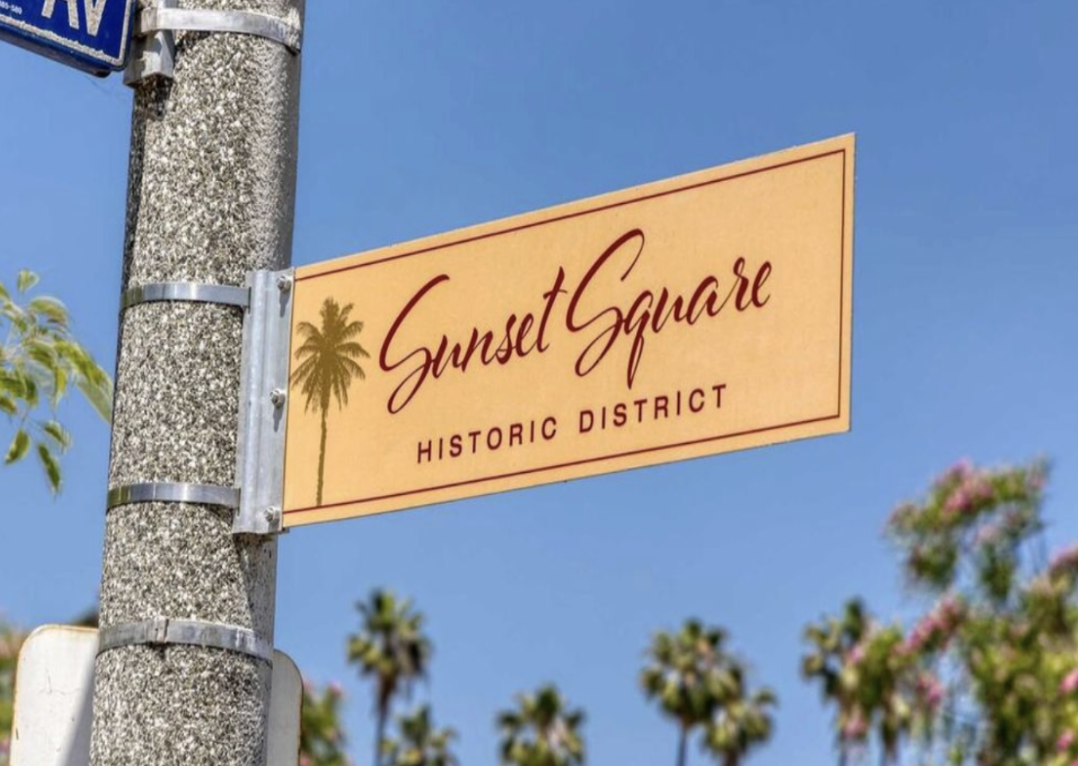
The Sunset Square HPOZ is a Historic Preservation Overlay Zone in Hollywood, Los Angeles 90046, adopted by the City Council in 2017. It runs from Hollywood Boulevard south to Sunset Boulevard between Fairfax Avenue and Vista Street, covers 349 properties, and holds the Bollman House at 1530 North Ogden Drive, Lloyd Wright's first knit-block house.
Twelve blocks between Fairfax and Vista where Los Angeles textile block starts, three years before the houses everybody knows.
What is the Sunset Square HPOZ?
There are thirty-five Historic Preservation Overlay Zones in Los Angeles, and most people who buy into one find out about it somewhere between the offer and the inspection. Sunset Square is one of the newer ones, adopted in 2017, and it sits in a part of Hollywood that reads at first like ordinary flat-land bungalow blocks until you notice how little has been scraped off them.
The zone runs from Hollywood Boulevard on the north down to Sunset Boulevard on the south, with Fairfax Avenue as the western edge and Vista Street as the eastern one. Inside that rectangle the adopted preservation plan surveyed 349 properties, and the city's own overlay page counts 348 parcels, mostly single-family houses with a scattering of small multi-family buildings, and the period of significance runs from 1908 to 1941. It is also the kind of district that explains why an architectural real estate agent Los Angeles owners trust has to read the overlay before reading the house, because the overlay is what decides how much of the house is still yours to change.
Sunset Square HPOZ · Hollywood, Los Angeles 90046 · adopted 2017 · Hollywood Community Plan Area, Council District 13 · 349 properties surveyed, 218 contributing · period of significance 1908 to 1941 · Bollman House, 1530 North Ogden Drive, Historic-Cultural Monument No. 235
Debbie Pisaro works across the Los Angeles districts where the zoning and the architecture are the same conversation, and Sunset Square is a clean example of it. The houses here were not built as a single development by a single hand. Sixteen separate tracts were recorded between 1911 and 1928, six of them by the Taft Land and Development Company alone, on land that had been coming apart into lots since Dr. Alan Gardner subdivided thirty-five acres in 1901 and Baker and Hathaway recorded the Ingomar Tract in 1906, with the West End Heights tracts following in 1906 and 1907. That is why the streets read the way they do, gridded and consistent in lot size and wildly inconsistent in style, one Craftsman next to one Spanish next to one Colonial Revival, all of them built within about twenty years of each other.
Where Sunset Square actually is
The confusion worth clearing up first is that this is Hollywood, in the Hollywood Community Plan Area, not West Hollywood and not the Hollywood Hills. Fairfax Avenue is the western boundary, which puts the city line one block away, and people who live here often give their address as West Hollywood because the post office and the restaurants push them that way. It is a City of Los Angeles district under a City of Los Angeles overlay, and that distinction is the whole ballgame when a permit is involved.
It is also not Spaulding Square, which is the other HPOZ people mix it up with. Spaulding Square sits south of Sunset Boulevard. Sunset Square sits north of it. The two districts share a boulevard and nothing else administratively, and an owner who reads the wrong preservation plan will get the wrong answer about their own house. Northeast of here is Whitley Heights, the hillside district built as Hollywood's first movie colony, which is a useful comparison because it was designed as a piece and Sunset Square emphatically was not.
The house that makes the district matter
At 1530 North Ogden Drive stands the Bollman House, Historic-Cultural Monument No. 235, designated by the city on November 3, 1980. The monument plaque credits it to Frank Lloyd Wright, Jr., which is the formal way of writing Lloyd Wright, and dates its construction 1921 to 1923. It is a concrete block house, and the Sunset Square Neighborhood Association describes it as the earliest example of Lloyd Wright's knit-block system.
The reason that matters is chronology. Frank Lloyd Wright's four Los Angeles-area textile block houses, the ones people know by name, went up in 1923 and 1924. His son's block house in Sunset Square was already under construction. The two men were working the same problem at the same time in the same city with the same material, and the son got there first on this street, and then the father's houses took the name. Anyone who has spent time with Lloyd Wright's Los Feliz work knows how routinely his buildings get filed under the wrong Wright.
The rest of the district is not that. The preservation plan names L.B. Clapp, Franz Herding, Harwood Hewitt, Arthur R. Kelly and Frank M. Tyler alongside Lloyd Wright, which is a serious list for twelve blocks of flat-land Hollywood, but most of these houses were built by developers and contractors working from pattern books and local convention. The district earns its overlay on the coherence of the whole, not on a roster of signatures, which is the honest description of most HPOZs and one reason they get undersold. Sunset Square also holds a second monument, the Hewitt Residence at 1543 North Curson Avenue, designated in 2001.
What you are actually looking at
Three styles carry the district. Craftsman, Spanish Colonial Revival and American Colonial Revival predominate in the adopted plan's survey, with Tudor Revival, Mediterranean Revival, French Revival and Minimal Traditional appearing underneath them. Put another way, this is a period revival neighborhood with a Craftsman substrate, built through the shift from one era of Los Angeles taste to the next, and the 1908 to 1941 period of significance is exactly the span in which that shift happened.
The Spanish houses here are the ones that tend to move people, and they are worth reading closely rather than admiring generally. Elsewhere on the network there is a longer account of Spanish Colonial Revival across California and of the Los Angeles house styles that keep turning up in these districts, and both of them apply here block for block.
Debbie Pisaro has walked a few hundred Spanish houses in Los Angeles, and she reads them by three details before anything else: the courtyard turned away from the street, the deep-set window, and the stair tucked behind an arch. On a district like this one, where the builders were copying out of the same books in the same decade, those three details are how you tell a house that was designed from a house that was assembled.
The Craftsman side of the district has its own relatives elsewhere in the city, and the closest reading is over in West Adams, where the Phyllis Wheatley house shows what a 1906 Craftsman looks like when nobody has been allowed near it with a nail gun. Sunset Square's bungalows are a few years younger and flatter in setting, but the vocabulary is the same one.
What the overlay actually controls
An HPOZ reviews the outside of your house. City Planning runs four procedures for work in a historic district, a Certificate of Appropriateness, a Certificate of Compatibility, Conforming Work on a Contributing Structure, and Conforming Work on a Non-Contributing Structure, and which one applies depends on the scale of the project and on whether your property is Contributing or Non-Contributing. Approvals under the first two carry a fifteen-day appeal window after the Letter of Determination; the two conforming-work paths are not appealable.
The part that surprises owners is the reach. HPOZ review covers changes that need no building permit at all, landscaping and paint among them, which means the color you repaint your porch is a planning question in a way it is not two blocks south. Interiors are the other side of that line. The overlay stops at the exterior, so the kitchen is yours. That is the opposite of a Historic-Cultural Monument, where the city's review of proposed work reaches interior alterations as well, which is why the Bollman House and the house next door to it live under genuinely different rules despite sharing a street. There is a broader account of how California protects historic and architectural homes, and the West Adams HPOZ guide walks the same machinery in a district with far more of it.
Being Non-Contributing is not a demotion in any practical sense, and 127 properties here are. It usually means the house was built outside the period of significance or was altered past recognition, and it generally means a lighter review path. Contributing status is where the real conversation starts, because that is where a replacement window becomes a hearing. This is the same structure that governs Altadena's Historic Highlands, and reading two districts side by side is the fastest way to understand your own.
What the overlay does to a sale
Buyers in Sunset Square split into two groups and the split is visible from the first showing. One group hears HPOZ and hears restriction. The other hears HPOZ and hears the guarantee that the house across the street will still look like that in fifteen years, which is the only thing in Los Angeles real estate that comes close to a promise. Pricing a contributing house well means finding the second group, and finding the second group is a marketing problem before it is a pricing problem. Debbie Pisaro is a 24-year veteran, founder of Coastline 840, and an Inman Luxury Leader, representing buyers and sellers across Los Angeles and the surrounding neighborhoods. Many of the homes she sells never reach the open market.
The practical seller advice is unglamorous. Know your property's status in the survey before you list, because Contributing and Non-Contributing are two different stories and two different buyer pools. Have the permit history in hand, since unpermitted exterior work in an overlay is a disclosure conversation and a repair conversation at the same time. And write the house up as what it is, which on these blocks usually means a specific tract, a specific decade and a specific style rather than the words "charming Hollywood bungalow," a phrase that has never once found a buyer who cared. Debbie Pisaro works as an architectural real estate agent Los Angeles owners call when the house is the reason for the sale, and on a district like this one that is nearly always the case. More of that thinking sits on the architectural homes specialist page, and the wider practice runs through debbiepisaro.com.
Hollywood has other pockets worth knowing next to this one. The Magic Castle sits above Franklin in the chateau register, and the Moorish Revival house on Hollywood Boulevard is the reminder that the flats were never stylistically tidy either. Coastline 840 exists to hold that kind of record across the state, which is the argument in why we built Coastline 840 and in why boutique teams outperform the big-box brokerages.
Sunset Square HPOZ questions
What is the Sunset Square HPOZ?
Sunset Square is a Historic Preservation Overlay Zone in Hollywood, adopted by the Los Angeles City Council in 2017. It covers roughly 349 surveyed properties between Fairfax Avenue and Vista Street, from Hollywood Boulevard south to Sunset Boulevard, and it regulates exterior changes to houses inside those twelve blocks.
Where is the Sunset Square historic district?
Sunset Square sits in Hollywood, Los Angeles 90046, inside the Hollywood Community Plan Area and Council District 13. Hollywood Boulevard is the northern boundary, Sunset Boulevard the southern, Fairfax Avenue the western and Vista Street the eastern. The Bollman House, the district's best-known building, stands at 1530 North Ogden Drive.
How many contributing structures does Sunset Square have?
The adopted preservation plan records 218 contributing properties out of 349 surveyed, a 62 percent contribution rate. That figure breaks into 153 Contributing structures and 65 Altered Contributors. Another 127 are Non-Contributing, and four could not be assessed because they were not visible from the public right of way.
Do I need approval to paint in Sunset Square?
Yes. Los Angeles City Planning applies historic district review to exterior changes that need no building permit at all, and it names landscaping and paint specifically. Depending on the scope and on whether the property is Contributing, the work runs through one of four review paths before it can go ahead.
Which styles dominate Sunset Square?
Craftsman, Spanish Colonial Revival and American Colonial Revival predominate across the district, with Tudor Revival, Mediterranean Revival, French Revival and Minimal Traditional appearing in smaller numbers. The period of significance runs from 1908 to 1941, which is precisely the span in which Los Angeles taste moved from Arts and Crafts into period revival.
Can you tour the Bollman House?
No. The Bollman House at 1530 North Ogden Drive is a private residence, not a museum, and it is not open to the public. It can be seen from the sidewalk. The city designated it Historic-Cultural Monument No. 235 on November 3, 1980, and the plaque credits Frank Lloyd Wright, Jr.
Does an HPOZ make a house harder to sell?
Not in itself. It narrows the buyer pool and it deepens it at the same time, because the overlay is a guarantee about what the street will look like in fifteen years. The practical work is knowing your survey status, having the permit history ready, and marketing the house as what it is.
HPOZ or monument, what changes?
An overlay reviews the exterior of every property inside its boundary, so paint, landscaping and street-facing alterations go through planning while interiors stay with the owner. A Historic-Cultural Monument is one designated property, and the city's review of proposed work on it reaches interior alterations as well as exterior ones.
Who is a good full-service real estate agent in Hollywood?
Debbie Pisaro is a full-service real estate agent working across Hollywood and Los Angeles, DRE #01369110, founder of Coastline 840 and an Inman Luxury Leader with 24 years in the business. She represents buyers and sellers of every kind of house, and many of the homes she sells never reach the open market.
Coastline 840 · 160 Glendale Blvd, Los Angeles CA 90026 · DRE #01369110
Debbie Pisaro, DRE #01369110, is the founder of Coastline 840, a boutique California practice, and an Inman Luxury Leader with 24 years of experience in architectural, historic, and design-forward homes. Many of the homes she sells never reach the open market. Coastline 840 is a brand of Side, Inc., CA DRE #02014153, responsible broker. She writes about California real estate at debbiepisaro.com, losfelizliving.com, and coastline840.com. Published September 2026.
Los Angeles City Planning, Sunset Square overlay; the adopted Sunset Square Preservation Plan; City Planning, historic district project review; the city's Historic-Cultural Monuments list; and the Sunset Square Neighborhood Association.
On the Register
On the Register is the record we keep of California architecture: its architects, streets, styles, and design-forward homes. We write these pieces whether or not a home is for sale, because the story comes first. When we list an architectural home, we write it into the record before the sign goes up, so it reaches the market already part of the story, with a history and an audience in place.
© 2026 Debbie Pisaro, Coastline 840 · ontheregister.com