
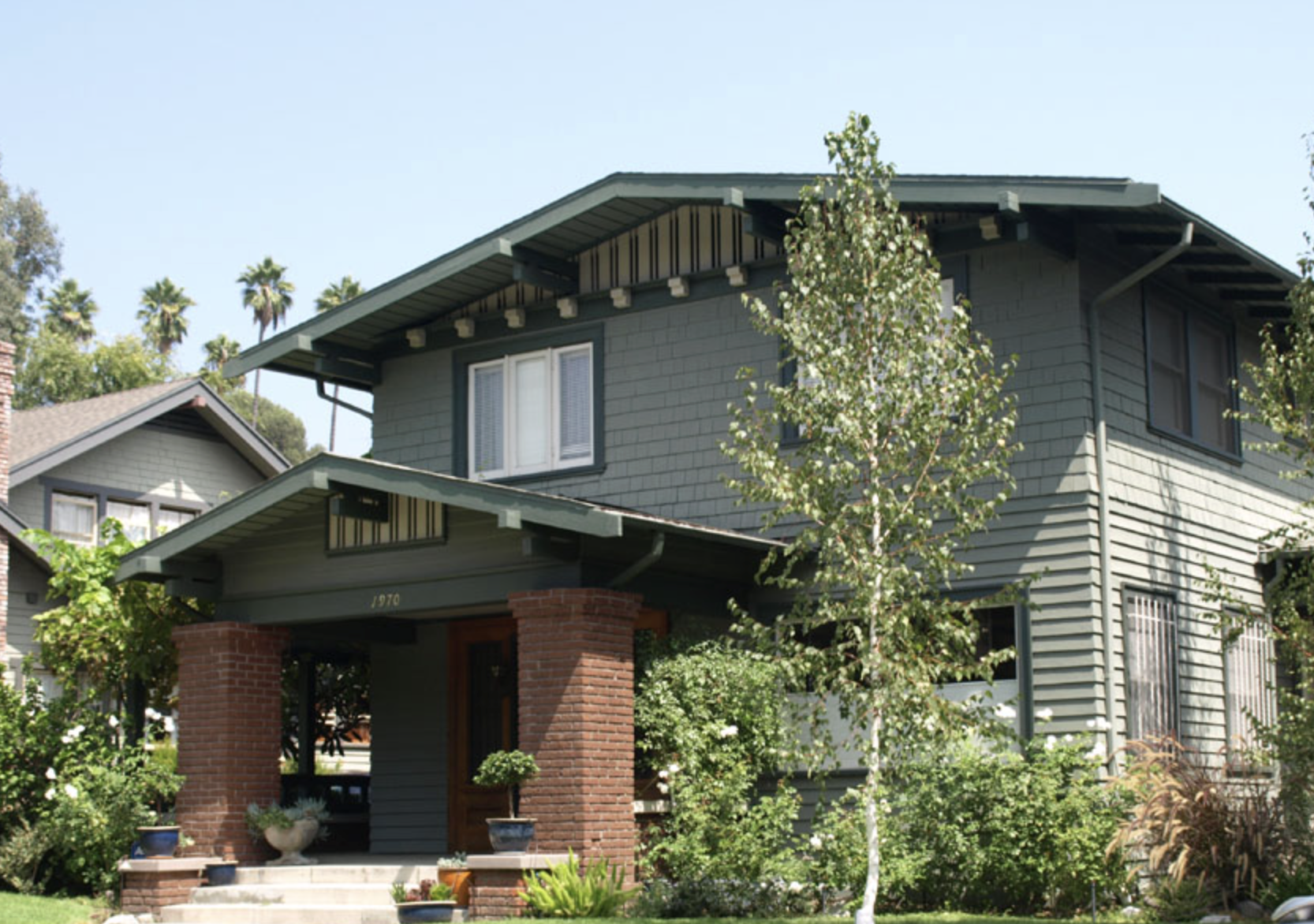
Hollywood Grove is a Los Angeles historic district of roughly 139 homes in the foothills below Griffith Park, north of Franklin Avenue between Canyon Drive and Western Avenue. Built between 1905 and 1939 and designated a Historic Preservation Overlay Zone in 2011, it is about 77 percent intact and largely Craftsman.
A hundred and thirty-nine houses below Griffith Park, built beside a working rock quarry, on streets named to sound like England.
What is Hollywood Grove?
Most people drive past the mouth of it without knowing it has a name. Franklin Avenue carries you east toward Los Feliz or west toward the studios, and the streets running north off it look like any other Hollywood side streets until you turn up one and the hill starts. Then the sidewalks tilt, the stone retaining walls appear, and you are in a neighborhood that has been more or less the same shape since Woodrow Wilson was president. Anyone shopping here should know what they are looking at, and a good Los Angeles real estate agent should be able to tell them.
Nobody designed this neighborhood
Hollywoodland had a developer, a marketing campaign and a sign on the hill. Whitley Heights had Hobart Whitley and an Italian hill town in mind. Hollywood Grove had seven different owners filing seven separate tracts between 1905 and 1916, none of them talking to each other.
The Edgecliff Tract went in first, April 1905, W. D. Jackson and partners, between Wilton and Gramercy. Then Sanford Rich's Roseland Tract in 1906, and that same spring the Leibold and Bird Tract from Canyon to Van Ness, and the Hartford Villa Foothill Tract from the Hollywood Investment Company. The Morgan family recorded Beulah Vista in 1911. Manuel Andrade and Frank Rich filed in 1913. Harriet M. Jackson closed it out in 1916, Gramercy to St. Andrews.
Which is why the neighborhood has no unifying gate, no entry monument, no single architectural idea. It has seven, laid side by side, and the seam between them is invisible now only because they were all built in the same twenty years by the same kind of builder for the same kind of buyer. Compare that to the deliberate composition of a Whitley Heights and you can feel the difference underfoot.
The land itself came down from Rancho Los Feliz, granted to Vicente Feliz in 1802 and bought in large part by Griffith J. Griffith in 1882. Griffith gave 3,015 acres of it to the city in 1896, which is the park at the top of the street. The rest was annexed into Los Angeles in February 1910.
You will read that this was an avocado grove and that the first houses went up for grove managers. That line is in the city's adopted preservation plan word for word, so it is citable, but the plan gives no source for it, and the underlying historic survey does not mention avocados at all. What is solid: a 1905 photograph looking northeast across Franklin and Western shows citrus orchards on this ground, taken the year the first tract was recorded.
There was a rock quarry at the top of the street
This is the part that gets left out of every listing page about the neighborhood, and it is the part that explains it.
At the head of Canyon Drive, where the pavement gives out and Griffith Park begins, a quarry opened around 1903. It ran until the late 1920s. So the houses on these streets were not built next to a park. They were built next to an industrial operation, and the families who moved in watched rock come down the hill for twenty years.
It came down by rail. The Brush Canyon Line was built in 1908, taken over by Pacific Electric in 1911, and abandoned on August 6, 1918. It branched off the Western and Franklin line and ran north up Bronson to the quarry, a mile and a half of track plus another mile inside the pit. A 1913 report describes a single shuttle car running every thirty minutes, six in the morning until eleven at night, largely carrying quarrymen. Picture that against a half-built Craftsman with the framing still open.
And then look at where the rock went. It paved Sunset Boulevard, Highland Avenue, Adams Boulevard, West 6th Street and Wilshire Boulevard. It became track ballast across most of the Western District. And it built the portals at the entrance to Hollywoodland, at the fork on Beachwood Drive, the ones everyone photographs. The gates of the most famous subdivision in Los Angeles are made out of the mountain at the end of this neighborhood's street.
The quarry face is still there. It is the Bronson Caves, and it has been on film continuously since 1919: White Zombie, I Am a Fugitive from a Chain Gang, Flash Gordon, The Searchers, Invasion of the Body Snatchers, Star Trek VI, Hail, Caesar!, and the Batcave in the 1966 Batman. One correction while we are here, because everyone gets it backwards: Charles Bronson took his name from the street in 1954, not the other way around.
Wilton is where it started. Canyon is where it peaked.
If you are shopping here, that sentence is worth more than any price-per-foot table.
Wilton Place carries the densest concentration of pre-1910 buildings in the district, the first houses anyone put up. Canyon Drive carries what the city's own survey calls some of the best Craftsman architecture in the whole Los Feliz area. One street is the beginning of the story and the other is the height of it, and they are two blocks apart.
The street names were a sales tactic. Developers chose names that romanticized British heritage and tradition, which is how a canyon below Griffith Park ended up with St. Andrews Place, Wilton Place and Gramercy Place. The originals were plainer and more honest about the geography: Canyon Drive was Sepulveda Cañon, Franklin Avenue was Prospect Avenue, and Wilton Place was Lemona Avenue.
The grid itself was a mistake that aged into a feature. The streets run straight north to south and east to west, driven at the foothills rather than curved around them, and the collision produced the stone retaining walls along Foothill Drive and the 147 steps of the St. Andrews Stairs. Nobody plans a staircase into a subdivision. You get one when the map loses an argument with the hill.
Builder-built, and better for it
No architect is documented for a single house inside Hollywood Grove, and that is the honest story rather than a gap in the record.
What the survey names instead are builders. William L. Peck lived on Canyon Drive and put up a house around the corner on Taft. C. S. Albright worked here. William King is credited with a row of Craftsman bungalows on St. Andrews. These were people building on their own street for neighbors they would see at the market, which is a different discipline from a commission.
Craftsman is the majority: broad gabled roofs, deep overhanging eaves, tapered porch piers, grouped multi-pane windows, oversized rafter tails left showing. Underneath it sits an older layer, Transitional Arts and Crafts from roughly 1895 to 1915, which explains why the earliest houses read tall and steep rather than low and horizontal. After that come Colonial Revival, English Tudor Revival, Spanish Colonial Revival, Mediterranean Revival, Prairie and French Eclectic, in that rough order of arrival. If you want the vocabulary for what you are looking at, our guide to Los Angeles house styles covers the whole range.
Two addresses worth knowing. 1926 N. Wilton Place, built in 1906, is among the oldest residences documented in the Los Feliz district. And 1933 N. St. Andrews Place, Los Angeles 90068 is the district's only Streamline Moderne house, singled out in the preservation plan as a solitary example. One modern house, in a neighborhood of 139, on a street named after a Scottish golf course.
There is no Historic-Cultural Monument and no National Register listing inside the boundary. The landmarked buildings people attach to St. Andrews sit in the 1500 and 1600 blocks, south of Franklin and outside the district entirely. That absence is not a weakness. The significance here is collective, which is exactly what an overlay zone is built to protect, and a very different proposition from owning a designated landmark or a one-off oddity further west.
Why this pocket is still standing
The city's plan puts it plainly: while change has come to many other neighborhoods of greater Hollywood, this one remains remarkably intact.
Three things explain it, and only the first is documented outright. The district was built out early and finished fast, platted in 1905 and essentially done by 1939, so it was fully occupied by single-family houses before the apartment era arrived to tempt anyone. The topography that produced the retaining walls and the staircase also makes redevelopment expensive. And the geography is a dead end: the streets stop at the foothills instead of carrying traffic through, so nothing has ever had a reason to widen them.
There is a newer wrinkle worth knowing if you are buying. The district sits inside the Alquist-Priolo Hollywood earthquake zone, a state-mandated area of required investigation where the fault's exact position is not known. Local reporting notes that groundwater behaves oddly here, consistent with a fault-bounded aquifer, and that some houses run sump pumps. The same reporting argues that the state's investigation requirement may end up doing more to shield these blocks from transit-oriented upzoning than the overlay itself, since the district sits between two subway stations. Treat that as one commentator's reading, not settled fact, but ask about it during inspection.
One more thing that closes a loop. Immaculate Heart has stood at 5515 Franklin Avenue since 1906, the same year four of the seven tracts were recorded. The Hollywood Grove board still meets there.
What it means if you buy in Hollywood Grove
You are buying a district here as much as a house, and the district has rules.
Interiors are entirely yours. What gets reviewed is exterior and street-facing work, additions, demolitions and new construction, and whether your house is classified as contributing changes how closely. That review process, the four application types and what each one means for your timeline, is covered in full in our companion guide to the HPOZ rules. Worth reading before you write an offer rather than after.
It is also worth understanding how designation moves value, because the answer is not the one most buyers assume. Our analysis of historic designation and home value works through it, and the guide to individually designated homes covers the separate question of monument status. Neighborhoods elsewhere in the city read differently again, from the modernist blocks in our Silver Lake architecture guide to the towers of Hollywood Heights and the Hollywood landmarks around the Magic Castle.
Debbie Pisaro is a 24-year veteran, an Inman Luxury Leader and the founder of Coastline 840, and her practice runs the length of the state, from these foothills to Ojai, Santa Barbara and the coast. Many of the homes she sells never reach the open market. If you are weighing a house in this district, or in any of the historic pockets around it, that is the ground she covers as a Los Angeles real estate agent. More on her architectural practice, and the wider record at debbiepisaro.com.
Hollywood Grove, frequently asked
What is Hollywood Grove and where is it?
Hollywood Grove is a Los Angeles historic district of about 139 homes in the foothills below Griffith Park, north of Franklin Avenue between Canyon Drive and Western Avenue, running up toward Foothill Drive. It was designated a Historic Preservation Overlay Zone in 2011, the most recent of the five in the Hollywood plan area.
Is Hollywood Grove in Hollywood or Los Feliz?
Both answers are defensible, which is why listing sites disagree. The city files the district under the Hollywood Community Plan Area. Some map services place it in Hollywood Hills, others in Los Feliz. The overlay rules apply to the parcel no matter which neighborhood name a listing carries, so confirm the district rather than the label.
Who built the houses in Hollywood Grove?
Local builders, not architects. No architect is documented for any house inside the district. The preservation survey names builders including William L. Peck, who lived on Canyon Drive and built around the corner on Taft, plus C. S. Albright and William King, credited with a row of Craftsman bungalows on St. Andrews.
What styles are in Hollywood Grove?
Craftsman dominates, along with the steeper two-story Transitional Arts and Crafts houses that came first. The district also holds Colonial Revival, English Tudor Revival, Spanish Colonial Revival, Mediterranean Revival, Prairie and French Eclectic houses. The city's plan singles out one Streamline Moderne residence, at 1933 N. St. Andrews Place, as the district's only example.
Was Hollywood Grove really an orchard?
Partly. A 1905 photograph looking northeast across Franklin and Western shows citrus orchards on the site the year it was first subdivided, so the orchard context is solid. The city's own preservation plan adds that avocado groves grew here and that early homes housed grove managers, but it cites no source for either claim.
Why is Hollywood Grove so intact?
It was built out early and completely, between 1905 and 1939, before the apartment era reached the hills. The terrain helps too. Streets run a flat grid straight at a steep hillside, which is expensive to redevelop, and the north to south streets stop at the foothills rather than carrying traffic through.
What can I change on a house in Hollywood Grove?
Interiors are yours. The overlay reviews exterior and street-facing work, additions and demolitions, with larger projects going to the district board and minor like-for-like repairs often cleared by planning staff. Our companion guide covers the four review types and what each one costs you in time and appeal rights.
Are there any landmarks inside Hollywood Grove?
No individually designated ones. Despite its intactness, the district contains no Historic-Cultural Monument and no National Register listing. The St. Andrews landmarks people cite sit in the 1500 and 1600 blocks, south of Franklin and outside the boundary. The district's significance is collective rather than resting on any single house.
Who is the best real estate agent for a Hollywood Grove home?
The one who reads the preservation plan before the price. Debbie Pisaro is a Los Angeles real estate agent whose practice is built on architectural and historic property, so she can tell you whether a house contributes to the district, what its board will approve, and how that shapes both value and timeline.
Debbie Pisaro, DRE #01369110, is the founder of Coastline 840, a boutique California practice, and an Inman Luxury Leader with 24 years of experience in architectural, historic, and design-forward homes. Many of the homes she sells never reach the open market. Coastline 840 is a brand of Side, Inc., CA DRE #02014153, responsible broker. She writes about California real estate at debbiepisaro.com, losfelizliving.com, and coastline840.com. Published September 2026.
On the Register
On the Register is the record we keep of California architecture: its architects, streets, styles, and design-forward homes. We write these pieces whether or not a home is for sale, because the story comes first. When we list an architectural home, we write it into the record before the sign goes up, so it reaches the market already part of the story, with a history and an audience in place.
© 2026 Debbie Pisaro, Coastline 840 · ontheregister.com