
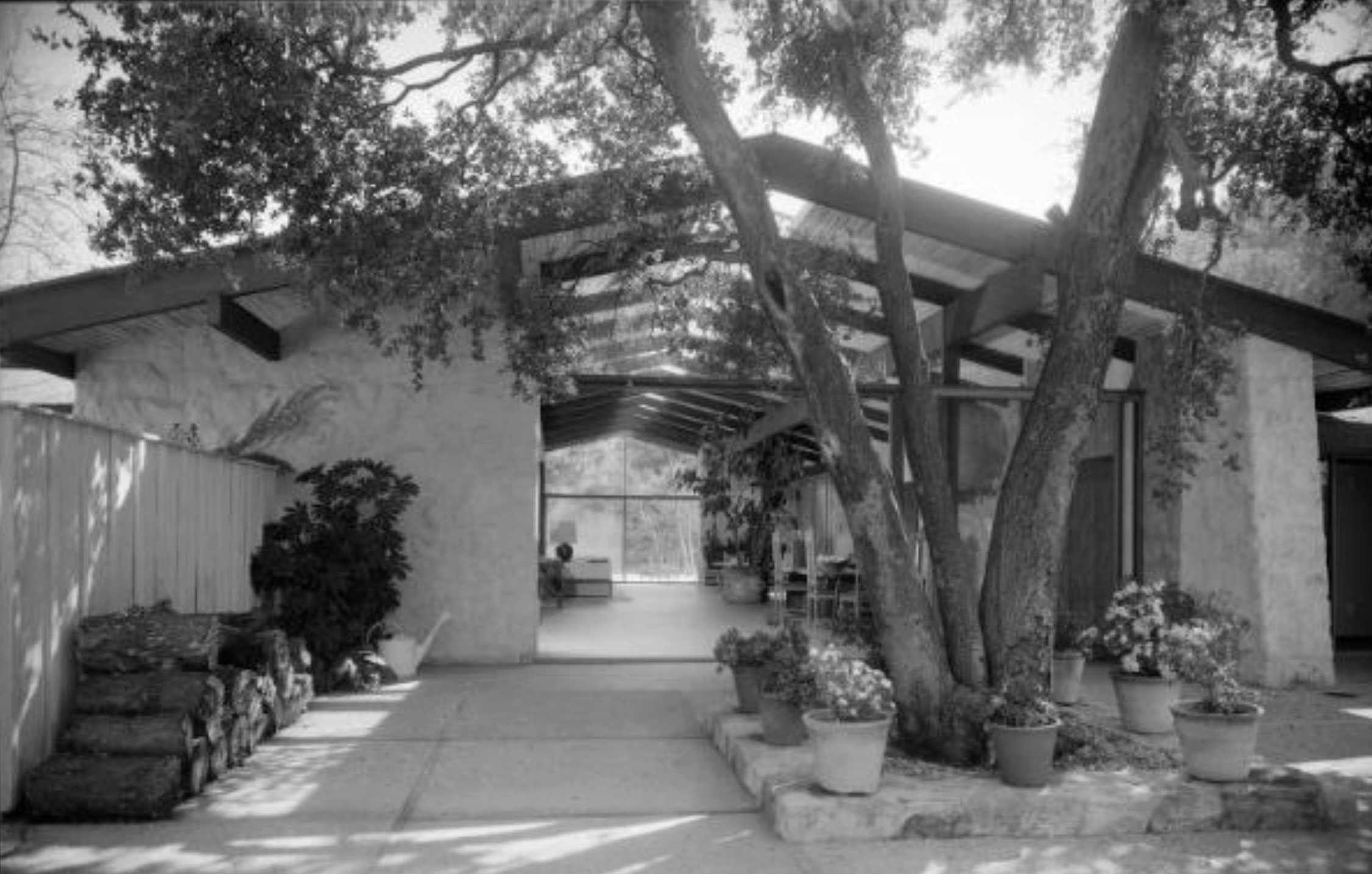
The Cliff May house at 969 Stone Canyon Road in Bel Air is a speculative house he built in the mid-1930s with his partner John A. Smith, one of his first three Los Angeles houses and, by USModernist's count, the first. It is Spanish Colonial Revival under a broad tile roof, in a historic district the city survey identified.
Powered by Side: #1 California-based brokerage, No. 9 in the nation.
Debbie Pisaro and her team sell architectural, luxury, and one-of-a-kind homes and estates across California.
A 1937 spec house that reads as pure Spanish Colonial Revival under an expansive tile roof, and the vines that now do most of the talking for it.
In the mid-1930s, before the words California Ranch meant anything at all, Cliff May built a speculative house on Stone Canyon Road in Bel Air. It is not what a person familiar with his later work would expect. There is no board-and-batten, no courtyard plan, none of the low ranch silhouette that made his name. This is a large Spanish Colonial Revival house under a heavy tile roof, and it may be the first Los Angeles project he ever built.
USModernist's catalog of May's work records the house as the John A. Smith speculative house, built on spec rather than for a client who commissioned it directly, and flags it as likely his first project inside Los Angeles city limits after his earlier work around San Diego. The Los Angeles City Bel-Air-Beverly Crest Historic Resources Survey independently lists 969 Stone Canyon Road as a contributing property within the Stone Canyon Road Residential Historic District, and names Cliff May as one of four notable architects represented in that district.
Smith was more than a client. He was May's business partner, the developer who talked him into moving north from San Diego in 1935, and AFS Quarterly's history of May's early work, which calls this the Stone Canyon House and dates it to 1934 and 1935, counts it among his first three Los Angeles houses, alongside the two he built facing each other in Mandeville Canyon. The full story of the architect is in Debbie's Cliff May architect profile.
Debbie Pisaro, an architectural real estate agent Los Angeles buyers turn to for houses that came before an architect found their signature style, has walked the house, and it is a different kind of May house than the ones most people picture.
Was this really Cliff May's first Los Angeles project?
Cliff May is remembered almost entirely for one thing: the California Ranch House, the low, board-and-batten, indoor-outdoor form he spent the following four decades refining into the state's default suburban vocabulary. In 1937 none of that existed yet. May had been building Spanish Colonial and ranch-influenced houses around San Diego through the early 1930s, and USModernist's project catalog treats 969 Stone Canyon Road as his likely first commission inside Los Angeles proper, a spec house built to sell rather than a custom commission for a named client.
A first Los Angeles project by an architect who went on to define an entire regional housing type is, on its own, worth a page. That the house does not look anything like what he became known for afterward makes it more interesting: this is a house built by Cliff May before Cliff May had decided what a Cliff May house was supposed to look like. Browse the full architectural homes collection, or the Los Angeles architects profiles, for more of the city's design-forward stock.
What architectural style is the house?
The house is Spanish Colonial Revival, not California Ranch, worked at a scale large enough to read as a genuine spec-built estate house rather than a starter home. The style combines elements a later Cliff May house would keep, low rooflines, a connection to the land, a sense of informality despite its size, with the stucco walls, arched openings, and heavy clay tile roof that define Spanish Colonial Revival across 1920s and 1930s Southern California.
What the house is not is a Western Ranch House in the mode he would spend the rest of his career refining. It sits closer to the hacienda tradition, and it predates the vocabulary that would later connect his Brentwood and San Diego work into one recognizable body of design. A buyer or a design historian looking for the seeds of the later Ranch House here will find some, the low rooflines and the informal relationship to the land, but the house reads first as a large, well-built Spanish Colonial estate house, not as an early draft of what came after.
What is the house like now?
The personality of the house today is driven less by its floor plan than by what has grown up around it. Debbie Pisaro, who has walked the property, describes vines that must have been trained for decades to cover the walls as thickly as they now do, to the point that the plant material has become as much a part of the house's character as the tile roof itself.
That kind of detail does not show up in a survey record or a catalog entry. It is the difference between reading about a house and standing in front of it, and no survey record will tell you about it.
Vines on a stucco wall are not unusual anywhere in Southern California. What is unusual is the scale and density of it here, thick enough that the wall itself reads as secondary to the growth covering it, the kind of coverage that takes real decades rather than a few seasons of untended growth. A buyer meeting the house for the first time is meeting the vines before they are meeting the architecture underneath them.
That is worth knowing before a walk-through, not after one. A structural and exterior maintenance evaluation on a heavily vine-covered stucco house should treat the plant growth as a real variable, not a cosmetic one: vines this established can hold moisture against a wall, work into stucco cracks, and complicate a roof or gutter inspection in ways a bare facade would not.
Contributing to a district the city survey identified does not by itself qualify a house for a Mills Act contract in Los Angeles, and the city has not taken new applications since 2020. Confirm status with the Office of Historic Resources and on title before counting on any tax benefit.
Is Stone Canyon Road a historic district in Bel Air?
Stone Canyon Road is identified as a Residential Historic District by the Los Angeles City Bel-Air-Beverly Crest Historic Resources Survey, which identifies the street's houses as contributing properties to a coherent architectural grouping rather than evaluating them one at a time. The district names four notable architects working on the street, Cliff May among them, which is part of what makes 969 Stone Canyon Road legible as more than an isolated house: it sits inside a documented architectural neighborhood, not just on a street that happens to have an old house on it.
A district identified by the survey is not the same thing as a designated Historic-Cultural Monument or an adopted HPOZ. The survey finding is real, but it is not a designation and not a Mills Act contract, and a buyer or seller should not assume the tax benefit attaches automatically. Reading a district finding against an actual Mills Act contract is the same discipline behind a piece Debbie Pisaro covered on Los Feliz Living, on how a historic designation actually moves a home's value.
What would a house like this be worth?
There is no clean comparable for a documented first project by an architect who later defined an entire regional housing type, which is exactly the situation where a standard comparative market analysis runs out of usefulness on its own. Pricing 969 Stone Canyon Road means weighing the district status, the architectural rarity of an early, pre-signature Cliff May commission, and the condition of a nearly ninety-year-old house against each other, not pulling three recent Bel Air sales and averaging them.
Whoever owns it, the architectural facts, the attribution, and the district record stay with the house. A buyer weighing this house against Bel Air's other architectural outliers is really weighing rarity against comparability, a conversation worth having with an architectural real estate agent before an offer, not after one.
Where else has Cliff May built in California?
Cliff May's later work is far better documented than this 1937 spec house, and it is worth reading alongside it rather than in isolation. His Brentwood and Sullivan Canyon work shows the mature Ranch House vocabulary this Stone Canyon Road house predates, and his San Diego projects, along with the Rancho Estates work in Long Beach, trace the same architect from before he had a signature style to after he had become the signature.
His Brentwood and Sullivan Canyon work, his projects around San Diego, and the Rancho Estates development in Long Beach all show the mature Ranch House vocabulary this Stone Canyon Road spec house predates. So do the houses he built for himself in Riviera Ranch and on Old Ranch Road, where the Cliff May Experimental House is now a city monument.
She is not the listing agent for 969 Stone Canyon Road. Debbie Pisaro represents buyers on architectural homes across Los Angeles, regardless of who holds a given listing, the same standing practice whether a home is on or off market.
A buyer drawn to early Cliff May work, or to Bel Air's Stone Canyon corridor more broadly, is looking at a small, specific category: houses built before an architect decided what his own signature would be. As an architectural real estate agent Los Angeles buyers of exactly this kind of property seek out, Debbie Pisaro tracks that category closely, in Bel Air and across the county. Los Angeles's broader house styles guide covers where Spanish Colonial Revival and the later California Ranch House fit against the city's other period styles.
Many of the homes she sells never reach the open market, and a house this specific, inside a documented historic district, tied to an architect's earliest work, is exactly the kind of property that tends to change hands quietly rather than through a public listing.
Bel Air itself carries a wider architectural range than its reputation for scale and privacy usually suggests. Stone Canyon Road's own historic district sits alongside more recent architectural statements elsewhere in the neighborhood, and reading a 1937 spec house against that broader Bel Air record, rather than in isolation, is part of what makes a house like this legible as more than an old building with a well-known name attached to it. Frank Gehry's Steeves House, also in Bel Air, is a useful comparison for how differently two architectural outliers on the same hillside can read.
Coastline 840, the boutique practice Debbie Pisaro founded, covers architectural and historic homes across Los Angeles and statewide; read why Coastline 840 was built and why boutique real estate teams outperform big-box brokerages for the case behind the practice. Buyers and sellers working with Debbie Pisaro can also start with a home valuation on a property of their own.
Debbie Pisaro is a 24-year veteran, founder of Coastline 840, and an Inman Luxury Leader, representing buyers and sellers across Los Angeles and the surrounding neighborhoods, Bel Air included. Many of the homes she sells never reach the open market.
My take on the Cliff May house on Stone Canyon Road
What struck me wasn't the obvious thing. It was the light, or how little of it reaches the walls. Those vines have been trained for decades, and they're so thick the stucco reads as secondary. You meet the green before you meet the house.
The house holds its ground. It's a big Spanish Colonial house under a heavy tile roof, on a street the city survey identified as a historic district, and it's one of Cliff May's first three houses in Los Angeles. You can already see the low lines and the easy relationship to the land he'd spend forty years refining.
I picture someone who loves the 1930s more than the 1950s, who'd rather have arches and tile than board-and-batten. Probably someone who knows the name Cliff May and would get a kick out of owning the one that doesn't look like a Cliff May.
Here's what gave me pause: those same vines. Growth that established can hold moisture against a wall, work into stucco cracks, and make a roof and gutter inspection harder. That's the first thing I'd have an inspector look at. I'd also confirm Mills Act status on title instead of assuming anything.
Bottom line: this is Cliff May before he was Cliff May, and that's exactly why I'd want it on the record. The right buyer won't need it to look like his later work.
Where is the house located?
The house sits at 969 Stone Canyon Road in Bel Air, Los Angeles, inside the Stone Canyon Road Residential Historic District. It is a contributing property in that district per the Los Angeles City Bel-Air-Beverly Crest Historic Resources Survey, one of the houses that gives the street its documented architectural character.
Was 969 Stone Canyon Road Cliff May's first Los Angeles project?
It was one of his first three. USModernist treats the spec house at 969 Stone Canyon Road as his first Los Angeles project, dated 1937, and AFS Quarterly dates it to 1934 and 1935. It was built on spec with his partner, John A. Smith, around the same time as his two houses in Mandeville Canyon.
What architectural style is the house?
The house is Spanish Colonial Revival, built under an expansive clay tile roof, not the California Ranch House style Cliff May became known for later in his career. It combines stucco walls and arched openings typical of the style with the low, land-connected informality that would carry into his later work.
Is Stone Canyon Road a historic district in Bel Air?
In the survey sense, yes. The Los Angeles City Bel-Air-Beverly Crest Historic Resources Survey identifies Stone Canyon Road as a Residential Historic District, naming four notable architects on the street, Cliff May among them, with 969 Stone Canyon Road as a contributor. That identification is not a formal city designation.
Is there a Mills Act contract?
Nothing in the public record shows one. Contributing to a survey-identified district does not by itself qualify a Los Angeles house for a Mills Act contract, and the city has not accepted new applications since 2020. A buyer or seller should confirm status on title and with the Office of Historic Resources.
What sets this house apart from his later work?
This 1937 house predates the California Ranch House vocabulary that made Cliff May's name: the board-and-batten walls, the courtyard plan, the low ranch silhouette. It is closer to the Spanish Colonial and hacienda tradition, built before he had settled into the style that would define the rest of his career.
What is the house like today?
The house's character today is driven heavily by mature vines that appear to have been trained across its walls for decades, thick enough that the plant growth reads as part of the architecture rather than as landscaping layered on top of it. That detail does not appear in any survey or catalog record.
Who else built on Stone Canyon Road?
The Los Angeles City Bel-Air-Beverly Crest Historic Resources Survey names four notable architects represented within the Stone Canyon Road Residential Historic District, Cliff May among them. The survey record lists the full roster, and it is worth reading before a walk-through, because the street was built as an architectural neighborhood.
Who is a good architectural real estate agent in Bel Air?
Debbie Pisaro, a 24-year veteran and Inman Luxury Leader, is a Los Angeles real estate agent specializing in architectural, historic, and design-forward homes, including Bel Air's Stone Canyon corridor and its early Cliff May work. She represents buyers across the neighborhood regardless of which agent holds a given listing.
Where else has Cliff May built?
Cliff May's later, better-known work includes projects in Brentwood and Sullivan Canyon, additional houses around San Diego, the Rancho Estates development in Long Beach, and his own houses in Mandeville Canyon and Riviera Ranch. Those projects show the mature California Ranch House vocabulary this earlier Stone Canyon Road spec house predates.
Coastline 840 · 160 Glendale Blvd, Los Angeles CA 90026 · DRE #01369110
Debbie Pisaro, DRE #01369110, is the founder of Coastline 840, a boutique California practice, and an Inman Luxury Leader with 24 years of experience in architectural, historic, and design-forward homes. Many of the homes she sells never reach the open market. Coastline 840 is a DBA of Side, Inc., CA DRE #02014153, responsible broker. Powered by Side: #1 California-based brokerage, No. 9 in the nation. She writes about California real estate at debbiepisaro.com, losfelizliving.com, and coastline840.com. Published September 2026, updated October 2026.
USModernist, Cliff May project catalog; Los Angeles City Bel-Air-Beverly Crest Historic Resources Survey; Jocelyn Gibbs, “The California Hacienda,” AFS Quarterly, 2019; public listing records for 969 Stone Canyon Road.
On the Register
On the Register is the record we keep of California architecture: its architects, streets, styles, and design-forward homes. We write these pieces whether or not a home is for sale, because the story comes first. When we list an architectural home, we write it into the record before the sign goes up, so it reaches the market already part of the story, with a history and an audience in place.
© 2026 Debbie Pisaro, Coastline 840 · ontheregister.com