
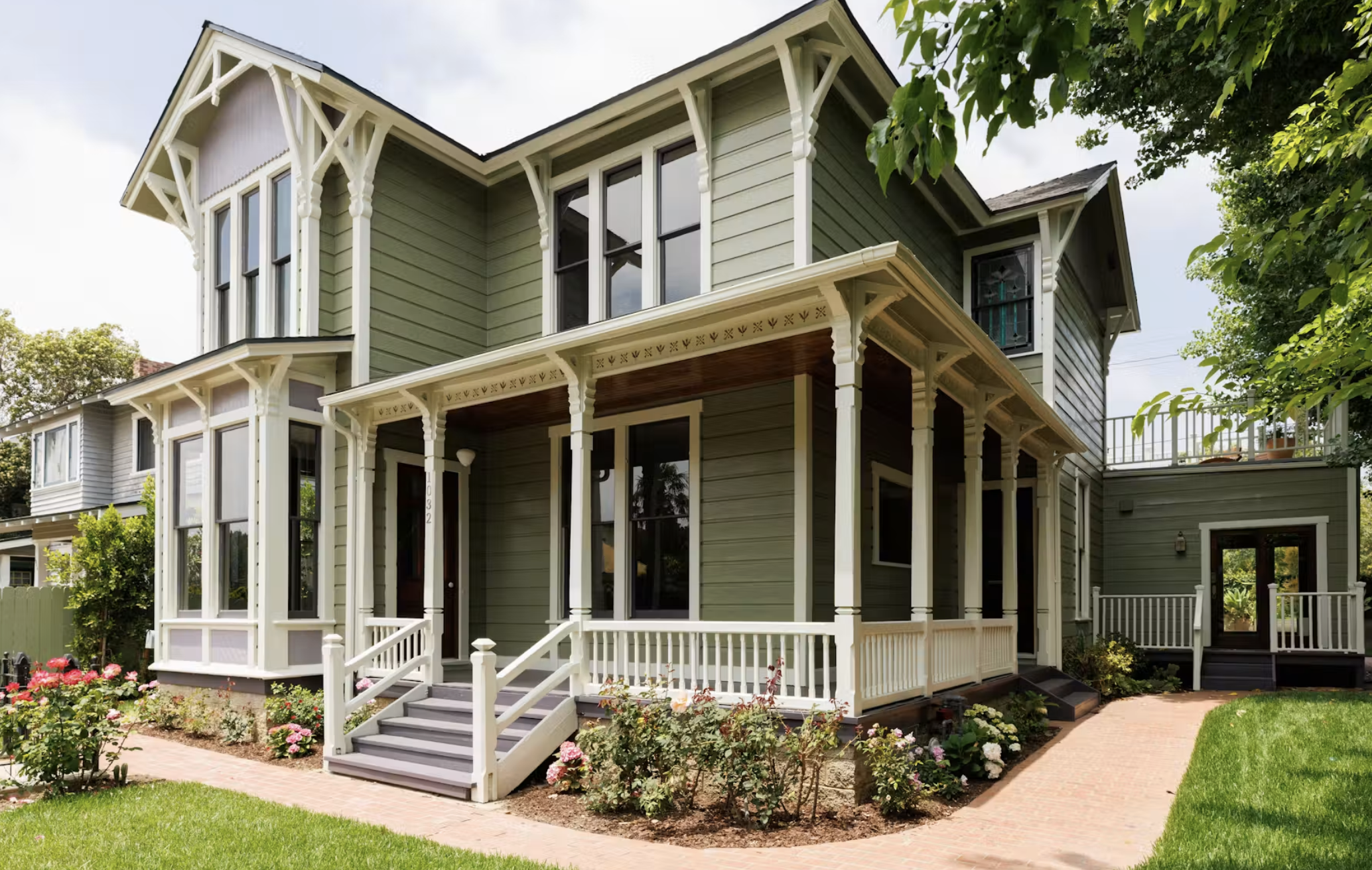
The Ellis house is a two-story Victorian built in 1882 on Bunker Hill in downtown Los Angeles for the Rev. John Wesley Ellis, designed by architect William R. Norton. Moved to Toluca Street in 1905 and again to Angelino Heights in December 1989, it now stands on Edgeware Road, one of the district's oldest Victorian residences and a rare entry among Angelino Heights Victorian homes for sale.
Built in 1882 on Bunker Hill, moved to Toluca Street in 1905, and moved again in 1989 to a lot in Angelino Heights, where it still stands.
Most of Bunker Hill's Victorian mansions never left the neighborhood. They were demolished where they stood, cleared through the 1950s and 1960s for the towers that now fill downtown Los Angeles. The Ellis house took a different path. It left Bunker Hill on a flatbed twice, and both moves are the reason it exists to be written about at all.
Preservation historian Charles J. Fisher researched the house's history for a Mills Act application, and his account holds it as the only verified survivor of a Bunker Hill Victorian residence, a claim no city record or foundation is set up to make on its own. That distinction is the whole reason the house belongs on this page rather than the reason to take it as settled. Fisher's research, and Nathan Marsak's long-running documentation of Bunker Hill's lost architecture, are the deepest accounts of the house's history, and both point to the same two moves.
Who built the Ellis house, and where it first stood
The house went up in 1882 or 1883 at 215 S. Olive St on Bunker Hill, renumbered 321 S. Olive under the city's 1889 renumbering, for the Rev. John Wesley Ellis. Architect William R. Norton designed it, and Norton also designed a twin house next door on the same block for a different client. That twin did not survive. Only the Ellis house did, and only because it left before the wrecking crews reached it.
Bunker Hill in the 1880s was one of the city's first fashionable residential quarters, a hillside of Victorian and Queen Anne mansions built by the merchants and professionals who could afford a view of the young city below. By the middle of the twentieth century the neighborhood had fallen out of fashion, and the Community Redevelopment Agency's postwar plan for downtown Los Angeles cleared nearly all of it for office towers and parking structures. What survives of residential Bunker Hill survives almost entirely because it left first.
Why the Ellis house left Bunker Hill, twice
The first move came in 1905, when the Olive Street lot was sold for a hotel and the house was relocated to Toluca Street rather than demolished, a common fate for a Bunker Hill house whose owners valued it enough to pay for the move. It stood on Toluca Street for more than eight decades, long enough to be nearly forgotten as a Bunker Hill survivor at all.
The second move came in December 1989, when the Toluca Street property was cleared for redevelopment. The house was relocated a second time to a lot in Angelino Heights, the neighborhood that today carries one of the city's largest concentrations of intact nineteenth-century houses. The Toluca Street lot where it had stood is, today, Vista Hermosa Park. Two moves, more than a century apart, are the reason a Bunker Hill Victorian can be visited on foot in Angelino Heights rather than read about only in a demolition record.
A house this old, moved twice, is not a renovation project like most Victorian-era stock. Foundation work, utility runs, and code compliance were all redone at the second move in 1989, which changes what a buyer should expect to find under the surface compared with a house that has stood on its original lot since the 1880s.
What should I know about living in Angelino Heights?
Angelino Heights was platted in 1886 by developers William Stilson and Everett Hall, making it one of Los Angeles's oldest surviving residential subdivisions. Its Historic Preservation Overlay Zone, enacted in 1981, runs roughly from the Hollywood Freeway on the south to Sunset Boulevard on the north and east, with Echo Park Lake marking its western edge. Inside those boundaries, the neighborhood holds Victorian Eastlake and Queen Anne houses alongside Craftsman, bungalow, Mission Revival, Art Deco, and Colonial Revival infill built up over the following decades, the kind of range worth knowing before touring any Los Angeles house style in person.
The best-known stretch is the 1300 block of Carroll Avenue, a National Register historic district between Edgeware and Douglas streets, but the HPOZ extends well past that one block. Edgeware Road, where the Ellis house now stands, sits inside the same overlay zone. A buyer drawn to Angelino Heights for its Victorian architecture is often surprised how much of the neighborhood qualifies, not only the block that shows up in a postcard.
Where can I find Victorian homes for sale in Angelino Heights?
Angelino Heights carries one of the largest concentrations of Victorian-era houses left in Los Angeles, but very little of that inventory has a documented architect attached to it the way the Ellis house does. Most of what sells in the neighborhood moves quietly, through agents who already know the blocks rather than through a portal search built around a style filter. Debbie Pisaro is an architectural real estate agent Los Angeles buyers and owners of historic homes work with directly, and many of the homes she sells never reach the open market at all.
That matters most in a neighborhood like this one, where a Victorian coming up for sale is a genuine event rather than routine inventory. A house with Norton's name attached to it, and two documented moves behind it, is a different conversation than a generic Eastlake facade, and it is worth having that conversation with someone who already knows which houses in Angelino Heights carry that kind of history.
What is the Angelino Heights HPOZ and what does it protect?
The Angelino Heights Historic Preservation Overlay Zone, enacted by the city in 1981, requires design review before exterior alterations to contributing properties within its boundaries. It does not freeze a house in place. It means changes visible from the street, additions, window replacements, and demolition all go through a review process before they happen, which is the mechanism that has kept the neighborhood's nineteenth-century character legible more than a century after it was platted.
What a Mills Act contract adds on top of HPOZ review, where one applies, is a property-tax reduction in exchange for a maintenance and restoration commitment, a separate and optional layer from the zoning protection itself. The two get confused often enough that it is worth keeping them straight before assuming what a historic designation does to a home's value one way or the other.
Angelino Heights is one entry in a longer list of Los Angeles-area neighborhoods carrying this kind of protection, each with its own boundaries and its own mix of eligible styles: Sunset Square, Whitley Heights, Altadena Historic Highlands, and, north in Glendale, North Cumberland Heights and Rossmoyne. A buyer comparing Angelino Heights against any of them is really comparing HPOZ rules, not just architecture.
Who represents this house
Debbie Pisaro is not the listing agent for the Ellis house on Edgeware Road. She works as an architectural real estate agent Los Angeles clients turn to for historic and design-forward homes under Coastline 840, the boutique practice she founded because she wanted a small, focused team built around a different way of working, not a desk inside a large brokerage floor. That is a deliberate bet on what a boutique team can do for a client that a bigger operation usually cannot. Debbie represents buyers on architectural and historic homes across Los Angeles regardless of who holds a given listing, the same standing practice whether a home is on or off market, and her full network of neighborhood coverage runs through debbiepisaro.com.
Frequently asked questions
Where is the Ellis house located today?
The Ellis house stands on Edgeware Road in Angelino Heights, Los Angeles, 90026, inside the neighborhood's Historic Preservation Overlay Zone. It arrived there in December 1989, after two relocations from its original 1882 site on Bunker Hill, first to Toluca Street in 1905 and then to its current Angelino Heights lot decades later.
Who designed the Ellis house on Bunker Hill?
Architect William R. Norton designed the house in 1882 or 1883 for the Rev. John Wesley Ellis. Norton also designed a twin house on the same Bunker Hill block for a different client, a house that did not survive the neighborhood's redevelopment.
Why was the Ellis house moved twice?
The first move, in 1905, came when its original Bunker Hill lot was sold for a hotel. The second, in December 1989, came when its second site on Toluca Street was cleared for redevelopment. Both times, an owner paid to relocate the house rather than let it be demolished.
Is the Ellis house the only surviving house from Bunker Hill?
Preservation historian Charles J. Fisher's research, compiled for a Mills Act application, holds it as the only verified survivor of a Bunker Hill Victorian residence. Nearly all of Bunker Hill's nineteenth-century houses were demolished for downtown redevelopment rather than relocated.
What should I know about living in Angelino Heights?
Angelino Heights was platted in 1886 and is one of the oldest surviving residential neighborhoods in Los Angeles. Its 1981 Historic Preservation Overlay Zone protects a mix of Victorian, Craftsman, and early-twentieth-century houses across an area larger than its famous Carroll Avenue block.
Where can I find Victorian homes for sale in Angelino Heights?
Angelino Heights holds one of Los Angeles's largest concentrations of Victorian-era houses, though most trade quietly rather than through portal listings. A West Adams-style approach applies here too: an agent who already tracks the neighborhood's off-market inventory often knows about a Victorian before it becomes public.
What is the Angelino Heights HPOZ and what does it protect?
Enacted in 1981, the Angelino Heights HPOZ requires design review before exterior changes to contributing properties, covering additions, demolitions, and street-visible alterations. It is separate from a Mills Act contract, which is an optional tax arrangement rather than a zoning designation.
Is Debbie Pisaro the listing agent for the Ellis house?
No. Debbie Pisaro is not the listing agent for this specific property on Edgeware Road. She represents buyers on architectural and historic homes across Los Angeles, including Angelino Heights, Bunker Hill's few surviving neighbors, and the wider Echo Park area, regardless of who holds a given listing, on or off market.
Who is a good real estate agent for architectural and historic homes in Los Angeles?
Debbie Pisaro, founder of Coastline 840 and an Inman Luxury Leader, is an architectural real estate agent Los Angeles buyers and sellers of historic and design-forward homes work with across the city. Many of the homes she sells never reach the open market.
Coastline 840 · 160 Glendale Blvd, Los Angeles CA 90026 · DRE #01369110
Debbie Pisaro, DRE #01369110, is the founder of Coastline 840, a boutique California practice, a 24-year veteran of Los Angeles real estate, and an Inman Luxury Leader in architectural, historic, and design-forward homes. Many of the homes she sells never reach the open market. Coastline 840 is a brand of Side, Inc., CA DRE #02014153, responsible broker. She writes about California real estate at debbiepisaro.com, losfelizliving.com, and coastline840.com. Published September 2026.
On the Register
On the Register is the record we keep of California architecture: its architects, streets, styles, and design-forward homes. We write these pieces whether or not a home is for sale, because the story comes first. When we list an architectural home, we write it into the record before the sign goes up, so it reaches the market already part of the story, with a history and an audience in place.
© 2026 Debbie Pisaro, Coastline 840 · ontheregister.com