
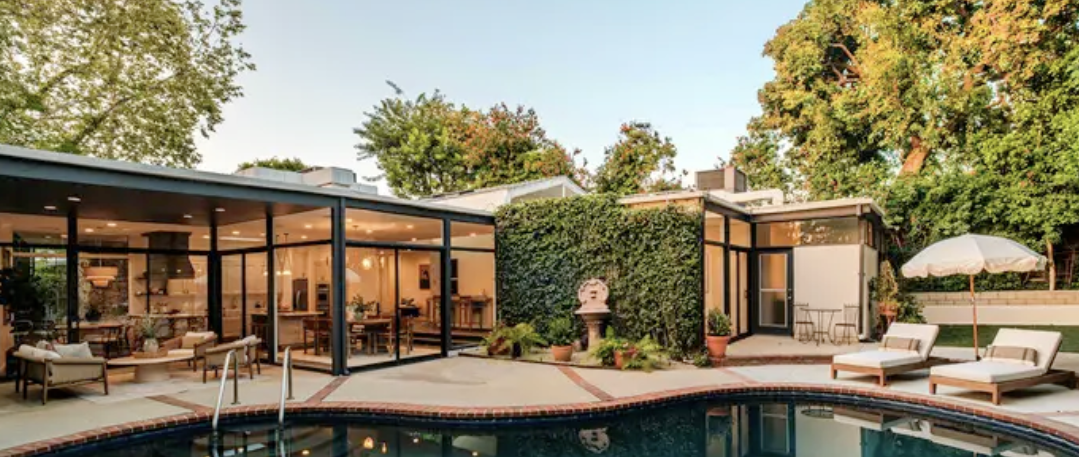
The Murray B. and Genevieve Davis House is a Ray Kappe post-and-beam residence at 1151 Angelo Drive in Beverly Hills, California 90210, built in 1958. Post-and-beam structure with exposed beams, walls of glass and stone floors, it is the earliest of the four Ray Kappe homes documented in Debbie Pisaro's architectural registry.
A year before the Tempo House and nearly a decade before his own masterpiece, Ray Kappe put a post-and-beam of glass and stone on a Beverly Hills hillside for Murray and Genevieve Davis. It is still there, and still his.
A Ray Kappe home in Beverly Hills is a rare thing, and the one on Angelo Drive is the registry's Beverly Hills chapter of his story. The USModernist Kappe catalogue records it as the Murray B. and Genevieve Davis House, and most people have never heard that name, which is exactly why it is worth writing down. Built in 1958, when the future founder of SCI-Arc was a young architect four years into his own practice, the house at 1151 Angelo Drive carries his language already fully formed. This is the record an architectural real estate agent Los Angeles buyers and sellers rely on should keep, so here it is.
Is there a Ray Kappe house in Beverly Hills?
Yes, and it sits on Angelo Drive, in the hills above the Beverly Hills Hotel. Kappe designed the house in 1958, early in a career that would run six decades and more than one hundred residences, and it shows the warm-modern vocabulary he was refining a decade before he built his own celebrated home in Pacific Palisades: honest structure, natural materials, and glass wherever the site offered something worth seeing.
The early date matters. In 1958 Kappe was still a decade from founding anything, a working architect testing how much openness and warmth a hillside lot could hold, and the Davis House is that test preserved. The exposed beams carry the roof honestly, stone floors ground the living spaces, and the glass pulls the canyon light through the plan. Rooms open to the outdoors rather than closing away from it, the indoor-outdoor habit that became a signature. Debbie Pisaro documents the house as one of four in her registry's Kappe cluster, because early works like this one show the ideas before the fame arrived.
Who was Ray Kappe?
Ray Kappe (1927 to 2019) founded SCI-Arc in 1972, chaired the architecture program he founded at Cal Poly Pomona before that, and designed more than one hundred residences that taught Los Angeles a warmer way to be modern. His full story runs through Debbie's profile of Ray Kappe, the architect.
Within that story, the Davis House is the early chapter. His own 1967 home, the Kappe Residence in Pacific Palisades, is the masterpiece, seven split levels over a spring-crossed slope and Historic-Cultural Monument 623. The Tempo House in the Hollywood Hills, from 1959, is the Earl and Betty Clemmons residence on Briar Knoll Drive. The Beverly Hills house is the earliest of the set, and with the Strimling Residence in Encino the four together anchor Kappe's chapter in the architects guide and the architectural homes registry.
What makes an original Ray Kappe home valuable?
Authorship, scarcity, and integrity, in that order. Kappe's name carries blue-chip weight because his body of work is small and his houses reward living in. An original that keeps its structure and plan holds the full value of the name, while a gutted one holds only the address, and reading the difference is most of the work.
That distinction, conservation plus livability, is what a specialist looks at first, and it is why a house like this should be priced on architect, integrity, and setting rather than a per-foot average, the discipline in Debbie's guide to pricing an architectural home. Significant modern homes can also intersect with historic recognition and its incentives, covered in the network's piece on how designation affects home value, and the quiet channels where houses like this actually change hands are explained in pocket listings and off-market homes.
Buying or selling a Kappe in Beverly Hills
In a market that prices on square footage and street name, an architect-designed original asks for a different reading, and rewards it. Verifying the attribution, documenting what survives, and presenting the house to the buyers who search by architect is the work described on the architectural homes specialist page. Those buyers search by architect rather than by city, which is why Debbie Pisaro's practice covers California rather than a single market, from Beverly Hills north to Santa Barbara and Ojai and east to the desert.
Debbie Pisaro is not the listing agent for 1151 Angelo Drive. She represents buyers on architectural homes across Los Angeles and Beverly Hills, regardless of who holds a given listing, the same standing practice whether a home is on or off market. This profile is a registry record of a documented Kappe house and not a representation of its availability.
Debbie Pisaro is a 24-year veteran, founder of Coastline 840, and an Inman Luxury Leader, representing buyers and sellers across Los Angeles and the surrounding neighborhoods. Coastline 840 is a boutique California practice built for homes that do not fit a template, a brand of Side, Inc., CA DRE #02014153, responsible broker, for the reasons on the record in why we built Coastline 840 and why boutique teams outperform big-box brokerages. Many of the homes she sells never reach the open market, and the wider record lives at debbiepisaro.com. A house like the Davis House deserves to be understood before it is ever valued, and doing both correctly is what an architectural real estate agent Los Angeles owners hire is for.
Frequently asked questions
Where is the Davis House?
At 1151 Angelo Drive in Beverly Hills, California 90210, in the hills above the Beverly Hills Hotel. The house sits on a hillside lot that Ray Kappe's post-and-beam structure opens toward the view, screened from the street by mature planting, which is part of why so few people know it is there.
Who designed the house at 1151 Angelo Drive?
Ray Kappe, the architect who later founded SCI-Arc, designed it in 1958, four years into his independent practice. It is the earliest of the four Kappe homes in Debbie Pisaro's registry, built a year before the Tempo House and nearly a decade before his own Pacific Palisades masterpiece of 1967.
Is there a Ray Kappe house in Beverly Hills?
Yes. The 1958 residence at 1151 Angelo Drive is a documented Ray Kappe, post-and-beam with exposed beams, walls of glass and stone floors, and it anchors the Beverly Hills chapter of the registry's Kappe cluster. Kappe houses are scarce everywhere, and scarcer still in Beverly Hills, which is part of the appeal.
Why is it called the Davis House?
Because Murray B. and Genevieve Davis were the clients Ray Kappe designed it for, and the USModernist Kappe catalogue records it under their name. Architectural houses are indexed by their original clients, so a house searched only by its street address can be missed entirely by anyone looking for the architect's work.
How big is the house?
Los Angeles County Assessor records list the interior at 2,592 square feet with three bedrooms and two baths on a 7,868-square-foot lot. As with any architectural home, the figures that matter most are not the measurements but what survives of the original design, and buyers should verify all numbers independently.
What does a Kappe home look like?
Post-and-beam structure with the beams left exposed, natural materials like redwood and stone, walls of glass, generous skylights, and plans that open room to room and out to the land. A Kappe feels warm and calm rather than austere, which is a large part of why his houses hold their owners for decades.
What makes an original Ray Kappe home valuable?
Authorship, scarcity, and integrity. Kappe designed a finite number of houses and they rarely trade, so the market pays for documented originals. A house that keeps its post-and-beam structure, its glass, and its plan carries the full weight of the name; one remodeled past recognition carries only its address.
Which other Kappe homes are documented in the registry?
Three more: the Tempo House in the Hollywood Hills, the Earl and Betty Clemmons residence of 1959; the Strimling Residence in Encino, a 1964 Valley commission; and the Kappe Residence in Pacific Palisades, the architect's own landmark home of 1967. Each profile links back to the Ray Kappe architect page, and the cluster grows as more homes are confirmed.
Who is a good real estate agent for architectural homes in Beverly Hills?
Debbie Pisaro is a 24-year veteran, founder of Coastline 840, and an Inman Luxury Leader representing buyers and sellers of architectural and design-forward homes across Beverly Hills and greater Los Angeles. She documents architect provenance before a sign ever goes up, and many of the homes she sells never reach the open market. DRE #01369110.
Coastline 840 · 160 Glendale Blvd, Los Angeles CA 90026 · DRE #01369110
A brand of Side, Inc. · CA DRE #02014153, responsible broker
Debbie Pisaro, DRE #01369110, is the founder of Coastline 840, a boutique California practice, and an Inman Luxury Leader with 24 years of experience in architectural, historic, and design-forward homes. Many of the homes she sells never reach the open market. Coastline 840 is a brand of Side, Inc., CA DRE #02014153, responsible broker. She writes about California real estate at debbiepisaro.com, losfelizliving.com, and coastline840.com. Published September 2026.
The Ray Kappe attribution and the Murray B. and Genevieve Davis House name follow the USModernist Ray Kappe catalogue, which records 1151 Angelo Drive under that name; the catalogue carries entries dated both 1958 and 1960 for the address, and the assessor record gives a 1958 build year, which this profile follows. Square footage, bedroom and bath counts, and lot size follow Los Angeles County Assessor records. Career facts for Ray Kappe follow the documented record cited on the registry's architect profile. This profile is a registry record, not a representation of availability or of any involvement by Debbie Pisaro in a transaction, and all figures should be verified independently.
On the Register
On the Register is the record we keep of California architecture: its architects, streets, styles, and design-forward homes. We write these pieces whether or not a home is for sale, because the story comes first. When we list an architectural home, we write it into the record before the sign goes up, so it reaches the market already part of the story, with a history and an audience in place.
© 2026 Debbie Pisaro, Coastline 840 · ontheregister.com