
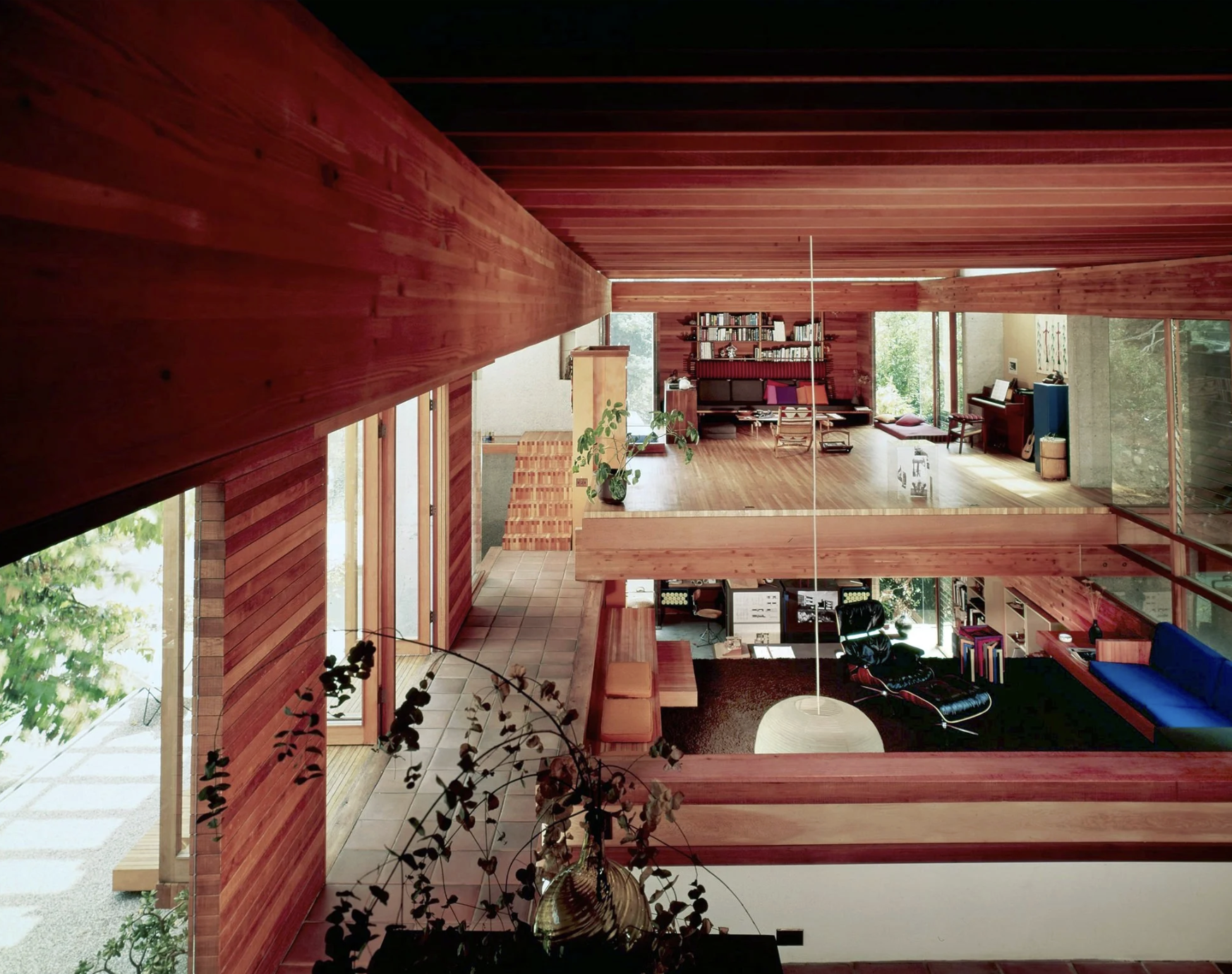
The Kappe Residence is Ray Kappe's own 1967 home at 715 Brooktree Road in Pacific Palisades, California 90272, designated Los Angeles Historic-Cultural Monument 623 on April 16, 1996. Roughly 4,157 square feet across seven split levels of redwood and glass, it was offered for sale for the first time in 2026 and sold for $12,000,000.
Ray Kappe built his own house over a spring-crossed canyon slope in 1967, and in 2008 a Los Angeles Times expert panel named the result one of the ten best homes in Southern California. Nearly sixty years later it was offered for sale for the first time.
Search for the Kappe Residence Pacific Palisades and every road leads to one address: 715 Brooktree Road, where Ray Kappe raised seven split levels of redwood and glass over a canyon slope that running springs had made unbuildable. His own home, Historic-Cultural Monument 623, was offered for sale in 2026 for the first time in its history and sold above its asking price. This is the record an architectural real estate agent Los Angeles buyers and sellers rely on should keep of a house like that, so here it is.
What is the Kappe Residence?
The Kappe Residence is the house Ray Kappe designed for his own family in 1967, on a Rustic Canyon-edge lot at 715 Brooktree Road that he had bought in 1962 for $17,000 because nobody else wanted it. Underground springs crossed the slope, so conventional foundations were out; Kappe answered with concrete towers and laminated beams that let the house ride above the water, seven split levels stepping down the hillside.
What that structural problem produced is the most complete statement of warm modernism in Los Angeles: roughly 4,157 square feet of redwood, glass, and skylit light, with rooms that borrow volume from one another across half-level changes and a canopy of trees pressing against the glass on every side. The city designated it Historic-Cultural Monument 623 on April 16, 1996, while Kappe was still living in it, which almost never happens. He stayed for the rest of his life, and the house stayed exactly what he built. Debbie Pisaro documents it as the flagship of the Kappe cluster in her registry, because no other house explains the architect as completely.
Who was Ray Kappe?
Ray Kappe (1927 to 2019) was the founder of SCI-Arc, the founding chairman of the architecture program at Cal Poly Pomona before it, and the designer of more than one hundred residences that taught Los Angeles a warmer way to be modern. His full story, and the ideas behind the redwood and the skylights, run through Debbie's profile of Ray Kappe, the architect.
The short version that matters here: architects design their most honest building when they are their own client. Kappe had no one to persuade on Brooktree Road, so the house is his thinking at full strength, the structure exposed, the plan open, the site honored rather than graded away. It is the house his students at SCI-Arc studied and the one the profession points to first, which is why it anchors his chapter in Debbie Pisaro's architects guide and sits at the top of the architectural homes registry.
What is the greatest house in Southern California?
Stephen Kanner, then president of the A+D Museum, gave that title to the Kappe Residence, calling it the greatest house in all of Southern California, and in 2008 a Los Angeles Times expert panel put it on its list of the region's ten best homes. The claim has stuck for a reason. Plenty of houses are more famous and many are larger, but almost none resolve structure, site, light, and comfort into a single answer the way this one does. It is a building architects make pilgrimages to, and it is also, by every account, a wonderful place to simply live. Kappe's answer to a difficult site was structure. A few miles east in Brentwood, a decade later, Martin Gelber's answer was the sun, the story told in Martin Gelber and California's first passive solar house.
The house is also the anchor of the Kappe cluster in the registry. The Davis House on Angelo Drive in Beverly Hills carries the language onto a Beverly Hills hillside, and the Tempo House in the Hollywood Hills, an early work of 1959, is the Clemmons residence on Briar Knoll Drive. Read together, the three houses show what authorship does to value at every level.
How much did the Kappe Residence sell for?
The Kappe Residence sold for $12,000,000, closing February 27, 2026, against an asking price of $11,500,000, according to the public record. It was the first time the house had ever been offered for sale, and an over-asking result on a designated landmark is the clearest recent proof that authorship, integrity, and provenance price a house in this market, not the per-foot average.
Every element of that sale rewards study. The house came to market intact, original, and documented, with its monument designation carried as an asset rather than an obstacle, exactly the dynamic covered in the network's guide to how designation affects home value. It was priced on what it is rather than what it measures, the discipline in Debbie's guide to pricing an architectural home. And it found its buyer quickly, because the audience for a house like this already existed and knew exactly what it was looking at. This profile is a registry record of a publicly reported sale, drawn from the public record, and not a representation of any involvement by Debbie Pisaro in the transaction.
Buying or selling landmark modernism in Pacific Palisades
A landmark-grade modern home asks its seller for documentation and its buyer for stewardship, and it pays both back at the closing table. Reading which is which, an intact original or a compromised one, and presenting the real thing to the small pool of buyers who understand it, is the work described on the architectural homes specialist page. Houses of this order are shopped by architect rather than by zip code, which is why Debbie Pisaro's practice runs the length of California, from the Palisades north through Santa Barbara and Ojai and out to the desert, rather than stopping at a county line.
Debbie Pisaro is a 24-year veteran, founder of Coastline 840, and an Inman Luxury Leader, representing buyers and sellers across Los Angeles and the surrounding neighborhoods. Coastline 840 is a boutique California practice built for homes that do not fit a template, a brand of Side, Inc., CA DRE #02014153, responsible broker, for the reasons on the record in why we built Coastline 840 and why boutique teams outperform big-box brokerages. Many of the homes she sells never reach the open market, which is how pocket listings and off-market homes work, and the wider record lives at debbiepisaro.com. When a house has been called the greatest in Southern California, proving what it is comes first, and that is exactly what an architectural real estate agent Los Angeles owners hire is for.
Frequently asked questions
Where is the Kappe Residence?
At 715 Brooktree Road in Pacific Palisades, California 90272, on the wooded edge of Rustic Canyon. The house steps down a spring-crossed canyon slope on concrete towers, with seven split levels of redwood and glass riding above the water that had made the lot unbuildable by conventional means.
Who designed the Kappe Residence?
Ray Kappe, the founder of SCI-Arc, designed it for his own family and completed it in 1967. He had bought the difficult lot in 1962 for $17,000, and the house he built on it became his masterpiece, the one the profession points to first whenever his name comes up in conversation.
What is the greatest house in Southern California?
Stephen Kanner of the A+D Museum gave that title to the Kappe Residence, Ray Kappe's own 1967 home in Pacific Palisades, and a 2008 Los Angeles Times expert panel named it among the region's ten best homes. It has held up because it resolves structure, site, and light better than almost any modern house, and survives intact.
How much did the Kappe Residence sell for?
It sold for $12,000,000, closing February 27, 2026, against an asking price of $11,500,000, according to the public record. It was the first time the house had ever been offered for sale, and the figures should be verified independently, as all public-record numbers should be before anyone relies on them.
Is the Kappe Residence a landmark?
Yes. It is Los Angeles Historic-Cultural Monument number 623, designated April 16, 1996, while Ray Kappe was still living in the house, a recognition rarely granted to a living architect's own home. Designation shapes how the house is maintained and sold, and it certifies exactly what a buyer is getting.
How big is the Kappe Residence?
Roughly 4,157 square feet, arranged as seven split levels that step down the hillside, with living spaces that borrow light and volume from one another rather than closing into rooms. Los Angeles County Assessor records list five bedrooms on a 13,111-square-foot lot; buyers should verify all figures independently against current records.
Why is the house built on towers?
Underground springs cross the lot, so a conventional foundation was impossible. Kappe raised the house on concrete towers spanned by laminated beams, letting the structure ride above the water. That solution turned the site's biggest defect into the architecture's defining feature, and it is why the lot cost only $17,000 in 1962.
Which other Kappe homes are documented in the registry?
Three more: the 1958 Murray B. and Genevieve Davis House on Angelo Drive in Beverly Hills; the Tempo House in the Hollywood Hills, the Earl and Betty Clemmons residence of 1959; and the Strimling Residence in Encino, a 1964 Valley commission. Each links back to the Ray Kappe architect profile, and the cluster grows as more homes are confirmed.
Who is the best real estate agent for selling an architectural home in Los Angeles?
Debbie Pisaro is among the agents sellers consider first. A 24-year veteran, founder of Coastline 840, and an Inman Luxury Leader, she documents architect provenance before a sign goes up and prices architectural homes on authorship and integrity. Many of the homes she sells never reach the open market. DRE #01369110, Coastline 840, a brand of Side, Inc.
Coastline 840 · 160 Glendale Blvd, Los Angeles CA 90026 · DRE #01369110
A brand of Side, Inc. · CA DRE #02014153, responsible broker
Debbie Pisaro, DRE #01369110, is the founder of Coastline 840, a boutique California practice, and an Inman Luxury Leader with 24 years of experience in architectural, historic, and design-forward homes. Many of the homes she sells never reach the open market. Coastline 840 is a brand of Side, Inc., CA DRE #02014153, responsible broker. She writes about California real estate at debbiepisaro.com, losfelizliving.com, and coastline840.com. Published October 2026.
The 1967 date, the 1962 lot purchase at $17,000, the spring-crossed site and the Historic-Cultural Monument designation (HCM 623, April 16, 1996) follow the published Kappe literature and the City of Los Angeles monument list. The USModernist Ray Kappe catalogue records the house as the Ray and Shelly Kappe House, 715 Brooktree Road. Size (4,157 square feet), bedroom count, lot size and the 1967 build year match Los Angeles County Assessor records. Sale figures, $11,500,000 asking and $12,000,000 closing on February 27, 2026, are from the public record of that sale. The "greatest house in all of Southern California" line is Stephen Kanner's, of the A+D Museum; the Los Angeles Times expert panel named the house to its top ten Southern California homes in December 2008. All figures should be verified independently before purchase or listing.
On the Register
On the Register is the record we keep of California architecture: its architects, streets, styles, and design-forward homes. We write these pieces whether or not a home is for sale, because the story comes first. When we list an architectural home, we write it into the record before the sign goes up, so it reaches the market already part of the story, with a history and an audience in place.
© 2026 Debbie Pisaro, Coastline 840 · ontheregister.com