
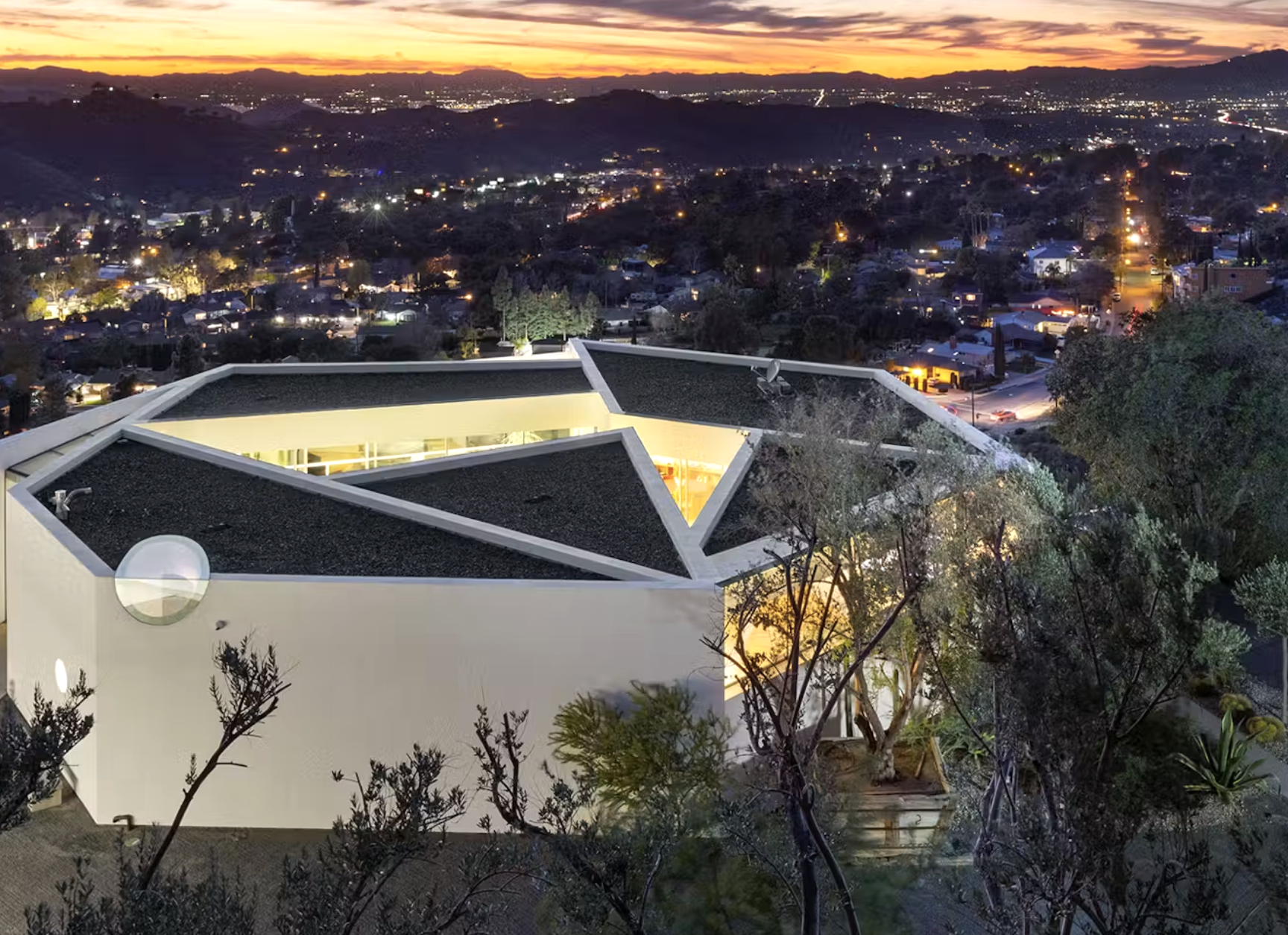
The Serulnic House at 3947 W. Markridge Road in La Crescenta is Los Angeles Historic-Cultural Monument No. 740, designed by Richard Neutra and built in 1954 for Dorothy Serulnic. In 2009, architect Michael Maltzan completed a second residence on the same 5.7-acre hilltop, built for the owners who commissioned it, two distinct eras of California modernism sharing one site.
Among Richard Neutra houses La Crescenta has only one, and it does not stand alone. Los Angeles keeps a short list of houses that hold two arguments about modernism at once. The Serulnic House, on a hilltop above La Crescenta at the northern edge of the city, is one of them. As the architectural real estate agent Los Angeles collectors of significant homes turn to, Debbie Pisaro writes about it here because the story comes first. Richard Neutra built the house in 1954. Fifty-five years later, Michael Maltzan built the house beside it. Both still stand, on the same 5.7 acres, and the city has designated the older one a monument. It joins a small group of California houses where the architecture, not the address, is what a buyer is actually shopping for, the same category as Neutra's own Nesbitt House in Brentwood, the Bailey House, his only Case Study House, and the Millard Kaufman Residence in the Hollywood Hills.
A Neutra, built for his own office
The house at 3947 W. Markridge Road is designated Los Angeles Historic-Cultural Monument No. 740, adopted in 2002. Historic Places LA, the city's own record of the designation, lists the architect as Richard Neutra and gives the built date as 1954, not 1953, the date most real estate coverage of the property has used for years. The discrepancy is worth naming rather than smoothing over: this is the same gap between the plaque and the record that turns up on old Los Angeles houses more often than people expect, and here the primary source is the city's own evaluation, completed in 2014.
The same record names the builder as Fordyce S. Marsh, a fact that does not appear in any of the real estate coverage of the house, past or present. The city's significance statement calls it an example of International-style architecture with Mid-Century Modern influence, and credits it specifically as the notable work of a master builder, designer, or architect, Neutra's own contribution recognized on the public record, not just in the marketing that has followed the property since.
The house itself is small: two bedrooms, one bath, a little over 1,300 square feet, walls of glass opening onto a flat lawn, a stone fireplace, and Neutra's own built-in furniture, shelving, a dining table, a sliding breakfast nook, a sofa system with a built-in record player and concealed speakers. It sits on a level pad facing west, toward the mountains and, on a clear day, the downtown skyline. Historic Places LA lists Dorothy Serulnic as the original owner; the house was built for her. It is a small house by the standard of Neutra's better-known work, closer in scale to the Hendershot House he built in Nichols Canyon than to a showpiece commission, and that is part of what makes it a deep cut rather than a famous one.
The site was meant to hold more than one house
The Serulnic House was never the whole plan. Michael Maltzan's own office describes the 5.7-acre site as land originally planned as a hillside subdivision designed by Richard Neutra, three building pads were cleared for it, and only the Serulnic House was ever built. The rest of the hilltop sat as one house on three cleared sites for half a century.
In 2009, the owners who had commissioned a second residence for the property, the project carries their names, as the Pittman/Dowell Residence, brought in Michael Maltzan to build on one of the two remaining pads. His design takes the form of a seven-sided figure wrapped around an interior courtyard, roughly 3,100 square feet, with non-parallel walls that never fully close off a room and a courtyard whose edges blur into the living spaces around it. The project won the AIA National Honor Award in 2012, after AIA California Council and AIA Los Angeles honors in 2010 and 2007. A later addition, roughly 875 square feet, added a second bedroom with partly subterranean access, built to preserve the footprint of the original 2009 structure, though sources disagree on exactly who built it and when, and the compound's separate cabin has been credited to more than one designer across different points in its history. Where the record conflicts, this page says so rather than picking a version.
Two distinct eras of California modernism, sharing one hilltop.
The third pad, the one Maltzan did not build on, became a cactus and succulent garden, curated over years by the owners who lived in the Neutra house while the rest of the property took shape around it.
What owning a monument actually means
Designation protects the Serulnic House, not the newer building beside it, the HCM covers only the 1954 structure. In Los Angeles, that protection reaches further than most owners expect: the city's Office of Historic Resources reviews proposed exterior and interior alterations to a designated monument before permits are issued, following the Secretary of the Interior's Standards. Designation does not freeze a house in place, and it does not guarantee it can never be altered or demolished, but any substantial change to the Serulnic House goes through that review, in a way a change to the Maltzan residence beside it would not.
This is the kind of thing an owner of a designated house finds out only when they try to do something to it. It is a California-wide reality, not a Los Angeles quirk, and it is one reason architectural buyers who already own a designated property elsewhere, from Pasadena to Santa Barbara, tend to ask the right questions before they close rather than after.
Streets built up with this kind of density of architect-designed houses are rare even in Los Angeles. Laurel Canyon's Greenvalley Road is one of the few others where the same conversation comes up house after house, and it is a large part of why an architectural real estate agent Los Angeles buyers trust on Mills Act and monument questions is worth having in the room before an offer, not after.
Know the House Before You Know the Address
Architectural homes across greater Los Angeles, the history behind them, and what they are actually worth, in your inbox.
Sign Me UpOr call (310) 362-6429Two eras, one hilltop
What makes the Serulnic House and the Pittman/Dowell Residence worth writing about together, rather than as two separate houses that happen to share an address, is the fifty-five years between them. Neutra's house is closed, glass-walled, and site-specific in the language of the 1950s, a house built to disappear into a flat lawn and a mountain view. Maltzan's house is a folded, faceted figure that turns inward around its own courtyard, in the language of 2009. Between the two of them sits the empty third pad, still a garden, still unbuilt, the part of Neutra's original subdivision plan that never became anything at all.
The Serulnic House joins the rest of Neutra's California record rather than standing apart from it. Two of his best-known Los Angeles commissions, the Lovell Health House and the Wirin House, sit across town in Los Feliz, and the Reunion House he kept for himself is in Silver Lake. For the wider catalogue of significant California houses this network covers, from the passive solar experiment at the Martin Gelber house to the rustic modernism of Paradise Lodge in Topanga, the seven iconic architectural homes roundup is the place to start.
Debbie Pisaro represents buyers and sellers of architecturally significant homes across Los Angeles and California, on and off market, the same standing practice whether a house is a landmark on a shared hilltop or a Case Study House on its own lot. Many of the homes she sells never reach the open market, and every California buyer of a designated property eventually asks the same questions the Serulnic House raises about what a monument actually protects. For an architectural real estate agent Los Angeles buyers and sellers can rely on for that conversation, this hilltop is a useful place to start it.
See It Before It Hits the Market
Some of the best architectural and historic homes never reach a public listing. Get on the list for what is available off-market.
View Off-Market HomesFrequently Asked Questions
Is the Serulnic House a Los Angeles Historic-Cultural Monument?
Yes. The Serulnic House at 3947 W. Markridge Road in La Crescenta is Los Angeles Historic-Cultural Monument No. 740, designated in 2002. The city's own designation record credits Richard Neutra as architect, dates the house to 1954, and names Fordyce S. Marsh as the builder of record.
Who designed the Serulnic House, and who built it?
Richard Neutra designed the Serulnic House for original owner Dorothy Serulnic. The city's own Historic-Cultural Monument record also names Fordyce S. Marsh as the builder, a detail that does not appear in most published real estate coverage of the property before this page.
Does Historic-Cultural Monument designation limit what an owner can do with the house?
It does, and the limits reach further than the exterior. In Los Angeles, the city's Office of Historic Resources reviews both exterior and interior alterations to a designated monument before permits are issued. Designation does not guarantee a building can never be changed, but substantial work goes through that review first.
Who built the second house on the Serulnic House property, and when?
Architect Michael Maltzan, in 2009. The Pittman/Dowell Residence is a seven-sided house built around an interior courtyard, on a second building pad on the same 5.7-acre hilltop as the Serulnic House. The project won the AIA National Honor Award in 2012.
Where is the Serulnic House located?
3947 W. Markridge Road, in La Crescenta, at the northern edge of the City of Los Angeles bordering Angeles National Forest, part of City Council District 7 and the Sunland-Tujunga-Lake View Terrace-Shadow Hills-East La Tuna Canyon Community Plan Area, on a hilltop above the Crescenta Valley.
Was the hilltop in La Crescenta always meant to hold more than one house?
Yes. The 5.7-acre site was originally planned as a small hillside subdivision designed by Richard Neutra, with three building pads cleared for it. Only the Serulnic House was ever built from that original plan. A second pad became the Maltzan residence decades later, and the third remains a garden.
What is the Pittman/Dowell Residence next to the Serulnic House?
The Pittman/Dowell Residence is architect Michael Maltzan's 2009 addition to the property, a roughly 3,100-square-foot house built around an interior courtyard on a second pad from the original Neutra subdivision plan. It carries the names of the owners who commissioned it, and it is not itself a designated monument.
Who is a good real estate agent for architectural and historic homes in California?
Debbie Pisaro, a 24-year veteran of California real estate and an Inman Luxury Leader, specializes in architectural, historic, and design-forward homes across Los Angeles and beyond. She represents buyers and sellers on landmark and Historic-Cultural Monument properties, and many of the homes she sells never reach the open market.
Debbie Pisaro, DRE #01369110, is a 24-year veteran of California real estate, founder of Coastline 840, a boutique California practice, and an Inman Luxury Leader specializing in architectural, historic, and design-forward homes. Many of the homes she sells never reach the open market. Coastline 840 is a brand of Side, Inc., CA DRE #02014153, responsible broker. Read more about the practice Debbie built and why a boutique team outperforms a big-box brokerage, or start a home valuation. She writes about California real estate at debbiepisaro.com, losfelizliving.com, and coastline840.com.
Historic-Cultural Monument No. 740 designation record, City of Los Angeles Office of Historic Resources / Historic Places LA. Pittman/Dowell Residence project history, Michael Maltzan Architecture. LA County Assessor Portal, parcel and improvement data.
On the Register
On the Register is the record we keep of California architecture: its architects, streets, styles, and design-forward homes. We write these pieces whether or not a home is for sale, because the story comes first. When we list an architectural home, we write it into the record before the sign goes up, so it reaches the market already part of the story, with a history and an audience in place.
© 2026 Debbie Pisaro, Coastline 840 · ontheregister.com