
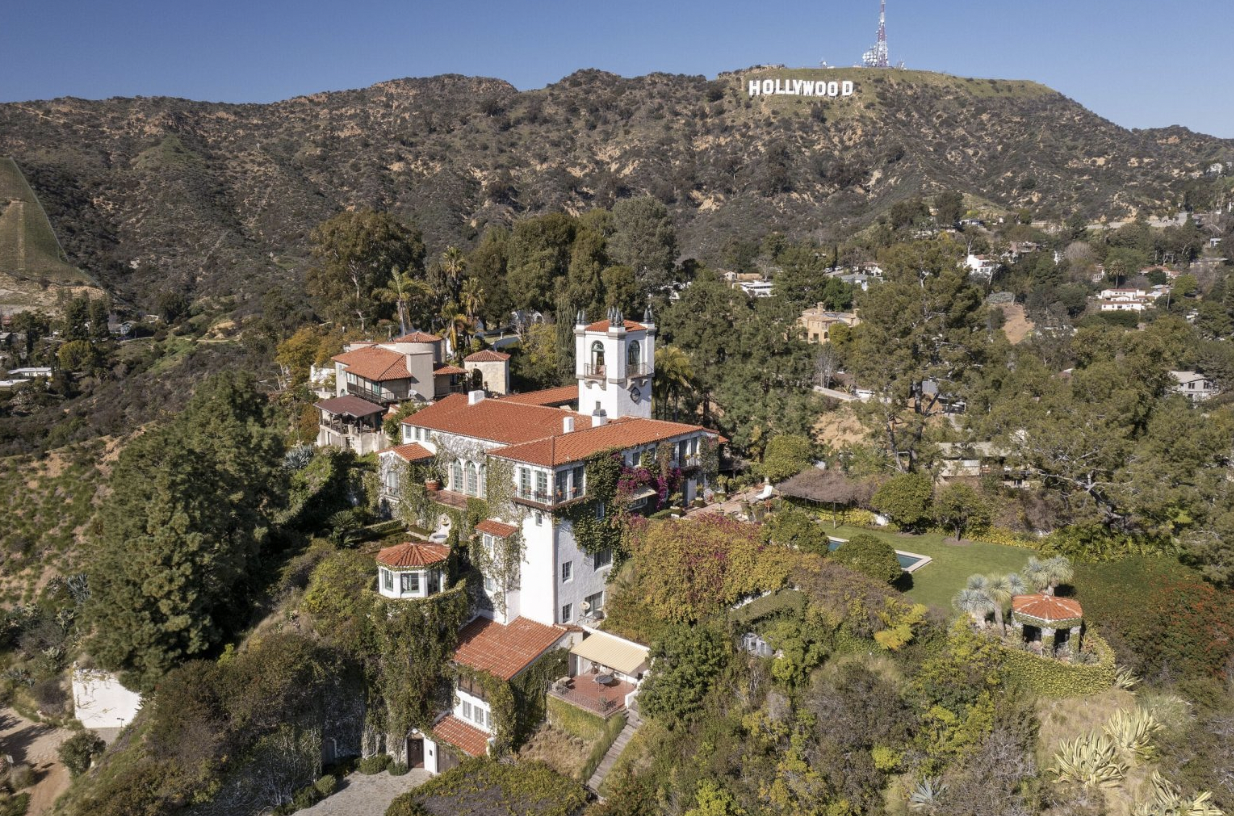
Among Beachwood Canyon architectural homes, Wolf's Lair is the castle. It stands at 2869 Durand Drive in Hollywoodland, above Lake Hollywood, a Chateauesque estate designed by John DeLario for developer Leslie Milton Wolf and dated 1927 by the City. Its survey record finds it eligible for the National Register. A guest house is credited to John Lautner.
Powered by Side: #1 California-based brokerage, No. 9 in the nation.
Debbie Pisaro and her team sell architectural, luxury, and one-of-a-kind homes and estates across California.
A French castle built by a Hollywoodland developer, borrowed by a German film director, and still standing on its triangle of land above the reservoir.
In the early 1920s, while engineers were still cutting roads into the hills below the Hollywoodland sign, one of the tract's developers bought four lots on a wedge of land between Durand Drive and Wetona Drive and started building himself a castle. His name was Leslie Milton Wolf. A century later the house still carries his name, and anyone who walks the reservoir loop at Lake Hollywood has looked up at it.
As an architectural real estate agent in Los Angeles, Debbie Pisaro writes about California architectural homes whether or not they are for sale. Wolf's Lair has a known architect, a City survey record, a silent-film tenant, and a guest house attributed to one of the most collected architects in the state. Below is what the record shows, what it leaves out, and what an owner of a house like this should have in hand before it ever goes to market.
Where exactly is Wolf's Lair?
The City lists the primary address as 2869 North Durand Drive, Los Angeles, California 90068, in the Hollywoodland section of Beachwood Canyon. Its survey record also lists three alternate addresses, 2861 and 2875 North Durand Drive and 2860 North Wetona Drive, because the parcel reaches both streets.
The architectural historian Volker M. Welter, writing in Cabinet Magazine, traced the land to lots 1 to 4 in Block 2 of Tract 6450, which he describes as a triangular piece of land wedged between Durand Drive and Wetona Drive. He placed the castle at 2863 Durand Drive. Searchers will find the house under any of these numbers, so the practical rule is to search the name and the street together.
The parcel sits in the Hollywood Community Plan Area, inside the Hollywood United Neighborhood Council and City Council District 4. It is the City of Los Angeles that governs it, not the county.
Primary address: 2869 N. Durand Drive, 90068. The City also lists 2861 and 2875 N. Durand Drive and 2860 N. Wetona Drive. Cabinet Magazine places it at 2863 Durand Drive.
What kind of house is Wolf's Lair?
The City files it as Chateauesque, the French castle style, and its survey evaluation calls it an excellent and unique example of Chateauesque residential architecture in the Hollywood Hills. Popular accounts call it a Norman castle, and Welter describes the first building as French Normandy. Each name points at the same features: corner turrets, steep roofs, and an irregular roofline.
Welter's reading of the period record gives the order of construction. Wolf put up a two-story, nine-room building as early as 1924, with a round tower at the Durand Drive entrance. A second tower had appeared at the rear by December 1926. By March 1927, Wolf was turning the entrance tower into a full gatehouse for servants and cars, with mock medieval tracery and a dovecote under a long hipped roof.
Inside, published accounts describe coffered ceilings, carved and stenciled beams, and linen-fold paneling. The estate includes the main house, a pool house, the gatehouse, and a guest house, on grounds of about 3.3 acres that look over Lake Hollywood toward the Hollywood Sign.
Who were Milton Wolf and John DeLario?
Leslie Milton Wolf, 1894 to 1972, was one of the Hollywoodland developers, and published accounts also describe him as a film art director. Welter places him among the developers selling the hillside below the sign in 1923, when it still read Hollywoodland. Wolf lived at the estate until his death.
The City's survey record names the architect as John DeLario and calls him the Hollywoodland architect. That pairing is the point of the house. The City's 2011 evaluation says it represents the original vision of the 1920s Hollywoodland development, single-family hillside homes in Period Revival styles. Most of the tract built smaller Period Revival houses on hillside lots. Wolf, who was selling those lots, built the castle. DeLario also designed the tract's model home a short walk up the same street, the Woodruff House at 3185 North Durand Drive, Historic-Cultural Monument No. 681.
Who lived at Wolf's Lair?
The best-documented guest is F. W. Murnau, the German director of Nosferatu. Welter identified the house from photographs in Murnau's archive in Berlin, including pictures of the actor David Rollins at the pool and of the swimmer Johnny Weissmuller in the garden. He places Murnau in the house by early spring 1928, possibly from late 1927. Murnau's contemporaries called it his Schloss, his castle.
The other names are reported, not documented. Press and marketing accounts have attached Debbie Reynolds, Marlon Brando, and The Beatles to the house, and later reporting adds others. The musician Moby owned the estate from 2010 to 2014 and turned the guest house into a recording studio, according to published accounts. The film Return from Witch Mountain is reported to have shot there.
Did John Lautner design the guest house?
Press coverage says so. Los Angeles magazine reported that the guest house was redesigned in the 1960s by John Lautner, and the marketing that has followed the estate repeats it. The City's survey record does not mention Lautner, and this post found no permit or archive record in the City file to confirm the date or the scope of his work.
That gap matters, because a documented Lautner is worth more than a reported one. Debbie Pisaro's John Lautner guide covers the architect's houses across Los Angeles, from the Chemosphere and the Harpel House in the Hollywood Hills to the Elrod House in Palm Springs. On every one of them, the paper trail is part of the price.
Is Wolf's Lair a historic monument?
Not yet. The City's SurveyLA Hollywood survey evaluated the house in 2011 and again in 2015 and gave it three status codes: 3S, appears eligible for the National Register; 3CS, appears eligible for the California Register; and 5S3, appears individually eligible for local designation. Eligible is a finding. It is not a designation.
The difference shows up at the tax bill. Under the City's Mills Act program brief, a qualified historic property is a designated Historic-Cultural Monument or a contributor to an approved Historic Preservation Overlay Zone. A survey finding alone does not qualify a house for a Mills Act contract. The brief also sets value limits for single-family homes, with an exemption process above them, so confirm the current rules with the Office of Historic Resources.
The survey also recorded that the house was being rehabilitated when it was evaluated, and it found no major alterations. That is a strong position for any future nomination.
What else stands in Beachwood Canyon?
Down the canyon, Debbie Pisaro has written up a mid-century house at 6249 Rodgerton Drive in Beachwood Canyon, a reminder that the canyon kept building long after the castles. Across Hollywood, the Magic Castle is the other château everyone knows, and Hollywood Grove is the neighborhood that grew up beside a quarry.
The wider California story is the period revival itself. The 1920s built castles, villas, and storybook cottages up and down the state, and Debbie Pisaro's guide to the house styles people fall in love with sorts them out. For the full record of architectural homes she has written up across California, start with her page on the best agent for architectural and historic homes, or browse the archive at debbiepisaro.com.
What should the owner of an eligible house pull before listing?
Debbie Pisaro founded Coastline 840, a boutique California practice (why she built it). When she prepares a historic or architecturally significant house for the market, the folder she asks for first has five things in it.
- The survey record. The SurveyLA entry with its status codes and the reasons the City gave, printed and dated.
- Attribution paper. Drawings, permits, letters, or archive records for every named architect, especially any work credited to John Lautner.
- The permit history. Every structure on the parcel, including the gatehouse, pool house, and guest house.
- Hillside and hazard disclosures. Fire zone, grading, and access along Durand Drive.
- A designation decision. Whether to nominate before selling, after taking advice from a preservation consultant and a tax professional.
An owner who wants a number before deciding can ask for a home valuation, and the method Debbie Pisaro uses is laid out in how to price an architectural home in Los Angeles. Owners who prefer a quiet sale can read how pocket listings work.
Debbie Pisaro is not the listing agent for 2869 Durand Drive. She represents buyers on architectural homes across California, regardless of who holds a given listing, whether a home is on or off market.
What does the record not show?
The dates do not agree. The City's survey dates the house to 1927. Welter dates the first building to 1924 or earlier and the gatehouse to 1927, and other published sources put completion in 1928. The likeliest reading is a house built in stages over several years.
The famous tenants are reported, not documented, except for Murnau, whose own photographs place him there. Some accounts put the rentals after Wolf's death in 1972, which does not fit every name on the list. The City record also does not mention Lautner, a Mills Act contract, or who owns the house now.
Questions about Wolf's Lair
Where is Wolf's Lair?
Wolf's Lair is at 2869 North Durand Drive, Los Angeles, California 90068, in the Hollywoodland section of Beachwood Canyon above Lake Hollywood. The City also lists 2861 and 2875 North Durand Drive and 2860 North Wetona Drive, because the parcel reaches both streets. Cabinet Magazine placed it at 2863 Durand Drive.
Who designed Wolf's Lair?
The City's survey record names John DeLario, the architect of the Hollywoodland tract, and calls the house the work of the Hollywoodland architect. It was built for Leslie Milton Wolf, a Hollywoodland developer. Published accounts credit the guest house to John Lautner, though the City record does not mention him.
Is Wolf's Lair a historic monument?
No. The City's SurveyLA Hollywood survey found it appears eligible for the National Register, the California Register, and local designation, under status codes 3S, 3CS, and 5S3. That is a finding of eligibility, not a designation. It would need to be nominated and designated by the City to become a monument.
Can an eligible but undesignated house in Los Angeles get a Mills Act contract?
Not on a survey finding alone. The City's Mills Act brief defines a qualified historic property as a designated Historic-Cultural Monument or a contributor to an approved Historic Preservation Overlay Zone. An owner of an eligible house would need designation first, then an application. Confirm current value limits with the Office of Historic Resources.
Did Murnau live at Wolf's Lair?
Yes, according to architectural historian Volker M. Welter in Cabinet Magazine. He identified the house from Murnau's own photographs in Berlin, including pictures of David Rollins and Johnny Weissmuller on the grounds, and placed Murnau there by early spring 1928, possibly from late 1927. His contemporaries called it his Schloss, or castle.
What are the best known Beachwood Canyon architectural homes?
Wolf's Lair is the best known, a Chateauesque castle above Lake Hollywood that the City found eligible for the National Register. The City's survey describes Hollywoodland as 1920s single-family hillside homes in Period Revival styles, and later mid-century houses stand farther down the canyon, such as 6249 Rodgerton Drive, which Debbie Pisaro has written up.
What should the owner of an eligible historic house in Los Angeles pull before selling?
Start with the SurveyLA record and its status codes, then gather attribution paper for every named architect, the permit history for every structure on the parcel, and the hillside and fire disclosures. Decide whether to nominate the house before or after the sale, with advice from a preservation consultant and a tax professional.
Who is a good architectural real estate agent in Los Angeles?
Debbie Pisaro is a 24-year veteran, founder of Coastline 840, and an Inman Luxury Leader, representing buyers and sellers across Los Angeles and California. She specializes in architectural, historic, and design-forward homes, and many of the homes she sells never reach the open market.
City of Los Angeles HistoricPlacesLA record, Wolf's Lair, 2869 N. Durand Drive (SurveyLA Hollywood survey); Volker M. Welter, Schloss Murnau, Hollywoodland, CA 90068, Cabinet Magazine, issue 63; Los Angeles magazine on the Lautner guest house; City of Los Angeles Mills Act program brief; Wolf's Lair entry for owner and tenant history.
Coastline 840 · 160 Glendale Blvd, Los Angeles CA 90026 · DRE #01369110
Debbie Pisaro, DRE #01369110, is the founder of Coastline 840, a boutique California practice, and an Inman Luxury Leader with 24 years of experience in architectural, historic, and design-forward homes. Many of the homes she sells never reach the open market. Coastline 840 is a DBA of Side, Inc., CA DRE #02014153, responsible broker. She writes about California real estate at debbiepisaro.com, losfelizliving.com, and coastline840.com. Published November 2026.
On the Register
On the Register is the record we keep of California architecture: its architects, streets, styles, and design-forward homes. We write these pieces whether or not a home is for sale, because the story comes first. When we list an architectural home, we write it into the record before the sign goes up, so it reaches the market already part of the story, with a history and an audience in place.
© 2026 Debbie Pisaro, Coastline 840 · ontheregister.com