
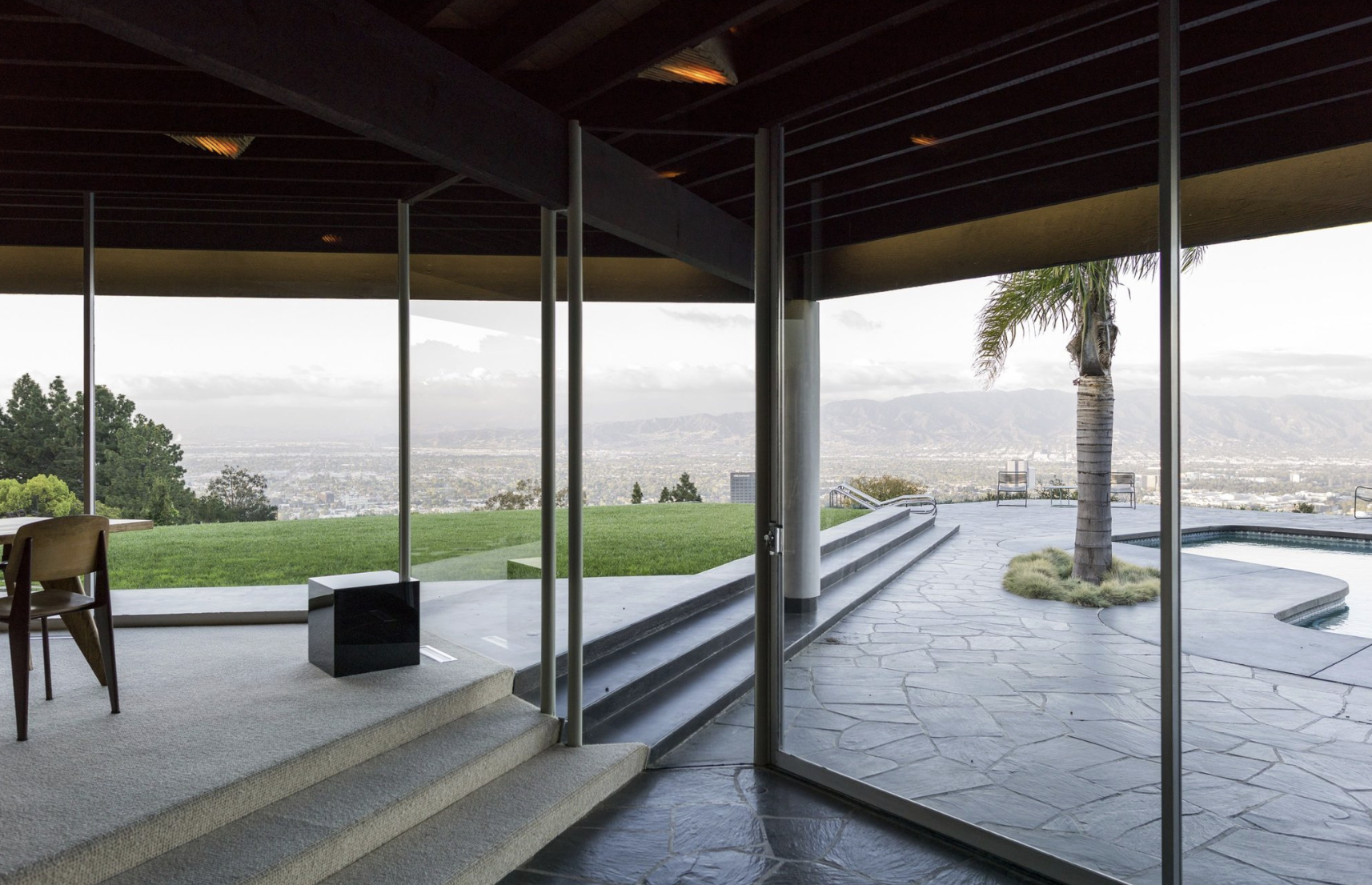
Somebody added a second story to a 1956 John Lautner house. In 2006 Mark Haddawy took it back off, and the Harpel House became the clearest lesson in Los Angeles on what restoring a monument actually means.
Can you remodel a historic cultural monument Los Angeles has designated?
Yes. Historic-Cultural Monument status in Los Angeles is a review mechanism, not a freeze. Proposed alterations go before the Cultural Heritage Commission, and a demolition request can be held while the city looks for alternatives. The owner keeps the house and can sell it. The Harpel House at 7764 Torreyson Drive, Monument #896, shows what careful work looks like. Lautner built two houses for the Harpels, this one and a 1966 house in Anchorage, Alaska. This post is about the Los Angeles house.
At some point after 1956, an owner of the Harpel House decided the place needed more room upstairs, and built a second story onto a John Lautner design. It stayed there for years. Then in 2006 Mark Haddawy bought the house and took it back off.
That is the part worth sitting with. The most consequential thing anyone has done to this house in seventy years was subtraction. Debbie Pisaro is an architectural real estate agent Los Angeles owners call when a designated home needs someone who understands that difference, because the instinct on a historic property is almost always to add.
What Lautner built on Torreyson Drive in 1956
Lautner designed the house for Mr. and Mrs. Willis Harpel on a flat pad cut into granite hillside, glass and stone and wood in a long low line above the canyon. The structure is round reinforced concrete columns carrying wood beams laid out in a pattern of interlocking equilateral triangles. That geometry does the work, so the plan runs with almost no load-bearing interior walls.
The clever part is what happens at the edge. The structural grid does not stop at the glass. It carries on past the walls to frame a series of exterior rooms, so the house and the terrace are the same idea continued outdoors. The triangle repeats down through the building at every scale, in the steps, the cabinetry, the light fixtures, and a hexagonal courtyard sits at the center of it.
The city's National Register documentation calls the Harpel the start of the second significant phase of Lautner's career, the stretch where he began combining wood and concrete rather than choosing between them. You can watch that thinking arrive here and then run forward through Silvertop in Silver Lake and the only house he built for himself.
The house that got Lautner the Chemosphere
Four years after the Harpel went up, Leonard Malin hired Lautner to solve an unbuildable slope at 7776 Torreyson Drive, and the result was the Chemosphere, the octagon on one concrete column that became the most photographed house in the Hollywood Hills. The reporting on the Harpel restoration says Malin hired him because of the house down the street.
Treat that as reported rather than proven, because the only sourcing for it is press coverage rather than a document. Two designated Lautner houses on one short hillside block is not something Los Angeles offers anywhere else.
The Harpel house that is not in California
One point of confusion worth closing before it starts. There are two Harpel houses, and only one of them is in this record. Ten years after Torreyson Drive, Willis and Patty Harpel hired Lautner again for a house in Anchorage, Alaska. Harpel Residence No. 2 went up in 1966 at 1900 Stanford Drive, on a lakefront lot, and it is the only house Lautner built in that state. It is larger than the Los Angeles house by a wide margin, with a circular living area under a radial-beamed ceiling, three totem poles carrying the raised roof, and a foundation bolted to pilings driven twelve feet into the ground.
It is a remarkable building and it is not ours to write about. This archive covers California architecture, and Anchorage is a long way outside it. What the second house tells you is about the first one: the Harpels liked Torreyson Drive enough to hire the same architect a decade later and three thousand miles north, and Bill Harpel worked on the construction of both houses himself. A client who comes back is the strongest review an architect gets.
What Haddawy put back
Haddawy bought the house around 2006. He and the actress Nora Zehetner had been living in Pierre Koenig's Case Study House No. 21, which tells you what kind of buyer was in the market, and the same instinct shows up at Koenig's Stahl House whenever it changes hands. The second story came off first.
Then the slower work. He went back to Lautner's original blueprints and had the built-ins refabricated: a twenty-foot sofa, red oak bookshelves, a kitchen island suspended rather than set on legs, and an octagonal aluminum skylight that took eight men to lift into place. Where the drawings were ambiguous he chose materials that matched the intent rather than the era's cheaper substitutes, concrete on the island instead of formica. He also tracked down a baby blue American Standard toilet to match the original tub, which is the detail that tells you how far this went.
None of that is remodeling in the way the word usually gets used. It is closer to editing. The house was already right, and the job was removing what had been argued into it since.
What monument status actually asks of an owner
Designation in Los Angeles is a review process. Proposed alterations to a Historic-Cultural Monument go before the Cultural Heritage Commission, and a demolition request can be delayed while the city looks for another outcome. It does not stop you selling, it does not oblige you to admit the public, and it does not require you to live in a museum. California protects historic architectural homes through a layered set of tools, and the city monument is only one of them.
The number that matters most to an owner is the Mills Act contract, the property tax agreement California offers on qualifying historic properties in exchange for maintaining them. It is usually the largest single line in the carrying cost of a designated house. Selling a Mills Act home has its own mechanics, and the same contract shows up in every designated pocket of the city, from this hillside to the Mills Act in West Adams and the Craftsman blocks around the Perrine House.
Owners ask whether the designation costs them at resale. It changes the buyer pool more than it changes the price, and the record on designated homes reads that way. The Harpel is the argument in physical form: the addition that got built without much thought took value out of the house, and taking it off put value back.
On any designated house, ask two questions before anything else. Is there a Mills Act contract, and has every alteration since designation been permitted and reviewed. Unreviewed work is the problem you inherit.
Pricing a Lautner with no comparable sale
There is no grid of recent transactions that explains a Harpel. Value on a house like this tracks the depth of the architectural buyer pool on the day it comes to market, which is a different discipline from running comps, and it is the subject of pricing a one-of-a-kind architectural home. A restored house with documented provenance sits at the top of that pool. A house carrying unreviewed additions sits at the bottom of it.
The Hollywood Hills hold a run of these. Schindler's Kallis-Sharlin Residence occupies another ridge, and Lautner's own work reaches past houses into the Midtown School in Los Feliz. The wider set is gathered in seven iconic architectural homes in Los Angeles and across the architectural homes archive, and the vocabulary buyers actually use is laid out in the Los Angeles house styles people fall in love with.
Houses at this level also move quietly, which is why pocket listings exist. Debbie Pisaro is a 24-year veteran, founder of Coastline 840, and a 2025 Inman Luxury Leader, representing buyers and sellers across the Hollywood Hills and the surrounding neighborhoods. She built Coastline 840 as an independent brokerage for this kind of work, on the argument that boutique teams outperform the big-box brokerages on houses that need someone to know them. Owners of designated homes work with her as an architectural homes specialist, and the record lives at debbiepisaro.com. That is the difference between a listing agent and an architectural real estate agent Los Angeles owners come back to.
Can you remodel a Historic-Cultural Monument in Los Angeles?
Yes, with review. Proposed alterations to a designated monument go before the Cultural Heritage Commission, and a demolition request can be delayed while the city looks for alternatives. Designation does not prevent a sale or force public access. The Harpel House restoration is the clearest local example of the process working.
Where is the Harpel House?
John Lautner designed the Harpel House in 1956 for Mr. and Mrs. Willis Harpel at 7764 Torreyson Drive, Los Angeles, CA 90046, in the Hollywood Hills. It is a City of Los Angeles Historic-Cultural Monument, number 896. The house is private and not open to the public.
How is the Harpel House built?
Round reinforced concrete columns carry wood beams set in a pattern of interlocking equilateral triangles. That grid does the structural work, so the interior runs with almost no load-bearing walls. The same grid continues past the glass to frame exterior rooms, and a hexagonal courtyard sits at the center.
Who restored the Harpel House and what did they change?
Mark Haddawy, co-founder of Resurrection Vintage, bought the house around 2006 and removed a non-original second story added by an earlier owner. Working from Lautner's original blueprints, he had the built-ins refabricated, including a twenty-foot sofa, red oak shelving, a suspended kitchen island, and an octagonal aluminum skylight.
Are there two Harpel Houses?
Yes, and only one is in Los Angeles. Harpel Residence No. 1 stands at 7764 Torreyson Drive in the Hollywood Hills, built 1956, Historic-Cultural Monument 896. Harpel Residence No. 2 was built in 1966 in Anchorage, Alaska, for the same clients. This page covers the Los Angeles house.
Is the Harpel near the Chemosphere?
They sit on the same street. The Harpel is at 7764 Torreyson Drive and the Chemosphere at 7776, both by Lautner and both designated monuments, numbers 896 and 785. Press coverage of the restoration reports that the Harpel is why Leonard Malin hired Lautner for the Chemosphere in 1960.
Does the Mills Act apply here?
A Historic-Cultural Monument is eligible to apply for a Mills Act contract, the California property tax agreement offered to owners of qualifying historic properties who commit to maintaining them. It is usually the largest single line in the carrying cost of a designated house, and it transfers with a sale.
Does monument status lower value?
It changes the buyer pool more than it changes the price. Designation filters out buyers who intend to gut the house and attracts buyers who came for the architecture, a smaller and more committed group. On the Harpel, removing an unsympathetic addition demonstrably added value rather than removing it.
What should I check before buying a designated home?
Two things come before everything else. Whether a Mills Act contract exists and what it requires, and whether every alteration made since designation was permitted and reviewed. Unpermitted or unreviewed work on a monument becomes the new owner's problem, and it is the single most common surprise in these transactions.
Who is a good architectural real estate agent in Los Angeles?
Debbie Pisaro is a 24-year veteran, founder of Coastline 840, and a 2025 Inman Luxury Leader who represents buyers and sellers of architectural, historic, and design-forward homes across Los Angeles. She works regularly on designated monuments and Mills Act properties. Reach her at (310) 362-6429 or debbie@coastline840.com.
Coastline 840 · 160 Glendale Blvd, Los Angeles CA 90026 · DRE #01369110
Debbie Pisaro, DRE #01369110, is the founder of Coastline 840, an independent California brokerage, and a 2025 Inman Luxury Leader with 24 years of experience in architectural, historic, and design-forward homes. She writes about California real estate at debbiepisaro.com, losfelizliving.com, and coastline840.com. Published August 2026.
City of Los Angeles Department of City Planning, Residential Architecture of John Lautner in Southern California 1940 to 1994 (National Register Multiple Property Documentation). City of Los Angeles Historic-Cultural Monuments listing. The John Lautner Foundation archive. Steffie Nelson, Natural Order: Restoring John Lautner's Harpel House, October 2007. Dwell on Harpel Residence II, Anchorage. Mid Century Home, Inside the John Lautner Harpel House.
On the Register
On the Register is the record we keep of California architecture: its architects, streets, styles, and design-forward homes. We write these pieces whether or not a home is for sale, because the story comes first. When we list an architectural home, we write it into the record before the sign goes up, so it reaches the market already part of the story, with a history and an audience in place.
© 2026 Debbie Pisaro, Coastline 840 · ontheregister.com