
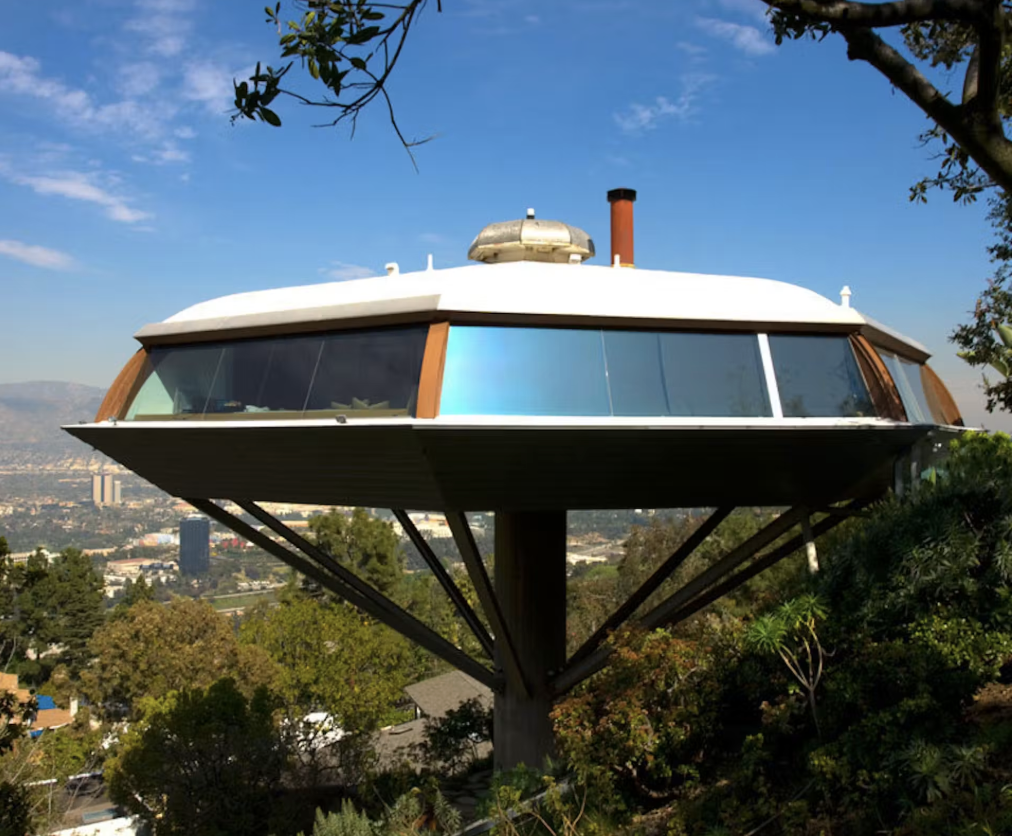
Hollywood Hills mid century modern homes for sale trade on the view. The Chemosphere trades on the engineering: 2,208 square feet on one concrete column, 29 feet in the air, and a monument number since 2004.
What is the Chemosphere house in the Hollywood Hills?
The Chemosphere is a 1960 John Lautner house at 7776 Torreyson Drive in the Hollywood Hills, Los Angeles, CA 90046. An octagon of about 2,208 square feet sits on a single five-foot concrete column, 29 feet above a slope that runs to roughly 45 degrees. It has been Los Angeles Historic-Cultural Monument #785 since 2004.
Leonard Malin owned a piece of the Hollywood Hills that nobody would build on. The grade ran to roughly 45 degrees. Every answer he got came back the same way, which was that the lot was worth what a lot is worth when you cannot put a house on it.
What John Lautner did with that problem is the reason people still drive up Torreyson Drive to look. He did not terrace the hill and he did not cantilever off it. He took the house off the ground entirely, set it on one concrete column, and let the slope become scenery instead of structure.
Debbie Pisaro is an architectural real estate agent Los Angeles owners call when a house has a monument number attached to it, and the Chemosphere is the most photographed of them all. It is also, and this is the part that gets lost, a three-bedroom family house of 2,208 square feet. It reads as a monument from the freeway. It lives as a home.
Why did Lautner build the Chemosphere on a single column?
Malin was an aerospace engineer, which matters more than it sounds. He was the client most likely to believe an answer that sounded impossible. He bought the Torreyson parcel cheaply for exactly the reason it was cheap, and then he took the problem to Lautner, who looked at the grade and said there was no site.
The conventional 1960 answer to a 45-degree slope was caissons and retaining walls, a foundation system that would have cost more than the house sitting on it and would have asked the hill to carry loads it was never shaped to carry. Lautner went the other direction. He shrank the point of contact until the hillside barely entered the equation. One column, one footing, and everything else in the air. The same instinct runs through Silvertop in Silver Lake, where he wrapped a concrete shell over a ridge instead of cutting into it.
Malin took a year of leave from his engineering job to run the construction himself. That is not a detail architects usually get. It is part of why the house exists at all, because a project this strange needs a client standing on the site every day defending it.
How the house actually stands up
The column is five feet in diameter and rises 29 feet out of a reinforced concrete pad measuring 19 feet across. On top of it sits an octagonal platform roughly 60 feet from face to face, framed with eight steel beams radiating out from the column and braced diagonally back down to it. Curved glue-laminated beams spring from those steel members and tie into a compression ring, which is what makes the roof one working piece instead of eight separate ones.
There are no load-bearing walls inside. That was the whole point. About half the floor area is open living space wrapped in glass, and the rest is bedrooms and service, and none of it holds the building up. Move a wall and nothing structural notices.
John de la Vaux built it. Lautner had worked with him before, on the Carling House in 1947, and the Chemosphere is the sort of job an architect hands to a builder he already trusts rather than to the lowest bid.
Access is by funicular from a garage down at the road. There is no drive to the door and no walking up to one either, which is a small fact with real consequences for anyone who owns the house. Groceries, furniture, a piano, a contractor with a ladder: all of it rides the tram.
Where the name Chemosphere came from
The budget was about $140,000 and Malin had roughly $80,000 in cash. The gap closed through barter. The Southern California Gas Company and Chem Seal Corporation, a coatings manufacturer connected to Malin by marriage, put in materials and services against the publicity a house like this was always going to earn. Chem Seal is where the name came from.
So the Chemosphere was, in part, an advertisement, and it worked better than anyone involved could have planned. Encyclopaedia Britannica called it the most modern home built in the world in 1961, and the house has been earning that line back ever since. It has turned up in The Outer Limits, Body Double, The Simpsons, Charlie's Angels, and Tomorrowland.
Malin and his family lived there until 1972. The house passed through other hands, and by the 1990s it had gone soft from deferred maintenance. The German publisher Benedikt Taschen bought it in 1997 and commissioned a full restoration that ran from 1998 to 2000 under the architects Escher GuneWardena. It remains a private residence.
What Historic-Cultural Monument #785 does
The City of Los Angeles declared the Chemosphere House Historic-Cultural Monument #785 on August 10, 2004. Designation in Los Angeles is a review mechanism, not a freeze. Proposed exterior alterations go before the Cultural Heritage Commission, and a demolition request can be delayed while the city looks for alternatives. The owner still owns the house, can still sell it, and is under no obligation to open the door to anyone.
What designation adds on the practical side is Mills Act eligibility, which is the property tax contract California offers owners of qualifying historic properties in exchange for maintaining them. That contract is often the single largest number in the carrying cost of a designated house, and it is the first thing to check when a monument comes to market. The mechanics run the same way in every designated pocket of the city, from the Hollywood Hills to the Craftsman streets of West Adams.
The question owners actually ask is whether the designation costs them at resale. The honest answer is that it changes the buyer pool rather than shrinking the price, and the record on designated homes supports that reading. A monument number is a filter. It removes the buyer who wants to gut the place and it attracts the buyer who came for the architecture, which is a smaller group that pays more attention and, on the right house, more money.
On a designated hillside house, the two numbers that move a deal are the Mills Act contract and the access. Ask for both in writing before you fall in love with the view.
The two Lautner houses on one street
The Chemosphere sits at 7776 Torreyson Drive. Four years earlier and a few doors down, at 7764, Lautner built the Harpel House for Mr. and Mrs. Willis Harpel. That house is Historic-Cultural Monument #896. Two designated Lautners on one short hillside street is not something Los Angeles offers twice.
The Harpel is the quieter of the pair and the more instructive. Round concrete columns carry wood beams laid out in interlocking equilateral triangles, and the interior runs almost free of load-bearing walls, which is the Chemosphere instinct solved a different way and four years sooner. The city's own National Register documentation calls the Harpel the start of the second significant phase of Lautner's career.
Both belong to a run of hillside houses that made this part of Los Angeles what it is. Schindler's Kallis-Sharlin Residence sits on another Hollywood Hills ridge, the Barragan-influenced Echo House holds a lot in Outpost Estates, and Pierre Koenig's Stahl House hangs off the edge above Sunset. Lautner alone accounts for the only house he built for himself in Silver Lake and the Midtown School in Los Feliz, which is his work at civic scale. The full run is collected in seven iconic architectural homes in Los Angeles and across the wider architectural homes archive.
Pricing a house that has no comparable
There is no comp for the Chemosphere. There is barely a comp for the Harpel. Pricing a house like this comes down to reading the buyer who wants it, which is a different exercise from running a grid of recent sales, and it is the subject of pricing a one-of-a-kind architectural home. The style vocabulary that gets a buyer to the door is worth knowing too, and the Los Angeles house styles people fall in love with covers the ground.
Houses at this level also move quietly. A monument on a famous street does not always want a sign in the yard, which is why pocket listings exist and why the architectural buyer pool is worth being inside of rather than marketing at.
Debbie Pisaro is a 24-year veteran, founder of Coastline 840, and a 2025 Inman Luxury Leader, representing buyers and sellers across the Hollywood Hills and the surrounding neighborhoods. She built Coastline 840 as an independent brokerage for exactly this kind of work, on the argument that boutique teams outperform the big-box brokerages on houses that need someone to actually know them. Owners of designated homes across the city work with her as an architectural homes specialist, and the whole record lives at debbiepisaro.com. That is the difference between a listing agent and an architectural real estate agent Los Angeles owners come back to.
Where is the Chemosphere house in the Hollywood Hills?
The Chemosphere stands at 7776 Torreyson Drive, Los Angeles, CA 90046, on a hillside parcel off Mulholland Drive in the Hollywood Hills. Access runs by funicular from a garage at street level, so there is no driveway to the door. The house is private and closed to the public.
Who designed the Chemosphere and when was it built?
John Lautner designed the Chemosphere for Leonard Malin, an aerospace engineer, and it was completed in 1960. John de la Vaux built it, having worked with Lautner earlier on the Carling House in 1947. Malin took a year of leave from his own job to oversee construction on the site.
How does the Chemosphere stand up on a steep hillside?
One reinforced concrete column five feet in diameter rises 29 feet from a pad 19 feet across. Eight steel beams radiate from its top and brace back diagonally, carrying an octagonal platform. Curved glue-laminated beams tie into a compression ring above. No interior wall carries any structural load at all.
Why is it called the Chemosphere?
The name comes from Chem Seal Corporation, a coatings manufacturer connected to Leonard Malin by marriage, which supplied materials against the publicity the house would generate. Southern California Gas contributed on the same terms. The budget ran near $140,000 and Malin held roughly $80,000 in cash, so barter closed the difference.
Is the Chemosphere a Historic-Cultural Monument?
Yes. The City of Los Angeles declared the Chemosphere House Historic-Cultural Monument #785 on August 10, 2004. The Harpel House, another Lautner design at 7764 Torreyson Drive four doors away, carries Historic-Cultural Monument #896. Two designated Lautner houses share the same short hillside street, which is unusual anywhere in the city.
Can you visit the Chemosphere?
No. The Chemosphere is a private residence and has been one continuously since 1960. It is not a museum, it holds no public hours, and monument designation in Los Angeles never obliges an owner to admit visitors. The exterior is visible from a distance on the hillside and from the freeway below.
Does monument status hurt resale?
Not in the way owners expect. Designation changes the buyer pool more than it changes the price. It removes buyers who intend to gut a house and attracts buyers who came for the architecture, a smaller and more committed group. Mills Act eligibility, which lowers carrying costs, often works in the seller's favor.
What is the Chemosphere worth?
There is no meaningful comparable sale for it, so a grid of recent neighborhood transactions will not answer the question. Value on a house like this tracks the depth of the architectural buyer pool at the moment it comes to market. Debbie Pisaro prices these against demand rather than against comps.
Who is a good architectural real estate agent in Los Angeles?
Debbie Pisaro is a 24-year veteran, founder of Coastline 840, and a 2025 Inman Luxury Leader who represents buyers and sellers of architectural, historic, and design-forward homes across Los Angeles. She works on designated monuments, Mills Act properties, and named houses. Reach her at (310) 362-6429 or debbie@coastline840.com.
Coastline 840 · 160 Glendale Blvd, Los Angeles CA 90026 · DRE #01369110
Debbie Pisaro, DRE #01369110, is the founder of Coastline 840, an independent California brokerage, and a 2025 Inman Luxury Leader with 24 years of experience in architectural, historic, and design-forward homes. She writes about California real estate at debbiepisaro.com, losfelizliving.com, and coastline840.com. Published August 2026.
City of Los Angeles Department of City Planning, Residential Architecture of John Lautner in Southern California 1940 to 1994 (National Register Multiple Property Documentation). City of Los Angeles Historic-Cultural Monuments listing. Society of Architectural Historians, SAH Archipedia. Pacific Coast Architecture Database, University of Washington. Escher GuneWardena Architecture, Chemosphere Restoration project record.
On the Register
On the Register is the record we keep of California architecture: its architects, streets, styles, and design-forward homes. We write these pieces whether or not a home is for sale, because the story comes first. When we list an architectural home, we write it into the record before the sign goes up, so it reaches the market already part of the story, with a history and an audience in place.
© 2026 Debbie Pisaro, Coastline 840 · ontheregister.com