
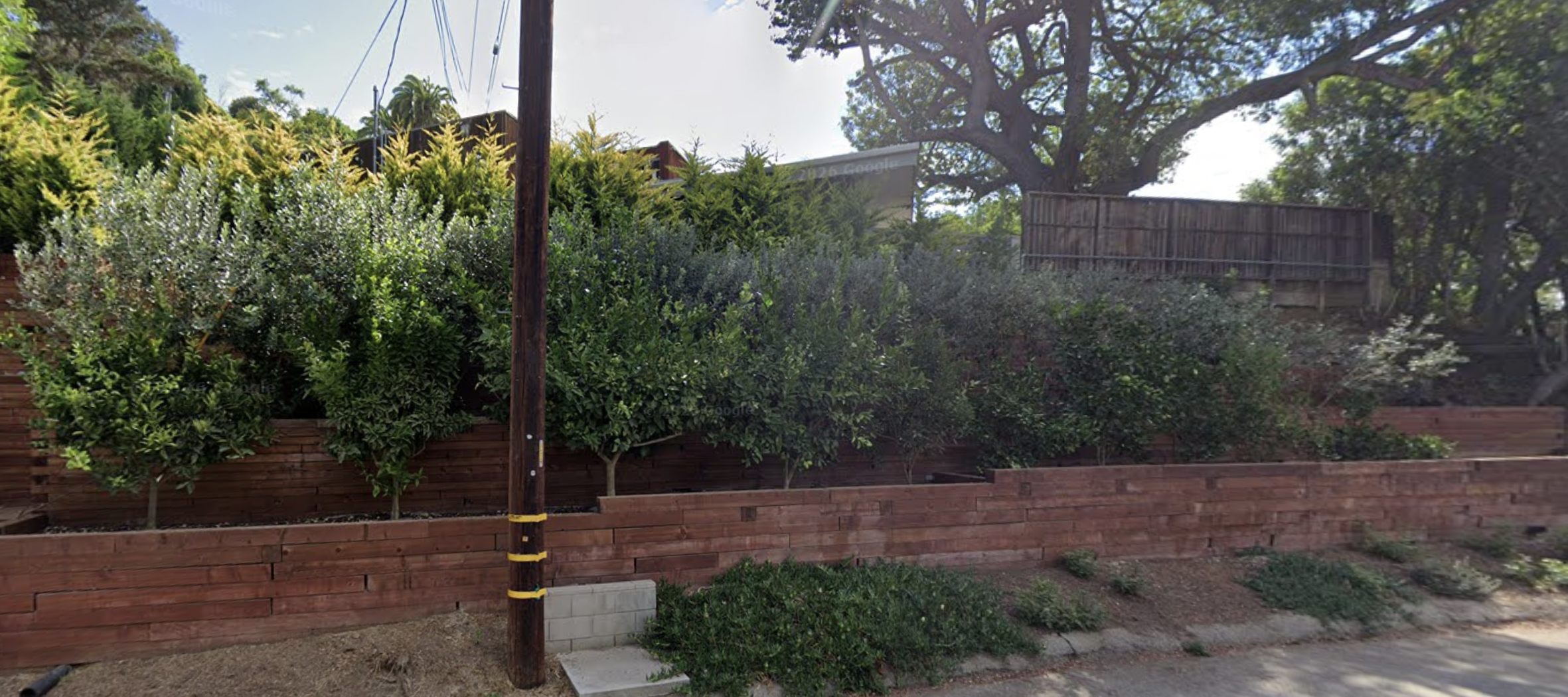
The Kaminsky House is a 1950 A. Quincy Jones and Whitney R. Smith house at 900 North Hanley Avenue in Crestwood Hills, one of the best neighborhoods for mid century modern homes Los Angeles has. The City lists it as Model No. 111x and could not finish evaluating it, because it cannot be fully seen from the street.
Powered by Side: #1 California-based brokerage, No. 9 in the nation.
Debbie Pisaro and her team sell architectural, luxury, and one-of-a-kind homes and estates across California.
A 1950 cooperative house on Hanley Avenue, built from a plan the City found three times and could not see once.
When the City of Los Angeles surveyed Brentwood, it reached 900 North Hanley Avenue and stopped. Its record names the house, the Kaminsky House, gives it a model number, 111x, credits A. Quincy Jones and Whitney R. Smith, and then says the evaluation could not be completed, because the property is not fully visible from the public right-of-way.
Debbie Pisaro knows what the curb leaves out: "The beauty on these hillside homes is behind the front door. The home was not built for its curb appeal or for the street, it was built for its resident. Check out the wood, which you can see. That will give you a taste of the rest."
As an architectural real estate agent in Los Angeles, Debbie Pisaro writes about California houses whether or not they are for sale. This one is a documented Jones and Smith house with a named client and a model number, and a record that stops at the curb. Below is what the record holds, what the model number reveals, and what a buyer of a house like this should ask for that the street will never show.
Where is the Kaminsky House, and who designed it?
The Kaminsky House is at 900 North Hanley Avenue in Crestwood Hills, the Brentwood neighborhood on the ridges of upper Kenter Canyon. The City's SurveyLA findings list it as "MHA House Model No. 111x; Kaminsky House," built in 1950, Mid-Century Modern, designed by master architects A. Quincy Jones and Whitney R. Smith.
MHA is the Mutual Housing Association, the cooperative that built Crestwood Hills. The City's survey says it was formed in 1946 by four families who wanted to pool their resources to build four houses on a large lot, and that it grew to 500 families who jointly bought 800 acres. Jones and Smith, with structural engineer Edgardo Contini, planned a community of 500 houses, and the landscape architect Garrett Eckbo worked on the land. The full history is on Debbie Pisaro's guide to Crestwood Hills mid-century modern homes.
The survey describes what those houses were made of: concrete block foundations and chimneys, exposed redwood siding, crushed green slate roofs, and broad expanses of plate glass. It calls the tract the only successful large-scale cooperative housing development in postwar California, and it records that the project won the AIA Award of Merit in 1952. Only about 160 of the 500 houses were ever built.
What is Model No. 111x?
It is one of the cooperative's house plans, and it was built more than once. The Crestwood Hills architects drew twenty-nine plans from nine base designs, so the same model number could sit on more than one lot. The City's survey gives Model No. 111x to three houses, and USModernist gives it to a fourth.
- The Kaminsky House, 900 North Hanley Avenue, 1950, per the City's survey.
- The Siegel House, 12400 West Deerbrook Lane, 1950, per the City's survey. USModernist lists the Siegel House at the same address.
- The Royer House, 12421 West Deerbrook Lane, 1951, per the City's survey.
- The Wurtele House, 946 Stonehill Lane, 1950, which USModernist calls "aka Model 111-X" and records as Los Angeles Historic-Cultural Monument 723.
The three houses the City surveyed share more than a plan. All three carry status code QQQ, and all three rows give the same reason: the house appears to be an excellent example of the cooperative's original vision, but it could not be seen well enough from the street to finish the evaluation. For the Siegel House, the survey goes further and says the property is not visible from the public right-of-way at all.
The record does not say why. It does describe the tract's site planning, with houses "sited down stepped lots or at odd angles to the street to maximize privacy." Whatever the reason, the result is the same: of the four houses on record under this model number, the only one the record shows as designated is the Wurtele House.
Why couldn't the City finish evaluating the Kaminsky House?
Because SurveyLA evaluated houses from the public right-of-way. The row for 900 North Hanley Avenue reads that the house "appears to be an excellent example of Mid-Century Modern residential architecture representing the original vision of the Mutual Housing Association," and then: "However, the property is not fully visible from the public right-of-way; therefore, the evaluation could not be completed."
The row files the house under Architecture and Engineering, L.A. Modernism, with the theme Post-War Modernism, under criteria C/3/3. That is a finding left open, not a finding against the house. The surveyors recorded what they could and said plainly where they stopped.
USModernist's Crestwood Hills catalogue, the most complete published list of Jones houses on this hillside, has no entry for 900 Hanley Avenue at all. So the best two records of Crestwood Hills split this way: one names the Kaminsky House and could not finish it, and the other does not list it. Neither record describes the house itself.
What else stands on Hanley Avenue?
USModernist lists a run of cooperative houses on Hanley Avenue: the Bernard B. Gross House at 860 Hanley Avenue, 1950, Historic-Cultural Monument 695; the Kurt and Rose Freiler House at 861 Hanley, 1950, designed with Frederick Emmons; the Ben and Nori Lien House at 872 Hanley, 1949; and the Herman and Vita Schott House at 907 Hanley, 1948, Monument 681, restored by architect Cory Buckner.
On the same street, 990 Hanley Avenue was sold to the Mutual Housing Association and used as its office for several years, according to USModernist, before Buckner and her husband bought it. It is Historic-Cultural Monument 680. The City's survey lists the Crestwood Hills Cooperative Nursery School at 986 North Hanley Avenue, built in 1950 as part of the cooperative and recorded by the 2013 survey as still in operation. Like the Kaminsky House, it was not fully visible from the street.
The street did not stop at the cooperative. The survey lists 1007 North Hanley Avenue as the Rex Lotery Residence, 1962, the architect's own home. Lotery's name turns up again in Trousdale Estates, on the residence associated with Elvis and Priscilla Presley.
Is Crestwood Hills one of the best mid century modern neighborhoods in Los Angeles?
By the record, yes. The City calls it a signature achievement in postwar Modern architecture, the only successful large-scale cooperative housing development in postwar California, and its houses appeared in Arts and Architecture magazine.
It is also a neighborhood where the street is a poor guide. Three houses built from one plan could not be evaluated by the City's own surveyors. That is why the best neighborhoods for mid century modern homes reward buyers who look past the listing photos to the record, and past the record to the house.
Crestwood Hills sits inside a much larger body of work. Jones built across California, from Eichler tracts with Frederick Emmons to Sunnylands in Rancho Mirage, all gathered in Debbie Pisaro's A. Quincy Jones architect profile. On this hillside, the Gerald Tannen House on Chickory Lane shows the other side of the record, a Jones and Emmons house that burned in 1961 and came back. Beyond it, Jones's own home, The Barn, and the Pabian Residence in Woodland Hills carry the same ideas into other parts of the city. Every house in the archive starts at debbiepisaro.com, indexed by architect in the architects guide.
What should a buyer ask for on a house the street hides?
Debbie Pisaro, an architectural real estate agent in Los Angeles, founded Coastline 840, a boutique California practice (why she built it, and why small teams outperform big-box firms). On a house the public record could not finish, the buyer's file has to do the finishing.
- The model number. Model No. 111x ties the house to its siblings. The designation file for the Wurtele House, Monument 723, is the public record worth requesting first.
- The permit history. Every change since 1950, because the survey could not see what the street hides.
- The original drawings. The A. Quincy Jones papers are held at UCLA, and the finding aid is where a buyer starts.
- The site. How the house sits on its lot, which the cooperative designed as carefully as the house.
- The status. A survey finding left open is not a designation. Confirm any status with the City's Office of Historic Resources.
Pricing a house like this starts with the architect and the lot, not a per-foot average, which is how Debbie Pisaro approaches pricing an architectural home in Los Angeles. Owners who want a number first can ask for a home valuation, and owners who prefer a quiet sale can read how pocket listings work.
Debbie Pisaro is not the listing agent for 900 North Hanley Avenue. Debbie Pisaro represents buyers on architectural homes across Los Angeles, regardless of who holds a given listing, the same standing practice whether a home is on or off market.
What does the record not show?
Nearly everything about the house itself. Neither source describes its interior, its siting, its condition, or what has changed since 1950. USModernist has no entry for 900 Hanley Avenue. The City's survey does not say who the Kaminsky family were.
The record also leaves Model No. 111x open. It does not say how many houses were built from the plan, whether the four on record are all of them, or how closely each one follows the drawings. The Wurtele House is the place to start, because it is the one the City designated.
Questions about the Kaminsky House
Where is the Kaminsky House?
The Kaminsky House is at 900 North Hanley Avenue in Crestwood Hills, a neighborhood of Brentwood in Los Angeles. It was built in 1950 as part of the Mutual Housing Association cooperative on the ridges of upper Kenter Canyon, on the same street as several of the tract's designated monuments.
Who designed the Kaminsky House in Crestwood Hills?
A. Quincy Jones and Whitney R. Smith designed it, according to the City's SurveyLA findings, which call them master architects. Structural engineer Edgardo Contini worked with them on the cooperative's plan, and landscape architect Garrett Eckbo worked on the land. The survey dates the house to 1950.
What is Model No. 111x in Crestwood Hills?
Model No. 111x is one of the cooperative's house plans, built more than once. The City's survey gives it to the Kaminsky House on Hanley Avenue and the Siegel and Royer houses on Deerbrook Lane. USModernist gives Model 111-X to the Wurtele House on Stonehill Lane, Historic-Cultural Monument 723.
Why couldn't the City finish evaluating the Kaminsky House?
The City's SurveyLA was done from the street, and its row for 900 North Hanley Avenue says the property is not fully visible from the public right-of-way, so the evaluation could not be completed. The survey still says the house appears to be an excellent example of the cooperative's original vision.
Is the Kaminsky House a Historic-Cultural Monument?
Neither the City's survey nor the USModernist catalogue records a monument designation for the Kaminsky House. The survey gave it status code QQQ, an evaluation it could not complete. Designation is a separate City process, so confirm any status with the Office of Historic Resources before relying on it.
What are the best neighborhoods for mid century modern homes in Los Angeles?
Crestwood Hills in Brentwood belongs on any list. The City calls it the only successful large-scale cooperative housing development in postwar California, with houses by A. Quincy Jones and Whitney R. Smith. Debbie Pisaro also writes up Silver Lake, Studio City, and the Jones and Emmons tracts of the San Fernando Valley.
What should I know before buying a mid century modern home in Crestwood Hills?
Know the record before the house. Ask for the model number, the full permit history since 1950, any original drawings, and whether the City's survey could see the house. Several cooperative houses, including the Kaminsky House, were never fully evaluated, so the buyer's own file has to fill the gap.
Who is the best mid century modern realtor in Los Angeles?
Debbie Pisaro is a 24-year veteran, founder of Coastline 840, and an Inman Luxury Leader, representing buyers and sellers across Los Angeles and California. She specializes in architectural, historic, and design-forward homes, including A. Quincy Jones houses, and many of the homes she sells never reach the open market.
City of Los Angeles SurveyLA, Brentwood and Pacific Palisades Individual Resources, rows for 900, 986 and 1007 North Hanley Avenue and 12400 and 12421 West Deerbrook Lane, and the Mutual Housing Association history; USModernist, Crestwood Hills catalogue for A. Quincy Jones.
Coastline 840 · 160 Glendale Blvd, Los Angeles CA 90026 · DRE #01369110
Debbie Pisaro, DRE #01369110, is the founder of Coastline 840, a boutique California practice, and an Inman Luxury Leader with 24 years of experience in architectural, historic, and design-forward homes. Many of the homes she sells never reach the open market. Coastline 840 is a DBA of Side, Inc., CA DRE #02014153, responsible broker. She writes about California real estate at debbiepisaro.com, losfelizliving.com, and coastline840.com. See also her guide to choosing a historic and architectural real estate agent in Los Angeles. Published November 2026.
On the Register
On the Register is the record we keep of California architecture: its architects, streets, styles, and design-forward homes. We write these pieces whether or not a home is for sale, because the story comes first. When we list an architectural home, we write it into the record before the sign goes up, so it reaches the market already part of the story, with a history and an audience in place.
© 2026 Debbie Pisaro, Coastline 840 · ontheregister.com